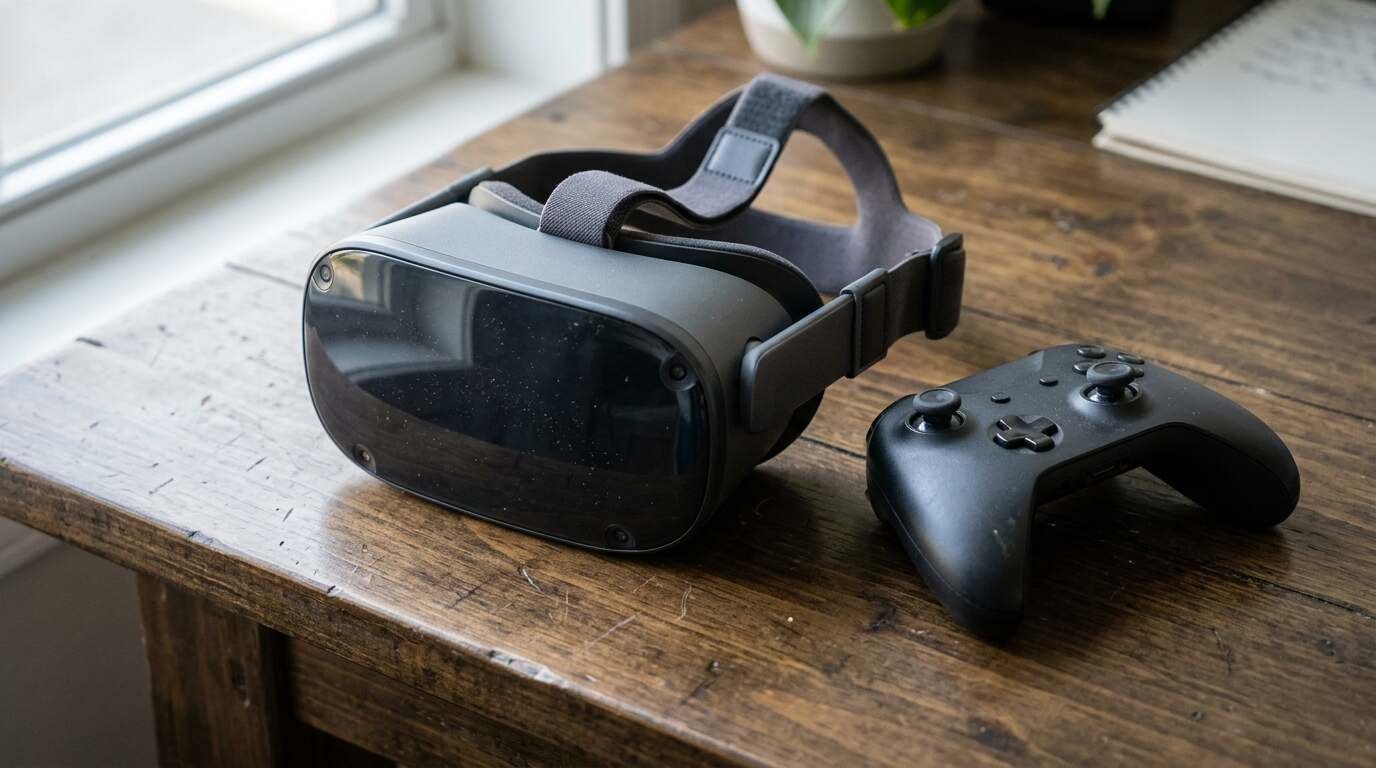
Valve’s Steam Frame now has a price. The standalone VR headset costs $1,059 with 256GB of storage and $1,299 with 1TB, and sign-ups to reserve one close today, Thursday, September 17, at 10 a.m. Pacific. After that, Valve randomizes the list and begins emailing people who won a purchase slot. Valve published the pricing on […]
Valve’s Steam Frame now has a price. The standalone VR headset costs $1,059 with 256GB of storage and $1,299 with 1TB, and sign-ups to reserve one close today, Thursday, September 17, at 10 a.m. Pacific. After that, Valve randomizes the list and begins emailing people who won a purchase slot.
Valve published the pricing on September 14, though one outlet dates the launch a day later. The headset runs SteamOS on a Snapdragon chip, ships with Half-Life: Alyx, and uses built-in eye tracking to cut the bandwidth needed for wireless PC streaming. What follows covers the reservation process, the hardware, the streaming design and the questions that remain open as of this morning.
How the Reservation System Works
Forget first come, first served. Valve is using a randomized lottery for the initial batch, the same approach it used for the Steam Controller and the Steam Machine, according to Games.gg. Buyers choose one model, join the list before the deadline, and wait. Signing up early earns nothing, because every registered name enters the draw together.
Each person then receives an email saying whether they hold a reservation or sit on a waitlist. Dexerto and TweakTown both point to September 18 for the first purchase emails, while Steam Deck HQ says September 17; the two dates likely reflect different readings of the same process. Steam Deck HQ also reports a 72-hour redemption window once an email arrives and says sign-ups are split by shipping region.
Context matters here. Dexerto notes that the Steam Frame completes the set of three hardware products Valve unveiled in November 2025, after the Steam Machine launched earlier this summer at $1,049. TweakTown attributes the limited stock and the high price to the DRAM and storage shortage.
Snapdragon 8 Gen 3, 16GB and SteamOS
The core is a 4nm Snapdragon 8 Gen 3, a smartphone-class ARM processor, paired with 16GB of LPDDR5X memory. Storage is UFS at 256GB or 1TB, and a microSD slot adds expansion. The operating system is SteamOS 3, the platform Valve also uses on the Steam Deck and Steam Machine.
An ARM chip in a headset has a practical consequence. Most Windows games are compiled for x86 processors, so a standalone headset needs either native builds or translation to run them. TweakTown reports more than 100 launch games that run natively on the headset, and Games.gg describes about 100 “Frame Verified” titles, with the library expected to grow. Titles outside that group can still be streamed from a gaming PC through the included adapter.
What Standalone Means in Practice
A standalone headset carries its own processor, memory and battery, so it can run software with no computer attached. Meta’s Quest line and Samsung’s Galaxy XR work this way, and the Steam Frame joins them. The benefit is freedom: no cable, no base stations, no PC required for the games that run natively.
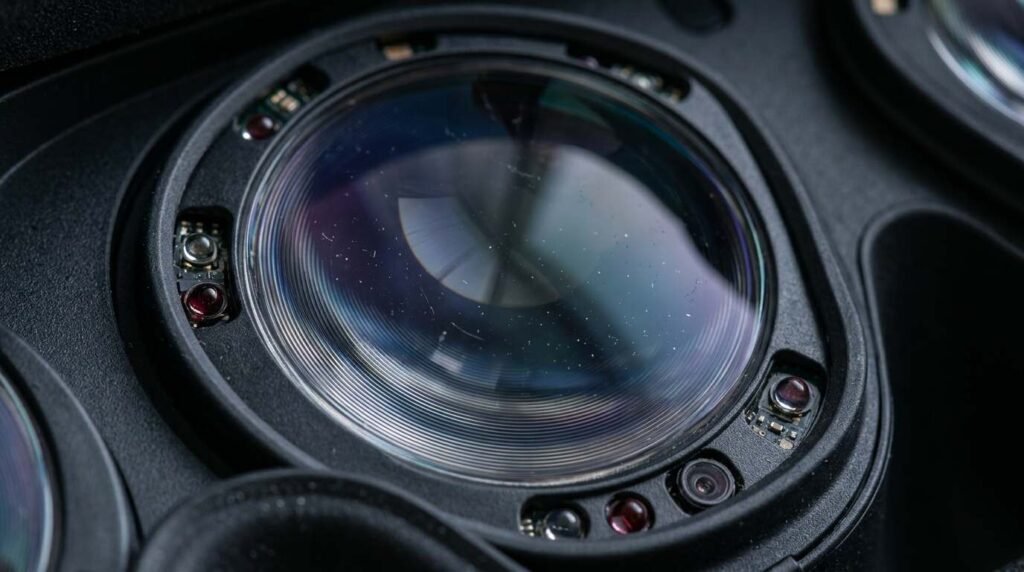
The cost is a power and heat budget measured in a few watts, set by what a head-mounted device can dissipate without becoming uncomfortable. That ceiling is why a phone-class chip, not a desktop GPU, sits in the front of the headset, and why Valve pairs it with a path to a real PC for demanding titles. Both modes exist in one product, and the second one is where the eye-tracking work pays off.
Display: Nearly 9.3 Million Pixels to Feed
Each eye gets its own 2160 x 2160 LCD panel. That multiplies out to 4,665,600 pixels per eye, or 9,331,200 across both, which is more than the 8,294,400 pixels of a 4K television. Refresh rate is 72Hz by default, with a 144Hz mode that Dexerto lists as experimental. Games.gg adds a horizontal field of view of up to 110 degrees, a figure the other coverage did not repeat.
Resolution alone does not describe image quality in VR. Pixels are spread across a wide field of view, so pixel density per degree sits well below what a monitor delivers at normal viewing distance. That is why VR headsets lean on rendering tricks, and why Valve has built the Steam Frame around one.
Foveated Streaming and Why Eye Tracking Matters
Human vision is sharp only in a tiny region near the center of gaze. Foveated techniques exploit that: render or transmit full detail where the eyes are pointed, and far less everywhere else. The Steam Frame includes eye tracking that, per TweakTown, powers what Valve calls Foveated Streaming, improving image quality where the user looks during wireless play.
The bandwidth arithmetic shows why this matters. Two panels of 2160 x 2160 pixels at 24 bits per pixel and 72 frames per second come to roughly 16 gigabits per second of raw video. That figure is arithmetic rather than a Valve specification, and it ignores compression, but it dwarfs what any home wireless link carries unaided. Games.gg says the included adapter streams over a dedicated Wi-Fi 6E band, even though the headset itself supports Wi-Fi 7. Compression gets the stream onto that link; gaze-directed detail makes the compression cheaper to hide.
The choice of band is deliberate. Wi-Fi 6E adds the 6 GHz range, which older devices on a home network do not use, so a dedicated link between the PC dongle and the headset avoids competing with phones, laptops and smart speakers for airtime. Short range is the trade-off: 6 GHz signals penetrate walls poorly, so the PC and the player need to share a room or at least a clear line of sight.
Tracking, Controllers and Weight
Positional tracking is inside-out, handled by cameras on the headset itself, so no external base stations are needed. The Steam Frame Controllers are battery-powered, offer full six-degrees-of-freedom tracking plus traditional gamepad controls, and track fingers as well as motion, per Dexerto and TweakTown.

On the body, TweakTown lists about 440 grams with the headstrap, and Games.gg gives the battery as 21.6 Wh Li-ion. There is no power supply in the box. Valve sells a 45W Steam Hardware Power Supply for $29, although Dexerto says a Steam Deck charger or any USB-C charger rated at 45W or higher also works. Two accessory kits are available: an Ergonomic Accessories Kit for $59 and an Accessory Replacement Kit for $49.
Where the Frame Fits in Valve’s Lineup
Valve unveiled three products in November 2025: the Steam Controller, the Steam Machine and the Steam Frame. Dexerto notes that the Frame completes that set, and all three share a software base in SteamOS and a similar sales method, a randomized reservation list. The pattern suggests Valve is building an ecosystem in which each device extends the same Steam library rather than competing for it.
Seen that way, the headset’s ARM chip and wireless PC streaming are two answers to one question: how to put a large PC game library on a face-mounted screen. Native titles run on the device, and everything else travels over the air from a computer that already owns the game.
Price in Context
At $1,059, the Steam Frame costs more than a 512GB Meta Quest 3 at $599. Games.gg places it in the same range as the HTC Vive Focus Vision and Samsung’s Galaxy XR, and below both the Pimax Dream Air and the Apple Vision Pro. The same article notes that Meta has historically sold headsets at a loss, while Valve has said it will not subsidize hardware.
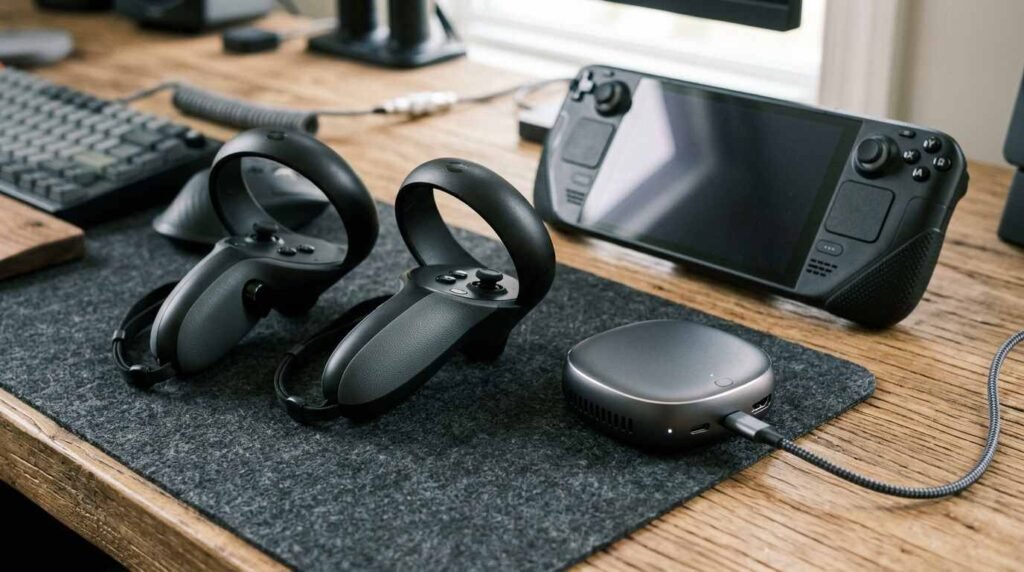
Half-Life: Alyx is included, a 2020 game that remains a showcase for PC VR. Whether that bundle justifies the premium depends on how much of a buyer’s library already lives on Steam, since the headset also plays flat, non-VR Steam games.
A Checklist Before the Window Closes
With the deadline close, a few decisions are worth settling now.
- Pick one capacity. The list accepts a single model per person, and Steam Deck HQ says sign-ups are separated by region.
- Budget for the extras. The box has no charger, the headset needs a 45W or stronger USB-C supply, and Valve sells one for $29 to anyone without a qualifying charger.
- Think about the PC. Streaming from a computer needs a machine capable of driving two 2160 x 2160 displays, plus a spot near it for the included adapter.
- Plan for a wait. A lottery with limited stock means a waitlist outcome is entirely possible, and Valve has not said how large the first batch is.
Open Questions as of Today
- Shipping dates and regions. None of the launch coverage gives firm ship dates, and only U.S. prices were reported.
- Battery runtime. The only battery figure is the 21.6 Wh capacity; no coverage reviewed here offers a rated runtime.
- Compatibility. Roughly 100 games run natively; how many more will work on an ARM headset is unclear.
- Waitlist length. Valve has not said how many units are in the first batch.
Sources