






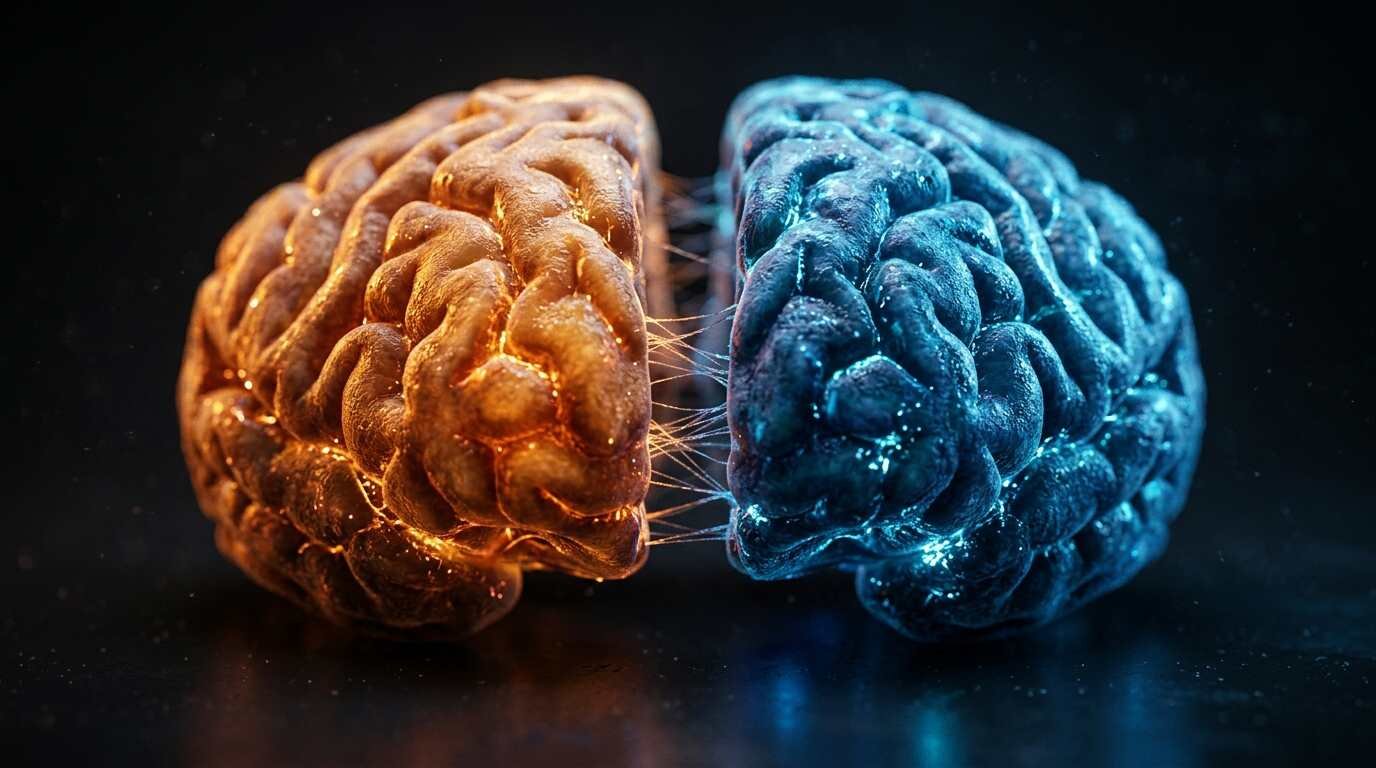
Cutting the corpus callosum produced strange results and a lasting debate: does the brain hold one mind or two? The classic studies and a 2017 challenge.
Split-brain patients are people whose two brain hemispheres were surgically disconnected to control severe epilepsy, and studying them has produced some of the strangest findings in the history of psychology. After the operation, the left hand sometimes did not seem to know what the right hand was doing, and a patient could name an object seen on one side of the visual field while insisting that nothing was visible on the other. The results forced a question that philosophers had long debated in the abstract: can one person hold two minds?
This article explains the surgery, the classic experiments, what they appear to show, and why a more recent challenge has made the story less tidy than the textbooks suggest.
What is a split brain, and why would anyone create one?
The brain is divided into two hemispheres joined by a thick bundle of nerve fibres called the corpus callosum. Cutting that bundle, a procedure called a corpus callosotomy, stops seizure activity from spreading from one side of the brain to the other. It is used as a last resort for epilepsy that does not respond to drugs.
The idea is old. In 1784 the French anatomist Félix Vicq-d’Azyr suggested that removing the structure would divide the brain into two independent regions. In 1936 the surgeon Walter Dandy reported three partial cuts of the rear two-thirds of the corpus callosum and noticed few obvious deficits afterward. A patient known as WJ underwent the first complete callosotomy in 1962. Today surgeons usually begin by cutting only the front third and extend the cut if seizures continue.
The surgery often reduces seizures. The cost, as the research showed, is not total but is real and odd.
Who ran the classic experiments?
The work was started by Roger Sperry, who first tested cats and monkeys and then people. His collaborator Michael Gazzaniga helped him summarise the early human results in a 1967 article in Scientific American, “The Split Brain in Man”. By then ten patients had been operated on, and four took part in the research. Sperry won the 1981 Nobel Prize in Physiology or Medicine for his work on how the hemispheres specialise. Gazzaniga carried on with the research for decades after Sperry died in 1994.
The clever part of the method was exploiting how the visual system is wired. What a person sees to the left of their gaze point travels to the right hemisphere, and what lies to the right goes to the left hemisphere. In an intact brain the two halves share what they receive within milliseconds. In a split brain they cannot, so researchers could flash an image to one side and see what only one hemisphere knew.
What did the experiments show?
The results followed a pattern. When a light or picture was flashed in the right visual field, which feeds the left hemisphere, the patient could say what it was. When it appeared only in the left field, which feeds the right hemisphere, the patient often said nothing was there. Yet the same patient could point to the light, or pick the matching object with the left hand. So the information was in the brain, but speech could not reach it.
Touch tests gave the same result. An object placed in the left hand, out of sight, could not be named, but the patient could identify it by feel among others. Shown a picture to the right hemisphere only, patients could not name it and still chose the right object with the left hand.
These findings support a view of hemispheric specialisation. The left hemisphere is strongly associated with language, reading, writing and arithmetic, and the right with spatial processing, recognising faces and some kinds of problem solving. The popular notion of a “logical left brain” and a “creative right brain” is a cartoon version of this. Even that tidier picture is still under investigation, and in the 1980s the researcher Jerre Levy argued that the hemispheres work in an integrated way, with no cognitive task relying on one side alone.
What is the chicken-foot experiment?
One of the best-known demonstrations involves a pairing of pictures. One hemisphere was shown a chicken foot and the other a snowy scene. The patient then picked matching pictures from a set with each hand. The hand linked to the chicken-foot side chose a chicken. The other hand chose a shovel.
Asked why, the patient, speaking with the left hemisphere, said that the shovel was for cleaning out the chicken shed. The speaking half had no access to the snow, yet it supplied a fluent and confident reason.
Gazzaniga later described a left-hemisphere system, which he called the interpreter, that builds explanations for behaviour after the fact. The demonstration has been widely read as a lesson about ordinary minds too: much of the time, the story we tell about why we did something may be assembled after the event. That broader claim goes beyond what the original patients can show, and it should be treated as a hypothesis.
So does a split brain contain two minds?
This is the philosophical heart of the topic. Sperry and Gazzaniga took a strong line. As they put it in the 1960s, a single split-brain patient should be thought of as two half-brain patients. Sperry saw this as support for materialism, since cutting a physical structure appeared to divide the person and left little role for an indivisible soul.
Everyday life looks different from the lab. Patients are generally described as behaving like one coherent individual outside testing. Why that should be is not fully known. One possibility is that other, lower pathways still link the halves; another is that the setup of the experiments, which deliberately blocks the usual shortcuts, exaggerates the split.
Studies of people born without a corpus callosum, such as Kim Peek, have been described as natural split-brain cases. One 1998 report found some transfer of information between hemispheres in such individuals, which suggests that other routes can sometimes carry it. Whether those routes remain in surgical patients is unclear.
The hardest problem is that we cannot step into a patient’s point of view. First-person reports are hard to interpret, and it is not known whether consciousness itself is divided, or only the flow of information.
What did the more recent challenge find?
In 2017 the cognitive psychologist Yaïr Pinto and colleagues at the University of Amsterdam tested two split-brain patients and reported results that cut against the standard story. The patients seemed aware of stimuli in both visual fields, and they rarely denied seeing anything on the left. There were still limits: they could not compare stimuli across the midline, and each hemisphere was better at certain jobs, the right with visual properties and the left with verbal labelling.
Pinto argued that this points to one person who receives two separate streams of visual information that cannot be combined, not two persons. He suggested the findings weaken a strong materialist reading and deepen the puzzle of how many separate processing modules form one self.
The evidence base is small, since very few patients are available for testing, and I did not review any published reply from the original researchers. A fair summary is that the older claim of two fully separate minds has become harder to defend, while the proposed alternative has not yet won agreement either. Different studies, different patients and different testing methods are pulling in different directions.
What do split-brain studies tell us about consciousness?
They show, at minimum, that the brain’s ability to report on its contents depends on particular connections. Information can exist in the brain, and guide behaviour, without being available for speech. This fits the broader distinction between processing and awareness.
They also suggest that a unified sense of self is something the brain constructs and maintains, not a given. Normally this construction goes unnoticed, which is exactly why a failure of it is informative.
There is a practical lesson too. Because testing relies on a handful of volunteers who each had different surgeries and different seizure histories, one patient’s quirks can easily be mistaken for a general rule. That is part of why a new study with two patients, such as the 2017 one, can reopen questions that seemed closed, and why researchers keep stressing caution about sweeping claims.
What the studies do not do is settle what consciousness is. They tell us about its dependence on wiring and about how its unity can be strained. The hard problem of why any of this is experienced stays where it was.
Common questions
Do split-brain patients have two personalities?
Not in any obvious way. Patients are generally described as acting as one person outside the lab, and the sharp divisions show up under special testing conditions. Whether there is one consciousness or two behind that behaviour is the unresolved question.
Is the corpus callosum cut for anything other than epilepsy?
The surgery described in the sources is used for intractable epilepsy, and I found nothing in them about other uses. It is considered when seizures resist medication, and it is decided case by case by specialists.
Are people really left-brained or right-brained?
The popular version is an oversimplification. The hemispheres do specialise, with language mostly on the left, but they work together, and no ordinary task depends on only one of them. The research on split-brain patients is where the specialisation was first shown, and also where the limits of the idea became clear.
Can a split-brain patient be tested today?
Only a handful of patients have ever taken part. In the 1967 summary, for example, ten had been operated on and four were studied. That scarcity is one reason the interpretation of the results remains uncertain.
Why does it matter outside the lab?
The research shapes how we think about self, responsibility and what happens when the brain’s parts stop talking. It also informs surgery decisions, since doctors now try to cut as little as needed.
What to remember
The established facts are the surgical history and the lab results: information shown to one hemisphere can be unavailable to speech, and specialisation of language and spatial skills was first demonstrated this way. What is not settled is the big claim, that cutting the brain makes two minds. Sperry and Gazzaniga argued for it, a 2017 study argued for one person with two unconnected visual streams, and the question is still open.
Treat vivid single stories, including the chicken-foot example, as illustrations, not proof of how every mind works.
Further reading
By the researcher who carried out the classic split-brain studies with Sperry. See it on Amazon (affiliate link)
As an Amazon Associate I earn from qualifying purchases. A commission may be earned if you buy through this link, at no extra cost to you.
Sources



