Three peer-reviewed self-driving lab results, from A-Lab to autonomous enzyme engineering, with the numbers, the caveats and what still needs human hands.
Self-driving labs are automated laboratories in which software chooses the next experiment, robots carry it out, and the results feed back into the software’s next choice. The three best-documented examples so far each did something real: a materials lab made dozens of new compounds in 17 days, a language-model system planned and ran chemistry on a liquid handler, and a biofoundry improved two enzymes in four weeks. None of them ran without human help, and the difference between “autonomous” and “unattended” is the main thing to understand.
What makes a lab self-driving
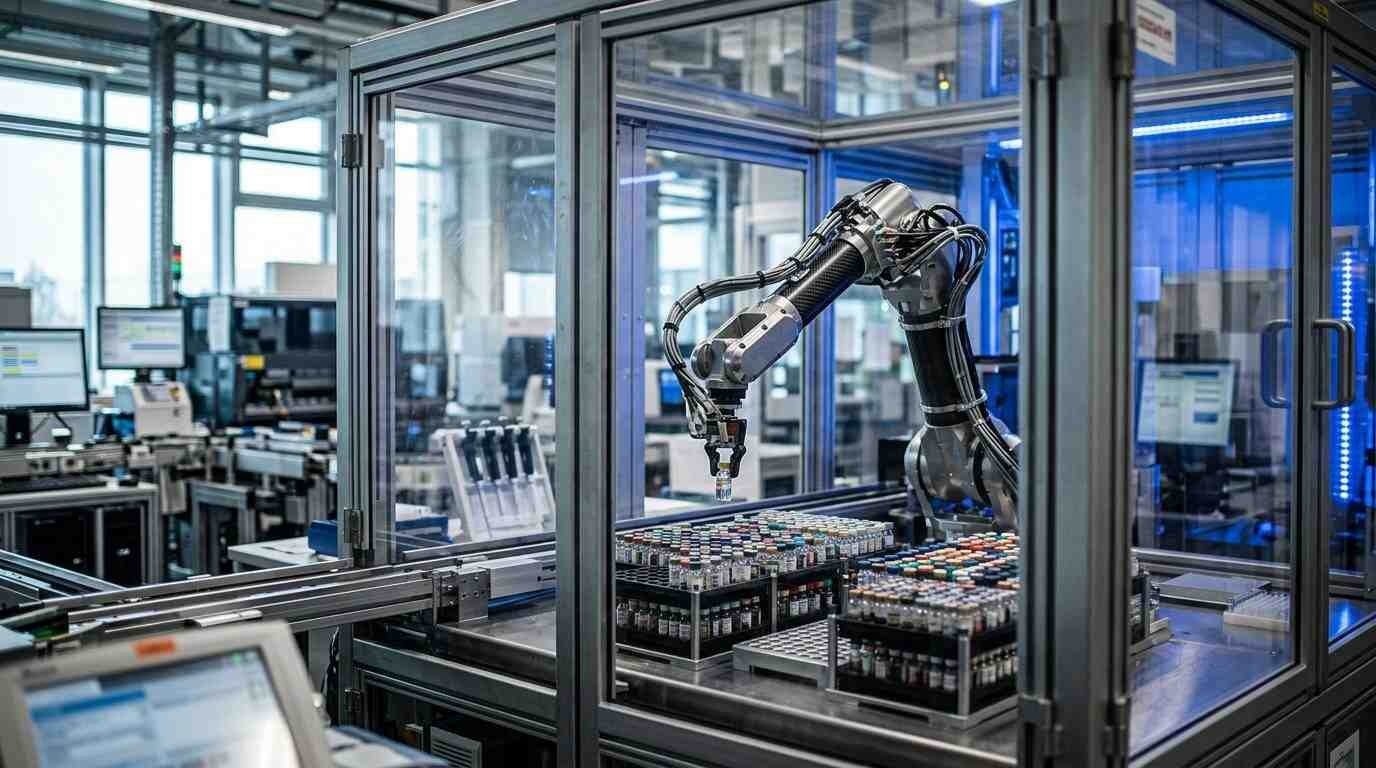
Automation alone is old. Pipetting robots have filled plates for decades. What is new is closing the loop. A self-driving lab needs four parts working together: a way to propose experiments, hardware to run them, an instrument that measures the outcome, and an algorithm that learns from the measurement and picks the next round. Remove the last part and you have a high-throughput screen. Keep all four and you have a system that can, in principle, search a problem space faster than a person taking turns with a robot.
The idea is attractive for biology because biology is full of search problems: which enzyme variant, which growth condition, which genetic circuit. It is also hard for biology, because assays are noisy, living systems drift, and many steps still need human hands.
Case 1: A-Lab and inorganic powders
A-Lab, built at Lawrence Berkeley National Laboratory, is not a biology system, but it is one of the most widely discussed self-driving labs, and its numbers show what the approach can and cannot do. The Nature paper, published online November 29, 2023, describes a platform for solid-state synthesis that combines computed stability data, language models trained on published recipes, active learning and robotics.
Over 17 days of continuous operation, it attempted 57 target compounds and made 36 of them, roughly 63 percent. (The page metadata gives 58 targets, a small discrepancy I could not resolve.) It ran 353 experiments, and only about 30 percent of individual recipes produced their target, so much of the success came from iterating on failed attempts.
The authors are open about the weak points:
- Identifying phases from X-ray diffraction is less reliable for multi-phase mixtures.
- Samples often contained byproducts, and a short hold time probably limited purity.
- Some failures traced to slow reaction kinetics, volatile precursors or inaccurate computed stability.
- Calculated decomposition energies for three targets, they write, may be suspect owing to computational errors.
The Nature page also shows an author correction dated January 19, 2026, though it does not describe the content, so I cannot say what changed.
Case 2: Coscientist and the language-model controller
The second example swaps the planner for a large language model. Coscientist, published in Nature on December 20, 2023, is a GPT-4-driven system that combines web and documentation search, code execution and lab hardware. The paper reports six demonstrations, including planning syntheses of known compounds, controlling a liquid handler, running commands in a cloud lab, and optimizing palladium-catalysed cross-coupling reactions.
The authors call the result a proof of concept, and the details justify the modesty. Plates were moved by hand, so the system was only semi-autonomous. Synthesis planning was uneven: models without web access mostly failed on ibuprofen, and the search-enabled version did worse on two simpler targets. The smaller GPT-3.5 version often failed to produce the requested format. The authors also withheld some code and prompts for safety reasons and discuss dual-use risks.
Case 3: Autonomous enzyme engineering
This is the most directly biological result. A group built a platform that pairs machine learning and large language models with a biofoundry called iBioFAB, and published it in Nature Communications on July 1, 2025. The system needs only a protein sequence and a measurable fitness readout.
The reported results are specific:
- Four rounds took four weeks, with fewer than 500 variants built and characterized per enzyme.
- For a plant halide methyltransferase, substrate preference improved 90-fold and ethyltransferase activity 16-fold.
- For a bacterial phytase, activity at neutral pH improved 26-fold.
Directed evolution of enzymes normally takes a lab months and a lot of manual labor, so this is a meaningful compression. Two cautions apply. The improvements are for two enzymes with a convenient assay, and the paper is a single group’s demonstration. Whether the platform generalizes to enzymes without easy readouts is the open question.
Side by side
| System | Domain | Headline result | Stated limit |
|---|---|---|---|
| A-Lab (Nature, Nov 2023) | Inorganic materials | 36 of 57 targets made in 17 days | Diffraction analysis; computed stability errors |
| Coscientist (Nature, Dec 2023) | Organic chemistry | Planned and ran cross-coupling optimization | Plates moved by hand; uneven planning |
| iBioFAB platform (Nat Commun, Jul 2025) | Enzyme engineering | Up to 90-fold gains in four rounds | Two enzymes; requires a measurable readout |
The design-build-test-learn cycle
Biologists describe the work as a cycle with four stages. Design means choosing what to try: a set of mutations, a pathway, a growth medium. Build means making it, which for a protein variant involves assembling DNA, putting it into cells and growing them. Test means measuring what happened. Learn means updating a model so the next design is better than the last.
A traditional lab runs this cycle with people at every stage, and a full turn can take weeks. The appeal of a biofoundry, a facility whose instruments are linked and scripted, is that build and test become programmable. The appeal of machine learning is that design and learn become automatic. The enzyme-engineering result above is the clearest case of all four stages joined, and its headline number, four rounds in four weeks, is simply the cycle running faster than a human team would manage by hand.
Speed has a cost, though. A fast loop can also chase noise quickly. If a measurement is unreliable, the software will confidently learn the wrong lesson, then design the next round around it. That is why experienced users of these systems spend so much effort on controls and replicates, the unglamorous parts that rarely make a headline.
Common questions
Do self-driving labs replace scientists? Not in anything published so far. People choose the problem, build or configure the platform, define what counts as success and interpret the outcome. The systems above automate the repetitive search within that frame.
Is a language model the brain of every self-driving lab? No. A-Lab used language models for proposing recipes, but also active learning and computed stability data. The enzyme platform combines machine learning and language models. Many self-driving labs use plain statistical optimization, which is often the better tool when the search space is small and the measurements are numeric.
Could this speed up drug discovery? Possibly in the early stages, such as improving enzymes and optimizing assays. Clinical trials, which take the longest, are untouched by lab robotics.
Where the loop still breaks
Reading across the three, the same bottlenecks appear. Each is a reason to be skeptical of grand claims and also a roadmap for where the field will focus.
- Measurement. The loop is only as good as its assay. A noisy or slow readout limits what the algorithm can learn, which is why the A-Lab team has to caveat its diffraction analysis.
- Hands-on steps. Moving plates, loading consumables and fixing jams are still often manual, as Coscientist shows.
- Planning quality. Language models can propose plausible procedures that fail in practice, so the system needs ground truth from the experiment.
- Generalization. Each demonstration was tuned to a task. A lab that can switch between very different problems without rebuilding is a goal, not a fact.
- Safety and misuse. The Coscientist authors held back material because the same tool that plans a benign reaction could plan a harmful one.
How to judge the next announcement
Ask what was actually autonomous. A press release may say the lab ran “without human intervention” while the paper discloses manual plate transfers. Check the number of experiments run against the number of successes, since a high success rate after hundreds of iterations is a different claim from one first-try hit. Look for the comparison: what would a skilled human team have achieved in the same time, with the same budget? That baseline is rarely reported, and its absence is worth noting.
Cost deserves a line as well. A robotic platform is a large capital investment, and its running costs include consumables, maintenance and engineers who understand both the instruments and the code. For a lab running a few experiments a month, a human with a pipette is still cheaper. The economics favor self-driving labs when the same type of experiment must be repeated hundreds of times, which describes enzyme variant screening far better than it describes most research. Expect early adopters to be biofoundries, large companies and well-funded institutes rather than the average university group.
The fair reading today is that self-driving labs have moved from concept to working prototypes with published numbers. They accelerate narrow, well-defined searches. They do not yet decide what questions are worth asking, which remains the human part.
Sources