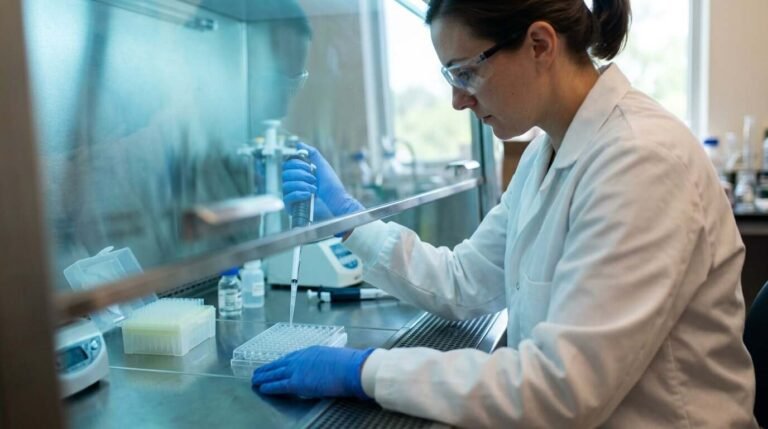
Semaglutide starts in yeast, tirzepatide is built chemically, and sterile filling capacity was the real choke point. A look at both routes, the shortage and what pills change.
GLP-1 drugs are made by two quite different routes, and the shortage that gripped them in 2022 to 2024 came from how slowly sterile injectable capacity can be built, not from a scarce ingredient. Semaglutide starts in yeast and is finished with chemistry. Tirzepatide is assembled chemically, fragment by fragment. Now that the US shortages are officially over, the interesting question is how GLP-1 drug manufacturing is changing as pills and a triple-hormone candidate arrive.
Two molecules, two production routes
Both drugs are peptides, short chains of amino acids, which puts them between small-molecule pills and large antibody biologics. That in-between size is the manufacturing problem. A peptide is too long to make like aspirin and too modified to grow cleanly in a cell.
According to an industry analysis from Deci Bio, semaglutide follows a hybrid path. A peptide backbone is expressed recombinantly in yeast, then modified chemically: an N-terminal fragment carrying one non-standard amino acid is attached, along with a fatty-acid linker. That linker lets the molecule bind albumin in blood, which is why a weekly injection works.
Tirzepatide is made by solid-phase peptide synthesis (SPPS). Four fragments are built separately and joined. The same analysis points out that tirzepatide carries two Aib residues, a non-standard amino acid, against one in semaglutide, and that recombinant systems generally work with the 20 standard amino acids. That is one reason a cell-based route is a poor fit. I could not find a primary company document describing either process in full detail, so treat the route descriptions as an industry summary rather than a regulatory filing.
| Feature | Semaglutide | Tirzepatide |
|---|---|---|
| Backbone | Expressed in yeast | Built by SPPS in fragments |
| Finishing | Chemical attachment of fragment and fatty-acid linker | Fragment conjugation |
| Main bottleneck | Strain and scale-up development | Solvents, protected amino acids, coupling reagents |
| Marketed by | Novo Nordisk | Eli Lilly |
Why chemical synthesis is expensive to scale
SPPS grows a peptide on a resin bead one amino acid at a time, washing between every step. It is reliable and flexible. It also consumes large volumes of solvent. The Deci Bio piece notes that the EU restricted two common SPPS solvents, DMF and NMP, in December 2023, and that the US EPA added DMAC to its hazardous substances list in 2024. Those rules do not stop production, but they push manufacturers toward solvent recovery and alternative chemistries, which takes engineering time.
Recombinant production avoids that waste stream but has its own delay: building and validating a production strain, then a fermentation and purification train, is slow work. Neither route can be turned up like a tap.
Purity is the other cost driver. A chain of three dozen amino acids can go wrong at any coupling step, and each small error leaves a related impurity that must be separated later by chromatography. Building a peptide from separately made fragments, as described for tirzepatide, is a way to keep those errors from piling up in one long chain. It also adds steps, tests and tanks.
The real bottleneck was fill-finish
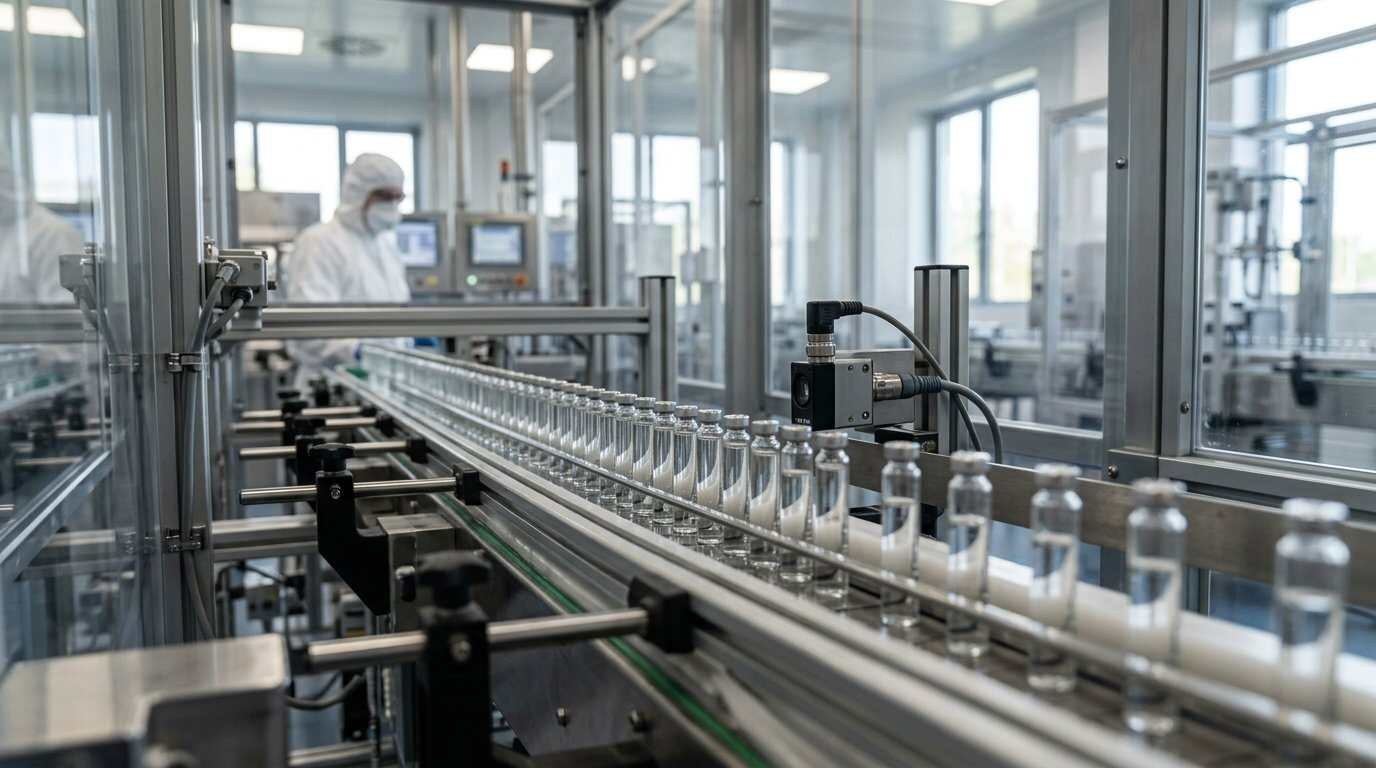
Making the active ingredient is only half the job. The drug then has to be filled into sterile pens or syringes under tightly controlled conditions, a step called fill-finish. Chemistry World reported that building, installing, validating and qualifying a facility can take three to five years, and that prefilled syringes need different fill lines than vials or cartridges.
That timeline explains the shortage. Demand for the weekly injections rose faster than anyone planned, and sterile capacity could not follow at the same speed.
How much capacity was added
The drugmakers responded with large commitments, several of which are only now coming on line.
- Lilly, Indiana. In May 2024 Lilly raised its spending at the LEAP district site in Boone County to $9 billion in total. BioProcess International reported that the site makes tirzepatide active ingredient, with production expected toward the end of 2026 and scaling through 2028.
- Novo Nordisk, fill-finish. Novo agreed to buy three sterile filling sites (Anagni in Italy, Brussels, and Bloomington in Indiana) for $11 billion, as part of Novo Holdings acquiring Catalent. European Pharmaceutical Review said Novo expected added filling capacity from 2026.
- Novo Nordisk, North Carolina. A $4 billion investment in a Clayton facility was announced in 2024, per Chemistry World.
I have not confirmed the closing dates or current operating status of these projects from company filings, so the “expected” dates above are announcements, not results.
When the shortages ended and what that did to compounding
The FDA’s own account is precise. Tirzepatide was first declared resolved on October 2, 2024; after litigation sent that decision back, the agency issued a new determination on December 19, 2024. Semaglutide followed on February 21, 2025. The agency’s compounding statement lists the enforcement windows that closed in March, April and May 2025, depending on drug and pharmacy type.
On April 30, 2026 the FDA proposed excluding semaglutide, tirzepatide and liraglutide from the 503B bulks list, with comments due June 29, 2026. I did not find a final decision. The FDA also says some local supply disruptions can still occur. That is a regulatory description, not medical guidance.
Pills change the manufacturing math
An oral drug skips the sterile filling bottleneck. Novo announced approval of a 25 mg daily semaglutide pill in late December 2025, with a US launch planned for early January 2026. In the OASIS 4 trial, as reported by Healio, adults on the pill lost 16.6% of body weight over 64 weeks against 2.7% on placebo (on-treatment figures, 307 participants). Note that the Healio page carries a February 2026 URL date but describes a December 2025 approval, so the exact FDA action date is unconfirmed here.
Lilly’s orforglipron, sold as Foundayo, is a small molecule rather than a peptide. According to Lilly’s release, it was approved on April 1, 2026 as a once-daily tablet with no food or water restrictions, and shipping through LillyDirect began April 6. Small molecules are made with conventional organic chemistry in tablet plants, which is a well-worn scale-up path. Lilly’s release says nothing about its inventory or production sites, so I cannot say how much supply exists.
What is next
Retatrutide, Lilly’s triple agonist, is still investigational. Topline results announced July 23, 2026 in a company press release reported weight loss of up to 22.6% at 80 weeks in TRIUMPH-3 (12 mg, efficacy estimand) against 3.2% for placebo. These are company-reported topline numbers, not yet peer-reviewed. Lilly says it is finishing the manufacturing section of a Biologics License Application and plans to submit in the first quarter of 2027.
Whether the manufacturing of a three-receptor peptide scales as smoothly as tirzepatide did is the part nobody outside the company can check yet. Lilly’s own wording, that it is “completing” the manufacturing package, tells us the filing is not ready.
A dated timeline
The sequence is easy to lose in the news flow, so here are the dated events cited above in order.
| Date | Event | Source type |
|---|---|---|
| Oct 2, 2024 | FDA first declares tirzepatide shortage resolved | Regulator |
| Dec 19, 2024 | New tirzepatide determination after litigation remand | Regulator |
| Feb 21, 2025 | Semaglutide shortage declared resolved | Regulator |
| Mar to May 2025 | Compounding enforcement windows close | Regulator |
| Late Dec 2025 | Wegovy pill approval announced | Company release |
| Apr 1, 2026 | Foundayo (orforglipron) approved | Company release |
| Apr 30, 2026 | FDA proposes 503B bulks exclusion | Regulator |
| Jul 23, 2026 | Retatrutide topline phase 3 results | Company release |
| Q1 2027 | Planned retatrutide FDA submission | Company plan |
Why this is a template for other drugs
The GLP-1 story shows a pattern that will recur. When a product moves from a niche indication to a mass-market one, the constraint is rarely the science. It is validated, inspected, sterile floor space, plus the trained staff to run it. A new filling line must pass regulatory inspection before it can ship, and that inspection is part of why the three to five year estimate holds.
Pills sidestep part of that chain, but they do not remove it. Tablet plants still need validated chemistry, and an oral peptide or small molecule has to be produced at the scale of millions of daily doses rather than weekly pens. Reading the next quarter’s capacity announcements with that in mind is more useful than reading price headlines alone.
None of this is a recommendation about any drug or any company; it describes how the products are produced and what the public record says.
Quick answers to common questions
Is semaglutide a biologic or a chemical drug?
It sits in between. The backbone comes from yeast, which is biological, and the finishing steps are chemical. That hybrid character is why people argue about how to classify these molecules.
Why did the shortage last so long?
Because sterile capacity takes years, not months, to qualify. Chemistry World puts the build-and-validate cycle at three to five years, and demand outran the plants that existed in 2022.
Does the end of the shortage mean supply is unlimited?
No. The FDA’s April 2026 compounding page says patients and prescribers may still see short, localized disruptions as product moves through the supply chain. The shortage designation and day-to-day availability at a given pharmacy are different things.
Are the pills cheaper to make?
I found no cost-of-goods data for either pill, so that is unknown. What the record does show is the list pricing Lilly announced for Foundayo: self-pay from $149 a month at the lowest dose, a company-stated figure that may change.
Sources
- Deci Bio, Chemical vs. Recombinant: The Manufacturing Decisions Behind Blockbuster Peptide Drugs
- Chemistry World, Weight-loss drugmakers bet billions on boosting supplies
- BioProcess International, Lilly injects another $5.3bn in Indiana plant
- European Pharmaceutical Review, Novo Nordisk $11b acquisition to support manufacturing capacity
- FDA, FDA clarifies policies for compounders as national GLP-1 supply begins to stabilize
- FDA, FDA proposes to exclude semaglutide, tirzepatide and liraglutide on 503B bulks list
- Healio, FDA approves Wegovy pill
- Novo Nordisk release via Pharma Focus Europe, Wegovy pill approved in the US
- Eli Lilly, FDA approves Foundayo (orforglipron)
- Eli Lilly via BioSpace, retatrutide successful in two additional Phase 3 obesity trials