A Wigner crystal is built from electrons alone. Two August 2026 Nature Physics papers used light to read its internal motion, and each named the signal a Wigner polaron.
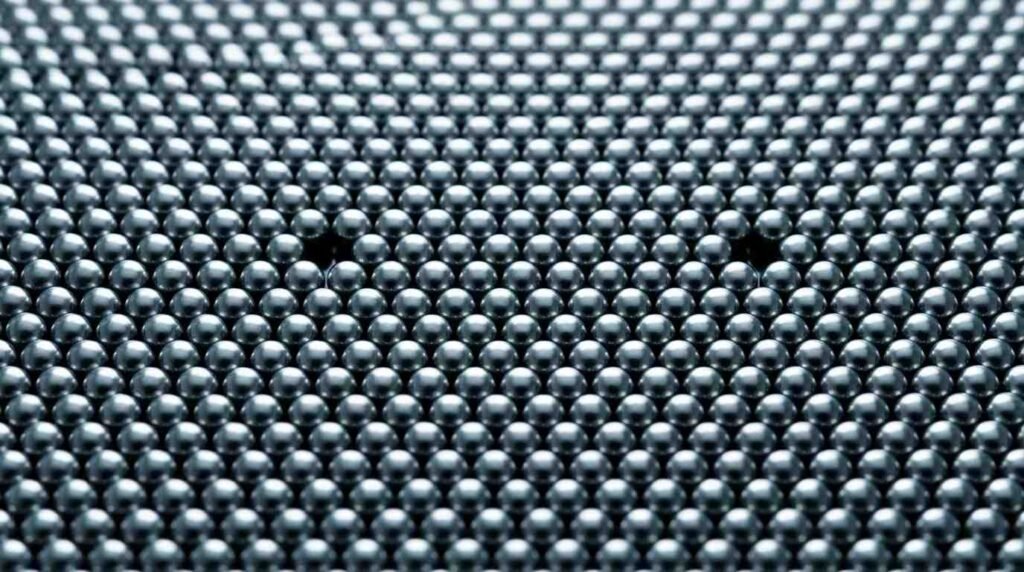
Most crystals are made of atoms. A Wigner crystal is made of electrons alone, locked into a lattice by nothing more than their own mutual repulsion. Eugene Wigner proposed the idea in 1934, and for the better part of a century the field could say little about these objects beyond whether one had formed.
August 2026 changed that. A Nature Physics paper from a University of Maryland–led group, published online on August 11, and a companion paper from the University of Basel and the Technical University of Munich, which drew its press release the following day, both used light to read how a Wigner crystal behaves from the inside. Each team gave the signal the same name: a Wigner polaron.
What follows covers what a Wigner crystal is, what the polaron label means, what each group measured, and where the evidence runs thin. Every figure comes from the journal pages or university releases linked at the bottom, and anything I could not confirm is marked as such.
What a Wigner Crystal Actually Is
Ordinary crystals form because atoms attract one another and settle into an orderly arrangement. Electrons do the opposite, since they repel. According to the American Physical Society’s Physics magazine, Wigner made his prediction as a theorist at Princeton: electrons in a metal, he suggested, could undergo a transition into an ordered crystal phase held in place by Coulomb repulsion. Nobody ever saw it happen in a metal.
A scaling argument shows why cold, dilute electrons are the candidates. In two dimensions, the repulsion energy per electron grows roughly as the square root of the electron density, while the kinetic energy that favors a free-flowing electron liquid grows in direct proportion to density. Thin the electrons out and repulsion wins. Pack them in and the liquid takes over. That scaling is textbook physics, not a result from these papers, but it matches Maryland’s own summary that Wigner crystals form only at very low temperature and very low electron density.
Experiments have caught the crystal in a few settings. Per the APS account, electrons floating above liquid helium form a triangular lattice below a temperature that rises with density. A later Nature paper (volume 628) imaged a magnetic-field-induced Wigner crystal in Bernal-stacked bilayer graphene with a scanning tunnelling microscope. It showed a triangular lattice, stable between filling factors of about 0.13 and 0.38, which melted into a modulated liquid at higher density or temperature and gave way to an anisotropic stripe phase at low field.
Those images are snapshots of structure. Most earlier work, as Maryland’s account describes it, asked a yes-or-no question about whether the crystal exists at all. Asking what the crystal is doing takes a different instrument.
The Accident in the Spectrum
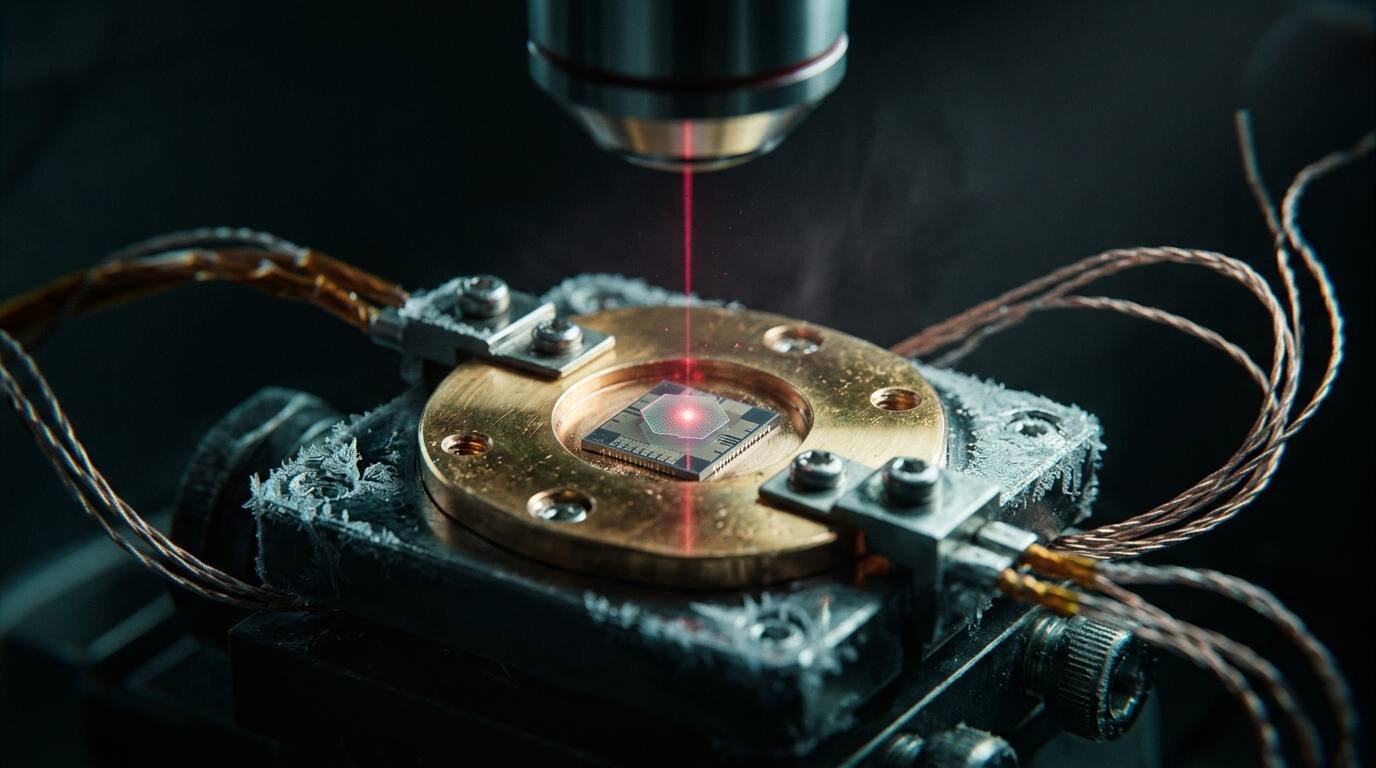
You Zhou, the corresponding author at Maryland, and his group were studying the optical properties of a two-dimensional material when unexpected extra peaks showed up in their spectra. The team could not explain them at first. The turn came with the realization that the peaks marked the electron lattice itself vibrating. “It was a discovery by accident,” Zhou says in the university account. Conventional techniques are poor at studying a Wigner crystal’s vibrations, the same account adds, and the crystals are fragile enough to have been demonstrated only a handful of times.
The samples were monolayer tungsten diselenide (WSe₂), with hexagonal boron nitride supplied by the National Institute for Materials Science in Tsukuba, Japan. Collaborators came from ETH Zürich, Heidelberg, Brookhaven National Laboratory and the University of Wisconsin–Madison. The journal received the manuscript on December 10, 2025 and accepted it on June 30, 2026. No external magnetic field was applied.
What a Wigner Polaron Is
A polaron is a particle that drags a distortion of its surroundings along with it. The classic case is an electron pulling a cloud of lattice deformation through a solid. The Wigner version recasts the characters. Light creates an exciton, a bound electron–hole pair, and the exciton locally distorts the electron lattice around it. Exciton plus distortion forms the quasiparticle the Maryland abstract calls a Wigner polaron.
Why would that reveal anything about the crystal? Because the exciton’s optical signature depends on how the surrounding lattice responds, and that response is the crystal’s dynamics. A soft lattice gives a large response; a stiff one, a small response. The spectrum turns into a readout.
The abstract also separates two kinds of resonance. An umklapp resonance, which in textbook terms involves scattering that hands momentum to a periodic lattice, reports on the static order. The Wigner polaron resonance reports on the dynamics. Two gauges, one device.
Two Papers, One Idea
The Maryland paper did not arrive alone. The Basel–Munich team, led experimentally by Tomasz Smoleński and on theory by Michael Knap, reached for the same concept in the same material.
| Detail | Maryland-led paper | Basel / Munich paper |
|---|---|---|
| Institutions | University of Maryland, with ETH Zürich, Heidelberg, Brookhaven, NIMS and Wisconsin–Madison | University of Basel and Technical University of Munich |
| Journal | Nature Physics, published online August 11, 2026 | Nature Physics, press release August 12, 2026 (DOI 10.1038/s41567-026-03395-0) |
| Material | Monolayer WSe₂ | Single atomic layer of tungsten diselenide |
| Temperature | Not shown in the page text I could read | Cooled to a few degrees above absolute zero; no exact value in the release |
| Technique | Optical probing in the frequency domain (exact method not shown) | Analysis of light reflected from the sample |
| Headline claim | Optical resonances from Wigner polarons; all-optical spin control; optical melting | Previously unseen optical features tied to Wigner crystal polarons; a model of how they form |
| Access | Paywalled | Listed as open access |
Timing is worth a note. The Maryland manuscript reached its journal in December 2025, and the Basel–Munich preprint sits on arXiv under an identifier beginning 2512, which by arXiv’s numbering scheme means December 2025 as well. Two groups arriving at one concept within weeks of each other suggests the idea was ripe, though the papers themselves do not say how independent the efforts were.
Beyond Detection: Spin Control and Optical Melting
Seeing the polaron would have been enough for a paper. The Maryland abstract claims more, in three parts.
- Optical control of spins. The authors report steering spins in the crystal with light alone, which let them probe valley-dependent polaron scattering well above the magnetic ordering temperature and with no external magnetic field. (In WSe₂, electrons occupy distinct momentum-space valleys, and the valley acts as an extra quantum label.)
- Optical melting. Light can melt the crystal. The static umklapp resonance and the dynamic polaron resonance respond differently as it does, which is exactly what two separate gauges should do.
- A suggested use. The authors propose that the approach could enable ultrafast optical control of interaction-driven quantum phase transitions. That is a proposal, not a demonstration.
What Is Still Missing
- Numbers. The page text available for the Maryland paper lists no temperature, electron density or resonance energies, and the full article sits behind a paywall. The Basel–Munich release likewise gives no figures.
- Breadth. Both studies use monolayer WSe₂. Whether the same signatures appear in other materials is untested in what I could read.
- Applications. Maryland’s account says the phonon-like vibrations could guide future applications and that electronics and optical-device researchers are interested because these materials can switch between states. Interest is not a device.
Why It Matters
Smoleński describes the approach as a powerful new tool for studying collective excitations of electronic crystals, while Fabian Pichler, another author on the Basel–Munich paper, says the signals tie the experimental observations directly to the underlying many-body physics. My own read, flagged as opinion: if an optical signature can stand in for a microscope image, more labs can study fragile electron states without a scanning tunnelling microscope, and the dynamics become measurable on timescales a static image never reaches. That outcome depends on the numbers the papers have yet to publish openly.
Frequently Asked Questions
Is a Wigner crystal a normal crystal?
Not quite. Its lattice sites are electrons, ordered by repulsion rather than the attraction that binds atoms in a solid.
Do the electrons freeze in place?
Not literally. The bilayer graphene study analyzed individual lattice sites in a way the authors say may relate to quantum zero-point motion, meaning the electrons keep jittering even in the crystal.
Will this lead to a device?
Neither paper demonstrates one. The practical claims are suggestions about future control of quantum phase transitions.
Where can I read the originals?
The Maryland-led paper and the Basel–Munich paper are both in Nature Physics. The Basel–Munich preprint is on arXiv.
Sources and Verification Notes
- Zhang et al., “Wigner polarons probe the dynamics of a Wigner crystal in a monolayer semiconductor,” Nature Physics (published August 11, 2026)
- University of Maryland engineering news story, August 24, 2026
- ScienceDaily on the Basel–Munich paper, August 12, 2026
- Wang et al., “Spectroscopy of Wigner crystal polarons in an atomically thin semiconductor,” Nature Physics (DOI 10.1038/s41567-026-03395-0)
- American Physical Society, Physics magazine, on Wigner crystals
- “Direct observation of a magnetic-field-induced Wigner crystal,” Nature 628, 287–292
What I could not verify: the Maryland paper’s full text, so temperature, density and quantitative results are missing here. The publication year of the bilayer graphene paper was not shown on the page I read, so I left it out. The December 2025 timing of the Basel–Munich preprint comes from reading its arXiv identifier, not from a dated page. The density-scaling argument is standard physics supplied by me, not drawn from either paper.