






Henri Kagan and Kenso Soai won the 2026 Nobel Prize in Chemistry for showing how a tiny molecular imbalance can snowball into one-handed chemistry. Here is how it works.
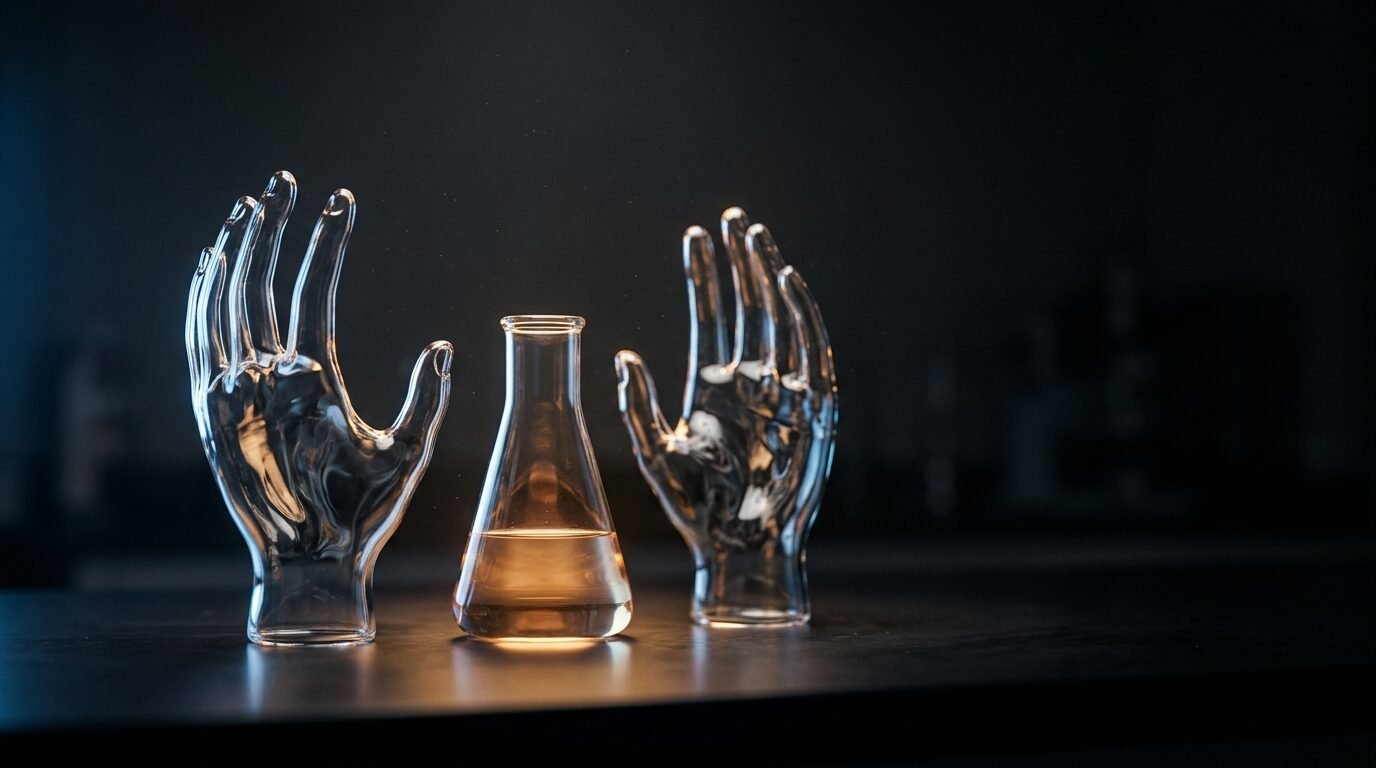
Hold your hands out, palms toward you. Now try to lay the left one exactly over the right. It cannot be done. The two match in every measurement, yet no amount of turning will convert one into the other. That stubborn mismatch, repeated across trillions of molecules, is the subject of this year’s Nobel Prize in Chemistry.
The Royal Swedish Academy of Sciences announced the award on Wednesday, October 7, naming Henri B. Kagan and Kenso Soai “for the discovery of non-linear effects and autocatalysis in asymmetric organic synthesis.” Kagan, 95, is a professor emeritus at Université Paris-Sud in Orsay, France. Soai, 76, is a professor emeritus at the Tokyo University of Science, and Al Jazeera reports that he called the day “the most exciting day in my life” when reached by phone at the news conference. The pair share 12 million Swedish kronor, about $1.2 million.
The citation is dense. The idea underneath it is not.
Why Molecules Have Hands
Many molecules come in two versions that are mirror images of each other, the way a left glove mirrors a right one. Chemists call this property chirality. Living things lean on it heavily: the amino acids in your proteins and the sugars in your DNA come almost entirely in a single version. The question of how nature ended up so one-sided is known as homochirality, and the Academy’s chair, Heiner Linke, described it as a chemical mystery more than a century old.
Laboratories, by contrast, are indifferent. Build one of these molecules from ordinary ingredients and the usual result is an even mix of both hands, as Interesting Engineering notes. That has consequences well beyond curiosity. Peter Somfai, a member of the Nobel Committee for Chemistry, pointed out that the left-handed and right-handed forms of a drug can have different effects on the body, so pharmaceutical chemists need ways to make one hand on purpose.
Kagan’s Crooked Line
The textbook expectation, for decades, was tidy and linear. Use a catalyst that is somewhat lopsided toward one hand, and the product should be lopsided in proportion. Double the purity of the catalyst, double the purity of the result.
In 1986, Kagan questioned that assumption. GEN’s coverage of the prize explains that a catalyst built from one left-handed and one right-handed piece drove the reaction differently from the all-left and all-right versions. That difference let him enhance the formation of one mirror-image product, and he described at least three reactions showing the same behavior. The pattern became known as a non-linear effect. In the favorable cases, the product came out more lopsided than the catalyst that made it.
It sounds like a bookkeeping curiosity. It was a crack in a long-held rule, and the next chapter drove a wedge straight through it.
Soai’s Flask That Copies Itself
Kagan’s work asked how a catalyst could produce more imbalance than it started with. Soai asked a stranger question: what if the product were itself the catalyst? A molecule that helps build more of itself, and favors its own handedness while doing so, is called an autocatalyst.
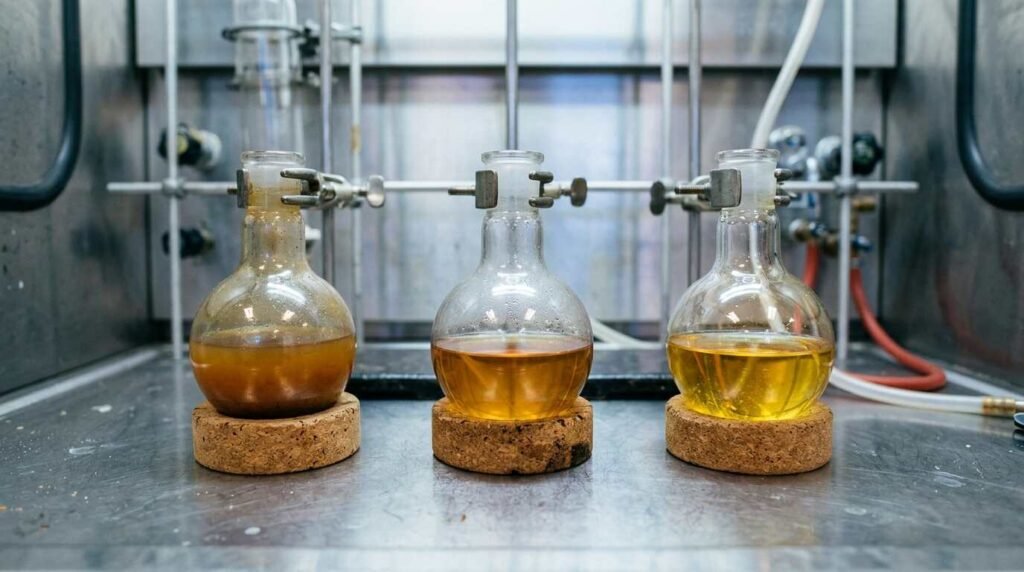
He published a working example in Nature in 1995. According to the Soai reaction entry on Wikipedia, the reaction adds diisopropylzinc to a pyrimidine aldehyde, and the alcohol it produces is chiral and speeds up its own formation. A flask of it behaves like a rumor mill. Each round, the version of the molecule that happens to be ahead gets a little further ahead.
The numbers come from Soai’s own 2011 review in the Bulletin of the Chemical Society of Japan. A term helps here: enantiomeric excess, or ee, measures how lopsided a mixture is. Zero percent means a perfectly even split. One hundred percent means every molecule has the same hand.
| Starting imbalance | After round one | Later result |
|---|---|---|
| 2% ee | 16% ee | 88% ee after four rounds |
| About 0.00005% ee | 57% ee | 99% after round two; above 99.5% after round three |
| 8% ee (a related compound) | 67% ee | Above 99% with repeated cycles |
Look at the middle row again. An imbalance of 0.00005% works out to roughly one extra molecule in every two million. After three rounds, the flask held almost nothing but a single hand. The review reports that the favored version multiplied about 630,000-fold while its mirror image multiplied fewer than a thousand-fold.
“This is probably the coolest experiment in organic chemistry.”
Peter Somfai, Nobel Committee for Chemistry, quoted by GEN
The same review describes how researchers have steered the outcome. Shine left-circularly polarized light of 313 nanometers on a racemic sample of the product, then let the autocatalysis run, and one hand wins at above 99.5%. Right-circularly polarized light produces the opposite hand at the same purity. Chiral crystals of cytosine and several other compounds did the same job, with the final product matching the handedness of the crystal that nudged it. Chemistry World ran its explainer under a headline calling the work “one of the most spectacular chemical experiments ever conducted,” an echo of the committee’s own enthusiasm.
What Happens Inside the Flask
For years, the reaction was easy to reproduce and hard to explain. Researchers could watch it work. They could not say, in satisfying detail, why a mismatch the size of a rounding error took over everything.
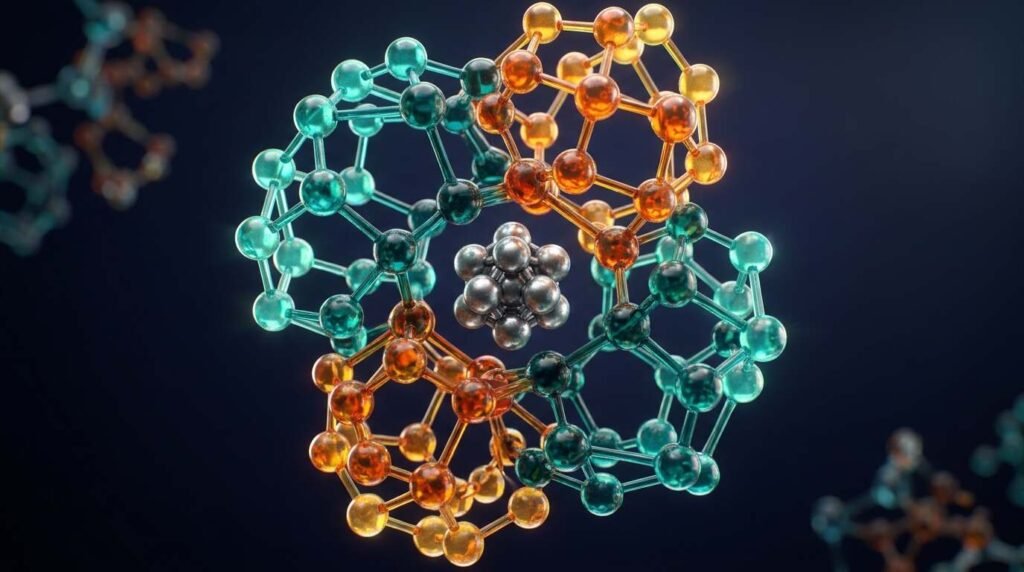
A 2020 paper in Nature Chemistry went a long way toward closing that gap. According to the University of Illinois announcement, Scott Denmark and graduate student Soumitra Athavale teamed with Kendall Houk and graduate student Adam Simon at UCLA, who handled the computational work. Their picture is a tetramer: four zinc-bound product molecules assembling into a larger catalytic structure. The tetramer built from a single hand turns out to be the active one. Its mixed-hand counterpart, although energetically favored, is catalytically inactive because it cannot bind the starting aldehyde in the right way. The computations put the preference for the single-handed pathway at 4.2 kilocalories per mole.
Put plainly, the flask has a built-in filter. Mixed clusters form and then sit idle, while single-handed clusters do the work and make more of their own kind. Denmark said a reaction this special had drawn a tremendous amount of attention, and the mechanism explains why the attention was deserved.
What the Prize Does Not Prove
It would be easy to read the headline and conclude that chemists have cracked how life got its handedness. They have not, and the Academy’s own phrasing is more careful than the headlines. Its statement says that “we now know how homochirality can emerge.” The key word is can.
The ingredients in Soai’s flask are laboratory reagents. The reaction demonstrates that a tiny imbalance can snowball into near-total dominance without any outside referee. It does not show that early Earth ran the same play. Think of it as a proof that a certain kind of door exists, not a map of the building where life walked through it.
On the practical side, National Herald lists drug development, cleaner and more selective chemical synthesis, and specialty materials among the areas the work touches. GEN adds that the laureates’ tools have been used in manufacturing drugs, flavors and scents.
Four Dates That Built This Prize
- 1986: Kagan challenges the straight-line assumption and describes non-linear effects in asymmetric reactions.
- 1995: Soai publishes a working autocatalytic reaction that amplifies a lopsided mixture, in Nature.
- 2020: Denmark, Houk and colleagues publish a detailed mechanism built around a catalytic tetramer in Nature Chemistry.
- October 7, 2026: The Royal Swedish Academy of Sciences awards both men the Nobel Prize in Chemistry.
Frequently Asked Questions
What is chirality?
Chirality is the property of a molecule that makes it different from its mirror image, like a left hand versus a right hand. The two forms have the same atoms joined in the same order but cannot be rotated to match.
What is autocatalysis?
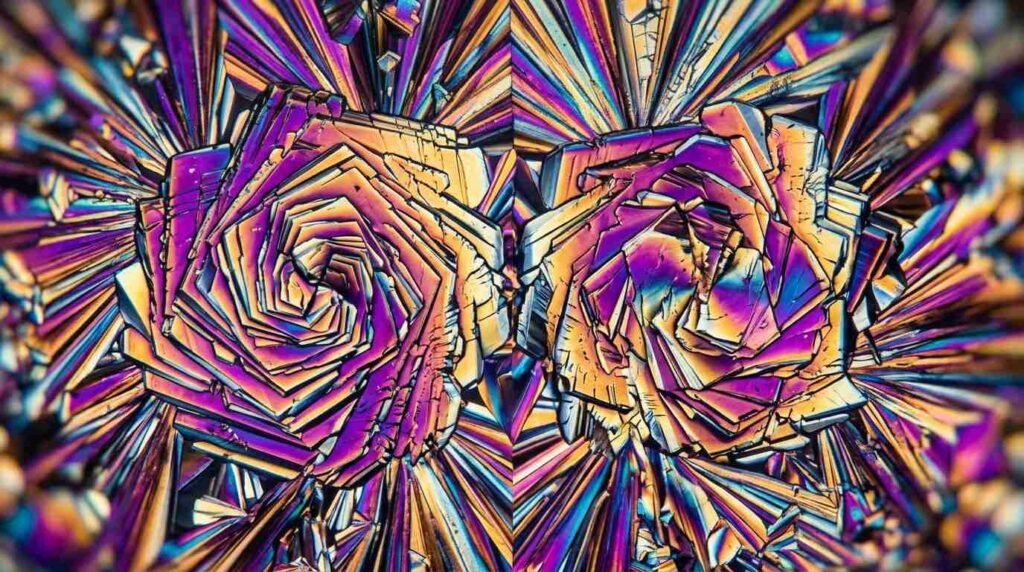
Autocatalysis happens when a reaction’s product also acts as a catalyst for making more of that product. In the Soai reaction, the product favors building more of its own handedness, which is why a small head start grows into a large one.
Who are Henri Kagan and Kenso Soai?
Kagan is a French chemist, 95, and professor emeritus at Université Paris-Sud in Orsay. Soai is a Japanese chemist, 76, and professor emeritus at the Tokyo University of Science. Kagan reported non-linear effects in 1986, and Soai published a working autocatalytic amplification reaction in 1995.
How much is the Nobel Prize in Chemistry worth?
The 2026 prize is 12 million Swedish kronor, about $1.2 million, shared by the two laureates.
Does this explain why life uses one hand?
Not by itself. The work shows a mechanism by which a one-sided outcome can emerge from a nearly even start. Whether that is how it happened on the early Earth remains a separate and open question.
Sources
- Khaleej Times: Henri Kagan, Kenso Soai win 2026 Nobel chemistry prize
- Al Jazeera: Henri Kagan, Kenso Soai win chemistry Nobel for ‘mirror image’ work
- GEN: Kagan, Soai win 2026 Nobel Prize in Chemistry
- Interesting Engineering: Nobel Prize in Chemistry 2026
- National Herald: Kagan, Soai win Nobel Chemistry Prize for solving century-old molecular mystery
- Soai, Bulletin of the Chemical Society of Japan, 2011, 84, 879 (review)
- University of Illinois Chemistry: researchers demystify the Soai reaction
- Wikipedia: Soai reaction
- Chemistry World: Why has work on homochirality won the 2026 Nobel Prize in Chemistry?
- NobelPrize.org: Chemistry 2026




One thought on “The 2026 Chemistry Nobel Explained: How One Flask Learned to Choose a Hand”