Fluke's new iSee ii01 plugs into an Android phone and shows where compressed air is escaping. The physics of 40 kHz leak noise, the leak-cost math, and the limits to know before you buy.
A compressed-air leak sounds like nothing at all. The hiss that matters most to a plant manager sits well above the range of human hearing, and it can run around the clock while the electric meter quietly turns.
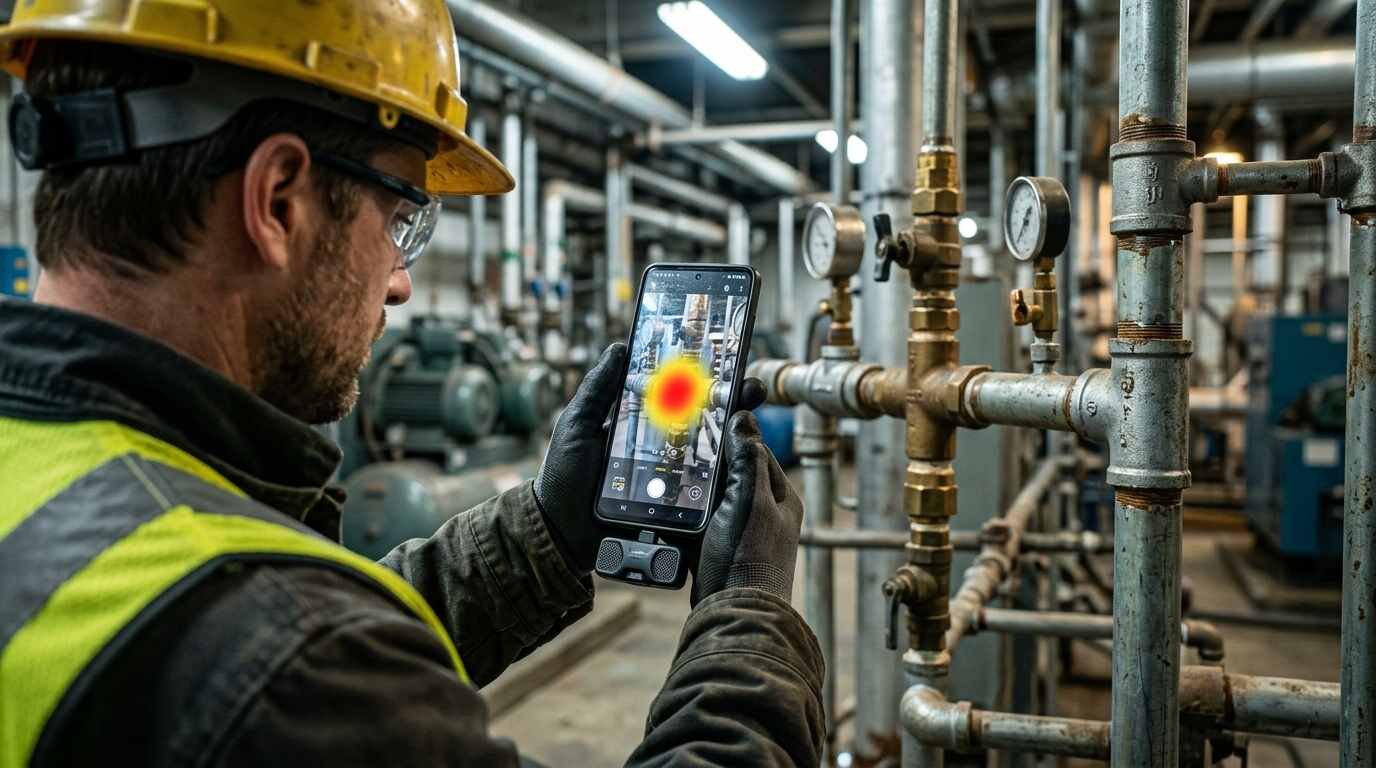
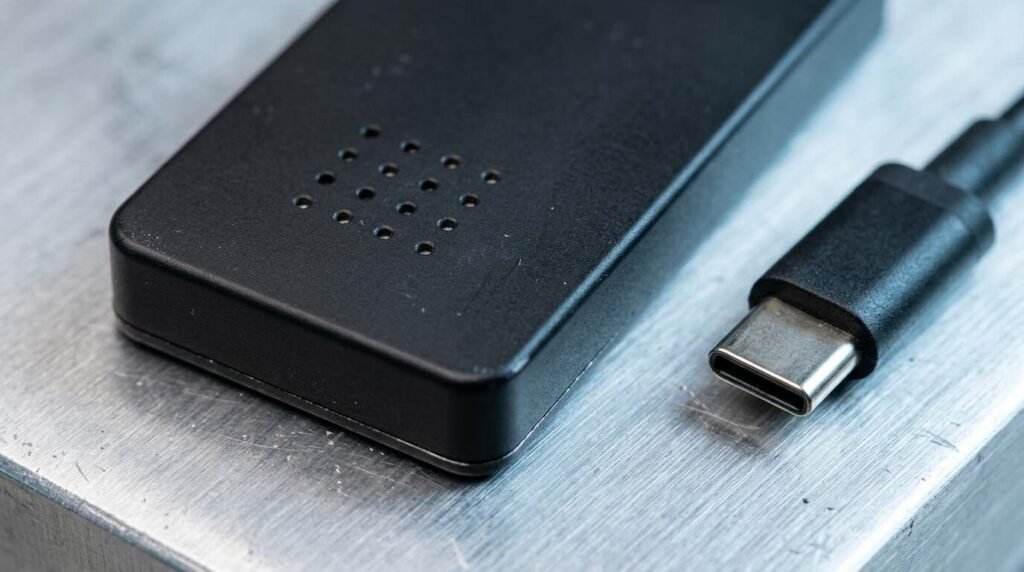
That is the problem a new sub-$1,000 gadget from Fluke is built to expose. The Fluke iSee ii01 is a 50-gram microphone array that plugs into an Android phone and paints the origin of a leak onto the camera view. ToolGuyd covered the launch on October 5, 2026, and trade coverage ran about a month earlier. Below, the physics comes first, then the economics, then the fine print.
- What it is: a USB-C acoustic camera with 16 MEMS microphones, listed by Fluke at $999.99.
- What it hears: 2 kHz to 48 kHz, with a one-tap leak mode tuned to about 40 kHz.
- The catch: Fluke’s spec sheet lists Android and HarmonyOS only. ToolGuyd confirms Android is the only supported platform for now.
- The context: Fluke’s standalone acoustic imager, the FLK-II915, costs more than $26,000, per ToolGuyd.
The Specs, Sorted by Source
Numbers in launch coverage do not always agree, so the table below records where each one comes from. Where a source stayed silent, that is stated rather than guessed.
| Item | Detail (source) |
|---|---|
| Microphones | 16 MEMS (Fluke product page; Control.com) |
| Frequency range | 2 kHz to 48 kHz (ToolGuyd; Control.com) |
| Leak mode | Tuned near 40 kHz, one tap (Control.com) |
| Detection distance | About 0.5 m to more than 20 m (Control.com). ToolGuyd lists none. |
| Field of view | 50° by 38° (Control.com) |
| Video | Clips up to five minutes in the Fluke iSee app (Control.com) |
| Weight | 50 g (Control.com) |
| Platform | Android 7.0 and HarmonyOS 2.0 to 4.2 (Fluke); Android only for now (ToolGuyd) |
| Price | $999.99 (Fluke and ToolGuyd listings) |
Why a Leak Is Loud Where You Cannot Hear It
Gas forced through a tiny opening becomes turbulent the instant it escapes. That churning radiates broadband noise, and a good share of it lands in the ultrasonic band. Fluke’s leak mode targets about 40 kHz for this reason. In a factory full of compressors, motors, and conveyors, the low frequencies are crowded. Up high, a pinhole stands out.
Wavelength is the second reason. It equals the speed of sound divided by frequency, so the arithmetic is quick:
At 1 kHz: 343 ÷ 1,000 = 0.34 m, or 34 cm
At 40 kHz: 343 ÷ 40,000 = 0.0086 m, or 8.6 mm
Short wavelengths make a small array useful. As a rule of thumb, the beam an array can resolve is about one wavelength divided by the width of the array, in radians. Take a hypothetical 10 cm aperture. At 40 kHz that gives roughly 0.0086 ÷ 0.1 = 0.086 radians, near 5 degrees. At 1 kHz the same formula returns 3.4 radians, which is to say no usable direction at all. The 10 cm figure is an illustration, not the ii01’s dimensions, which the sources reviewed do not give.
So how does an array turn microphone signals into a picture? In general terms, a sound from one spot reaches each microphone a fraction of a millisecond apart. The processor delays and sums the 16 signals for many candidate directions. When the delays line up, the sum peaks. Plot those peaks as color, lay them over the camera image, and a hot spot appears on the fitting. Fluke calls its version SoundMap, according to Control.com, and the published coverage does not detail the algorithm beyond that.
The Money Math
A $999.99 tool earns its keep only if leaks cost real money. They do, though the best-known figures are old. The U.S. Department of Energy’s compressed-air guidance, as relayed by the maintenance site Reliamag, says leaks sometimes waste 20-30% of a compressor’s output
in poorly maintained systems. A typical plant without a leak program loses about 20%, and a well-run one stays below 10%. Those numbers date to 1990s fieldwork and early-2000s publications, and this post has not checked them against the original DOE documents.

Per-leak costs come from the same fact sheet, assuming 100 psig, continuous operation, and $0.05 per kilowatt-hour:
| Leak size | Annual cost, DOE basis | Scaled to 8.66 ¢/kWh* |
|---|---|---|
| 1/16 inch | $523 | about $905 |
| 1/8 inch | $2,095 | about $3,630 |
| 1/4 inch | $8,382 | about $14,500 |
*Reliamag scales the DOE basis to an April 2026 U.S. industrial average of 8.66 cents per kilowatt-hour, a factor of about 1.73, and puts the quarter-inch leak near $14,500. The other two scaled values are this site’s own multiplication using the same factor.
Assumes one 1/8-inch leak, running nonstop, found and fixed on day one
Treat that payback line as a ceiling on optimism. Real plants run compressors on shifts, and pressures vary. Fluke itself says up to 40% of compressed air is lost in industrial facilities, but its page cites no source for that figure, so it belongs in the sales-claim column. Fluke also publishes an air leak ROI calculator for running your own numbers.
Watch It Work
Fluke’s own webinar library shows the technique on a live compressed-air system. The clip below is a vendor demonstration, so read it as a best-case workflow.
Fluke on-demand webinar. If the player does not load, find it on Fluke’s leak detection page.
A Survey Routine That Fits the Tool
Owning the camera is the easy part. Turning it into savings takes a repeatable walk-through, and the outline below is general maintenance practice, not Fluke guidance.
- Scan when the plant is quiet. Fewer competing ultrasonic sources means cleaner images, and a leak is easiest to isolate while production equipment idles.
- Record every hit. The app saves clips of up to five minutes, and Fluke highlights sharing results with supervisors, so tag each location the moment it is found.
- Rank by cost, not by volume. A loud leak on a low-pressure line can matter less than a small one on a high-pressure header. Use the size and pressure columns from the cost table above.
- Repair, then rescan. A fixed fitting that still lights up the screen is a failed repair, and the second pass is where the savings get confirmed.
- Repeat on a schedule. Leaks creep back as hoses age and quick-connects wear, which is why a sustained program, not a one-time audit, is how well-run plants stay under 10%.
Limits and Open Questions
Start with the platform. Fluke’s specification lists Android 7.0 and HarmonyOS 2.0 to 4.2, and iPhone users are left out for now. ToolGuyd readers noticed immediately; some said they would want an iOS version or a standalone unit near $1,200, though those are reader comments rather than reporting.

Range is the next gap. Control.com reports a detection span from about half a meter to beyond 20 meters, yet the ToolGuyd write-up found no distance figure. Separately, microphone count appears on Fluke’s page but not in ToolGuyd’s. Availability is murky as well: trade coverage dated September 10 predates ToolGuyd’s October 5 piece, and Fluke’s page currently shows the unit in stock without stating a release date.
Beyond the paperwork, general acoustics sets limits any array shares. Hard, reflective surfaces can bounce ultrasound and smear the picture, and a loud ultrasonic source nearby can mask a quiet leak. Fluke says its cameras work in noisy environments, which is a vendor claim. A field trial in your own plant is the only test that counts.
Opinion: the price is the story. Acoustic imaging used to be a capital purchase with a procurement process. At $999.99, a maintenance lead can expense one. The Android restriction is a real irritation, but it will matter less to a shop that already hands out rugged Android phones.
Fluke’s pitch is that the cameraturns hidden problems into visible fixes.Fluke, as quoted by ToolGuyd, October 5, 2026
Fluke’s chief product officer, Vineet Thuvara, framed the goal in Control.com’s coverage as helping teams avoid downtime and cut energy waste. Whether one handheld array delivers that depends on the plant, the leaks, and the discipline to repair what the camera finds.
Frequently Asked Questions
Does the Fluke ii01 work with an iPhone?
Not according to Fluke’s specification list, which names Android and HarmonyOS. ToolGuyd describes it as Android-only at launch.
What kinds of leaks can it find?
Fluke targets compressed air and gas leaks first. Coverage also mentions vacuum leaks, airtightness checks, and inspection of pipelines, machines, and pneumatic equipment.
Is 40 kHz special?
It is where leak noise stands out from background machinery while short wavelengths keep the array directional. The camera’s full range is 2 kHz to 48 kHz.
How accurate are the DOE leak-cost numbers?
They are decades old and rest on stated assumptions, including continuous operation and a low electricity rate. Rescale them to your own rates and run hours before trusting any payback figure.
Sources
- ToolGuyd, October 5, 2026: Fluke ii01 USB acoustic imager for smartphones
- Control.com, September 10, 2026: Fluke releases mobile ii01 acoustic imaging camera
- Fluke: iSee Mobile Acoustic Imaging Camera ii01 product page
- Fluke: Acoustic imaging resources
- Reliamag: Compressed air leak and energy waste statistics