






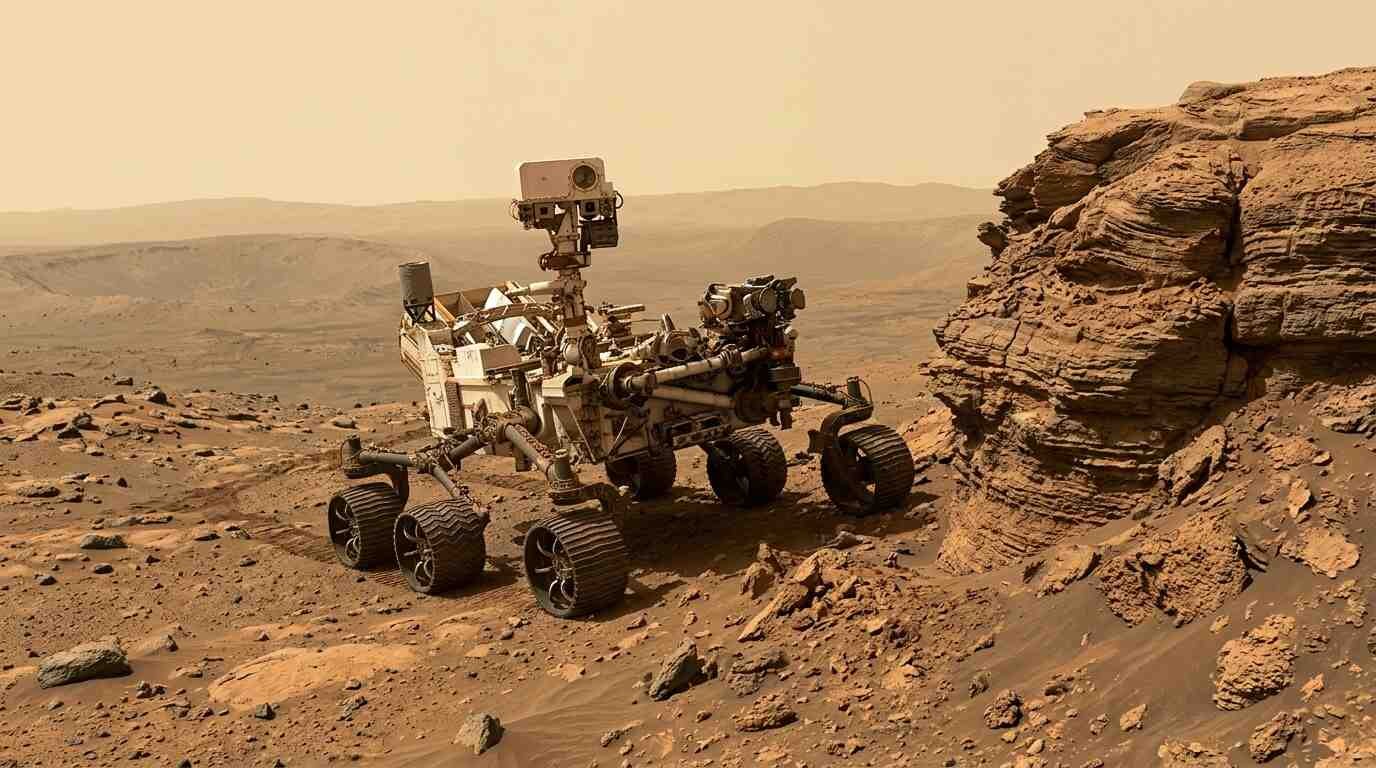
Perseverance’s SHERLOC mapped macromolecular carbon across rocks in Jezero crater’s Bright Angel formation. Here is what was measured, why the origin is open and what would settle it.
Mars organic carbon has now been mapped across several rocks in an ancient river valley, not just spotted once in a single place. In a paper published in Science Advances on June 24, 2026, a team led by Ashley Murphy of the Planetary Science Institute and Kyle Uckert, deputy principal investigator of the SHERLOC instrument, reported hundreds of organic detections in the Bright Angel formation of Jezero crater.
The material is a durable kind of carbon that forms on Earth through biology and through plain chemistry alike, which is exactly why the result has drawn careful language from the authors themselves. It is encouraging for habitability. It is not a verdict on life.
What follows explains what the rover instrument measured, what macromolecular carbon is, how the two rocks differ, and why settling the origin will almost certainly require samples brought back to Earth.
Where Bright Angel Sits and Why It Matters
Perseverance has worked in Jezero crater, a basin that once held a lake. The Bright Angel formation is a light-toned outcrop in Neretva Vallis, an ancient river channel that fed the crater’s lake. Fine-grained river and lake sediments are good places to preserve organic material on Earth, which is why the rover team targeted such rocks.
The paper is titled “Spatially distributed complex organic matter detected in an ancient river valley in Jezero crater, Mars,” appears in volume 12, issue 26, and carries the DOI 10.1126/sciadv.adx0047. It lists around seventy co-authors. According to the Planetary Science Institute’s summary, the organic carbon was confirmed in the same two Bright Angel rocks that NASA reported the previous September as a potential biosignature, and the team also collected a sample from a rock called Cheyava Falls. I did not independently check the earlier NASA announcement.
What SHERLOC Does
SHERLOC stands for Scanning Habitable Environments with Raman and Luminescence for Organics and Chemicals. It is mounted on the rover’s robotic arm and uses Raman spectroscopy: laser light is shone on a rock surface, and the way the light scatters reveals which minerals and organic compounds are present, without destroying the sample. Scanning across a surface turns single readings into maps.
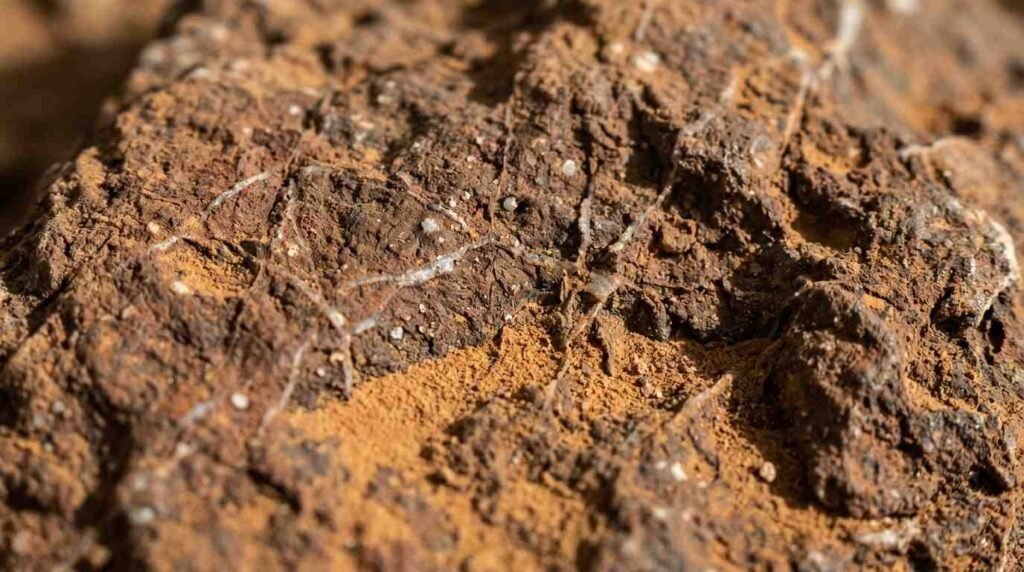
As general background, disordered carbon typically shows two broad Raman bands at roughly 1,350 and 1,600 wavenumbers, which is how this kind of material is recognised. I did not check the paper’s spectra, so treat that as context rather than a statement of what the figures show.
Macromolecular Carbon, Explained
The compound class found is macromolecular carbon, abbreviated MMC: large, tangled networks of carbon atoms, as opposed to small, individual molecules like amino acids. It is common in Earth rocks and in meteorites. It is also tough. It can survive conditions that would break down simpler organic molecules, which helps explain how it could persist for billions of years on a planet whose surface is harsh.
The same toughness limits what it can tell us. MMC can arise from biological or non-biological processes, and the structure alone does not say which one made it.
Two Rocks, Two Settings
The two rocks show the carbon in different company. In one, MMC is associated with secondary carbonate and sulfate minerals, which formed after the rock was deposited when fluids altered it. In the other, it appears within the original silicate-rich mudstone matrix. The authors read the difference as a sign that organics may have been incorporated through more than one process, at different stages of the rocks’ history.
Two further details stand out in the Planetary Science Institute account. The MMC was preserved only microns below the surface, thinner than a sheet of paper, which the release describes as the shallowest MMC detection yet reported on Mars. And the detections lie more than 2,000 miles from organic detections made by NASA’s Curiosity rover in Gale crater (Sci.News gives the distance as more than 3,500 kilometres, which is consistent).
Three Ways to Make the Same Carbon
| Possible origin | What it would imply | What this dataset can and cannot say |
|---|---|---|
| Meteorites and interplanetary dust | Carbon delivered from space and mixed into river sediment | MMC is common in meteorites, so the match is plausible; the instrument cannot tell infall from other sources |
| Abiotic reactions of water and rock | Organics made on Mars by geochemistry | Association with later carbonate and sulfate minerals fits fluid alteration, but does not rule out the others |
| Biological activity | Carbon left by ancient life | Listed by the authors as possible; proving it needs laboratory analysis the rover cannot do |
The authors state that biological, geological and meteoritic sources are all possible, and that the formation mechanism remains unknown.

How Organics Survive the Martian Surface
Radiation, sunlight and reactive chemicals at the surface destroy organic matter, so finding carbon so close to the top of a rock needs an explanation. Murphy suggests two. The MMC may resist degradation, or it may have been shielded by minerals such as clays or iron-rich soil. Her broader reading, according to the institute’s summary, is that organic material may have been more widely available in ancient Martian lakes and rivers than previously thought.
That is an inference about habitability, and a modest one. Organics being present is a necessary ingredient for life as we know it, not evidence of it.
Where the Claim Is Fragile
- No evidence of life is claimed. Both news summaries say explicitly that the finding does not show alien life, and that the origin is unresolved.
- The rover lacks the right lab. Neither Curiosity nor Perseverance carries the large laboratory equipment needed to test whether Bright Angel holds fossilised microbial life.
- Spot measurements, not molecules. Raman mapping shows that macromolecular carbon is present and where, not the detailed chemical structure or isotopic fingerprint that would help discriminate origins. (That distinction is my reading of what the technique can do.)
- Secondary reporting. I could not open the journal page, so the details here come from the Planetary Science Institute release as carried by SciTechDaily and from Sci.News.
What Sample Return Would Add
The research team says higher-resolution analysis in Earth laboratories would be needed to constrain the origin, and sample return is the route to that. Perseverance has already collected a sample from Cheyava Falls, and the authors hope for such analysis if samples come back. Whether and when that happens is outside what the sources I read address.

Reading the Spectra: Why a Carbon Signal Is Not a Fingerprint
Raman spectroscopy works by shining a laser on a surface and measuring the small fraction of light that returns at shifted energies. Those shifts map onto how atoms vibrate in their bonds. SHERLOC uses a deep-ultraviolet laser, which I recall as 248.6 nm, though I’m not confident in that figure from memory, so verify it against the instrument paper before quoting it. The reason for a short wavelength is practical: it excites fluorescence and Raman scattering from carbon-bearing material while keeping the two signals apart.
Disordered carbon typically shows two broad features in the Raman spectrum, usually called the D and G bands. Their positions and widths tell you something about how ordered the carbon structure is. They do not tell you whether a living thing, a meteorite, or a hot mineral-bearing fluid assembled it. That is the core limit, and it is a property of the technique, not a flaw in the rover.
Context does the rest of the work. The same laser scan also records which minerals sit beside the carbon, and that pairing is what lets the team argue about water, temperature and preservation. A carbon signal sitting on a mineral that forms in cool, wet conditions reads very differently from the same signal on a mineral that forms in a hot, dry one.
Think of it as a chemist’s equivalent of finding a footprint without the animal. The shape narrows the field. It rarely names the culprit.
This section is general background on the technique, not a summary of the paper’s methods. Check the published article for the exact instrument settings and band assignments.
Frequently Asked Questions
Does this mean there was life on Mars?
No. The authors and the press summaries stress that macromolecular carbon can form without life, and that the mechanism that made this carbon is unknown.
What is macromolecular carbon in plain terms?
Large, tangled carbon networks, similar in broad character to the carbon found in some meteorites and ancient Earth rocks. They are more resistant to breakdown than small organic molecules.
Why does sample return matter?
Distinguishing a biological from a non-biological origin takes laboratory techniques too large to fly on a rover. Returned samples could be examined at much higher resolution.
Sources and Verification Notes
- Sci.News report on Murphy et al., June 30, 2026
- SciTechDaily, carrying the Planetary Science Institute release, August 5, 2026
- Science News, September 2026 issue contents, which lists its coverage of the finding
- Paper DOI: Murphy et al., Science Advances 12 (26), 2026 (link from the coverage; I did not open the page)
Verification notes: all details of the study come from two news reports, not from the paper, which I did not read. The description of Raman bands is background knowledge. The earlier NASA announcement about the same rocks is mentioned only as the Planetary Science Institute’s summary describes it, and I did not verify it separately.




One thought on “Mars Organic Carbon in the Bright Angel Rocks: What SHERLOC Measured and What It Cannot Say”