






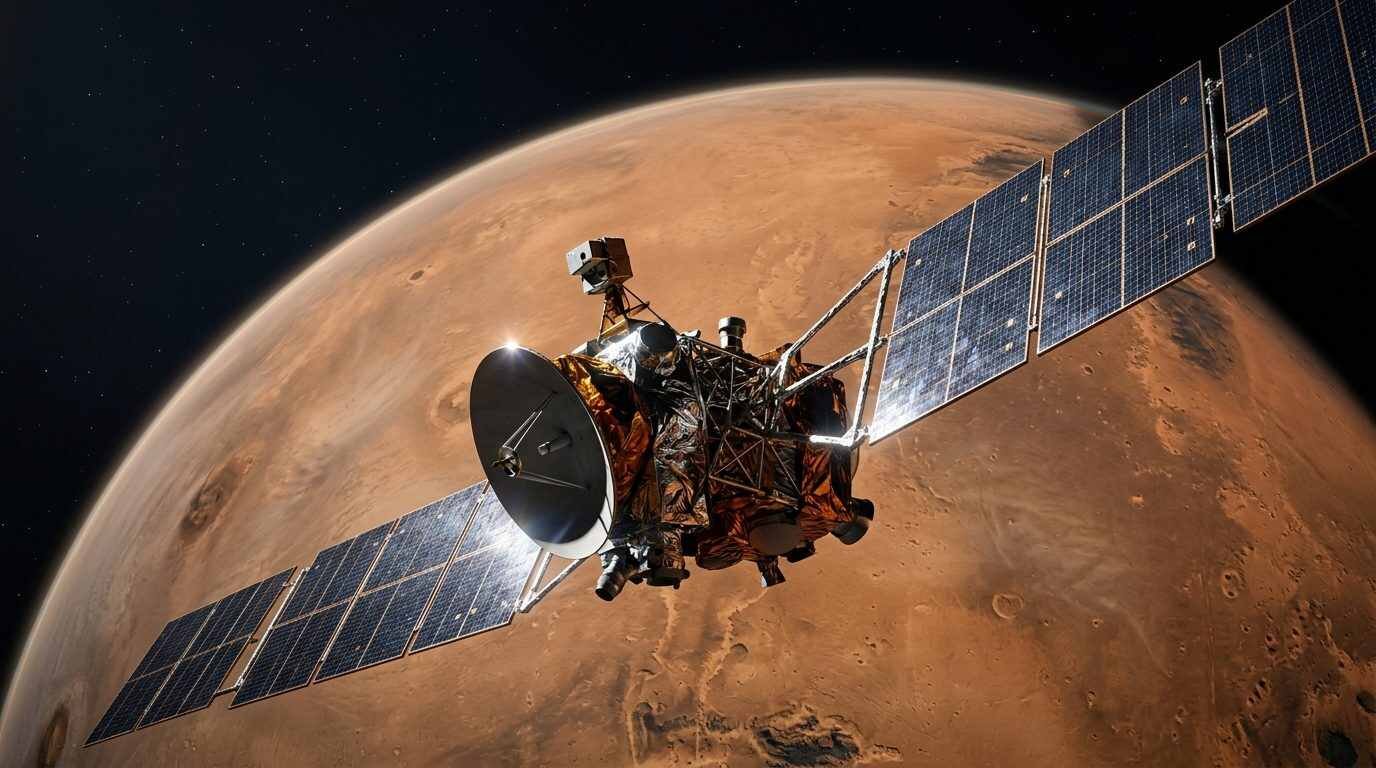
NASA's Psyche probe passed Mars on May 15, 2026, gaining about 1,000 mph and a one-degree orbital tilt without using fuel. Here is the physics and what the cameras tested.
The Psyche Mars flyby on May 15, 2026 gave NASA’s metal-asteroid explorer a free speed boost of about 1,000 mph, tilted its orbit by roughly one degree, and let the team test its cameras and sensors on a real planet. It did all that without burning a drop of the xenon the spacecraft needs for the long trip. Here is how a gravity assist works, what Psyche measured on the way past, and why a rock in the asteroid belt is worth the effort.
What happened on May 15
Psyche launched on October 13, 2023, and its route to the asteroid of the same name runs by way of Mars. On May 15, 2026, it passed the planet at roughly 12,300 mph. NASA’s preview said the closest approach would be about 2,800 miles above the surface; after the pass, JPL reported a measured closest distance of 2,864 miles (4,609 km).
The navigation team confirmed that the spacecraft gained about 1,000 mph and that its orbital plane around the Sun tilted by about one degree. Don Han, the mission’s navigation lead at JPL, said the spacecraft is now on course for Psyche. Both changes were planned, and the speed gain alone is worth a lot: as Sky & Telescope noted, this was the mission’s only gravitational assist, so there is no second chance to fix the route later.
How a gravity assist borrows speed from a planet
A flyby does not use the planet’s gravity as a rope. It exchanges a sliver of momentum with the planet as the two move around the Sun. Seen from Mars, the spacecraft arrives and leaves at the same speed, and only its direction changes. Seen from the Sun, that new direction, combined with Mars’s own motion of about 24 kilometers per second, changes how fast and in which direction the spacecraft travels.
Mars, with a mass that is vastly larger than the spacecraft’s, slows by an amount far too small to measure. Psyche gains. The same trick has carried many missions through the solar system, and it shows up in the numbers here: a thousand miles per hour for free is a large saving for a vehicle that normally accelerates by tiny increments.
Why saving xenon matters so much
Psyche does not use a chemical rocket for its main travel. Its two large solar panels feed four xenon-fueled Hall-effect thrusters, the solar-electric propulsion system uses electric power from the Sun to push out xenon gas, and the thrust is gentle. As Engadget summarized NASA’s plan, the spacecraft builds speed gradually, and conserving xenon is the main reason to bend the route around Mars.
Think of the propellant as a fixed bank balance. A flyby that changes speed and direction at no cost leaves more of it for maneuvering at the asteroid, where fine adjustments for orbit insertion and mapping will need it. The whole trip covers about 2.2 billion miles over six years, according to a Scientific American report.
A rehearsal for the real target
The flyby was also a free exam. Mars is large, well-mapped and nearby, so it makes a good calibration target for instruments that will later face an unknown object. NASA’s pre-flyby blog named three instruments to exercise:
- The multispectral imager, which photographed the approach, the surface and the atmosphere, and practiced techniques for the asteroid.
- The magnetometers, expected to detect Mars’s magnetic environment; JPL said early calibration data may have caught the planet’s bow shock.
- The gamma-ray and neutron spectrometer, which monitors changes in cosmic ray flux during the flyby and is compared with existing Mars data to calibrate it.
Jim Bell, the imager lead at Arizona State University, called the Mars data “unique and important opportunities” to calibrate and characterize the cameras. Calibration imaging was set to continue for the rest of the month.
Plan versus result
Because NASA published expectations ahead of time, the flyby can be checked against the plan. The comparison is short and mostly boring, which is exactly what a navigation team wants.
| Quantity | Before the flyby | After the flyby |
|---|---|---|
| Closest approach to Mars | About 2,800 miles (4,500 km) | 2,864 miles (4,609 km) |
| Speed at closest approach | About 12,333 mph | Not restated in the reports used here |
| Speed gain | Expected, to save xenon | About 1,000 mph |
| Orbital plane change | Expected | About 1 degree relative to the Sun |
The first row is the only place the numbers differ, and the difference is the usual gap between a rounded preview figure and a measured one. The reports used here do not mention an extra correction burn.
What else the sensors caught
Besides pictures, the spacecraft recorded measurements as it crossed Mars’s bow shock, the boundary where the solar wind piles up against the planet’s environment. Mars has no global magnetic field, but the wind still interacts with its upper atmosphere, and a magnetometer that sees that interaction is behaving as it should. The team also ran a wide-survey scan for Phobos and Deimos, although the reports do not say whether the moons were found.
The Deep Space Network, NASA’s set of large radio dishes, tracked the spacecraft throughout. It follows a probe by Doppler shifts, small changes in the pitch of the radio signal that reveal how fast the spacecraft is moving toward or away from Earth. Those shifts are also how navigators confirmed the 1,000 mph gain. Lindy Elkins-Tanton, the principal investigator at UC Berkeley, told Sky & Telescope that so far “everything looks great from all instruments.”
The pictures
Psyche approached Mars from a nearly anti-sunward direction, which gave a crescent view that is rarely possible from Earth. JPL released several frames. A thin crescent of Mars was captured on May 15 at about 5:03 a.m. PDT. Later frames show the first near-full view from the south polar cap to Valles Marineris, a close-up of the south polar cap that spans more than 430 miles, wind streaks across craters in the Syrtis Major region, and an enhanced-color view of Huygens crater, about 290 miles wide. Because it is southern summer on Mars, Sky & Telescope noted, the polar cap looked smaller than it would in winter.
These are working images, not a science campaign. Their value to the team lies in comparison: Mars has known colors and features, so any error in how the cameras render brightness or color shows up quickly. Fixing it now is cheaper than discovering it at the asteroid.
Why 16 Psyche is worth a visit
The destination is the largest known metallic asteroid in the solar system, roughly 280 kilometers (about 173 miles) across at its widest, discovered by Annibale de Gasparis in Naples on March 17, 1852. Scientists think it may be the exposed iron-rich core of an early planetesimal, a building block of a planet whose outer layers were stripped away in violent collisions. NASA says a visit could offer a one-of-a-kind window into the violent history of planet formation.
The idea has a practical punch. Nobody can drill into Earth’s core, but a naked core fragment in the asteroid belt might be examined with cameras, a magnetometer and a spectrometer. If Psyche carries a remnant magnetic field, the magnetometers could show that its parent body once had a molten, churning core, as Earth does. That is a hypothesis for the mission to test, and the asteroid may turn out to be something else.
Three quick questions
Why not fly straight to the asteroid? A direct path would demand more speed change than a low-thrust electric engine can supply economically. The Mars pass supplies part of that change for free, and the thrusters handle the slow, steady remainder.
Was the flyby risky? Passing a planet at 2,864 miles is a routine navigation problem, but a small error early on grows over a multi-year cruise. That is why the team confirmed the speed and plane change with tracking data right after the pass rather than assuming the plan had worked.
What comes next? The spacecraft keeps thrusting toward the belt. Per Sky & Telescope, its first distant images of the asteroid are due in May 2029, and the spacecraft is then planned to spend about two years orbiting and mapping the surface, a figure Engadget gave.
When does it arrive?
Reports differ on the date. Engadget gave July 2029, with science operations starting a month later and about two years in orbit. JPL’s release and Sky & Telescope said August 2029, with first distant images of the asteroid beginning in May 2029, while Han described summer 2029. NASA’s earlier blog said late 2029. Until the team publishes a firm schedule, treat the arrival as summer 2029 give or take a few months.
For a different look at how scientists read old planetary material, see our post on organic carbon in Mars rocks measured by SHERLOC.
Sources
- NASA JPL, NASA’s Psyche Mission Aces Mars Flyby, Targets Metal-Rich Asteroid
- NASA Science, NASA’s Psyche Mission to Fly By Mars for Gravity Assist
- Sky & Telescope, NASA’s Psyche sends back amazing images of Mars
- Scientific American, NASA’s Psyche captures gorgeous Mars crescent photo on way to asteroid
- Engadget, NASA’s Psyche spacecraft just got an assist from Mars



