AlphaFold predictions are used daily in labs, yet AlphaFold 3 struggles with moving proteins, RNA and drug potency. A question-by-question guide to uses and limits.
AlphaFold structure prediction gives biologists a good first guess at the three-dimensional shape of a protein from its amino acid sequence alone, and for many well-behaved proteins that guess is close to what an experiment would show. It does not replace experiments, and it is least reliable exactly where drug hunters often want certainty: flexible proteins, shifting conformations and the strength of a drug binding.
The rest of this piece is organized as questions a working scientist, or a curious reader, would reasonably ask.
What does AlphaFold actually produce?
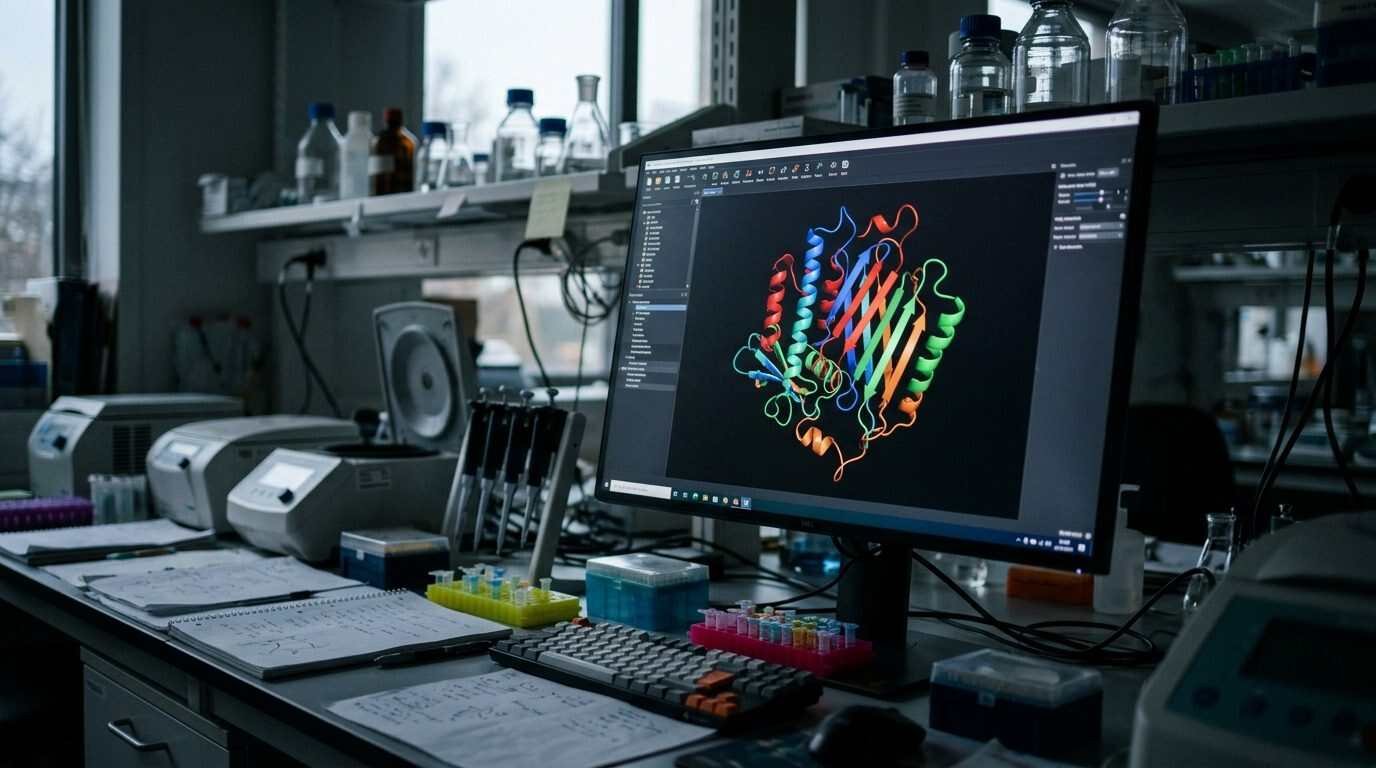
A set of atomic coordinates plus confidence scores. Given a sequence, the model outputs a predicted fold, and a per-residue confidence estimate that tells you which stretches to trust. A model without that confidence layer would be close to useless in practice, because a confident-looking picture of a floppy, disordered region is a fabrication of order.
The first version to reach the public, AlphaFold 2, was recognized in the 2024 Nobel Prize in Chemistry: half to David Baker for computational protein design, and a quarter each to Demis Hassabis and John Jumper for protein structure prediction. The two halves of that prize point to a useful distinction. Prediction takes a sequence and returns a shape. Design runs the other way, starting from a desired shape or function and asking for a sequence. This article covers the first; design is a separate story.
How big is the resource, and who uses it?
In 2021 DeepMind and EMBL-EBI opened a free database of predictions. By July 2022 it had grown to more than 200 million structures, covering nearly every protein sequence in the UniProt resource, under a CC-BY 4.0 licence. That single step changed daily habits: instead of building a model or waiting for a crystal, a researcher can look a protein up.
The usage numbers are large, though they come from the developers. A November 2025 post on the FEBS Network, summarizing a Google DeepMind article, reports more than 3 million users in over 190 countries and more than 35,000 publications citing AlphaFold. I could not check those totals independently, so read them as the team’s own count.
What is it used for in practice?
Most real uses are modest and valuable rather than dramatic. Five come up repeatedly:
- Orienting a project. Before designing an experiment, a lab checks the predicted fold to decide which regions to express, which to cut and where a domain boundary probably sits.
- Finding relatives. Tools such as Foldseek and Dali, which EMBL notes were built on the database, search for proteins with similar shapes even when their sequences have drifted apart.
- Interpreting mutations. A variant in a patient is easier to reason about when you can see whether it lands in a core, an interface or a loop.
- Solving experimental structures. A predicted model can be a starting point for fitting data from crystallography or cryo-electron microscopy, with the experiment still doing the judging.
- Teaching and access. Students and groups without a structural biology core can now ask structural questions at all.
The DeepMind post also claims labs using AlphaFold report more new experimental structures, which would suggest it opens harder problems rather than substituting for lab work. That is the developers’ observation and I have not seen an independent measurement.
What changed with AlphaFold 3?
The Nature paper, published May 8, 2024, extended the approach from single proteins to complexes: proteins with DNA, RNA, small-molecule ligands, ions and modified residues. Architecturally, it swapped the earlier structure module for a diffusion model that generates atom positions directly, paired with a simpler block for processing sequence relationships.
The authors report that its protein-ligand predictions beat standard docking tools, that protein-nucleic acid predictions beat specialized predictors, and that antibody-antigen predictions improved substantially over the previous multimer model. Those claims hold on the benchmarks they chose. The paper is also frank about weak points, which is where the story gets practical.
Where does it fail?
The authors themselves list several problems. Predicted structures sometimes get the handedness of a molecule wrong, at a rate of 4.4 percent on the PoseBusters benchmark. Atoms occasionally overlap. The generative design can invent tidy structure in regions that are actually disordered. And the output is a single static snapshot, so alternative states can be missed: the model predicted the closed form of the protein cereblon whether or not a ligand was bound.
Independent groups have probed the edges. A 2025 bioRxiv preprint (not peer reviewed) assessed AlphaFold 3 on drug-discovery tasks and reported the following:
| Task | What the preprint reported |
|---|---|
| Ligand binding with little protein movement | Works best here; authors call it a true-hit binary interaction modeler |
| Complexes needing large rearrangements | Accuracy drops |
| Newer structures released after training cutoff | Advantage shrinks or disappears, which the authors read as memorization |
| Ranking compounds by potency | Confidence scores did not correlate with measured potency in two inhibitor series |
| Kinase selectivity | Only slightly better than random for three inhibitors |
| Molecular glue and PROTAC ternary complexes | Poor recovery of protein-protein interfaces |
Treat that as one group’s findings on selected systems. The direction, though, matches what the Nature paper concedes about dynamics.
What about RNA?
RNA is a clear current limit. A 2025 study in Acta Crystallographica Section D tested AlphaFold 3 on five RNA benchmark sets against ten other methods. On the CASP-RNA set it did not beat human-assisted approaches, and the authors conclude that deep learning has not yet solved RNA structure prediction. They point to unusual base-pairing interactions, which make up a small fraction of residues yet shape the fold, as one reason.
Why the training cutoff matters so much
Machine-learning models are tested on examples they have not seen, and in structural biology that is harder to arrange than it sounds. The public structure archive is full of near-duplicates: the same enzyme with a dozen different inhibitors, the same antibody with slightly different partners. If a test case resembles something in the training data, a good score may reflect recall rather than understanding.
This is why the preprint above looked at structures released after the model’s training cutoff, and why its authors read the shrinking advantage as a warning. The Nature paper takes the issue seriously too, but a single benchmark cannot settle it. For a working scientist, the practical rule is simple. A protein family that is well represented in public data will probably be predicted well. A novel fold, an unusual ligand or a rare complex deserves more suspicion, and a prediction for it deserves an experiment.
Static pictures of moving machines
Many of the proteins that matter most for medicine are not rigid. Receptors flip between active and inactive states. Enzymes open and close around their substrates. The cereblon example in the Nature paper is a small version of this: one protein, two functional states, and a model that returned the same closed shape for both.
The preprint makes the same point with a receptor involved in calcium sensing, where the model predicted an active-state arrangement regardless of whether the input ligand was meant to switch the receptor on or off. If you are trying to find a molecule that blocks a receptor, a model that always returns the “on” shape will mislead you. The fix is not a better colour scheme on the output. It is a method that samples motion, such as molecular dynamics or experiments that capture several states, used alongside the prediction.
Prediction and design are different jobs
It helps to keep the other half of the 2024 prize in view. Structure prediction answers the question “what shape does this sequence take?” Protein design asks “what sequence would take this shape and do this task?” The two feed each other. A designed sequence is typically checked by running it through a prediction model to see whether it folds as intended, and the result is only a hint until a lab confirms it.
How should a non-specialist read a predicted structure?
- Look at the confidence coloring first. Low-confidence stretches are hypotheses, and often just disorder.
- Remember that one model is one pose. Proteins move, and function often depends on the motion.
- Do not read a drug-binding prediction as a measured affinity.
- Check whether the protein or its close relatives existed in public structure data before the model was trained. If so, the accuracy may be inflated.
- Where a decision is expensive, such as picking a compound to synthesize, an experiment still comes first.
The honest assessment is that AlphaFold structure prediction is now infrastructure, in the way a good sequence database is. It removes friction from thousands of projects. It has not removed the need to measure.
One last point on interpretation. Agreement between a prediction and an experiment is not binary. A model can place the overall fold correctly while getting a loop, a side chain or a binding pocket wrong, and the pocket is often the part a drug designer cares about. That is why the sensible workflow treats a prediction as a hypothesis generator: it tells you where to look and what to test first, and the experiment tells you whether it was right.
Sources
- Nature, Accurate structure prediction of biomolecular interactions with AlphaFold 3 (2024)
- NobelPrize.org, The Nobel Prize in Chemistry 2024
- EMBL, AlphaFold database expands to over 200 million structures (2022)
- FEBS Network, AlphaFold five years on (November 2025)
- bioRxiv preprint, AlphaFold3 in drug discovery: capabilities, limitations and applications (2025, not peer reviewed)
- Acta Crystallographica Section D, AlphaFold3 and RNA 3D structure prediction (2025)