





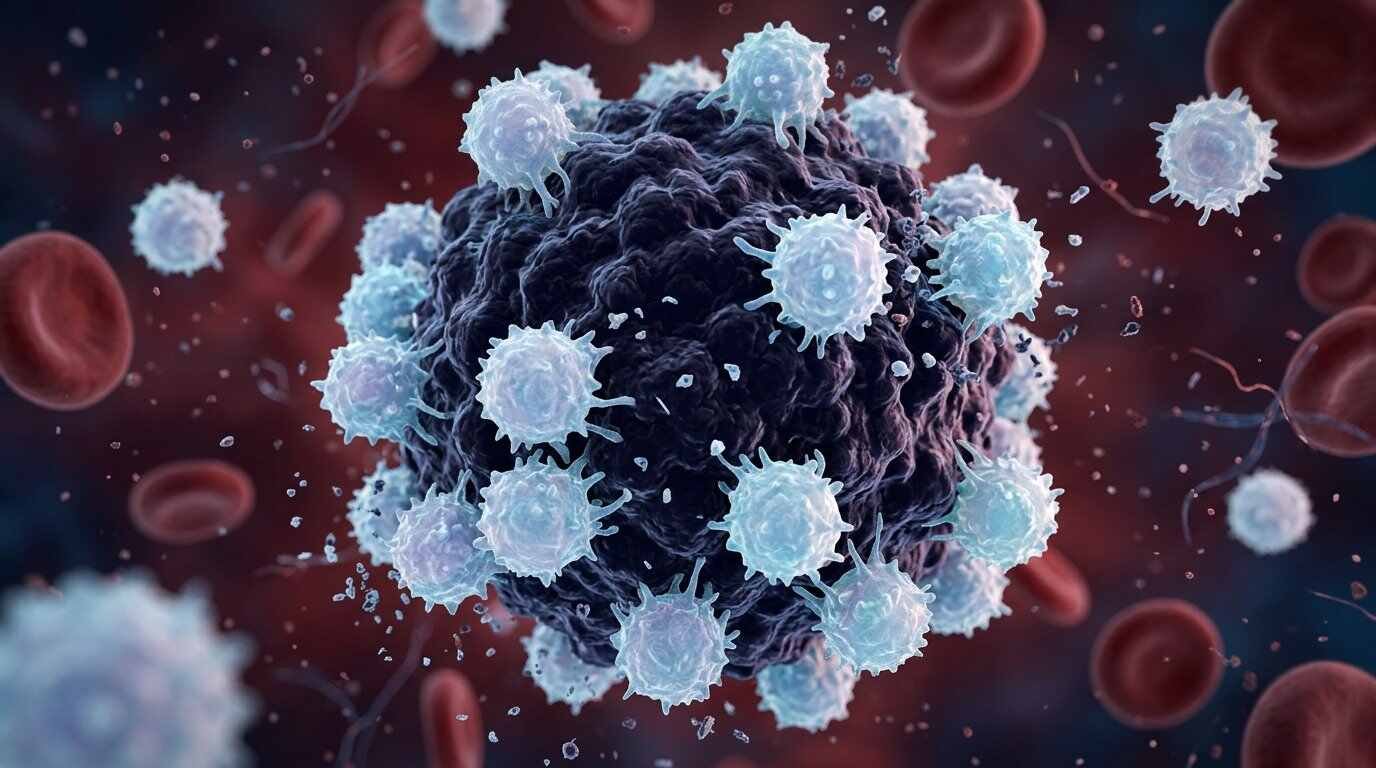
One infusion, no factory: how in vivo CAR-T turns a patient's own T cells into cancer fighters, and what small 2026 trials in myeloma and lymphoma have and have not shown.
In vivo CAR-T therapy skips the factory. Instead of drawing a patient’s blood, engineering the T cells in a lab and infusing them back, a single injection delivers genetic instructions that turn T cells into cancer-fighting CAR-T cells inside the body. Early human data from 2026 look striking, but they come from a few dozen patients at most, and much of it is company-reported.
That combination, big promise and thin evidence, explains why the field is attracting multibillion-dollar deals while clinicians stay cautious. This post explains how the approach works, what the 2026 results actually show, and what is still unknown.
Why the current CAR-T process is the bottleneck
Approved CAR-T products are made one patient at a time. T cells are collected by leukapheresis, shipped to a manufacturing site, genetically modified, expanded for days or weeks, and returned. Patients usually receive lymphodepleting chemotherapy first, to make room for the new cells. The wait can be long for someone with fast-moving cancer.
In vivo approaches aim to remove three steps at once: collection, manufacturing and, ideally, the chemotherapy. If it works, the product becomes something closer to a drug that a hospital can stock than a bespoke procedure. Legend Biotech states the goal for its candidate plainly: an off-the-shelf, single-infusion treatment that avoids lymphodepletion and can be given in an outpatient setting. That is a stated aim, not a demonstrated result.
How a CAR T cell gets made inside the body
Two delivery systems dominate the work so far. Both have to solve the same problem: find T cells among trillions of other cells, deliver the CAR gene, and leave everything else alone.
| Approach | Delivery vehicle | Genetic cargo | Expected duration | Example |
|---|---|---|---|---|
| Viral vector | Engineered lentiviral particles with a T-cell-targeting surface | CAR gene that integrates into the T cell’s DNA | Longer, because the gene is copied as cells divide | ESO-T01, KLN-1010, LB2501 |
| Lipid nanoparticle | Fat-based particles carrying a targeting antibody | mRNA encoding the CAR, with no DNA change | Shorter and transient, so doses may be repeatable | CPTX2309 (Capstan, now AbbVie) |
The lentiviral route borrows the logic of existing ex vivo products but moves it into the bloodstream. In the paper describing ESO-T01, the vector was built to home in on circulating T cells through an anti-TCR nanobody, carried a modified envelope to reduce off-target uptake, and used a T-cell-specific promoter so that CAR expression stayed below 1% in non-T cells, according to a CancerNetwork summary of the Nature Medicine paper.
The lipid nanoparticle route is the one used by Capstan Therapeutics. Its candidate CPTX2309 is a targeted nanoparticle that delivers mRNA for an anti-CD19 CAR to CD8-positive T cells, with design features to steer it away from the liver, per AbbVie’s announcement of its acquisition of the company for up to $2.1 billion. Because mRNA fades, the CAR cells should too, which some researchers see as a safety feature for autoimmune disease.
What the 2026 data show
ESO-T01 in myeloma: peer-reviewed, five patients
The most rigorous dataset so far was published in Nature Medicine in March 2026. In a phase 1 study in China, five people with heavily pretreated multiple myeloma received a single infusion of an in vivo anti-BCMA CAR-T vector, with no leukapheresis and no lymphodepleting chemotherapy. Four had objective responses, three of them stringent complete remissions, and the evaluable responders were negative for minimal residual disease by day 60, according to CancerNetwork.
The safety picture was not mild. Fierce Biotech reported that all five patients had at least one grade 3 or higher adverse event, four had cytokine release syndrome (grade 3 in three of them), and one person died 19 days after infusion. The authors attributed the death to spinal cord compression from an extramedullary tumor, though they could not fully exclude progression or an immune-related contribution. AstraZeneca acquired the developer, EsoBiotec, for $425 million upfront plus up to $575 million in milestones.
KLN-1010 in myeloma: company and conference data
Kelonia’s BCMA-targeted product reported its largest update at the ASCO 2026 meeting. Fierce Biotech’s account of the presentation says that all 18 treated adults were MRD-negative in bone marrow one month after treatment, that everyone assessable at six months stayed negative, and that 16 of 18 had low-grade cytokine release syndrome. Two had neurotoxicity. The trial is early-stage, dose finding continues, and the longest follow-up was a little over ten months. These figures come from the company and a conference setting rather than a published paper.
The money followed. Eli Lilly announced on April 20, 2026 that it would acquire Kelonia for up to $7.0 billion in cash, including $3.25 billion upfront, with closing expected in the second half of 2026, per Lilly’s release.
LB2501 in lymphoma: a press-release dataset
Legend Biotech presented first-in-human data at the EHA 2026 congress for LB2501, a CD19/CD20 dual-targeting product tested in relapsed or refractory B-cell non-Hodgkin lymphoma (trial NCT07002112). The company’s June 2026 filing reports 12 patients across two dose levels. At the higher dose, 6 of 6 responded and 5 of 6 reached complete response. Across both doses the response rate was 50%. No dose-limiting toxicities or deaths were reported, and cytokine release syndrome was grade 1 or 2. Median follow-up was only 4.0 months overall and 2.3 months at the higher dose.
Note the pattern in the lower dose: it did poorly. That is why dose-finding matters here, and why headline response rates from the best cohort should be read with the whole table in view.
The autoimmune angle
Autoimmune disease is where the transient mRNA approach may matter most. Ex vivo CAR-T has produced remarkable early results in lupus, but the process is heavy for a non-cancer condition. A treatment that briefly deletes B cells, then fades, could be easier to justify. AbbVie has CPTX2309 in phase 1, and Legend lists LB2505, a BCMA product for autoimmune disease, as initiating. Neither has produced published efficacy data that I could verify, so treat the autoimmune promise as a hypothesis under test.
A short timeline of the field
- June 30, 2025: AbbVie announces it will acquire Capstan Therapeutics, with CPTX2309 in phase 1.
- March 2026: The ESO-T01 phase 1 results appear in Nature Medicine.
- April 20, 2026: Lilly announces its Kelonia acquisition.
- June 2026: Legend Biotech presents LB2501 lymphoma data at EHA, with a data cutoff of April 1, 2026.
- Second half of 2026: Lilly expects the Kelonia deal to close, subject to regulatory approvals.
Why the choice of vehicle matters for safety
This part is reasoning rather than trial evidence. A vector that inserts DNA gives a lasting effect, which may suit a cancer where a long-lived CAR-T population is the goal. It also means a mistake cannot be undone by waiting. An mRNA package fades within days, which limits both benefit and risk, and could allow a second dose if the first falls short. Which trade-off wins will depend on the disease. In lymphoma and myeloma, durability is the prize. In lupus, a reset that does not leave a permanent engineered cell line may be the more attractive profile. Only larger trials with longer follow-up can say whether either theory holds up.
What nobody knows yet
- Durability. The longest follow-up is around ten months. Whether remissions last, and whether a single dose is enough, is open.
- Safety at scale. Cytokine release was common. With integrating vectors, long-term monitoring for off-target gene insertion will be required, as it is for current CAR-T products.
- Where the vector goes. Legend reports no non-specific transduction in the cells it examined and rapid vector clearance. Independent confirmation in larger groups is still needed.
- Dose and cost. The doses are not yet settled, and nobody has published a manufacturing cost for these products.
- Regulatory path. Legend’s stated next step for LB2501 is a U.S. IND filing. No in vivo CAR-T product is approved anywhere that I could find.
How to read the next headline
Three questions sort most announcements. How many patients? Is the result peer-reviewed or from a company presentation? How long were people followed? A 100% response rate in 18 patients at one month is a reason to run a bigger trial, not a conclusion. The ESO-T01 paper, for all its small size, shows what a fuller account looks like: benefits and a death reported side by side.
Common questions
Is in vivo CAR-T approved? Not that I could find. Every product named here is investigational and in early-phase trials.
Does it replace current CAR-T? Too early to say. Approved ex vivo products have years of follow-up and randomized data in some settings. The in vivo products have months of follow-up and tiny cohorts.
Why do so many early reports focus on myeloma and lymphoma? Those cancers already have well-validated CAR targets, BCMA and CD19, and measurable response criteria. A new delivery method can borrow that groundwork rather than prove a new target at the same time.
This article is general information about research and is not medical advice.
Sources
- CancerNetwork, What ESO-T01 tells us about the next frontier in multiple myeloma
- Fierce Biotech, AstraZeneca’s in vivo CAR-T bet eradicates cancer in 3 of 5 patients, but death mars dataset
- Fierce Biotech, ASCO: Lilly exec points to 100% response rate for in vivo CAR-T
- Eli Lilly, announcement of the Kelonia acquisition (April 20, 2026)
- Legend Biotech, Form 6-K with EHA 2026 LB2501 data
- AbbVie, announcement of the Capstan Therapeutics acquisition
- ClinicalTrials.gov, ESO-T01 registry entry