






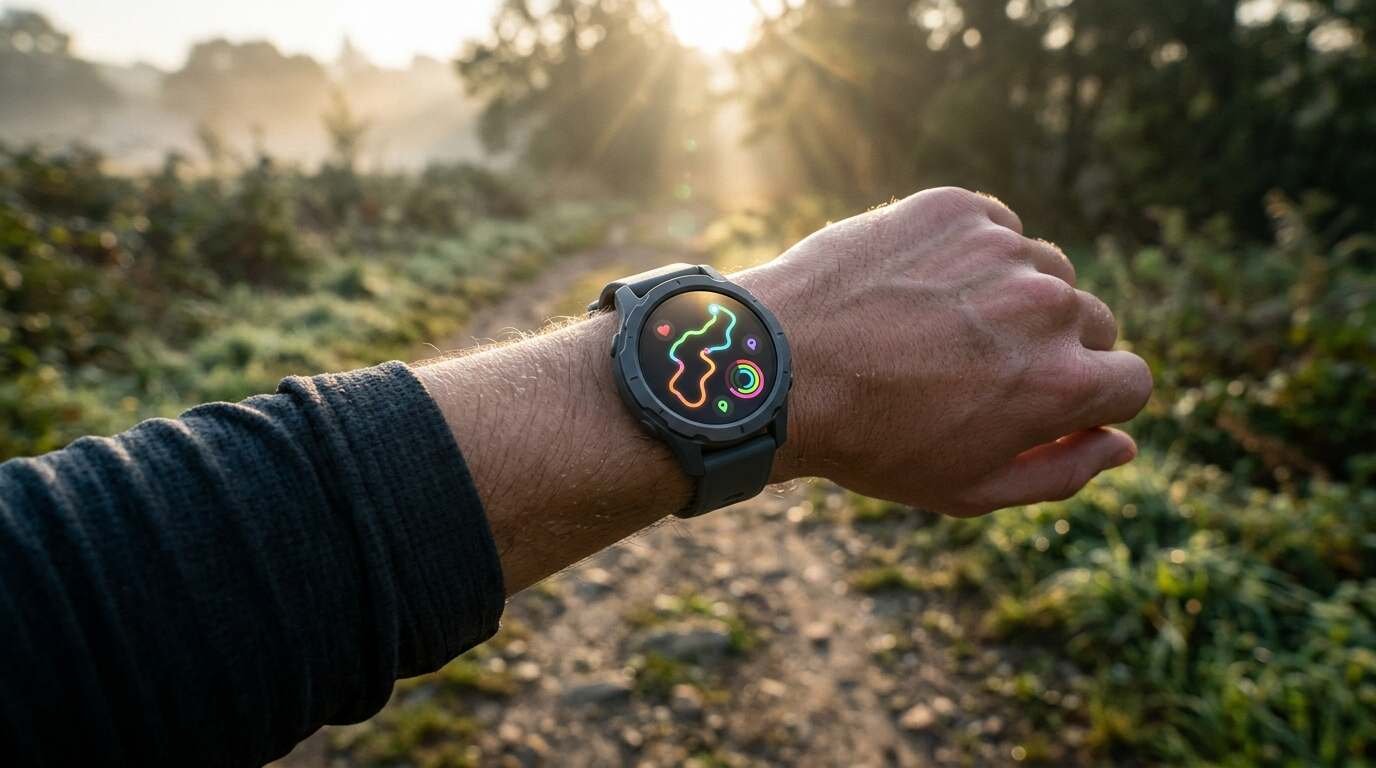
The Forerunner 165 gives beginner and intermediate runners an AMOLED screen and accurate tracking at a lower Garmin price. It drops training load and maps. Here is how reviewers and shoppers see it.
As an Amazon Associate I earn from qualifying purchases. A commission may be earned if you buy through this link, at no extra cost to you.
This Garmin Forerunner 165 review starts from a simple premise: Garmin wanted a running watch with a good screen that did not cost as much as its pricier Forerunners, and it mostly pulled that off. Launched in March 2024, the 165 carries a bright AMOLED display, solid GPS and a body light enough to forget about. It leaves out the training analysis that costs more elsewhere in the range. I haven’t tested this unit; this review is based on published tests and shopper feedback. What follows is a look at what that trade-off means for a real buyer.
What the Forerunner 165 is, and who it is for
The 165 sits at the entry end of Garmin’s running line. It has a 1.2-inch, 390 by 390 AMOLED touchscreen plus five physical buttons, and it weighs 39 grams. The case measures 43 by 43 by 11.6 mm, and the water rating is 5 ATM. A Music edition adds 4 GB of storage and Wi-Fi for a higher price, according to Android Central.
| Spec | Detail |
| Display | 1.2 in AMOLED touchscreen, 390×390, plus five buttons |
| Weight / size | 39 g; 43 x 43 x 11.6 mm |
| Water rating | 5 ATM |
| Battery (Garmin claim) | Up to 11 days smartwatch mode; about 19 h GPS |
| Satellite systems | GPS, GLONASS, Galileo; single-band |
| Heart rate sensor | Elevate Gen 4 optical with SpO2 |
| Connectivity | Bluetooth, ANT+ |
| Band | 20 mm quick-release silicone |
Garmin placed the 165 below its pricier Forerunners, and Tom’s Guide and TechRadar both treat the Music edition as the costlier of the two versions. Retail pricing has moved since launch, so check the current price on Amazon before you decide.
Garmin’s own battery claim is generous, so treat it as a ceiling. Independent results ran lower, which the later sections cover. The sensor list covers SpO2 on the heart rate unit, plus an altimeter, compass, thermometer and ambient light sensor, according to The 5K Runner.
The ideal owner is a beginner or intermediate runner. Someone who wants accurate pace and distance, a screen readable in sunlight, and a watch that lasts about a week between charges. Data-hungry runners and multisport athletes are better served higher up the range.
What Amazon shoppers say
The Amazon listing carries a large body of shopper feedback. It does not make clear to me whether that feedback covers the standard model, the Music edition or both, so read the product title closely.
Amazon’s summary of shopper comments is positive. People call it a great fitness device with accurate steps, distance and heart rate, used for running, swimming and cycling. Several see good value, and one customer calls it the least expensive Garmin with an AMOLED screen. Opinion splits on the interface: some find it simple, while others find it hard to figure out.
That last point echoes the reviewers. I did not check a Google or Google Shopping rating for this post, and shoppers can compare it themselves.
What independent reviewers found
TechRadar called it a very good first running watch with a great screen and strong value. Its sub-scores ran from 5 out of 5 for performance and 4.5 for design down to 3.5 for value, with no overall number. The review points experienced marathon and trail runners toward the Forerunner 265.
Android Central named it the best budget Garmin running watch, and found heart rate readings accurate when compared with a chest strap. Its main complaint was the absence of training load metrics. The same outlet lists Garmin’s battery claims of up to 11 days in smartwatch mode and about 19 hours with GPS running.
The more critical voice was The 5K Runner, which scored it 4 out of 5. It found the menus confusing, the plastic case prone to scratches and the satellite fix weaker beneath trees and tall buildings. OutdoorGearLab gave it 75 out of 100, praising accuracy, light weight and the bright screen, while noting breadcrumb-only navigation and modest battery life.
Tom’s Guide ran a 10K with the 165 next to the newer Forerunner 170 and found core tracking equally accurate on both. The extra money for the 170, it concluded, buys software and training tools rather than better tracking.
What it does well
- The screen. AMOLED on an entry-level Garmin is rare, and TechRadar and Trusted Reviews both liked it.
- Weight. At 39 grams it sits lightly on the wrist, and reviewers called it comfortable.
- Accuracy. GPS and heart rate held up in several tests, including the 10K comparison.
- Battery. TechRadar saw about nine days of mixed use; Trusted Reviews described roughly a week.
- Coaching tools. Garmin Coach, Race Predictor and course creation are still present, per TechRadar.
Put those together and you get a watch that does the running basics very well. For someone training for a first 10K or half marathon, that covers most needs.
Where it falls short
Training Status, Training Load and Training Readiness are all absent, as both Android Central and TechRadar point out. For a runner who likes numbers that explain how hard to push tomorrow, that is the headline gap. Maps and a multisport or triathlon mode are missing too, per The 5K Runner.
Accuracy was not flawless. CoachWeb’s 150-mile test found the optical heart rate sensor running high against a chest strap on most runs, and it once locked onto cadence. Its sleep tracking overstated sleep by 30 to 60 minutes compared with an Oura ring. Battery was shorter in that test as well: 4 to 5 days with the always-on display, well under Garmin’s claim.
GPS lock-on was slow in Trusted Reviews’ experience. The watch uses single-band satellite reception, with no dual-frequency option, which may help explain weaker results among buildings and trees.
A few other irritations. The plastic body picks up scratches. Music and Wi-Fi need the dearer Music edition. And the 165 has been superseded by the Forerunner 170, though I did not verify that model’s release date or whether the 165 is still sold new at every retailer.
Feature gaps aside, the 165 shares much of its software with dearer models. Garmin Coach gives adaptive training plans, Race Predictor estimates finish times, and course creation lets you build a route to follow. TechRadar counts those among the reasons the watch feels like a real Forerunner rather than a cut-down one. Navigation, though, is limited. OutdoorGearLab calls it breadcrumb only, meaning a line to follow without maps behind it.
A note on testing quality. Most of the evidence here is from established outlets that wore the watch for runs, and two of them compared it with a chest strap or a second watch. CoachWeb’s 150-mile test is the longest I found, and it is also where the most negative findings come from. That is a useful reminder that a short review can miss problems that only appear over weeks. I found no Reddit threads to add owner experience beyond what shoppers wrote on Amazon.
Video reviews
Three independent video reviews follow. I haven’t verified who made them or watched them in full, so treat them as extra viewing.
How it compares
The Forerunner 170 is the direct successor. Tom’s Guide puts it at a noticeably higher price, and it adds training readiness and status features. If those matter to you, the extra outlay is justified. If you only want accurate tracking, Tom’s Guide’s 10K test suggests you give up very little by staying with the 165.
The Forerunner 265 is a bigger step up, with deeper training analysis, according to TechRadar. It makes sense for a runner who has outgrown the basics.
On the other side, LiveScience and CoachWeb cite the COROS Pace 3 as a budget rival, lighter and with longer battery life. I haven’t compared the two myself and have no current price for the COROS, so check before deciding.
Who should buy it, and the verdict
Buy it if you are new to structured running, or moving up from a basic fitness band, and want accurate tracking on a good screen. Skip it if you race triathlons, run trails and need maps, care about training load, or ride with a power meter.
In my view, the 165 makes sense for the large middle group of runners who never open a training-load screen anyway. Reviewers broadly agree on the strengths and on the gaps. The most notable weakness in testing was optical heart rate that ran high, and the most common irritation was a menu system that takes some learning. Neither is a deal-breaker for the intended buyer, though runners who plan to build toward a marathon should read TechRadar’s advice about the 265 before spending. Upgrading later costs more than starting higher, but starting higher costs more up front, and only you know which of those matters. Check whether the listing you choose is the standard or Music edition, since the two cost different amounts.
- The Garmin Forerunner 165 is a light, accurate AMOLED running watch for beginners and intermediate runners who can do without training load. See it on Amazon (affiliate link)
As an Amazon Associate I earn from qualifying purchases. A commission may be earned if you buy through this link, at no extra cost to you.



