






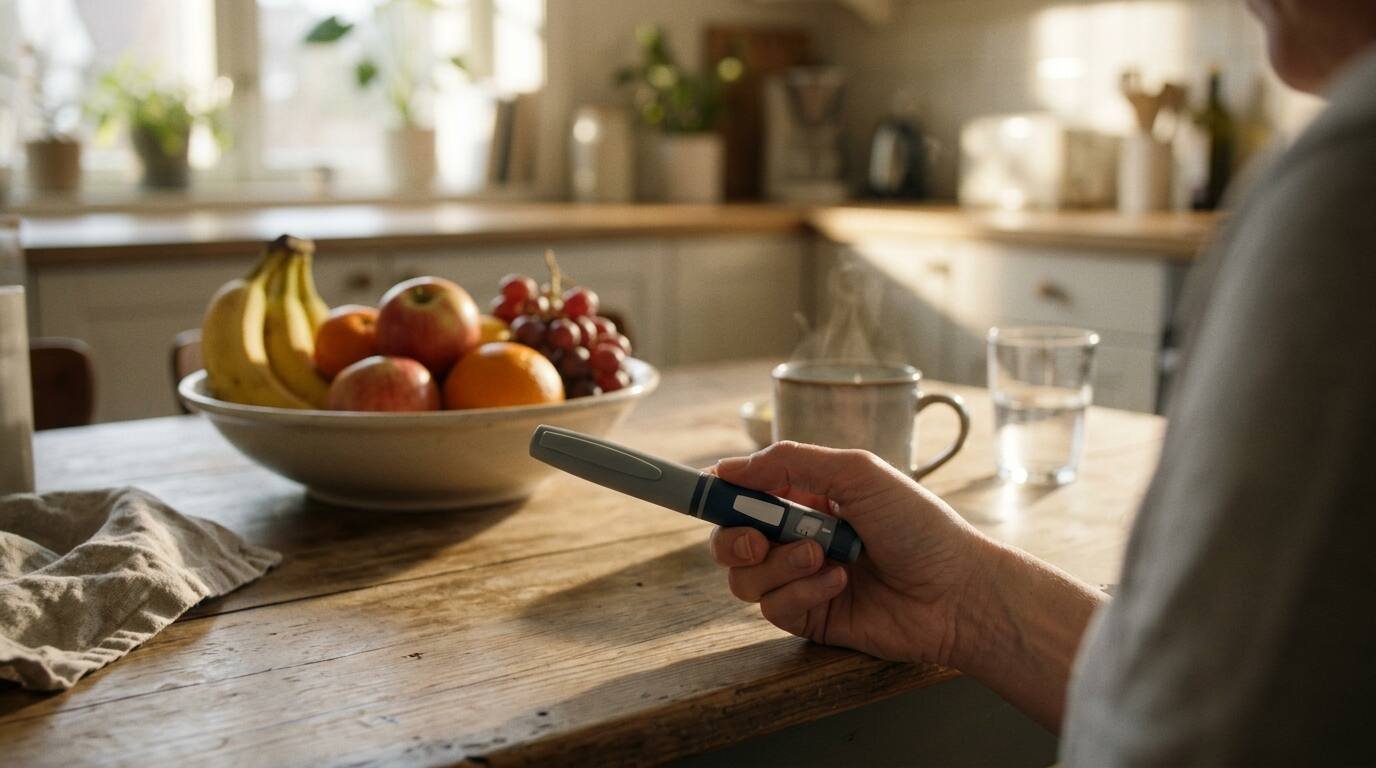
GLP-1 drugs copy a gut hormone that raises insulin, calms appetite and slows the stomach. This is what trials show and where evidence is thin. Educational only, not medical advice.
GLP-1 drugs such as semaglutide have gone from diabetes prescriptions to a fixture of everyday conversation in a few years, and the explanations that circulate are often vague or inflated. This post covers how the drugs work, what the large trials found, and where the evidence is thin. It is educational and not medical advice. Whether any drug is right for a person is a question for that person’s clinician.
What is GLP-1, and what do the drugs copy?
GLP-1 is a hormone released from the small intestine after you eat. It prompts the pancreas to release insulin, holds back glucagon, which raises blood sugar, and sends a fullness signal to the brain. The hormone itself does not last. The enzyme DPP-4 breaks it down in about two minutes, so as a medicine it would be useless in its natural form.
Drugs in the GLP-1 receptor agonist class are modified versions that bind the same receptor but survive much longer. Semaglutide, for example, carries a fatty side chain that attaches to albumin in the blood, giving it a half-life of about a week. That is why it can be injected weekly.
Blood sugar falls because the drugs act on the pancreas, raising insulin output and lowering glucagon. The insulin effect is the original reason they were developed, and the first approvals were for type 2 diabetes.
How do they cause weight loss?
Two main routes, both established. First, in the brain, the drugs act on regions including the hypothalamus to increase fullness and reduce food intake. Second, they slow gastric emptying, so the stomach releases food more slowly and fullness lasts longer.
The relative contribution of each, and the full picture of how the drugs affect cravings and reward, is still under study. Many people describe less interest in food. That is a self-report pattern, and the mechanisms behind it are not settled.
Which drugs are in the family?
Liraglutide (sold as Victoza and Saxenda), dulaglutide (Trulicity), and semaglutide (Ozempic, Rybelsus and Wegovy) are GLP-1 receptor agonists. Tirzepatide (Mounjaro and Zepbound) is a dual agonist that acts on the receptor for another gut hormone, GIP, as well as the GLP-1 receptor. Several earlier drugs, including exenatide, have been discontinued.
Liraglutide, developed by Novo Nordisk starting in 1998, was the precursor to semaglutide. Semaglutide is on the World Health Organization’s Essential Medicines List, and there were about 25 million US prescriptions for it in 2023. That is a measure of how mainstream the drug has become, not of how well it works for any one person.
In the US, Ozempic was approved in December 2017 for diabetes, the pill Rybelsus in September 2019, and the higher-dose Wegovy for weight management in June 2021. Tirzepatide was approved for diabetes in May 2022 and for weight loss as Zepbound in November 2023.
What did the weight-loss trials show?
For semaglutide, a phase III trial reported in 2021 enrolled 1,961 adults with obesity. At week 68, average weight change was minus 14.9 percent with semaglutide and minus 2.4 percent with placebo, . For tirzepatide, the SURMOUNT-1 trial in adults without diabetes found average losses of 15.0, 19.5 and 20.9 percent at 5, 10 and 15 milligrams after 72 weeks, versus 3.1 percent with placebo. A head-to-head trial in adults with obesity found tirzepatide produced greater weight loss than semaglutide at its maximum tolerated dose.
These are averages. Individual results vary widely, and trial participants are followed closely, which may differ from everyday use. The US National Institute of Diabetes and Digestive and Kidney Diseases frames the benefit more modestly across the whole class of weight-management medications: adults who combined medication with a lifestyle program lost about 3 to 12 percent more of their starting weight after a year than those using lifestyle changes alone, with most of the loss in the first six months.
Do the drugs help beyond weight and blood sugar?
For heart disease, there is good evidence for semaglutide. In a trial of 17,604 participants with established cardiovascular disease and overweight or obesity, major adverse cardiovascular events happened in 6.5 percent of the semaglutide group and 8 percent of the placebo group over about 34 months, a relative reduction of 18.8 percent. The FDA approved Wegovy for that purpose in March 2024, and has since approved other expanded uses, including one for a liver condition called MASH in August 2025.
The diabetes evidence is broad as well. Seven trials with 4,087 participants at 536 sites in 33 countries supported the diabetes approval of semaglutide. A meta-analysis of 37 randomized trials and 19 real-world studies, covering 46,719 people, found no increased cancer risk over 18 months, though 18 months is short for a question about cancer.
Other hoped-for benefits have fared less well. Two large Alzheimer’s trials of semaglutide, evoke and evoke+, did not slow disease progression, even though observational studies had suggested a possible benefit. A UK study found no benefit in Parkinson’s disease. Treat claims of broad benefits with caution unless they come from randomized trials.
Who is prescribed these drugs?
The NIDDK lists the criteria for weight-management medications as a body mass index of 30 or higher, or 27 or higher with a weight-related condition such as high blood pressure or type 2 diabetes. Liraglutide and semaglutide are also approved for people 12 and older. The agency notes that medication is not for everyone with a high BMI, and that a lifestyle program may be an option. They are not to be used during pregnancy or when planning pregnancy. If less than 5 percent of body weight has been lost after 12 weeks on the full dose, the NIDDK says the clinician will probably advise stopping.
What are the side effects?
Mostly digestive: nausea, vomiting, diarrhea, constipation and abdominal pain, which are commonest while the dose is increased. Rapid weight loss can raise the chance of gallstones. Doctors often pause these drugs before surgery because they slow stomach emptying and may raise the risk of aspiration during anesthesia.
Some warnings are more serious. Semaglutide carries a US boxed warning about thyroid C-cell tumors, based on rodent studies, and it is not used in people with a personal or family history of medullary thyroid cancer. Whether the effect occurs in humans is unknown. In June 2025, the European Medicines Agency added optic nerve damage, known as NAION, as a very rare side effect. Pancreatitis evidence is mixed, and a 2026 warning from the UK regulator about severe acute pancreatitis with tirzepatide has been reported.
Mental health concerns have been reviewed too, and sources differ on where things stand: the NIDDK page says the FDA is still studying whether these drugs cause suicidal thoughts, while a later summary reports the FDA found no causal link by January 2024 and asked in January 2026 for the warning to be removed. After reports of suicidal thoughts in 2023, the FDA examined the data and found no evidence of a causal link by January 2024. Evidence on mental health effects remains an active research topic.
What happens when someone stops taking them, and what about muscle?
Weight tends to come back. A 2025 review estimated that people regain about 67 percent of lost weight within a year, and other sources put the figure between 50 and 70 percent, with a return to prior weight in around a year and a half. In one trial funded by the manufacturer, people kept roughly a third of their weight loss after two years.
This is why researchers describe obesity as a chronic condition and these drugs as long-term treatment for many users. Whether that is the right framing is debated, and so is the cost-effectiveness for people without diabetes.
Any large weight loss loses some muscle along with fat. A 2024 review found lean mass decreases of 0 to 40 percent of total loss in some studies, though the ratio of lean to total mass rose overall. The implications for older adults are being studied. This is an area where evidence is still developing.
Why are there shortages, fakes and compounded versions?
Demand outran supply. The FDA declared a shortage of Ozempic and Wegovy in August 2022, and shortages continued globally through 2023. Counterfeit Ozempic pens turned up in Europe in October 2023, possibly containing insulin, and the FDA issued a warning in December 2023. Compounded versions were widely used, with a reported 1.5 million US users by January 2026, though the FDA has cautioned that compounded semaglutide salts have not been shown to be safe or effective.
The market is shifting. An oral version of Wegovy was approved in the US in December 2025. Patent protection for semaglutide ended in India and Brazil in March 2026, and generics followed: India launched dozens of brands, and Brazil’s regulator approved one on 26 May 2026. The US patent is expected to run until at least December 2031. Novo Nordisk said in February 2026 that list prices for its injectables would fall to $675 a month from January 2027.
Common questions
Is semaglutide the same as Ozempic?
Semaglutide is the active ingredient. Ozempic, Wegovy and Rybelsus are brand names, with different doses and approved uses.
How is tirzepatide different from semaglutide?
Tirzepatide activates both the GIP and GLP-1 receptors, while semaglutide targets only GLP-1. In a head-to-head trial in adults with obesity, tirzepatide led to more weight loss.
Do GLP-1 drugs work without diet or exercise changes?
The NIDDK says these medications work best alongside healthy eating and physical activity, and the typical approach pairs them with a lifestyle program. How much a person loses without those changes is not something these sources quantify.
Are GLP-1 drugs safe?
They are approved and widely studied, and the most common side effects are digestive. Some rarer risks are still being assessed. A prescriber can weigh these for a given person.
What happens if you stop?
Most people regain a large share of the lost weight within a year or two, according to reviews.
What to remember
GLP-1 drugs mimic a gut hormone that boosts insulin, calms appetite and slows the stomach. Large trials show clear weight loss and, for semaglutide, a lower rate of cardiovascular events in people with heart disease. The best evidence is for those uses.
The limits are real. Side effects are common, some rare risks remain under review, weight returns after stopping, and several hoped-for benefits have not held up in trials. Supply, price and access are shifting quickly, so check current information from regulators and clinicians rather than relying on any single article.
Sources



