SawStop is winding down its table saw business in Europe and the UK by the end of 2026. Here is the timeline behind the flesh-sensing brake, the rule that never arrived, and what owners should ask now.
A hot dog meets a spinning blade, and the blade loses. For more than twenty years that one stunt has been SawStop’s entire argument, replayed on trade-show floors and in endless videos: a table saw can tell a finger from a plank and stop before the damage is done.
On October 9, 2026, the tool-news site ToolGuyd reported that SawStop is closing its table saw business in Europe and the United Kingdom, with an orderly wind-down by the end of 2026. The company, according to that report, described it on social media as a new chapter. Why it is happening has not been explained.
- What happened: SawStop is ending its European and UK table saw operations by the close of 2026, per ToolGuyd (October 9, 2026).
- What continues: support, warranty assistance, and access to essential parts, brake cartridges included, past December 2026, according to the same report.
- What is unknown: the reason. The report does not give one, and SawStop’s own announcement could not be located for this post.
- What has not changed, as far as anyone has reported: the North American business. SawStop’s news page currently lists new products, including a professional bandsaw.
The Timeline: 1999 to Today
The Europe news makes more sense against the long arc behind it. The brake did not arrive as a product. It arrived as an argument, and it spent decades being litigated, lobbied over, and demonstrated.
Steve Gass, a patent attorney and amateur woodworker with a physics doctorate, conceives the idea of a saw that reacts to skin contact (per Wikipedia’s SawStop entry).
He tests the concept on hot dogs, then on his own finger. SawStop is founded the same year in Tualatin, Oregon.
Licensing talks with Ryobi collapse. Later conversations with other manufacturers stall over indemnification demands, and SawStop decides to build saws itself. The first one comes off the line in November 2004.
The Power Tool Institute, the trade group for major toolmakers, opposes the technology in testimony, citing cost, false trips in wet wood, and royalty concerns.
At the AWFS Vegas Fair, SawStop runs its hot dog demonstration every hour on the show floor, as Woodworking Network reported at the time.
The Bosch Reaxx fight. A judge finds in September 2016 that the Reaxx infringes two SawStop patents (but not two others), and in March 2017 the patent board declines Bosch’s request for review. Woodworking Network later credited SawStop’s case with blocking the Reaxx imports.
Ownership passes to TTS Tooltechnic Systems, the German parent of Festool.
The U.S. Consumer Product Safety Commission votes 3 to 1 to publish a supplemental proposed rule on table saw blade-contact injuries.
The CPSC holds its hearing. SawStop pledges to dedicate one key patent (U.S. 9,724,840) to the public if a rule takes effect.
SawStop’s Compact Table Saw and Jobsite Saw Pro launch in the UK and EU.
The CPSC announces it is withdrawing the rulemaking, along with several others.
ToolGuyd reports that SawStop is winding down its table saw business in Europe and the UK by the end of the year.
How a Table Saw Learns the Difference Between Oak and a Finger
The mechanism is simple enough to explain in a paragraph and difficult enough to have taken years to commercialize. A small electrical signal, 12 volts at 200 kilohertz according to Wikipedia’s summary, runs through a plate beside the blade. A second plate on the other side picks it up by capacitive coupling. Wood and flesh conduct differently, so when skin touches the blade the signal sags.
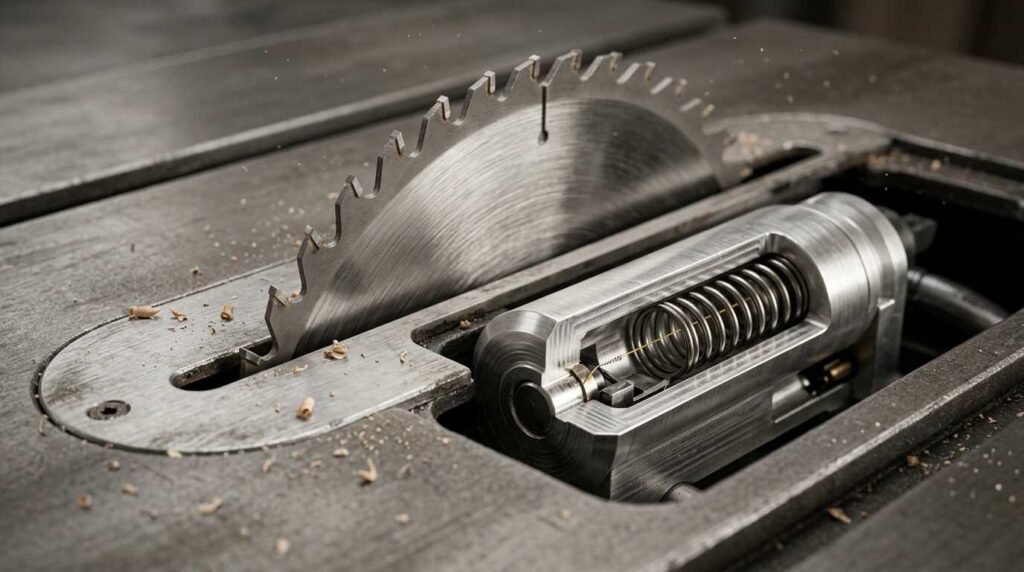
If the sag lasts about 25 microseconds, the detector fires. A spring drives an aluminum block into the teeth, held back until then by a wire that an electric pulse melts, much like a blown fuse. SawStop’s own website says the blade stops in under five milliseconds. The momentum then pulls it below the table.
Two details matter for owners. First, the brake is a one-shot device. Activation usually wrecks the blade and requires a new brake cartridge. Second, the system has limits: it has to be bypassed for very green or wet wood, it will not work with non-conductive blades, and it cannot easily be retrofitted to another saw.
Opinion: that cartridge detail is why the parts promise in the Europe announcement matters more than the headline. A SawStop without cartridges is an ordinary saw with a very expensive paperweight under the table. Owners should read the support commitment closely and ask for specifics.
The Demo
Almost everyone who knows the brand knows the demo. The version below shows the hot dog test, and it is worth watching once with the sound off. The point is how little happens.
A hot dog stands in for a finger. If the player does not load, open the video on YouTube.
SawStop claims its technology has produced more than 10,000 “finger saves” since introduction. That figure comes from the company, as relayed by Woodworking Network, and the article cited no independent injury statistics. Keep that in mind when you hear the number repeated.
The Rule That Never Arrived
The regulatory thread is the least tidy part of the story. The proposed CPSC standard would have required that a test probe moving toward a spinning blade at one meter per second be limited to a cut no deeper than 3.5 millimeters. It was a performance test rather than a design mandate. The Power Tool Institute said at the hearing that technology from its members’ joint venture could meet it, subject to the SawStop patent question.

Industry resisted. The Power Tool Institute argued that a mandate would push low-end saws out of reach for many buyers. At the 2024 hearing, then-Commissioner Peter Feldman, who would later lead the agency, accused SawStop of rent-seeking and pressed it on licensing. SawStop answered with the conditional patent pledge. Then, in August 2025, the new leadership withdrew the project, with Feldman saying the agency would not spend limited resources on symbolic rules
that reduce consumer choice.
As far as can be told, the patent pledge hinged on a rule taking effect, and no rule is coming. ToolGuyd’s author noted it is unclear whether the withdrawal is permanent. For now, no federal standard on blade contact is moving forward.
If You Own One in Europe or the UK
These are practical suggestions, not guidance from SawStop. The one hard commitment on the record, relayed by ToolGuyd, is that support will continue throughout the transition, and beyond
, including warranty help and essential parts such as brake cartridges after December 2026.
- Get the commitment in writing. Ask your dealer or SawStop’s EU/UK support channel (the site has a region selector in its header) what parts and warranty coverage will look like in 2027.
- Ask about cartridge supply and price. Since a single trigger consumes one, availability is the practical measure of the promise.
- Check the dealer situation. A reader told ToolGuyd that EU dealers have cut inventory by about 30%. That is one unconfirmed reader report, and it is not tied to the announcement.
- Keep your documents. Receipts, serial numbers, and registration details tend to matter when a brand changes how it supports a market.
What Nobody Has Explained Yet
The report does not say why SawStop is leaving. It lists related posts on table saw regulation and the patent pledge, but it does not claim they caused the decision, and I will not either. Markets close for many reasons, and a company that is still launching new products elsewhere is not a company in retreat by default.

One detail does offer a clue about direction. ToolGuyd says Festool’s own SawStop-equipped table saw remains available in these markets, and that Festool and SawStop share an owner. Whether that stays true is something to verify with Festool rather than assume.
Frequently Asked Questions
Is SawStop going out of business?
Nothing reported says so. The announcement concerns table saw operations in Europe and the UK. SawStop’s own news page currently highlights new products, including a professional bandsaw.
Will European and UK owners still be able to get brake cartridges?
According to ToolGuyd, SawStop says support, warranty assistance, and essential parts, including brake cartridges, will continue past December 2026. The details have not been published in the sources reviewed here, so confirm them directly.
Can a SawStop brake be fitted to any table saw?
No. Wikipedia’s summary notes that the system cannot easily be retrofitted, which is part of why the technology is sold as a complete saw.
Does the brake work on wet wood?
Not reliably. It has to be disabled for very green or wet wood, which is a long-standing criticism from the toolmakers’ trade group. Follow the manual for your model.
Sources
- ToolGuyd, October 9, 2026: SawStop is Shutting Down their Table Saw Business in Europe
- ToolGuyd, August 24, 2025: CPSC Withdraws SawStop Table Saw Safety Rulemaking
- ToolGuyd, February 29, 2024: CPSC table saw hearing takeaways
- Woodworking Network, September 9, 2025: CPSC drops plan to require table saw safety devices
- Woodworking Network, August 14, 2011: SawStop’s hot dog demonstration at AWFS
- SawStop (Wikipedia)
- SawStop news page