From phosphoramidite chemistry to Golden Gate and Gibson assembly to cell-free protein synthesis, an evergreen guide to how a digital design becomes a protein.
DNA synthesis is the chemical writing of a custom DNA sequence, base by base, and it is the step that turns a digital design into physical genetic material. Short strands are made chemically and then stitched together into genes. Once you have the gene, a cell-free system can read it and produce the protein in a tube, with no living cells involved, often within a day or two.
That chain, from file to protein, is one of the quiet engines of modern biotech. This explainer follows it step by step, with the limits at each stage. It is an evergreen overview rather than a news report, and I have flagged where I could not check recent developments.
The workflow in five steps
- Design. Choose or generate a sequence on a computer, adjusting it for the host system.
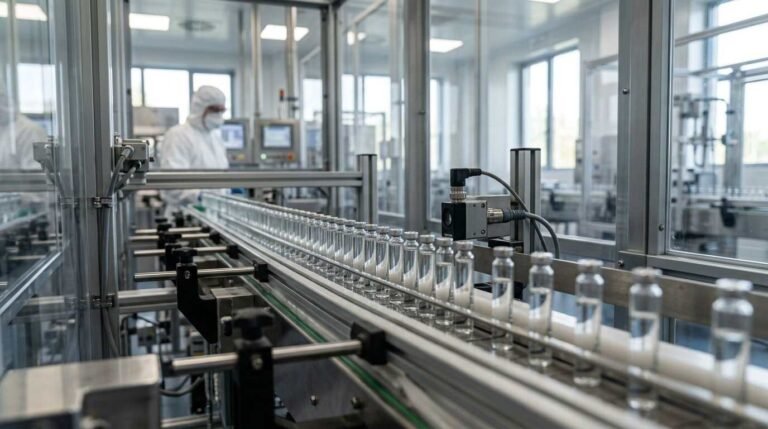
- Synthesize short pieces. A machine builds oligonucleotides, short single strands of DNA, chemically.
- Assemble. The pieces are joined into a full gene or pathway.
- Verify. Sequencing checks that the assembled DNA matches the design.
- Express. Cells, or a cell-free extract, read the DNA and make the protein.
How DNA is written chemically
The standard method is phosphoramidite chemistry. According to the overview of oligonucleotide synthesis on Wikipedia, the chain is built one nucleotide at a time, running in the opposite direction from how cells copy DNA, and chemical protecting groups keep the reactive parts from reacting in the wrong place. A capping step blocks the small fraction of chains that fail to add a base, so they do not turn into near-copies missing one letter.
The arithmetic is unforgiving. No coupling step is perfectly efficient, so the share of full-length product falls exponentially with length. The same source gives the relationship as yield equal to the coupling efficiency raised to the power of length minus one, and notes that this restricts high-yield synthesis to roughly 13 to 200 nucleotides. Typical oligonucleotides are only 15 to 25 bases long. A paper cited there reports ultra-long strands of 800 and 1,728 nucleotides using a specialized approach, but that is the exception, not the routine.
An accessible way to picture it: if each step were 99 percent efficient, a 100-base strand would be about 37 percent full-length product. That figure is my own calculation from the formula above, and it explains why errors, not speed, set the length limit.
From strands to genes
A typical gene is longer than any strand a machine can make well. The gene synthesis overview notes that the most commonly ordered genes are 600 to 1,200 base pairs, and that much longer constructs are joined from fragments under 1,000 base pairs. Difficult sequences, with strong secondary structures, extreme GC content or repeats, often have to be split into shorter parts, which adds time and labor.
Two assembly methods dominate, and they differ in useful ways:
| Feature | Golden Gate | Gibson assembly |
|---|---|---|
| How pieces join | Type IIs restriction enzyme (such as BsaI) cuts programmed overhangs | Overlapping ends; exonuclease, polymerase and ligase in one tube |
| Scar left behind | None in the final construct | None needed; joins at overlaps |
| Typical capacity | BsaI overhangs allow up to 240 unique junctions | Up to 5 fragments in the one-pot protocol; kits claim up to 15 in two steps |
| Weak point | Sequences containing the cut site must be redesigned | Reliance on PCR can reduce fidelity for long, GC-rich or repetitive fragments |
The cut-site caveat is a standard feature of the technique rather than something the overview states in those words, so treat that cell as general knowledge.
Writing whole genomes
Assembly has been pushed much further. A Wikipedia summary of synthetic genomics lists a 600 kb Mycoplasma genitalium genome built in 2008, a bacterial cell controlled by a chemically synthesized genome in 2010, and, in May 2019, an E. coli genome that uses only 61 of the 64 codons. The page cites the original Science and Nature papers. I have not opened those papers, so use the summary only as a pointer to them.
What “cell-free” means
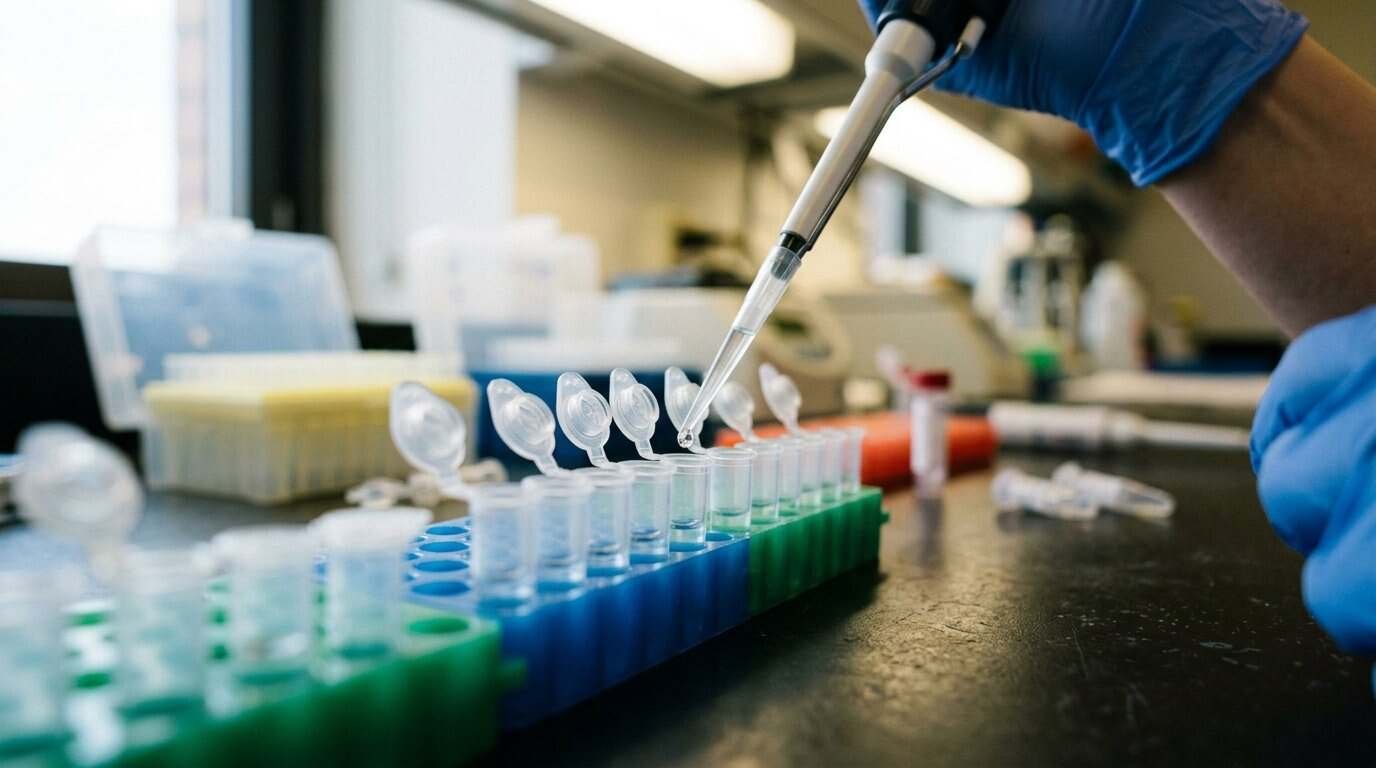
Cell-free protein synthesis borrows the machinery of translation from cells and runs it in a test tube. A review in Methods and Protocols describes the usual route: grow cells, break them open, clear the lysate into an extract, then add a DNA or mRNA template. The extract also needs an energy source, amino acids and cofactors. In a coupled reaction, transcription and translation happen in the same tube.
The idea is old. The review notes that researchers used cell-free systems about 60 years ago to help decipher the genetic code. What has changed is cost and convenience. The same review reports in-house E. coli extract at about two cents per microliter, against roughly 15 to 57 cents for commercial lysate kits and about a dollar for the PURE system, which uses purified components in place of an extract. Lyophilized extract keeps about 20 percent of its activity after 90 days, whereas liquid extract at room temperature loses all activity within a month.
Why researchers use it
A summary in BMC Biology, “Synthetic Biology Goes Cell-Free”, lays out the advantages. With no living cell, nothing self-replicates, which helps biosafety. DNA can be added directly, skipping cloning and transformation, so design-build-test cycles shorten. Freeze-dried reactions have stayed active for at least a year without refrigeration. Because there is no cell wall, researchers can add or tune components at will.
A Wikipedia entry on the technique puts a typical run at one to two days, against one to two weeks for expression in living cells, and notes that toxic proteins can be made since cell survival is irrelevant.
Applications reported in these sources include:
- Diagnostics. Freeze-dried reactions embedded in paper can be activated with water. In one example the review describes, a system detected Zika virus down to 2.8 femtomolar in plasma, after adding an amplification step.
- Small-batch manufacturing. Freeze-dried systems have been used to make more than 50 therapeutics and reagents on a small scale, and centralized production has reportedly reached 1,000 liters.
- Teaching. The Methods and Protocols review mentions BioBits classroom kits at about $100 per class set.
- Difficult proteins. Toxic proteins, virus-like particles and, with added membrane mimics, membrane proteins.
Limits to keep in mind
None of these tools is a universal solution. The BMC Biology review points out that early paper diagnostics lacked the sensitivity needed for patient samples, which is why amplification steps were added. E. coli extracts cannot natively form some disulfide bonds, and sugar modification is limited to what the source cells can do. Pathways beyond about eight enzymes and larger reaction volumes remain active challenges. The Methods and Protocols review adds that eukaryotic platforms often give lower yields than E. coli, that mRNA degrades quickly, and that commercial kits can be cost-prohibitive for heavy use.
Linear DNA templates add their own hurdle. Nucleases in the extract chew free DNA ends, so yields from linear templates are usually lower than from plasmids, according to the Wikipedia overview, and strategies such as adding a phage protein that blocks one exonuclease are used to help.
Choosing between cells and a cell-free tube
For a researcher deciding how to express a new protein, a few questions usually settle it:
- How many variants? Hundreds or thousands of designs favor cell-free, because skipping cloning and growth saves days per round.
- Is the protein toxic to cells? If so, cell-free avoids the problem, since nothing needs to survive.
- Does it need complex modifications? Heavy sugar decoration or several disulfide bonds can push you toward a eukaryotic system, or a modified extract.
- How much do you need? Milligrams for a screen are easy. Kilograms for a drug are another matter, though one source above reports reactions scaled to 100 liters in E. coli batches.
- What is the budget? In-house extract is cheap per microliter, but making it takes skill and time.
That list also explains why DNA synthesis and cell-free expression pair so naturally. If a team can order or assemble a gene in a few days and test its protein in a day, the loop from idea to result closes quickly. This is the same cycle that automated labs try to run without people in the middle, and it is why advances in writing DNA tend to matter first to protein designers and screening groups.
Myth versus fact
| Myth | Fact |
|---|---|
| You can order any DNA sequence at any length. | Chemical synthesis makes short strands; long genes are assembled and some sequences are hard. |
| Cell-free means no biology is involved. | It uses real cellular machinery extracted from cells. |
| Cell-free replaces cell-based production. | It is faster and more flexible for screening and small batches; large-scale production and complex modifications often favor cells. |
One gap to be clear about: newer methods, including enzyme-based DNA synthesis, aim to extend length and cut error and waste. I have not verified current performance claims for those, so this piece does not rely on them.
For readers who want to go further, the two reviews cited here are the best starting points, since they list the original papers behind each claim. Keep in mind that the figures for cost and yield come from 2019 publications and vary by lab, kit supplier and protein, so check current prices before planning a project around them.
Sources