Researchers have stored books, movies and all of Wikipedia in synthetic DNA. Here is how it works and why it is not in data centers yet.
DNA data storage is the idea of writing files into synthetic DNA instead of onto a disk or a tape, then reading them back by sequencing the molecules. It sounds like a stunt, and for years it partly was. But the underlying chemistry is sound, the lab results go back more than a decade, and a small industry now exists around it. The question is not whether it works. It does. The question is whether it can ever be cheap and quick enough to matter.
Can DNA really store computer data?
Yes, and researchers have shown it repeatedly. In 2012, a team led by George Church at Harvard stored a 53,400-word book, eleven JPEG images and a small JavaScript program in DNA, with redundant copies included. In 2016, Church and the company Technicolor stored and recovered a 22 MB movie with no errors. In June 2019, all 16 GB of English Wikipedia was encoded into synthetic DNA.
The idea is older than most people assume. In 1988, the artist Joe Davis worked with Harvard researchers to place a tiny five-by-seven-pixel image into the DNA of E. coli bacteria. In 2007, a University of Arizona group encoded data as mismatch sites in DNA and read it by cutting the molecules with restriction enzymes. A few years later, in 2011, Church, Kosuri and Gao encoded a 659-kilobit book and found 22 errors after decoding. Each step was small. Together they turned a curiosity into a method.
None of these were products. They were demonstrations that the pipeline of encode, synthesize, store, sequence and decode can be made to work end to end. That is established fact. What remains open is the economics.
How does a computer file become DNA?
Digital files are strings of ones and zeros. DNA is a string of four chemical letters: A, C, G and T. So the first job is translation. In the simplest picture, each pair of bits maps to one letter, so 00 might become A and 11 might become T.
Real schemes are fussier. One approach described in the research literature converts the binary data to base 3 first, then maps each digit to one of the nucleotides in a way that depends on the previous letter. The point of that trick is to avoid homopolymers, long runs of the same letter, which sequencing machines tend to misread. Other schemes add short index sequences so the strands can be put back in order, since the data ends up as millions of short fragments floating in a tube rather than one long thread.
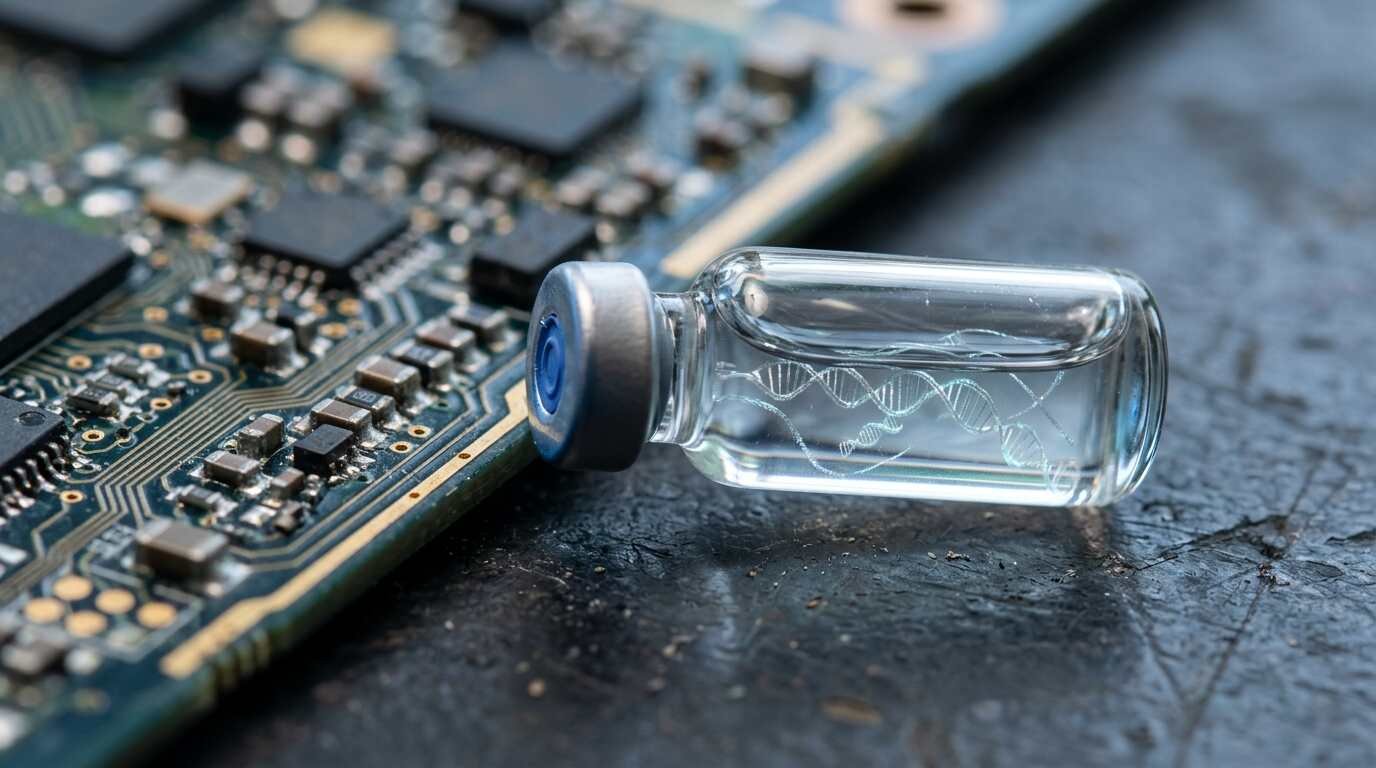
Then comes writing. A DNA synthesizer builds each fragment one letter at a time, typically a couple of hundred letters long. The finished strands are dried or encapsulated, and that tiny pellet is the archive.
How is the data read back?
Reading uses a DNA sequencer, the same family of machines used in genetics labs. It reads the fragments, software groups and orders them using the index sequences, and error-correcting codes repair mistakes. Because each fragment is usually present in many copies, a wrong letter in one copy can be outvoted by the others.
That redundancy matters because both synthesis and sequencing make errors. In an early 2011 experiment by Church and colleagues, decoding a 659-kilobit book produced 22 errors. Later work added stronger error correction. A 2013 study led by Nick Goldman at the European Bioinformatics Institute reported accuracy between 99.99 and 100 percent using overlapping fragments, indexing and a repeated layout. In 2017, Yaniv Erlich and Dina Zielinski published a method called DNA Fountain, borrowed from coding techniques used in streaming, that approached roughly 85 percent of the theoretical capacity limit of DNA storage.
How much can DNA hold?
A lot. Church’s 2012 paper put the density at about 5.5 petabits per cubic millimeter. DNA Fountain reported 215 petabytes per gram. These are laboratory figures for the molecules themselves and do not account for the packaging, the tubes, or the machinery around them, so a working storage system would not be anywhere near that compact. Still, even after generous discounts, the density is far beyond what hard drives or tape offer.
One popular line holds that a gram of DNA could hold one trillion gigabytes. That number appears in a 2016 article republished by the World Economic Forum and is of the same order as the research figures. Treat it as a theoretical ceiling, not a spec sheet.
How long does DNA data last?
DNA is stable when it is kept dry, cool and dark, and it has been recovered from ancient specimens. That is the basis for the claim that DNA archives could last thousands of years with very little upkeep, compared with decades for most tape and disk media.
Researchers have tried to make that more concrete. In 2015, a group at ETH Zurich added Reed-Solomon error correction and sealed the DNA inside tiny silica glass spheres, which improved its stability. Company claims go further: a French firm, Biomemory, has said it would guarantee data for 150 years and hoped to extend that to far longer. Those are company projections, not long-term measurements, and nobody has yet watched a DNA archive for centuries.
Why isn’t everyone using it yet?
Cost and speed. Writing DNA is expensive, and it is slow compared with a disk. Goldman’s 2013 team estimated about $12,400 per megabyte to encode and $220 per megabyte to retrieve, and projected that DNA would become cost-effective for long-term storage by around 2023, if synthesis and sequencing prices kept falling. The DNA Fountain team reported roughly $7,000 to synthesize 2 MB of data and $2,000 to read it.
That 2023 target was not met in any obvious way. In a December 2023 interview, Biomemory’s chief executive described the company’s first consumer product, a card holding one kilobyte, as a proof of concept priced at about $1,000 per kilobyte. The article itself noted that this is about one trillion times more expensive per byte than a conventional hard drive. The company called it an early-adopter premium.
Speed is the other obstacle. In 2021, the company Catalog reported a custom DNA writer capable of about one megabit per second. That is real progress, and it is still far from the throughput of a data center.
What about searching and editing the data?
Ordinary storage lets you jump to a file. In a tube of mixed DNA, that is harder. In 2018, researchers at the University of Washington and Microsoft stored about 200 MB and showed random access, meaning they could pull out one file without reading everything. In March 2019, they described a fully automated system that could encode and decode data without a person moving samples by hand.
Other groups have pushed into odder territory. In 2019, a team from Eurecom and Imperial College stored relational data in DNA and ran SQL-like operations on it chemically. In 2020, researchers used enzymes to nick native DNA sequences to enable bit-level access. These are research results. They show the ideas are workable, not that anyone can buy a DNA database.
Is storage the only thing DNA could be used for in computing?
Not quite. Some work treats DNA as more than a passive archive. In 2021, a group at Newcastle University led by N. Krasnogor implemented a last-in, first-out stack, a basic computing structure, in DNA. Another line of research uses living cells as recorders. A 2018 estimate by Kalhor and colleagues suggested a mouse could in principle record about 2 terabytes of developmental information in its own DNA, though only selected parts could be read back. In 2023, a proof-of-concept system in E. coli used light-sensitive enzymes to write light signals directly into the cells’ DNA.
These ideas are far from the archive use case. They show that the field is not only about copying files, but about treating DNA as a medium that can be written, searched and sometimes even computed on.
Who would actually use it?
The most plausible customers are archives with a lot of data that rarely changes: film studios, national libraries, scientific projects, regulators. The pattern the field talks about is cold storage, data you must keep but seldom read. For that, slow access is tolerable and long life is valuable.
An industry body, the DNA Data Storage Alliance, operates under the storage standards group SNIA. Its spring 2026 newsletter reported work on a draft extension of the Swordfish storage management standard to cover DNA systems, along with a conference on DNA storage and computing in Rome in May 2026. The same newsletter listed no new commercial products or cost figures. Standards work suggests the field is organizing itself. It does not show that a product is shipping at scale.
Some stranger uses have appeared as well. In January 2015, Nick Goldman of the European Bioinformatics Institute announced the Davos Bitcoin Challenge: the private key to a bitcoin was encoded in DNA, and whoever decoded it could keep the coin. Sander Wuyts won, with the result announced in January 2018, three years later. In 2019, a lander carrying DNA-encoded books and images, part of the Arch Mission Foundation’s lunar library, crashed on the Moon. Researchers have also embedded a 3D printed bunny’s blueprint in the plastic of the bunny itself. They are curiosities, but they illustrate how small and durable the medium can be.
Common questions
Is DNA data storage the same as the DNA in my body?
No. The DNA used for storage is synthesized in a lab as short fragments carrying encoded files. It does not come from a person, and it is not a gene. Nothing about it is alive.
Can DNA storage be hacked or read by anyone?
Anyone with a sequencer can read DNA, so the data would need encryption just like data on any other medium. Some researchers have argued that DNA’s structure could provide extra security, but those claims are early and come with few published details.
Is DNA storage faster than a hard drive?
No. Both writing and reading are much slower. Its advantages, if they pan out, would be density and longevity for archives, not speed.
Has anyone stored a movie or an album in DNA?
Yes. A 22 MB movie was stored and recovered without errors in 2016, and in April 2019 an album, Massive Attack’s Mezzanine, was reportedly encoded into synthetic DNA.
Will DNA storage replace data centers?
Unlikely any time soon, and probably never for everyday files. The more realistic role is a deep archive tier for data that must be kept for a long time and rarely retrieved.
What to remember
DNA data storage works in the lab. Files go in as chemical letters and come out again, with error correction cleaning up the mistakes. The density and expected lifespan are impressive on paper.
Cost and speed are what hold it back. Writing is slow and still very expensive, and the early commercial product described in 2023 was priced far above conventional storage. Claims about future prices and 150-year guarantees are company projections, not results. The sensible reading: a real technology for archives, with a long road to everyday use.
Further reading
Written by the Harvard geneticist behind the 2012 DNA storage experiment; covers synthetic biology broadly. See it on Amazon (affiliate link)
As an Amazon Associate I earn from qualifying purchases. A commission may be earned if you buy through this link, at no extra cost to you.
Sources
- DNA digital data storage (Wikipedia)
- The next generation in data storage: your DNA (World Economic Forum, 2016)
- Biomemory CEO interview (TechRadar Pro, December 2023)
- Arizona State University DNA nanotechnology storage report (GeneOnline, February 2026)
- DNA Data Storage Alliance newsletter, Spring 2026 (SNIA)