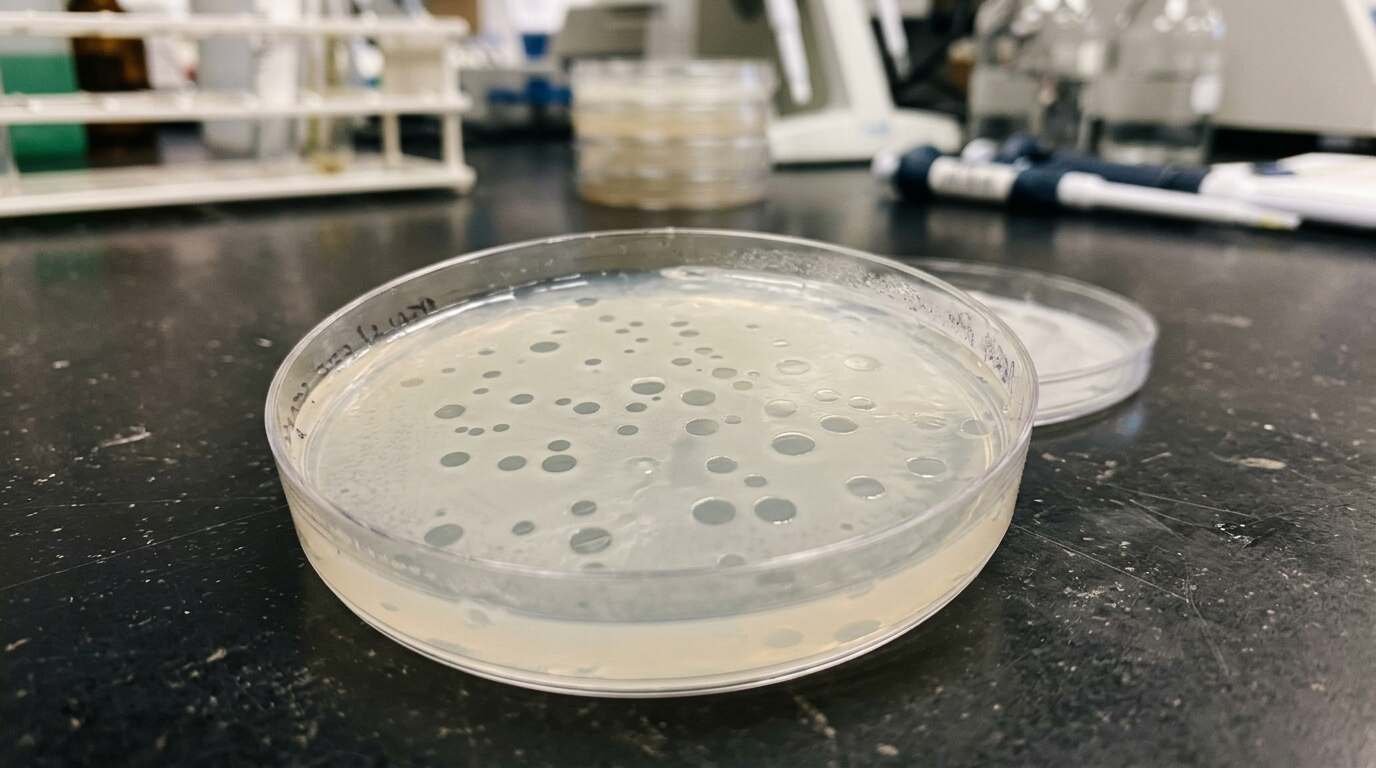
A Science paper reports that a phage's own protease cuts a bacterial sensor and starts CBASS immunity. What was found, what is missing, and why it matters.
Bacteria have immune systems, and one of the most blunt is CBASS. When it fires, the infected cell kills itself before a virus can finish copying and spread to its neighbors. The hard part is the trigger: a system that deadly cannot afford false alarms. A paper in Science, by Samuel Hobbs of University of Utah Health and Philip Kranzusch, reports that the trigger for CBASS immunity can be a protease made by the phage itself, which cuts a sensor protein inside the host and flips the switch.
The paper, titled ‘Phage proteases activate CBASS antiphage immunity’, was released on October 1, 2026 under embargo and is peer reviewed. It is also the thinnest of my sources: the paper was not accessible to me, and the press material omits the methods, the phages and bacteria used, the name of the protein that is cut and every number. This post therefore does two things. It reports what is confirmed, and it explains the biology around it, labeled as background, so that the announcement makes sense.
If you want a study with a table of results to dissect, this is not that post. If you want to know what the claim is, how it fits with earlier work and what to look for when the full paper is read, keep going.
What CBASS is
CBASS stands for cyclic oligonucleotide-based antiphage signaling system. Per the Utah release as relayed by GEN and News-Medical, it is a last-resort defense that kills the infected bacterium before the virus can spread. The sensor at its core is a CD-NTase, short for cGAS/DncV-like nucleotidyltransferase. The name flags the connection to cGAS, the human enzyme that senses stray DNA in the cytoplasm and builds a cyclic signal molecule. The release says CBASS is related to that human pathway, which would imply a lineage conserved since bacteria and humans shared an ancestor. That is the researchers’ interpretation.
In general terms, which is background from the field and not a result of this paper, an activated CD-NTase makes a cyclic nucleotide messenger. The messenger switches on an effector protein, and the effector wrecks the cell by cutting DNA, breaking membranes or draining a metabolite. The cell dies, the phage’s replication fails, and neighboring cells survive. For a population, it is a trade of one cell for the colony.
Hobbs describes CBASS as one of the most common forms of bacterial immunity, though the release gives no data for that statement. The March preprint summary discussed below adds that bacteria encode thousands of diverse CBASS operons, which the authors cite as evidence of the system’s importance.
The question: what does a CD-NTase actually sense?
An alarm that kills the cell needs a reliable signal of infection. Several related antiviral systems look for viral genetic material. The release says the new trigger works differently: the system detects a protein-cutting event, not a nucleic acid.

Here is the reported mechanism. A phage protease, which the virus needs to complete its life cycle, acts directly on a host protein. The cleavage is the signal that starts the pathway. Hobbs calls this a totally new mechanism. The release says the sensed activity is one the virus needs in order to survive, which is the clever part of the design. A phage can mutate away from a DNA motif that the host recognizes, but a protease that its own capsid assembly depends on is harder to discard.
The specific protease and the specific cut are not named in any of the press accounts I retrieved. The GEN account does use the term ‘prohead protease’, and that term connects to earlier work.
What the earlier work suggests
A prohead protease is an enzyme phages use when assembling a capsid: it trims the internal scaffold proteins of the immature head, called the prohead, so the head can mature and be packed with DNA. Because the cut happens late in infection, it makes a plausible timing signal for a cell that wants to abort at the last responsible moment. That reasoning is mine, an inference from how such proteases work in phage biology, and the press material does not state it.
There is a prior paper in the same line of work. The Kranzusch lab lists a 2024 article in Cell Host and Microbe from Richmond-Buccola and colleagues titled ‘A large-scale type I CBASS antiphage screen identifies the phage prohead protease as a key determinant of immune activation and evasion’. The title alone tells you the earlier screen pointed at the prohead protease, so the 2026 Science paper reads as the mechanistic follow-up. I could not open the 2024 abstract, so I cannot report its numbers.
There is also a bioRxiv preprint dated March 2026 with a near-identical title, ‘Phage protease enzymes activate CBASS antiphage immunity’, summarized on a Scoop.it page. I cannot confirm it is an earlier version of the Science paper. If it is, the summary describes a CD-NTase with surface-exposed activation loops, where a prohead protease cut switches the enzyme on, mapped in three clades of CD-NTase, with phage T4 used to reconstruct recognition in a test tube, and a finding that protease activity alone is sufficient to activate CBASS in living cells. Treat that as a lead, not as the published paper’s content.
How a claim like this is normally tested
The following describes the logic of this kind of experiment in general. It is not a description of what the authors did, which I could not read.
To show that a cut activates a sensor, the usual steps start with a purified sensor and a purified protease in a test tube: does cleavage produce the signaling molecule? Next, you change the cut site and see whether activation disappears, and you inactivate the protease and check that it does too. Then you move to living bacteria and ask whether expressing the protease by itself, without any phage, is enough to kill cells carrying a working CBASS system. Finally you run real infections, and ask whether phages with the protease change or removed escape the defense.
The preprint summary mentions several of these elements, including an in-vivo sufficiency test and a reconstruction with T4, which is why it is a credible lead. The numbers that would make the claim quantitative, such as how much cleavage is needed and how fast cells die, were not in anything I could retrieve.
Why the finding matters beyond bacteria
The practical hook is phage therapy, where viruses that infect bacteria are used against drug-resistant infections. If bacterial CBASS immunity triggers on a protease that phages need, then therapeutic phages that carry a modified protease might slip past it, or phage cocktails could be chosen to avoid triggers. The release frames this as a way to design phages that evade bacterial immunity. That is a hope. No therapeutic testing is reported.
The evolutionary angle is quieter and probably more durable. If a bacterial pathway related to human innate immunity works by sensing a virus’s essential enzyme, it adds to a picture in which immune systems across life are built from shared parts used in different configurations. The release makes the statement that the human relative implies deep conservation. It offers no direct human data, and the CBASS-to-human link is an inference from relatedness.
What the study cannot show
From what I could retrieve, there are four gaps. First, I cannot tell you which phages and which bacteria were used, so I cannot say how general the finding is. The release shows an illustration of a phage infecting E. coli, but credits it as a general picture and does not tie it to the experiments.
Second, CBASS comes in many varieties, and a trigger found in some CD-NTase types may not hold for others. The preprint summary mentions three clades, which is a subset of the diversity the field describes.
Third, a sensor that responds to a protease also invites a phage counter-move. Viruses commonly evolve ways to block bacterial defenses, and the 2024 title mentions evasion directly. How fast phages could change their protease to avoid detection is an open question.
Fourth, therapy. The distance between a mechanism in cultured bacteria and a safer phage treatment in patients is large, and nothing in the retrieved material measures it.
Frequently asked questions
What is CBASS?
CBASS is a bacterial antiphage defense that uses cyclic nucleotide signals. When activated it kills the infected cell so the virus cannot spread, and it is related to a human immune pathway.
What does the new paper claim?
That a protease made by the phage cuts a host sensor protein, and that this cleavage starts the CBASS pathway. It is described as different from systems triggered by viral genetic material.
Is the paper peer reviewed?
Yes, it is in Science, with embargo lifted October 1, 2026. I could not read the paper itself, only press releases and trade coverage.
Does this lead to a new antibiotic?
Not directly. The authors suggest it could help design phage therapies that evade bacterial immunity, but no therapeutic testing is reported.
The claim is simple enough to state in a sentence: a bacterium watches for the one enzyme its attacker cannot do without, and kills itself when it sees it cut. What is missing from the public material is everything that would let a skeptic grade it, from the name of the protein to the first number. The sensible approach is to wait for the full text, check which CD-NTase types were tested, and see whether phage mutants that dodge the cut still replicate normally. If they do, the trigger is weaker than it looks. If they pay a price, it is the kind of defense that is hard to evolve around, and the therapy argument gets real support.
Sources
- News-Medical: Phage proteases activate bacterial immune response to viral infection
- Newswise: Research uncovers how bacteria fight viruses (University of Utah Health release)
- GEN: Phage proteases trigger a conserved bacterial antiviral defense pathway
- ScienceDaily: Bacteria turn a virus’ own weapon against it
- Scoop.it: Phage protease enzymes activate CBASS antiphage immunity (bioRxiv summary)
- Kranzusch Lab publications page (2024 Cell Host and Microbe CBASS screen title)