







ESA and CAS's Smile spacecraft just released its first ultraviolet aurora footage. Here is how its four instruments, lobster-eye X-ray optics, and 121,000 km orbit are built to map Earth's magnetic shield.
For one hour on 24 July 2026, a camera high above the north pole watched an entire auroral oval at once. A ripple traveled around the glowing ring. A few distant stars slid across the frame like dust on a lens.
ESA released the clip on 30 September, and NASA’s Astronomy Picture of the Day carried it to a far larger audience on 6 October. The footage came from the ultraviolet imager aboard Smile, a joint mission of the European Space Agency (ESA) and the Chinese Academy of Sciences (CAS). It is only the opening act. The spacecraft also carries a soft X-ray camera built on optics inspired by lobster eyes, and nothing like it has ever been pointed at Earth’s magnetosphere.
This article breaks the mission into its working parts: what the video shows, how each of the four instruments earns its place, what the X-ray physics actually is, and what the orbit buys the science team.
What the footage shows
The video covers roughly 59 minutes, from 00:00 to just under one hour UT on 24 July, captured while Smile was still in its in-space commissioning phase. In ultraviolet light the aurora appears as a complete ring around the pole. According to ESA, a ripple in that ring points to a substorm, a brief disturbance in Earth’s magnetosphere.
Substorms follow a recognizable sequence. The solar wind, a stream of charged particles from the Sun, squeezes Earth’s magnetic field lines on the night side until they pinch together. Energetic particles then rush toward the poles and light up the upper atmosphere. ESA says about 300 substorms are expected during Smile’s three years of operation, and that they are more frequent right now because the Sun sits near the peak of its 11-year cycle.
The dots drifting on the left side of the frame are stars. They are not moving; the camera view shifts as the spacecraft orbits, a point NASA’s APOD editors make explicitly.
Why a spacecraft sees what the ground cannot
Someone standing under the northern lights sees a slice of the oval, never the whole thing. APOD notes that a complete oval is visible to spacecraft but not to ground observers, and that this footage was captured during daytime.
Ultraviolet adds a second advantage. Much of the ultraviolet light emitted by the aurora is absorbed before it reaches the ground, which is a general reason this kind of imaging is done from space.
ESA states that Smile is the first spacecraft since 2008 to image the full oval this way, and the first to hold the view for 45 hours at a time, a record. That continuity matters more than any single frame. A substorm unfolds over tens of minutes, and a camera that has to look away misses the beginning or the end.
The four instruments at a glance
Smile stands for Solar wind Magnetosphere Ionosphere Link Explorer, and the name describes the plan: connect what the solar wind is doing to what the magnetosphere and the aurora do in response. Each instrument covers one link in that chain.
| Instrument | What it does | Why it matters |
|---|---|---|
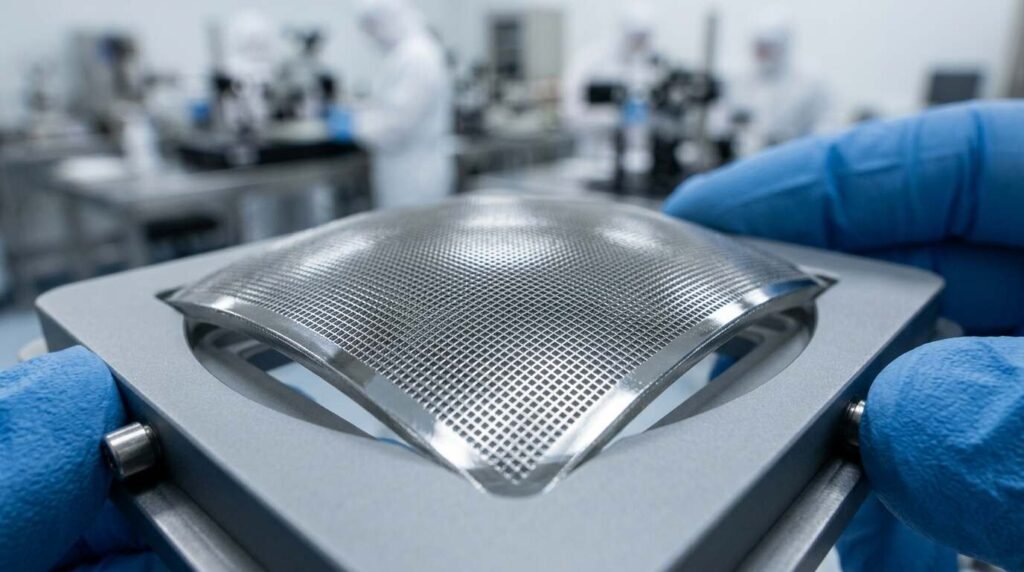
| Soft X-ray Imager (SXI) | Images the magnetosphere in soft X-rays | The first X-ray view of Earth’s magnetic environment; the largest of the four instruments |
| Ultraviolet Imager (UVI) | Tracks geomagnetic storms in the aurora | Shows how the ionosphere responds, for up to 45 hours continuously |
| Light Ion Analyser (LIA) | Counts solar wind ions passing the spacecraft | Records the solar wind conditions behind each SXI image |
| Magnetometer (MAG) | Measures the local magnetic field | Reveals whether Smile is inside or outside the magnetosphere at that moment |
The pairing is deliberate. An image of the magnetosphere is hard to interpret without knowing what the solar wind was doing when it was taken, and LIA and MAG supply that context.
The lobster-eye optics
Focusing X-rays is awkward. They pass through ordinary lenses and skim off mirrors only at shallow angles. SXI solves the problem with micro pore optics, a design inspired by the structure of lobster eyes. According to ESA, square tubes channel the X-ray light onto two detectors, and the approach is lightweight, well established, and cost-effective.
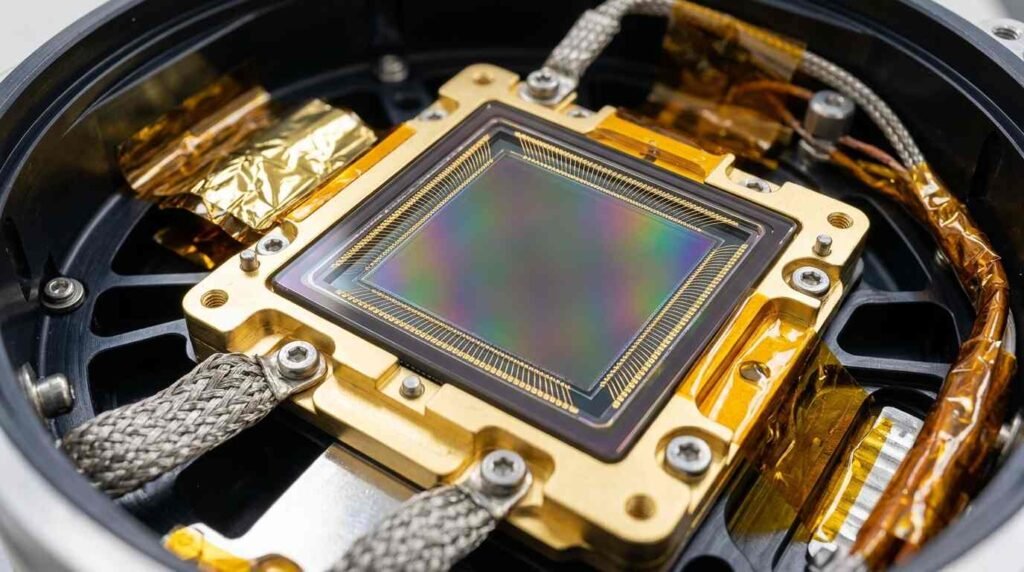
The detectors are charge-coupled devices (CCDs), thin silicon wafers sensitive to light. Each one measures 8.1 by 8.1 centimeters, which ESA describes as the largest CCDs ever flown from Earth, and that size supports a wide field of view and high resolution. They are cooled to minus 120 degrees Celsius for maximum sensitivity. Shutters protect them whenever Smile passes through the Van Allen radiation belts.
The University of Leicester developed and built SXI for ESA, working with the Mullard Space Science Laboratory and the Open University, all UK-based, plus several other European institutions. ESA says every system in the instrument uses European parts.
ESA also published a first test X-ray image from SXI in September 2026, showing the supernova remnant Cassiopeia A, according to the title of that release. The page was not available to this author, so the details of the exposure are left out here.
Where the X-rays come from
The signal SXI hunts is produced by a process called solar wind charge exchange. When a highly charged ion from the solar wind meets a neutral atom, it can capture an electron. The ion ends up in an excited state, and as it settles down it emits an X-ray photon, a low-energy “soft” one.
Astronomers first recognized the effect in 1996, when the ROSAT satellite observed Comet Hyakutake. Later images from ROSAT and XMM-Newton showed similar emission near Earth, which suggested the same process operates in the upper atmosphere. Astronomy magazine describes Smile as the first spacecraft to use this emission to image the magnetosphere, so the boundary between the solar wind and Earth’s magnetic field will be mapped by a glow that has, until now, mostly shown up as unwanted background.
From its high perch above the North Pole, SXI is designed to observe X-ray emission from the Sun-facing magnetopause and from the polar holes in Earth’s magnetic field, tracking where and when the emission happens.
The orbit is part of the instrument
Smile launched in mid-May 2026 on a Vega-C from Europe’s Spaceport in Kourou, French Guiana, after the original 9 April date slipped because of a technical issue with the rocket. Reports put its first orbit at about 707 kilometers. Mission planners had described roughly 11 engine burns over 25 days to raise that orbit.
The science orbit is a highly elliptical one. The apogee is about 121,000 kilometers over the North Pole, and the perigee is about 5,000 kilometers over the South Pole, where Smile downlinks its data to ground stations.
None of the sources consulted states the orbital period. My own arithmetic, using standard two-body orbital mechanics and those two altitudes, gives about 50 hours. Treat that as an estimate rather than an official figure. If it holds, it explains the headline number neatly: a roughly 50-hour lap leaves room for a 45-hour uninterrupted view of the northern aurora.
How to read the video like an analyst
Raw footage rewards a methodical look. Four cues carry most of the information.
- The ring itself. A steady, thin oval means a quiet magnetosphere. Brightening and thickening on the night side is the visual signature of energy being dumped into the atmosphere.
- The ripple. ESA ties the disturbance in this clip to a substorm. Following where it starts and which direction it travels around the oval is how researchers connect an image to a physical sequence of events.
- The clock. The on-screen timestamp runs from 00:00:00 to roughly 00:59:08, so every change can be pinned to a minute. Substorm timing is half the science.
- The stars. They look like they swim across the frame, but APOD’s editors explain that the camera view shifts as the spacecraft orbits Earth. Stars make a handy check that the motion is the camera, not the sky.
One caution applies to anyone reusing this footage in their own work. The clip is a single hour from a commissioning period, so it illustrates what the instrument can do and does not establish how often, or how strongly, substorms behave across a whole solar cycle.
Why the timing in the solar cycle matters
ESA notes that substorms are currently more common because the Sun is at the most active point of its 11-year cycle. For a three-year mission that is a gift. A quiet Sun would give the team fewer events to study, and a spacecraft built to catch them benefits from launching into a busy stretch.
The same busy Sun is what makes the practical goal urgent. Strong solar storms can disturb spacecraft and ground electrical systems, and the mission’s stated aim is to understand the physical link between the solar wind and the magnetosphere well enough to help protect astronauts, satellites, and power grids.
A short glossary
- Magnetosphere: the region around Earth dominated by its magnetic field, which acts as a shield against the solar wind.
- Magnetopause: the boundary where the solar wind and Earth’s magnetic field push against each other.
- Ionosphere: the electrically charged upper layer of the atmosphere where auroras glow.
- Solar wind: the stream of charged particles flowing outward from the Sun.
- Substorm: a brief disturbance in the magnetosphere that brightens the auroras.
- CCD: a charge-coupled device, a silicon chip that turns light into an electronic image.
- Apogee and perigee: the farthest and nearest points of an elliptical orbit.
What to watch next
Plenty is still unknown. The full-oval UVI footage is a commissioning result, and science operations are the real test. The X-ray side is earlier in its story: ESA’s published SXI image so far is a test image, and a first picture of the magnetosphere itself would be the milestone to wait for.
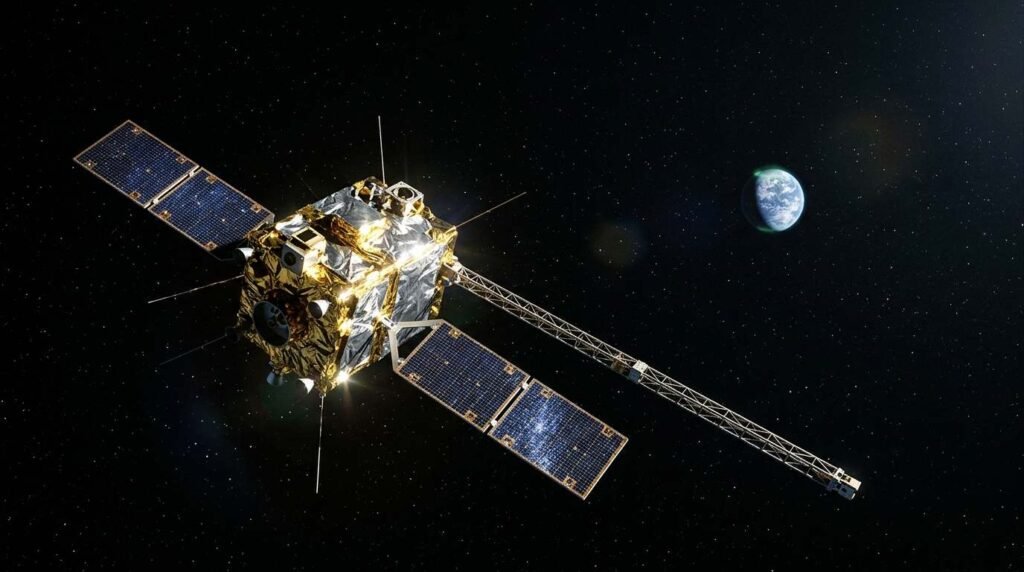
The stated purpose is practical. NASA’s APOD text says one goal of Smile is to better understand how the Sun’s wind interacts with the magnetosphere, aimed at protecting astronauts, spacecraft, and ground electrical grids from solar storms.
Frequently asked questions
When did Smile launch?
It launched in mid-May 2026 on a Vega-C from Kourou, French Guiana. The original 9 April date slipped after engineers found a technical issue with the rocket.
How long will Smile operate?
The mission is planned for three years.
What is a substorm?
A substorm is a brief disturbance in Earth’s magnetosphere in which solar wind pressure pinches magnetic field lines and sends energetic particles toward the poles, brightening the auroras. ESA expects about 300 of them during the mission.
Can I use the footage?
ESA lists the clip under a CC BY-SA 3.0 IGO license or the ESA Standard License, with the credit “ESA & CAS/Smile/UVI.” Check the release page for the exact terms before reusing it.
Where can I watch ESA’s introduction to the mission?
ESA’s video “Introducing the Smile mission” is the first episode of its “Let’s Smile” series, and it is hosted on ESA’s video site.
Sources
- ESA: Smile’s first ultraviolet footage shows auroral substorm
- NASA APOD, 6 October 2026: A Complete Auroral Oval from SMILE
- ESA: Smile’s X-ray vision
- Astronomy: SMILE to give Earth’s magnetosphere its first X-ray
- Starlust: Smile launch timeline and mission goals
- Cislunar Space: Vega C launches Smile



