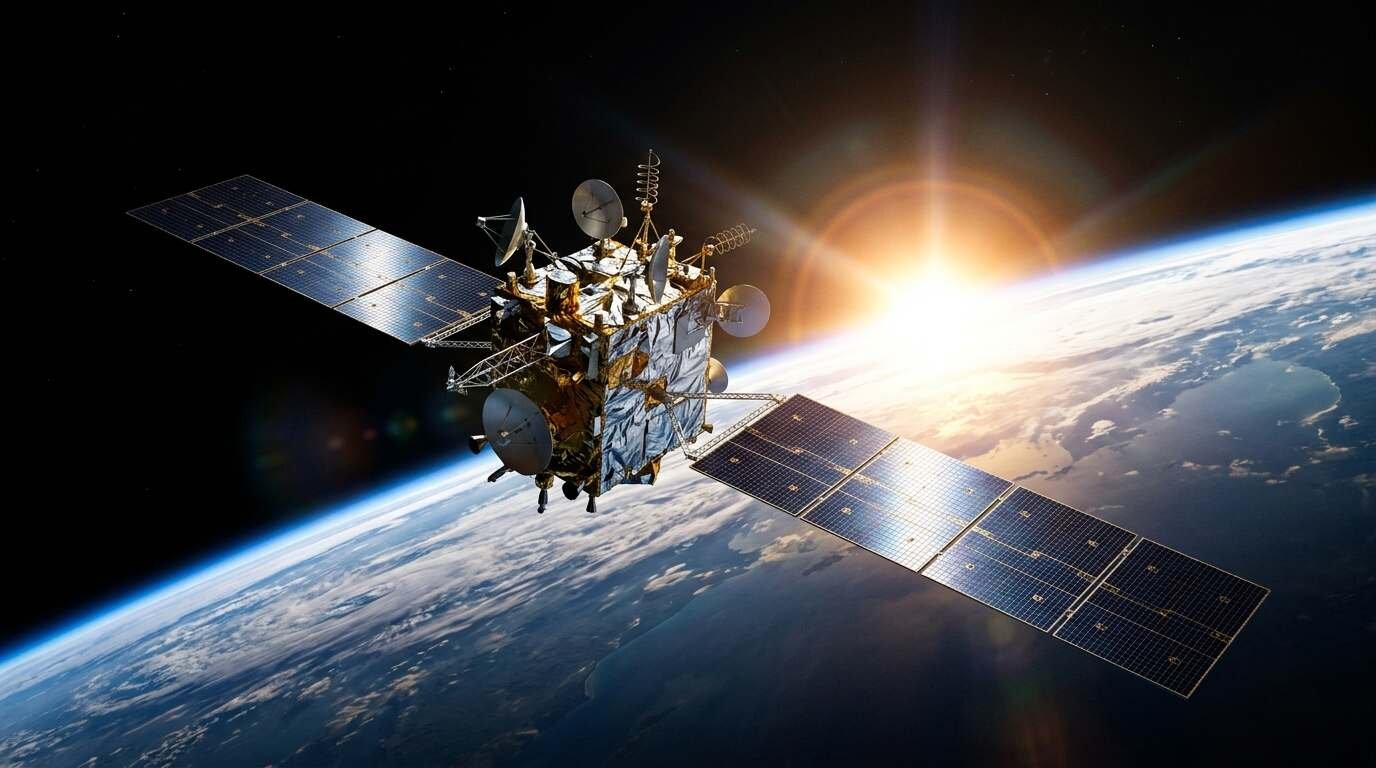
The FCC approved 15,000 direct-to-cell satellites for SpaceX on Oct 6. The orbit physics, spectrum, deadlines and what remains unproven.
On October 6, 2026 the FCC granted SpaceX most of what it asked for in its application for a new fleet of direct-to-cell satellites: up to 15,000 spacecraft, flying in nine shells between 326 and 335 kilometers above the Earth. The order, numbered DA 26-1078, is a partial grant. Some spectrum requests were set aside for later, and the most valuable frequencies cannot be used until a separate corporate deal closes in late 2027.
A big headline number wrapped in conditions is typical of spectrum rulings, and it makes the story easy to misread. This post separates what the order authorizes from what SpaceX says it intends to build, works through the radio arithmetic that explains why anyone would fly this low, and lists the claims that nobody has demonstrated yet.
What the order actually authorizes
SpaceX filed for the constellation in September 2025, shortly after announcing its purchase of spectrum from EchoStar. The FCC took about a year. According to Satellite Today, the grant covers supplemental coverage from space (SCS) and mobile satellite service (MSS) inside the United States, MSS and direct-to-cell service outside it, and fixed satellite service links for backhaul and for telemetry, tracking and command.
The system, which SpaceX calls Starlink Mobile, is separate from the Starlink broadband constellation. It is also separate from the roughly 650 satellites that currently provide SpaceX’s direct-to-cell service in the United States through T-Mobile.
The license term is 15 years, starting at 3 a.m. Eastern on the day the first new satellite reaches its authorized orbit, per Light Reading. Two milestones apply. Half of the maximum satellite count must be launched and in orbit by October 7, 2032, and the full authorized fleet must be operating by October 7, 2035. SpaceX must also file semi-annual reports, due January 1 and July 1, covering satellites that were removed or have reentered.
The spectrum, and the date attached to it
The frequencies are where the conditions bite. SpaceX’s authority over the spectrum it is buying from EchoStar depends on the second step of that transaction, in which licenses held in a trust transfer to SpaceX. Satellite Today puts that on or about November 30, 2027. Until then SpaceX may deploy satellites and test payloads on those bands only with EchoStar’s permission.
One report, from Tesla North, lists the cleared bands as 1695-1710 MHz, 2000-2020 MHz, 2180-2200 MHz, 1915-1920 MHz and 1995-2000 MHz. I could not confirm that list against the order text itself, so treat the exact edges as provisional. Adding those five ranges gives 65 MHz of spectrum in total. That sum is my own arithmetic, and it says nothing about how the 65 MHz splits between uplink and downlink.
Meanwhile the satellites may keep using T-Mobile’s PCS G-block, which is 1910-1915 MHz and 1990-1995 MHz. That is the arrangement behind today’s T-Satellite service. Two things were deferred: MSS operations in the 2020-2025 MHz band in the United States, and the 20.2-21.2 GHz and 30.0-31.0 GHz bands, which the FCC held back because of heavy federal use.
Why fly at 326 kilometers
A phone is a poor radio terminal. Its antenna is small, its transmit power is capped, and it has no steerable dish. Every decibel of path loss between handset and satellite has to be paid for somewhere else, usually in a bigger, more expensive satellite antenna.

Free-space path loss grows with the square of distance, so the cheapest decibels come from getting closer. Using the standard formula, loss in dB equals 20 log10(distance in km) plus 20 log10(frequency in MHz) plus 32.44. At 2,000 MHz and 326 km, straight overhead, that comes to about 148.7 dB. A satellite at 550 km, a typical altitude for broadband constellations, would face about 153.3 dB at the same frequency. The lower shell buys roughly 4.5 dB, which is a factor of 2.85 in received power, before counting any other design change.
Those figures are calculations of mine, not numbers from the filing, and they describe the best case of a satellite directly overhead. At a slant angle the distance is longer and the loss grows. They still show the logic: the order’s altitude range is a link-budget decision as much as an orbital one.
What a 326 km orbit costs
Low is not free. At 326 km, circular-orbit speed works out to about 7.7 km/s (again my calculation, from standard gravitational constants), and one lap takes roughly 91 minutes. A handset sees any given satellite for only a few minutes per pass, so service depends on handing the connection from one spacecraft to the next constantly.
The same speed produces Doppler shift. At 2 GHz the maximum shift from a 7.7 km/s closing speed is about 51 kHz, and geometry reduces that for a real pass. Cellular modems are built for much slower relative motion, so the satellite has to pre-compensate the signal. This is a solved problem in principle, but it is part of why direct-to-cell is harder than putting a base station on a tower.
Atmospheric drag is the other bill. At such low altitude, residual air is dense enough that satellites need continuous propulsion to stay up and reenter quickly when they fail. The sources I retrieved do not discuss lifetime or the replacement launch rate, so I cannot say how many satellites SpaceX would have to build per year to hold 15,000 in place. That omission matters for the cost story.
From 4 Mbps to 150 Mbps: the arithmetic
Current service on the roughly 650 satellites is described by Light Reading as about 4 Mbit/s. SpaceX targets user speeds of up to 150 Mbit/s with the next generation, a company claim. The ratio is 37.5 times. SpaceX president Gwynne Shotwell has said the EchoStar spectrum could make the service “100 times better than what we’ve got right now,” per Satellite Today, but she did not say which metric that refers to, and 100 does not match 37.5.
A quick Shannon-limit check shows why the 150 figure is demanding. If a single user were served on one 20 MHz channel, 150 Mbit/s would need 7.5 bits per second per hertz. Even with ideal coding that requires a signal-to-noise ratio of about 180, or 22.6 dB, on the link. Real systems get more from wider channels, multiple antennas and carrier aggregation, so this does not prove the target is unreachable. It shows the target cannot come from a small phone antenna and a thin slice of spectrum alone.
Tesla North reports that SpaceX’s plan also involves smaller ground femtocells alongside the satellites, and that T-Mobile’s CFO has dismissed that approach. I did not find the CFO’s remark in a primary source, so that detail is secondhand.
- Fleet size: 15,000 satellites across 9 shells, an average of about 1,667 per shell if split evenly (the filings I read do not say they are).
- Earth’s surface is about 510 million square kilometers, so 15,000 satellites is one per roughly 34,000 square kilometers on average.
- Speed claim: 4 Mbit/s today versus up to 150 Mbit/s targeted, a 37.5x gap.
Who else is racing, and who objected
Eutelsat, Viasat, DirecTV and SES objected to the application, according to Light Reading. The FCC granted it anyway. The agency’s chairman, Brendan Carr, has described the existing rules as needing “a major refresh,” and the agenda for the FCC’s October 29 open meeting includes a notice of proposed rulemaking to make an additional 482 MHz available for SCS and an auction of 25 MHz in the 1675-1695 MHz and 2020-2025 MHz bands, per Fierce Network.
Competitors are also moving. AST SpaceMobile and Elveo Mobile, formed by the merger of Lynk and Omnispace, are in the field. Light Reading reports that Amazon Leo has applied for a system of more than 5,000 satellites in five shells and has proposed acquiring Globalstar. AT&T, T-Mobile and Verizon have launched a joint venture, led by interim chief executive Paul Roth, that aims to pool spectrum and offer a technology-neutral satellite platform. EchoStar’s Boost Mobile will use SpaceX’s next-generation platform.
The business case is less settled than the physics
Carriers are not obviously cheering. Light Reading reports that T-Mobile’s chief executive, Srini Gopalan, said direct-to-device traffic is about 0.0002 percent of the operator’s total network usage, and that T-Mobile appears to have removed Starlink references from its T-Satellite site. The Big Three have said they do not plan to sign MVNO deals with SpaceX. Analyst Craig Moffett is quoted predicting that SpaceX will “negotiate, cajole, and, if necessary, coerce” to land one.
So the sequence is uncertain. The constellation can be built under this order, but a satellite fleet that sells to consumers still needs a retail channel, and the three obvious ones are building a competitor.
What remains unproven
No second-generation Starlink Mobile satellite has flown in anything I read. Satellite Today reports that SpaceX intends to start launching them in 2027 and have service by the end of that year, which is a statement to investors, not a delivered capability. The 150 Mbit/s figure is a target. The lower altitude is a design choice whose reliability record will only exist after years in orbit.
The spectrum timeline depends on a transaction that has not closed. And the 2032 and 2035 milestones allow nine years, a schedule that tells you the regulator expects the build to be slow.
Frequently asked questions
How many satellites did the FCC approve for Starlink Mobile?
Up to 15,000 non-geostationary satellites in nine orbital shells between 326 and 335 km, under order DA 26-1078 adopted on October 6, 2026. Some spectrum requests were deferred.
Can SpaceX use the EchoStar spectrum right now?
Not freely. Reports say the authority depends on the second step of the EchoStar deal, expected on or about November 30, 2027. Before then SpaceX may deploy and test only with EchoStar’s permission.
Will my current phone work with the new satellites?
The sources I read do not say. Today’s service runs through T-Mobile’s T-Satellite on about 650 satellites at roughly 4 Mbit/s. Which handsets and bands the next generation will support was not stated in the material I retrieved.
When will the 150 Mbit/s service launch?
No date is confirmed. Satellite Today reports a plan to begin flying second-generation satellites in 2027 with service by the end of 2027, and the 150 Mbit/s figure is a company target.
The approval settles a regulatory question and leaves the engineering and commercial ones open. Fifteen thousand satellites at 330 kilometers is a bet that proximity can substitute for antenna size, and the path-loss arithmetic says the bet is sound in principle. Whether it pays depends on launch cost, satellite lifetime in thin-but-draggy air, the November 2027 spectrum handover, and whether a carrier agrees to sell the result. Watch the October 29 FCC meeting, where the rules for pairing satellites with terrestrial spectrum are on the table, and watch for the first second-generation launch. Until then, 150 Mbit/s remains a slide, not a measurement.
Sources
- Satellite Today: FCC grants SpaceX approval for 15,000 direct-to-device satellites in MSS spectrum
- Light Reading: FCC OKs SpaceX to deploy 15K D2D satellites, and nine years to complete it
- Fierce Network: SpaceX scores 15K-satellite win as FCC doubles down on D2D
- Tesla North: FCC Grants SpaceX Approval for 15,000 Direct-to-Cell Starlink Satellites