The Nothing Headphone 1 Pro adds a solid-state xMEMS treble driver and 10-mic ANC for $399. Confirmed specs, battery math and what is unverified.
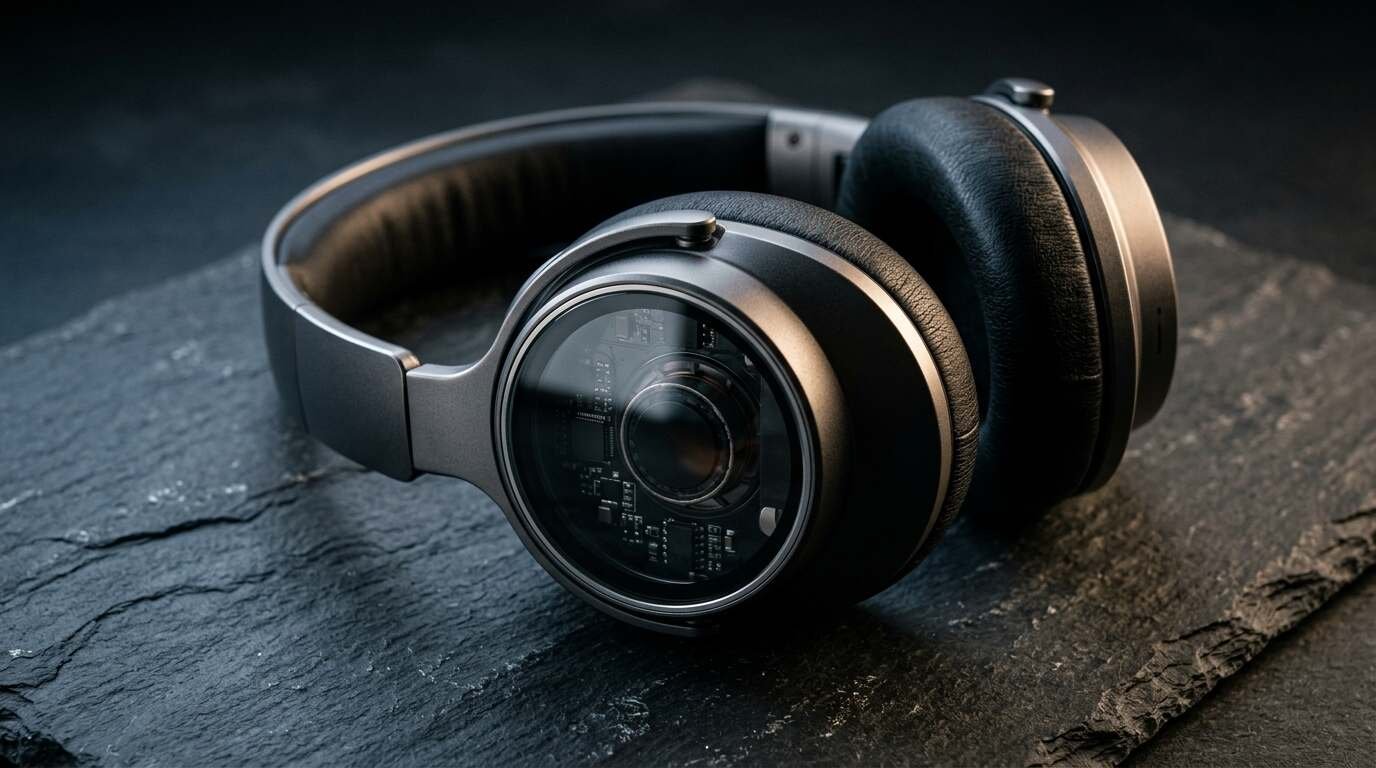
The Nothing Headphone 1 Pro is an over-ear headphone that hands its treble to a chip. Announced September 28, 2026 and on sale from September 29 at $399 in the US, it pairs two conventional dynamic drivers with a solid-state xMEMS driver made of silicon, and it raises the microphone count for noise cancelling from six to ten.
Nothing’s own marketing is stronger than the evidence so far. The company claims noise reduction of up to 46 dB, hi-res audio and studio-grade tuning, but no independent lab or reviewer had published measurements in the sources I opened. So this post separates the specifications Nothing states from the claims that need testing.
The headphone is also a step back in one area, battery life, and the sources do not agree on every number, which is covered below.
The specifications Nothing has published
Nothing’s UK product page lists the headphone at £349; Android Authority reports the US price as $399, up $100 from the $299 Headphone (1). It comes in black and white. The UK page showed one color as sold out when I loaded it, and the layout did not make clear which.
- Drivers: 40 mm dynamic bass driver, 13 x 8 mm dynamic precision driver, solid-state xMEMS treble driver
- Noise cancelling: adaptive ANC, 10 microphones (five per side), transparency mode, rated by Nothing at up to 46 dB
- Battery: 1,060 mAh; up to 68 hours with ANC off and 30 hours with ANC on (AAC); with LDAC, 53 and 28 hours
- Charging: about 2 hours for a full charge; 5 minutes gives up to 4 hours of playback with ANC off
- Connectivity: Bluetooth 6.1, dual connection, Auracast, Google Fast Pair; codecs AAC, SBC and LDAC
- Build: aluminum frame, titanium arms, 9H Panda Glass over the earcup windows, IP52, 327 g
- Frequency response: 20 Hz to 40 kHz
- Software: Flat EQ switch on the left cup, Dynamic Spatial Audio with five profiles and head tracking, custom EQs, tuning with Metropolis Studios in London
How an xMEMS treble driver works
A normal headphone driver is a coil of wire attached to a diaphragm and suspended in a magnetic field. Current through the coil makes it move. The design is cheap and well understood, and its weakness is mass: the coil, the former and the diaphragm all have to be pushed back and forth, and at high frequencies that inertia limits how quickly and cleanly the diaphragm can respond.
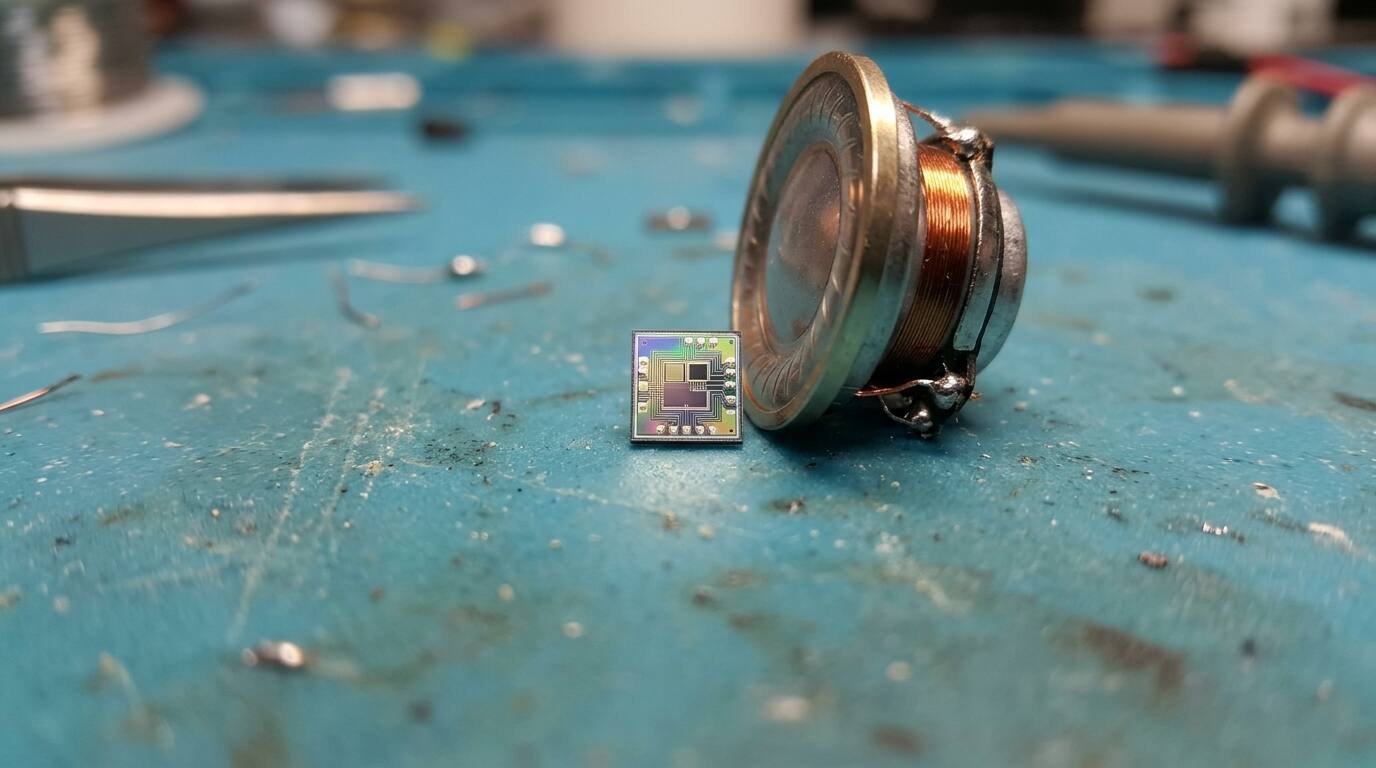
xMEMS replaces the coil and magnet. An earlier Design News article describing the company’s technology says the transducer uses a piezoelectric thin film on a silicon membrane. When a voltage is applied, the piezoelectric material changes shape, and the silicon moves with it. The article reports company claims that the membrane is 95 times stiffer than conventional diaphragm materials, that the speaker weighs about a tenth as much and takes up 40 percent of the size of a coil speaker, and that its impulse response is 150 times faster. The same piece reports the company says it has no moving parts and meets IP58 protection from dust and sweat. These are manufacturer numbers, not measurements.
Nothing does not say which xMEMS part it uses, and I did not find a source that names it. The headphone’s frequency response is listed to 40 kHz, which is double the usual 20 kHz limit of human hearing. A wide stated band is a marketing figure unless the measurement method is given, and Nothing has not published one in the material I read.
Why use a chip for treble only? Silicon membranes are small and stiff. That suits high frequencies, where wavelengths are short and a small, light surface radiates well. They are less suited to bass, which needs large air movement, so the 40 mm dynamic driver handles the low end and the 13 x 8 mm dynamic unit covers mids. A three-way split needs a crossover that hands each band to the right driver, and crossovers are where phase and tonal errors creep in. Whether Nothing’s tuning handles that well is one of the things only listening and measurement can show.
Noise cancelling: from 6 microphones to 10
Android Authority reports Nothing claims a 5 dB stronger average noise reduction and 40 percent broader frequency coverage than the original. Droid Life adds that the new ear cushions include an 8 mm silicone baffle wall to improve the seal, and that Nothing says gains should be most noticeable in strong wind and heavy traffic.
The figure to treat carefully is 46 dB. Nothing’s page describes it as an up-to maximum from its own lab tests, and it does not say at which frequency. A reduction of 46 dB is a factor of about 200 in sound pressure, or 40,000 in power. ANC systems approach numbers like that only at low frequencies, typically a narrow band below a few hundred hertz, and fall off toward the kilohertz range where passive isolation from the cushions does most of the work. The average across the audible range will be much lower. Nothing’s other claim, 5 dB better on average, is a more honest indication of the improvement.
More microphones help in two ways. Feedforward microphones outside the cup hear noise before it reaches the ear, and feedback microphones inside measure what remains. Extra microphones let the system average out wind noise and better tell outside sound from the listener’s own voice. Nothing says its array is five microphones per side, but does not describe which face where.
What the battery figures imply
The 1,060 mAh cell is the key number. Assuming a typical lithium-ion nominal voltage of 3.7 volts, which Nothing does not state, that is about 3.9 watt-hours. Spread over 68 hours with ANC off, the headphone averages around 58 milliwatts. Over 30 hours with ANC on, the average rises to about 131 milliwatts. The difference of roughly 73 milliwatts is the price of ten microphones and the processing that keeps the antiphase signal accurate, plus any other features enabled in that mode.

The LDAC figures give a second data point. At 53 hours with ANC off the average draw is about 74 milliwatts, around 16 milliwatts more than with AAC, which is the cost of the higher-bitrate radio link and decoding. With ANC on, 28 hours implies about 140 milliwatts.
Fast charging: five minutes yields up to 4 hours with ANC off, or roughly 231 milliwatt-hours at the 58 milliwatt average. That implies a charging power of around 2.8 watts over those five minutes, while a full two-hour charge averages about 2 watts. Both are plausible, but they depend on the assumed voltage, so read them as rough estimates.
Android Authority points out that this is a step back from the first model, which lasted 42 hours 53 minutes with ANC on and 80 hours with it off in SoundGuys testing, against the new rated 30 and 68. The comparison mixes a lab test with a manufacturer rating, so the true gap is uncertain, but the direction is clear. Nothing seems to have traded endurance for more drivers and microphones.
Codecs, hi-res claims and a conflict in the sources
Nothing’s page lists AAC, SBC and LDAC for music, with LC3 reserved for broadcast audio through Auracast. Android Authority says the headphone supports hi-res audio over both wired and wireless connections. Droid Life goes further and gives 24-bit/192 kHz for wireless and wired USB-C.
Those statements are hard to reconcile. LDAC, as far as I know, is specified up to 96 kHz, not 192, so a 192 kHz figure probably applies to the wired USB-C connection only. Nothing’s own page, as I retrieved it, does not state a maximum sample rate. Until the company publishes one, the wireless ceiling is unverified.
On the practical side, 24-bit/192 kHz stereo is 9.2 megabits per second of raw data, and a Bluetooth link cannot carry that uncompressed. LDAC compresses, which is why wireless hi-res is a different thing from lossless.
Price, positioning and what is unproven
At $399 the headphone is priced against the Bose QuietComfort Headphones (2nd Gen) and the Sennheiser Momentum 5 Wireless, which Android Authority names as Nothing’s targets. That is Nothing’s positioning, not a test result.
Several things are unverified. No independent noise-reduction curve exists in the material I read. The sound quality claims, including the Flat EQ mode designed for producers, have no listening reports behind them. There is no information about the long-term reliability of the xMEMS driver in a consumer over-ear product, though its solid-state design may well help. And there is the question of tuning: three drivers, two crossovers and a software equalizer give plenty of room for the sound to be excellent or odd.
Droid Life notes that US sales are through Nothing’s store, Amazon and Best Buy, with availability in the US and Canada. Availability elsewhere is unclear from the sources I opened.
Frequently asked questions
How much does the Nothing Headphone (1) Pro cost?
$399 in the US, from September 29, 2026. Nothing’s UK page lists £349. The original Headphone (1) was $299.
What is an xMEMS driver in the Nothing Headphone (1) Pro?
A solid-state speaker made from a piezoelectric film on a silicon membrane, used here for the treble. The bass and mids are handled by two conventional dynamic drivers.
How long does the battery last?
Nothing rates it at up to 68 hours with ANC off and 30 hours with ANC on over AAC. With LDAC the figures drop to 53 and 28 hours.
How strong is the noise cancelling?
Nothing claims up to 46 dB, a lab maximum, and an average 5 dB improvement over the first model. No independent measurements were available when this was written.
The interesting thing about this headphone is not the price or the glass. It is the decision to hand a slice of the frequency range to a silicon component with no coil in it. If that works as intended, it shows a path for putting semiconductor-style manufacturing into a part of the audio chain that has been mechanical for a century. If it does not, a more expensive headphone with shorter battery life will have been the cost. Measurements will decide, and they are due soon.
Sources