A Toronto theory paper proposes that octupolar magnetism splits a Raman-active phonon by about 1.5 meV. What the prediction says and what is untested.
Octupolar magnetism is a kind of order that ordinary magnetic probes cannot see, which is exactly why it is hard to find. A theory paper from the University of Toronto, published in Physical Review Letters according to early-October coverage, proposes a way around that: look at how the order shifts the vibrations of the crystal lattice, using circularly polarized light.
Press summaries have used verbs like identify and observe. The paper itself, as the arXiv version shows, is a prediction. No experiment has yet seen the effect it describes, and the authors say so. That distinction is the useful part of this story, together with the size of the splitting they expect.
What an octupole is, in this context
An ordinary bar magnet is a dipole, two poles. A quadrupole has four lobes, an octupole eight. In solids with strongly spin-orbit-coupled ions, the low-energy physics sometimes involves a two-level system called a non-Kramers doublet, and that doublet can carry two kinds of order at once. One is quadrupolar, a distortion of the electron cloud. The other is an octupolar moment, which the paper writes as an Ising-type variable.
The wrinkle is that the octupolar component breaks time-reversal symmetry, as a dipole does, but it produces essentially no magnetization that a conventional probe would pick up. Neutron scattering and magnetometry struggle with it. This is why physicists call such order hidden, and why a symmetry-based signature would be valuable.
The proposed fingerprint
The authors, Ruairidh Sutcliffe, Kathleen Hart, Swati Chaudhary and Arun Paramekanti, consider doubly degenerate E_g phonons in cubic crystals. These are Raman-active lattice vibrations whose two components can be written in terms of d_{x²−y²} and d_{3z²−r²} distortions. Normally the pair has the same frequency.
By symmetry, the time-reversal-odd octupole cannot couple linearly to the phonon, but the quadrupolar components can. When the octupoles order ferromagnetically, they act somewhat like an effective field in the pseudospin space and mix the two quadrupolar components into complex combinations, Q+ = Q_x + iQ_z and Q− = Q_x − iQ_z. These modes carry what the paper calls pseudo-angular momentum along the [111] axis. The atoms do not actually circle; the paper stresses that the modes are rotationless. The label describes how the modes transform, and it is what lets circularly polarized light tell them apart.
How the calculation was done
The group used a path-integral treatment in which the fast phonons respond to slow pseudospins, and sampled the pseudospin background with large Monte Carlo simulations, averaging over about 10⁵ configurations to build the spectral function. The model is a face-centered-cubic lattice with nearest-neighbor exchange; the parameters quoted for a barium osmate, Ba2CaOsO6, include a ferro-octupolar coupling J0 of about 1 meV and a ratio J1/J0 near 0.5.
The phonon frequency, about 60 meV, and the spin-phonon coupling, about 5 meV, come from density-functional calculations. That is a source of uncertainty. The authors also note that the exchange parameters are uncertain and that the ground state of these materials, ferro-octupolar versus antiferroquadrupolar, is itself debated.
Working through the numbers
The central result is a simple formula. In the ferro-octupolar phase the splitting of the doublet is approximately 4λ²/Ω0, where λ is the coupling and Ω0 the bare phonon energy. With λ of 5 meV and Ω0 of 60 meV, that is 4 × 25 / 60, or about 1.7 meV. The paper states about 1.5 meV and, in its discussion, about 1 meV, so its own figures are not fully consistent; the formula with the quoted inputs gives the higher end.
For Raman spectroscopists, 1.5 meV is about 12 wavenumbers (1 meV is roughly 8.07 cm⁻¹), sitting on a 60 meV phonon near 484 cm⁻¹. The splitting is therefore about 2.5% of the phonon energy. That is small but within the resolution of ordinary Raman instruments, provided the lines are narrow. The center of the pair is also pushed down by about 0.3 meV, by the formula 4λ²h/Ω0², with h about 12 J0; the inputs reproduce that value.
In the competing antiferroquadrupolar phase, the splitting is parametrically smaller, scaling as 1/Ω0², and the paper quotes about 0.4 meV. My own check of the stated formula with the same inputs gives nearer 0.2 meV, so I would not rely on that figure. The qualitative point survives: with realistic damping, the ferro-octupolar peaks stay resolvable while the antiferroquadrupolar ones do not, and only a slow temperature-dependent shift of the central peak remains.
Why circular light
The selection rules do the discriminating. For back-scattering with light along [111], the signal appears in cross-circular channels, meaning the incoming and scattered light have opposite helicity. The co-circular channels vanish for both modes. The two modes of opposite pseudo-angular momentum show up in opposite cross-circular channels, each peaked at one of the two split frequencies.
This helicity-resolved pattern is the signature. A split line seen only in one polarization setup could come from strain, domains or a structural distortion. Seeing the two components swap between cross-circular configurations is a harder pattern to fake, though the paper does not claim it is unique to octupolar order.
The idea has precedent in magnets with ordinary dipole order. The paper cites phonon splittings in CrI3, Fe1.75Zn0.25Mo3O8 and Co3Sn2S2 as analogues, where time-reversal breaking separates phonon branches of opposite handedness. The new element is that an octupole carries no net dipole moment, so the same kind of splitting would be a rarer and more indirect signature. The authors also note a related proposal in their reference list that uses dual-circular Raman optical activity as a probe of axial multipolar order, which suggests the field is converging on polarization-resolved optics as the tool of choice.
What an experiment has to clear
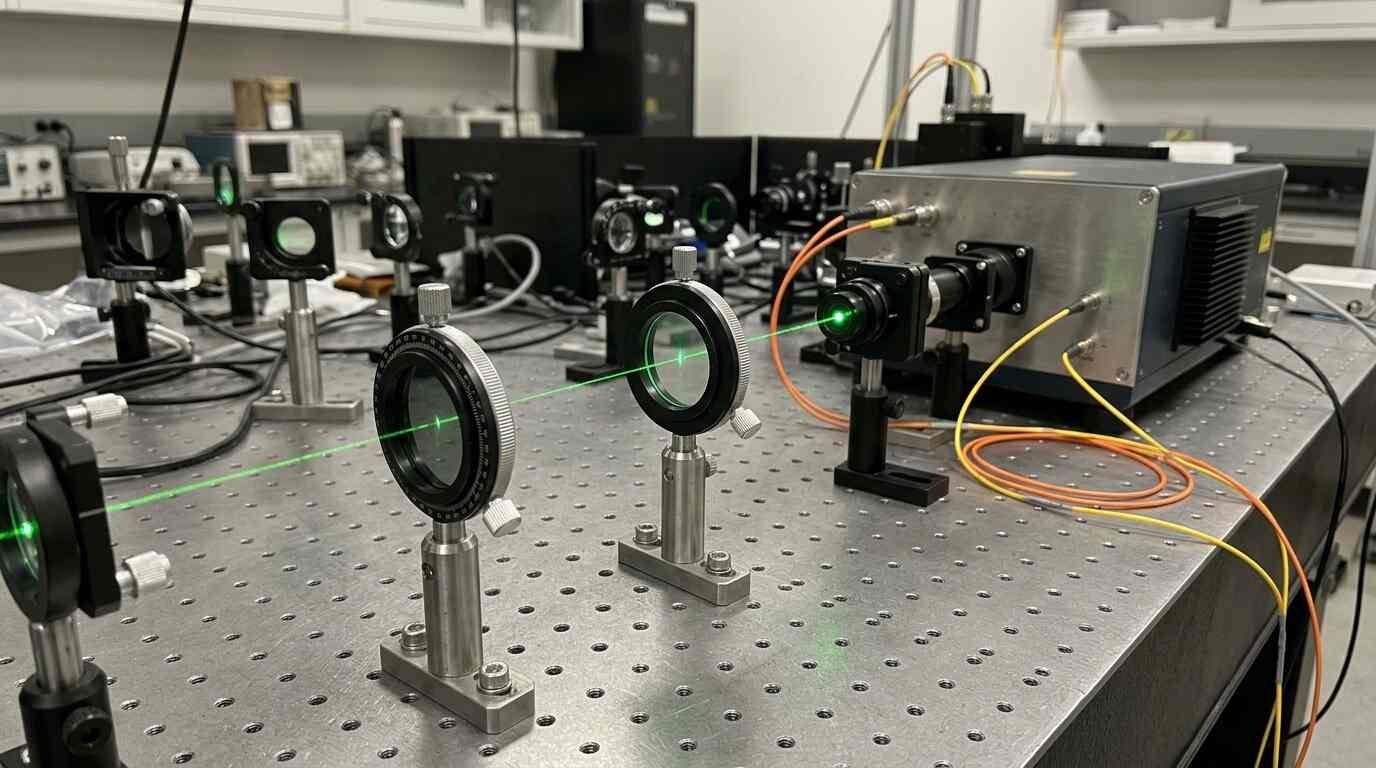
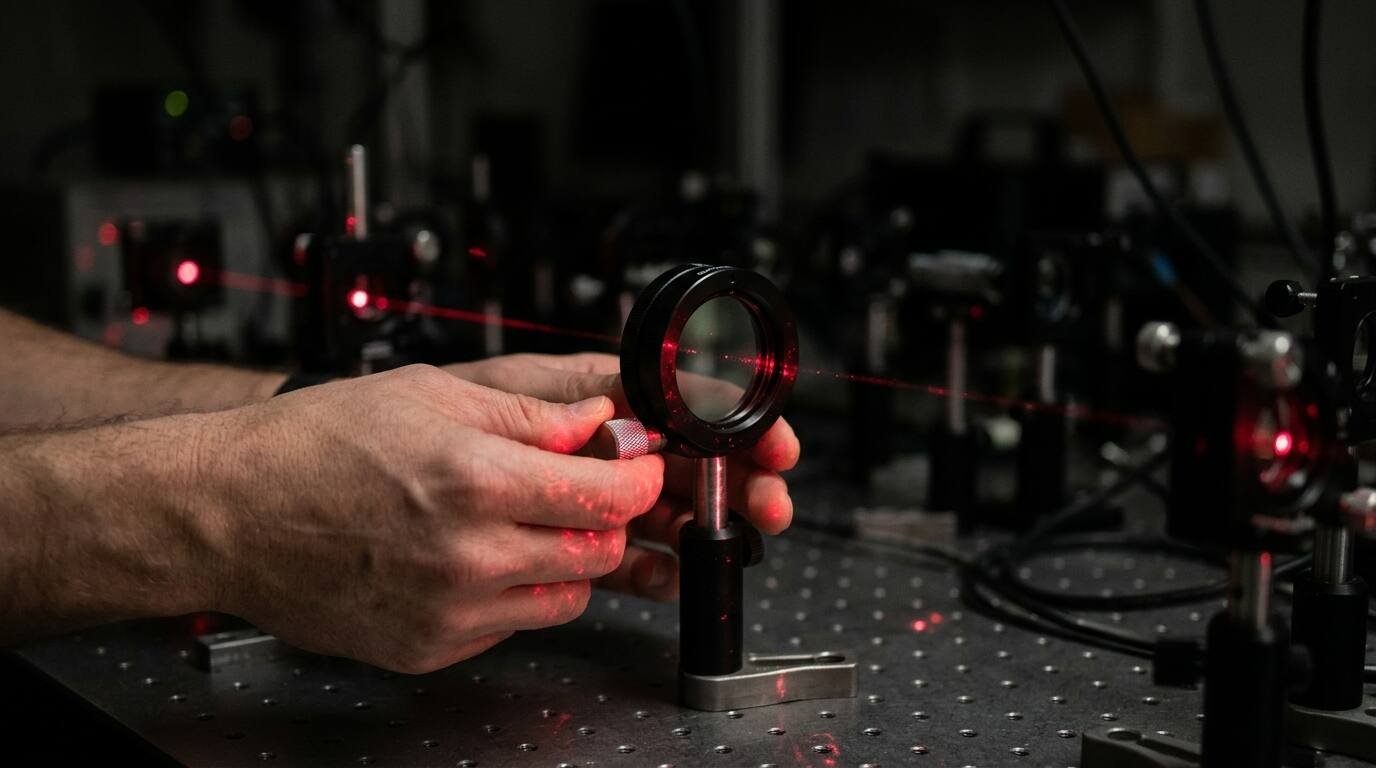
A real test would start with a single crystal of one of the candidate materials, cooled below its ordering temperature, with a back-scattering Raman geometry and circular polarization optics on both the incoming and collected beams. The predicted effect is a pair of peaks about 1.5 meV apart, each visible in only one of the two cross-circular channels. The experimenter then warms the sample through the transition and watches the pair merge, as the pump-probe version of the calculation predicts for a zero-momentum mode.
Three things can go wrong. The line may be broader than the splitting, in which case the pair blurs into one asymmetric peak. The crystal may break into domains of opposite sign, which would populate both channels equally. And the real coupling may be smaller than the 5 meV the density-functional calculation suggests. Because the splitting scales as the square of the coupling, a coupling smaller by a factor of two would cut the splitting by four, from roughly 1.5 meV to under 0.5 meV, which is hard to resolve.
That scaling is the most useful single sentence in the paper for an experimentalist. It says the proposal lives or dies on one number that so far comes from a calculation. Existing spectroscopy on candidate crystals might bound the coupling before anyone commits to a new growth campaign, though I have not seen such a bound in the sources I read.
Temperature dependence and domains
The simulated splitting does not follow the order parameter directly. The authors find that the normalized splitting tracks the ferro-octupolar order parameter without being proportional to it, because it depends on the direction of the local Weiss field rather than its magnitude. In the modeled ferro-octupolar case the ordering temperature is about 3.2 J0, and a pseudogap-like regime persists up to roughly 1.2 times that temperature. In a pump-probe variant, a zero-momentum mode shows split peaks that merge above the transition.

Real samples add complications the model leaves aside. Local splitting depends on domains and domain walls, and a crystal with domains of opposite octupolar sign would mix the signals. Whether single-domain crystals can be grown or selected is an experimental question.
Which materials, and what remains open
The abstract names Ba2CaOsO6 and PrV2Al20 as candidates. The detailed numbers in the text concern the osmate; the paper gives no specific figures for the praseodymium compound, and it lists a longer set of related systems elsewhere. The analogy is to chiral and split phonons already seen in dipolar magnets, which the paper cites.
What is not there is data. The authors call this the first such prediction for octupolar order and propose helicity-resolved Raman scattering as the test. The Slashdot summary of the Phys.org coverage says the team observed an optical fingerprint, which reads as though an experiment had been done. Based on the arXiv text, it has not, and the final published version may carry additions I could not check. Until a group measures the split in a real crystal, this stays a well-motivated hypothesis.
The list of related systems the paper mentions is long: NpO2, URu2Si2, CeB6, PrO2, spin ice, Ba2NaOsO6, Ba2MgReO6 and Cs2WCl6 among them. Several of these have long-running debates about whether their order is dipolar, quadrupolar or higher. A phonon test that distinguishes them by symmetry, without needing a neutron source, would be useful whether or not the octupolar prediction turns out to be right.
Frequently asked questions
What is octupolar magnetism?
It is a type of magnetic order built from eight-lobed moments rather than the usual two-pole dipoles. It breaks time-reversal symmetry but produces almost no ordinary magnetization, so it is hard to detect with standard probes.
Has octupolar order been observed with this technique?
No. The arXiv version describes a theoretical prediction and proposes helicity-resolved Raman spectroscopy as a test. No experimental observation of the predicted phonon splitting is reported.
How large is the predicted phonon splitting?
About 1.5 meV in the ferro-octupolar case with the authors’ parameters, roughly 12 wavenumbers on a 60 meV phonon. The paper also cites about 1 meV in its discussion, so the exact figure varies in the text.
Which materials are candidates?
The paper suggests Ba2CaOsO6 and PrV2Al20 among others, using the osmate for most of the numerical estimates.
Hidden order earns its name because nothing in the usual toolbox reads it out, so a proposal that turns the lattice into a witness is worth taking seriously even before data. The test is cheap by condensed-matter standards: a Raman setup with circular polarization optics and a good crystal. If a split of the predicted size appears and swaps between cross-circular channels, it would be strong evidence for the symmetry argument. If it does not, the failure will say something too, about the coupling constants or the assumed ground state. In either case the measurement is now well defined.
Sources