OIST physicists used NV-center electron spin to shake a 128 mg levitated diamond resonator by over 100 nm. The numbers, and what they do not prove.
A levitated diamond has now been pushed around by the spins of its own electrons. Researchers at the Okinawa Institute of Science and Technology (OIST) report that pulsed green light on nitrogen-vacancy defects drives a 128 mg diamagnetically levitated resonator through more than 100 nm, a very large mass for this kind of effect. The work is reported by The Debrief on October 8, 2026 as published in Science Advances.
The headlines have called it a quantum effect moving a centimeter-scale object. The paper is more modest, and more useful for it: a small quantum force producing a large classical response, with a clear mechanism and honest limits. I worked from the arXiv version of the paper, since the journal page itself was not accessible to me.
What the experiment looks like
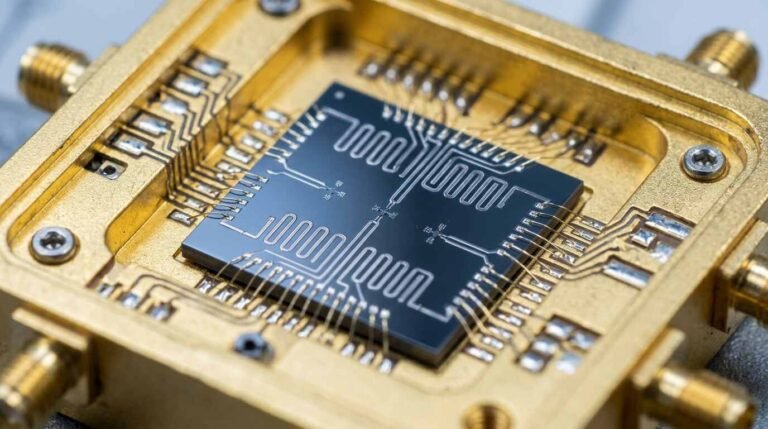
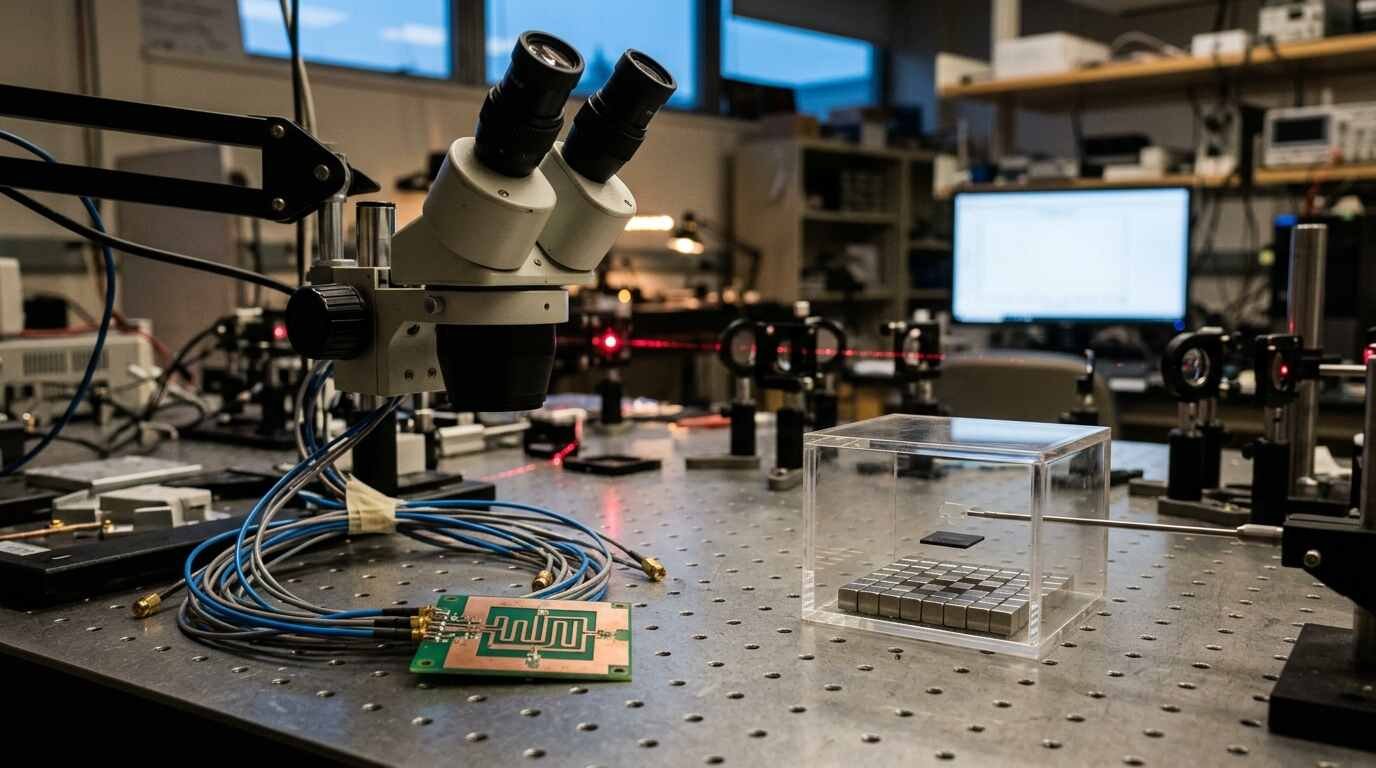
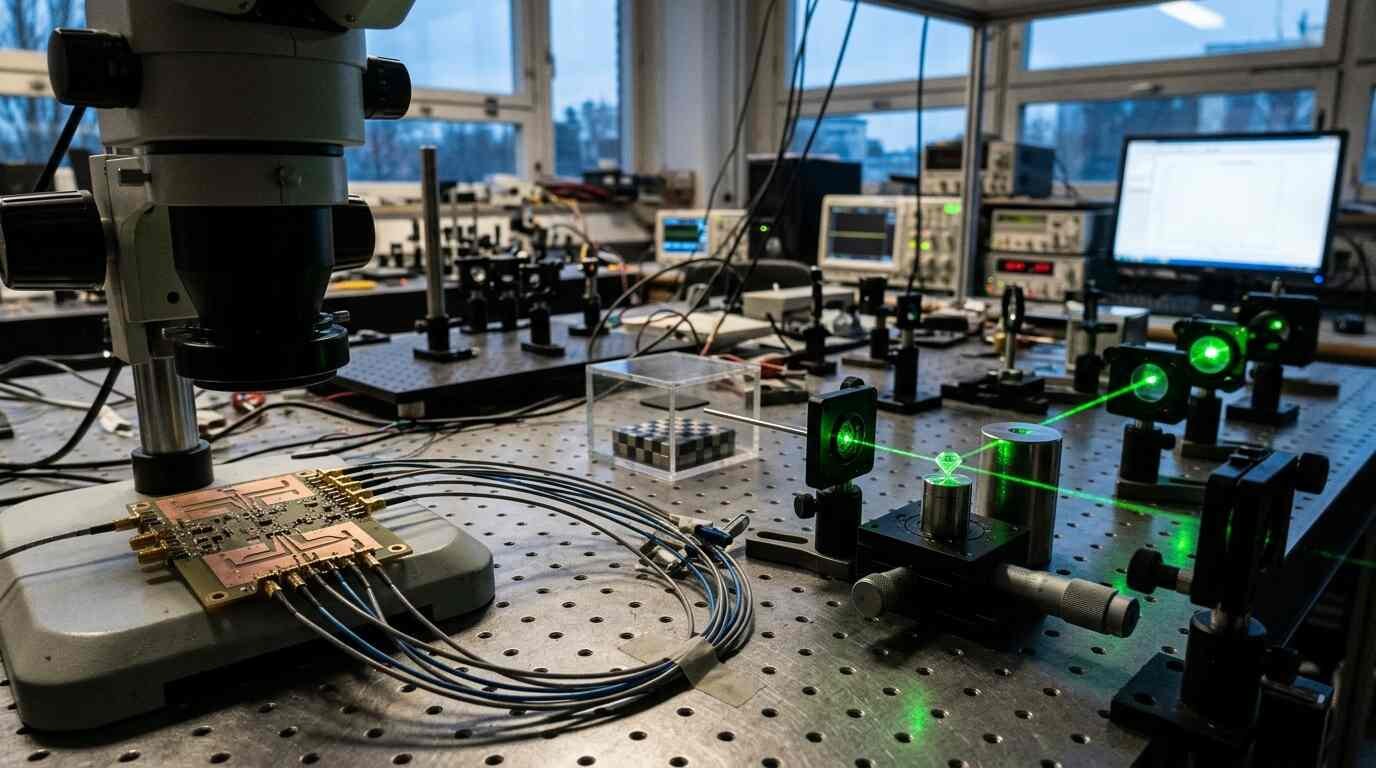
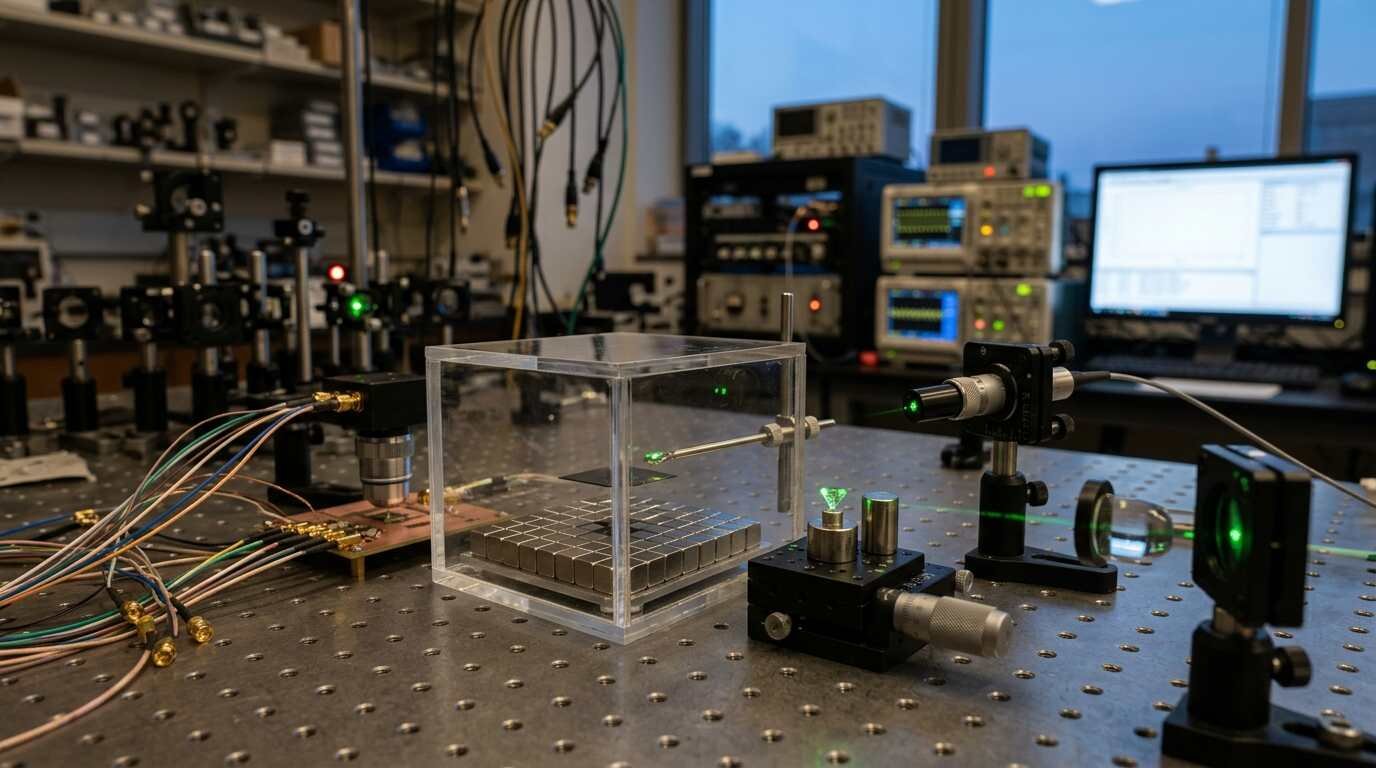
The moving part is a small seesaw of materials. A commercial diamond slab, 3 mm × 3 mm × 0.5 mm with a nitrogen-vacancy (NV) concentration of 4.5 parts per million in the preprint, is attached by a 5 cm carbon-fiber rod to a pyrolytic graphite plate. The plate is diamagnetic, so it floats above four N52 neodymium magnets arranged in a checkerboard. The total moving mass is 128 mg, and a mirror glued to the plate lets a fiber-optic interferometer read its position to picometer precision.
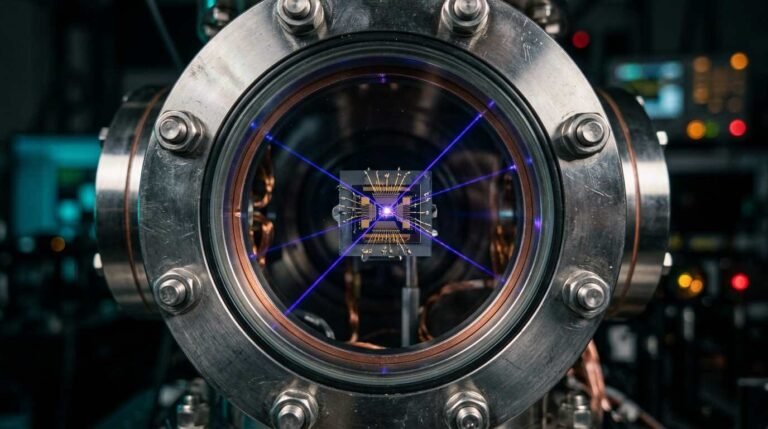
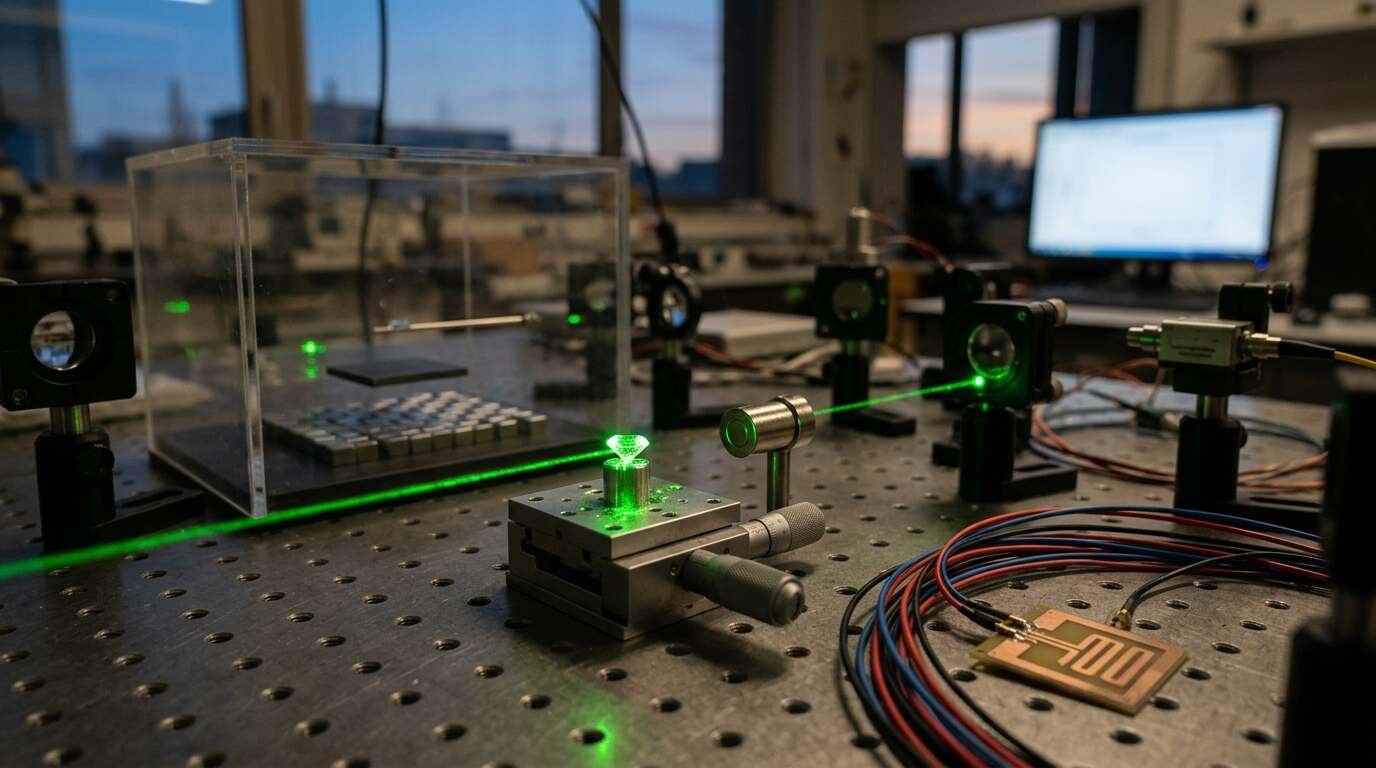
A separate cylindrical magnet on a translation stage sits close to the diamond, 0.5 mm away at the nominal gap, and supplies a strong field gradient. A 532 nm green laser, 50 mW and pulsed electronically, shines on the diamond. Everything runs at room temperature and atmospheric pressure, on an actively isolated table inside an acrylic box.
Where a spin force comes from
The negatively charged NV defect has an electron spin that acts as a tiny magnet. In a field gradient, a magnetic moment feels a force that depends on its orientation, which is the principle behind the Stern-Gerlach experiment. Green light pumps NV spins into the m_s = 0 state, so every pulse changes the average magnetic moment of the whole ensemble, and with it the net force on the diamond in the gradient.
The authors switch the laser on and off at the mechanical resonance frequency of the plate, 17.6 Hz. Each cycle swaps the ensemble between an optically polarized state and a thermally polarized one, and the periodic force resonantly drives the oscillator. Forces along x and y cancel by symmetry, leaving motion along z, toward the magnet, as the model predicts.
Ruling out the obvious impostors
Light on diamond can do other things, and the paper runs controls for them. If the magnet is removed, the resonance peak vanishes. If the green laser is replaced by a 980 nm infrared beam that does not polarize NV spins, modulated with a mechanical chopper, there is again no peak. Laser heating is estimated at about 3 K for the diamond, which the authors acknowledge could create photophoretic and thermal forces, but the infrared control shows no such signal at this power.
A further test distinguishes force from torque. The authors argue the effect is a force from the field gradient, since a magnet with a stronger field but a weaker gradient produced a smaller response. The motion is also phase-coherent and nearly sinusoidal when averaged over periods, as expected for a resonant drive.
The orientation of the defects matters. The NV axes sit about 54.7° from the vertical in the slab. When an axis lines up with the local field, optical pumping mostly populates m_s = 0 and the force is weak; misaligned axes allow spin mixing and a stronger force. A seven-level rate-equation model predicts the spin polarization and force, with the empirical factor of 1.2 mentioned below.
Working through the numbers
Start with the oscillator. At 17.6 Hz the angular frequency is about 110.6 rad/s. With a mass of 128 mg the effective spring constant is m ω², roughly 1.6 N/m. An amplitude of 100 nm therefore corresponds to a restoring force of about 160 nN. The quality factor in air is only about 55, so the steady-state drive needed is smaller by that factor, about 2.8 nN.
That sits in the right range for the paper’s maximum measured force, which it puts at more than 5 nN. The two do not coincide exactly, and I have not reconciled them. The calculation treats the system as a simple damped oscillator and ignores how the drive waveform is defined, so factors of order two are plausible.
Now compare with the ceiling. Taking the preprint’s slab volume (4.5 mm³) and the 4.5 ppm NV concentration, with diamond containing about 1.76 × 10²⁹ carbon atoms per cubic meter, gives roughly 3.6 × 10¹⁵ NV centers. One Bohr magneton in a gradient of 98 T/m (the simulated figure at the NV location, in a field near 0.63 T) gives about 9 × 10⁻²² N per spin. Multiply and you get a few micronewtons if every spin flipped its contribution fully. The measured force of a few nanonewtons is therefore around a tenth of a percent of that ceiling, which matches the paper’s statement that the spin population change is much smaller than full transfer. These are my estimates, built from the preprint’s parameters, not figures from the authors.
How big is big?
The press coverage calls the object centimeter-scale and about 100 mg. Both descriptions are loosely true. The preprint’s resonator is 128 mg, which is where the title’s 100 mg comes from. The diamond itself is a few millimeters across in the preprint, while the full assembly, with its rod and graphite plate, spans centimeters. The Debrief, quoting the published version, says the diamond is centimeter-scale, so the published diamond may differ from the preprint. That is unresolved here.
The comparison that matters to specialists is mass. The press account says the resonator is 8 to 9 orders of magnitude heavier than earlier spin-driven mechanical resonators. I could not check that ratio, because the sources I read did not list the earlier devices. The preprint’s own claim is simply a step toward spin-based control of motion in the high-mass regime.
Noise floor and the road to vacuum
The oscillator itself is the interesting engineering. The pyrolytic graphite plate is 10 mm × 10 mm × 1 mm, and the authors cut slots in it with a femtosecond laser to reduce eddy currents, which would otherwise act as a brake as the plate moves through the magnetic field. An iron shield plate, 4 mm thick, sits beneath the magnet array. Even so, the quality factor in air is only about 55, and the authors name air damping and eddy damping as the limiting terms on amplitude.
The power spectrum of the motion shows a peak roughly four orders of magnitude above the Brownian noise floor, so the detection is not marginal. The practical noise is ambient. Position noise is about 1 nm, set by the room, not the interferometer, and the authors estimate that better vibration isolation could improve sensitivity by about three orders of magnitude toward the picometer range.
The expected payoff of pumping out the air is a larger amplitude, about 1.5 µm according to the paper, with a composite diamagnetic resonator in high vacuum possibly reaching a quality factor near 10⁵. That figure is a proposal and has not been demonstrated. If it were reached, the same drive would give an amplitude larger by the ratio of quality factors, which is a factor of well over a thousand, though real systems rarely deliver the full ratio.
What the result does not show
Nothing here is a macroscopic superposition. Lead researcher Jason Twamley is quoted as saying the team showed a large classical response from a small quantum effect, and the Debrief states plainly that the team did not demonstrate quantum superposition in a macroscopic object. The motion is a driven oscillation of 100 nm, set against position noise of about 1 nm, which comes from ambient laboratory vibration rather than from the interferometer.
The apparatus is also far from ideal. Air damping and eddy-current damping in the graphite limit the amplitude. No microwave control was used, so the spins are only optically and thermally polarized, not coherently manipulated. The simulation needs an empirical scaling factor of 1.2. The preprint also contains small internal inconsistencies: the duty cycle is given as 48% in the text and 48.73% in a caption, and one figure uses 10 mW rather than the 50 mW of the main protocol.
Why anyone wants a heavy, spin-driven oscillator
The authors point to two next steps. One is high vacuum, where they expect the amplitude to rise to about 1.5 µm and, after redesigning the resonator, toward 100 µm. The other is coherent microwave control with shorter pulses, which should give stronger forces and less heating. Longer term, they mention spin cooling of the center-of-mass motion and tests of non-classical motional states.
The Debrief adds that the team sees possible sensors for gravitational waves and dark matter. That is a stated ambition, not a result. A levitated, low-friction, optically readable mass is a good force sensor in principle, and adding a spin-based way to drive or cool it is a sensible direction. Whether it beats competing approaches is an open question that this paper does not attempt to answer.
Frequently asked questions
Did scientists move a diamond with quantum spin?
Yes, in a limited sense. Pulses of green light changed the average spin of nitrogen-vacancy defects in a diamond sitting in a magnetic field gradient, and the resulting small force made a levitated 128 mg resonator oscillate by more than 100 nm.
Is this a macroscopic quantum superposition?
No. The authors and the press coverage both say the motion is a classical response to a quantum spin force. Reaching a superposition is described as a possible future goal.
How big is the force involved?
The preprint reports a maximum measured force above 5 nN, with a resonator mass of 128 mg and a quality factor near 55 in air.
Where was it published?
The Debrief reports it in Science Advances, October 2026. I could not open the journal page; the arXiv preprint is number 2605.17750.
A force of a few nanonewtons driven by roughly a thousandth of the available spin signal is not the kind of result that rewrites textbooks. It is the kind that tells an experimentalist what to try next: add microwaves, pull a vacuum, and see how much of the several-micronewton ceiling can be reached. If the gap closes even partly, a heavy levitated mass that can be pushed and cooled by its own spins becomes a serious sensor candidate. Until then, the careful reading is the one the authors give themselves, a large classical response from a small quantum effect.
Sources