
The Kobalt TXP battery brings tabless cells to Lowe's 24V line at $99 and $159. Here is what is confirmed, what the watt claims imply, and what is missing.
The Kobalt TXP battery is the first tabless pack in Lowe’s 24V line, and it showed up in the news on October 7, 2026, when ToolGuyd reported 4Ah and 8Ah versions listed at $99 and $159. Lowe’s marketing claims up to 1,200 watts from the smaller pack and 2,400 watts from the larger one, plus the longest runtime of any Kobalt 24V battery.
Those are claims, not measurements, and several basics are missing from the listings: a release date, the cell format, who makes the cells, and which tools the packs are meant to feed. This post lays out what is confirmed, works through the arithmetic behind the wattage numbers, explains what a tabless cell actually changes inside the pack, and marks the gaps. x9m8 does not test hardware, so everything here comes from published sources.
What has been announced
According to ToolGuyd’s October 7 report, the TXP line launches as two 24V Max packs sold through Lowe’s: a 4Ah at $99 and an 8Ah at $159. Lowe’s copy, as quoted by ToolGuyd, says the 4Ah can generate up to 1,200 watts and the 8Ah up to 2,400 watts, and that both offer the longest runtime of any Kobalt 24V battery. The packs also add new charge indicator lights, and the tabless cells are said to support faster charging, though the retailer did not say how much faster.
The article calls the product a launch but gives no in-store date. It does not say whether the packs work with every existing Kobalt 24V tool, and it does not list any new tools built around them. One commenter claimed TXP tools exist; the author said he had not found them. Treat that as unconfirmed.
What tabless means inside the cell
A conventional cylindrical lithium-ion cell is a long strip of coated foil rolled into a spiral. In a tabbed cell, one or a few thin metal strips are welded to each foil and carry all the current out to the terminals. Every ampere has to travel along the foil to reach that strip, and the strip itself is a bottleneck.
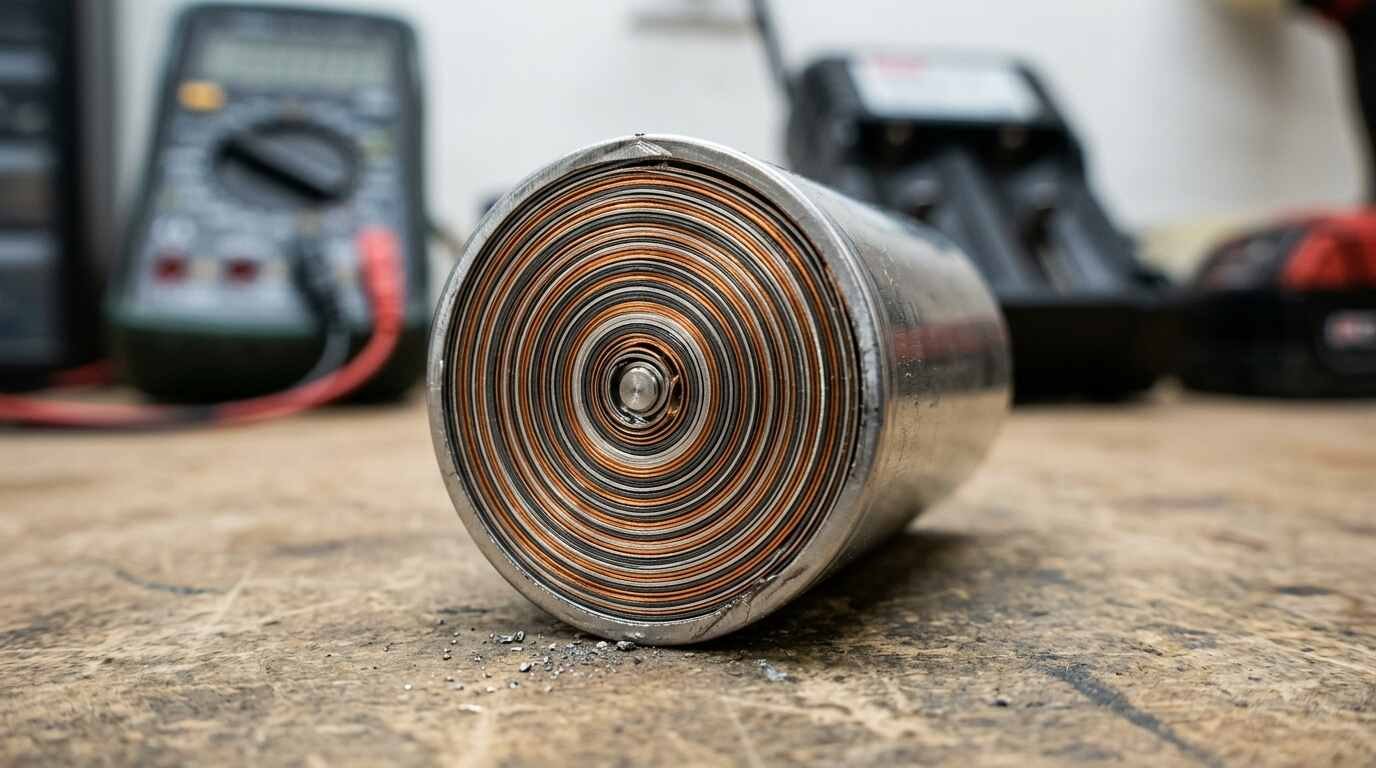
In a tabless cell, the foil’s edge is left uncoated and used as the contact, so current leaves along the entire spiral rather than through one point. One retailer explanation of the technique says this shortens the electron path and lowers internal resistance, which reduces voltage sag under load and spreads heat more evenly. That same page gives no measured resistance figures for either design, so the size of the effect is not quantified there. ToolGuyd’s description of Ryobi’s tabless packs uses the same reasoning and the same absence of numbers.
Lower internal resistance matters because power lost as heat inside the pack equals current squared times resistance. Halve the resistance and you halve the heat at the same current, or you can draw more current at the same temperature. That is the physical basis for a higher watt rating. It is also why the claim needs to be read carefully: the rating depends on how hot the pack is allowed to get and for how long.
Working through the watt claims
Power is voltage times current, so the claims can be converted into amps. At the 24V label, 1,200 watts is 50 amps, and 2,400 watts is 100 amps. Divide each by its capacity and you get the same rate: 50 A from 4 Ah and 100 A from 8 Ah are both about 12.5 times the capacity per hour, usually written 12.5C. At that rate a pack would be empty in roughly 4.8 minutes if it could sustain it, since 60 divided by 12.5 is 4.8.
That does not mean a TXP pack runs for under five minutes in real use. Lowe’s says up to, which normally signals a peak figure for short bursts, not a continuous rating. The source does not say which. Also, the voltage that actually appears at the terminals under a heavy load is lower than the label, because of the sag described above, so the current needed for the same wattage would be higher than the numbers above. The ’24V Max’ label in cordless tools generally refers to the voltage off the charger, but Kobalt’s nominal voltage is not given in the ToolGuyd article, so watt-hours cannot be computed from the listing.
- 1,200 W at 24 V is 50 A; 2,400 W is 100 A (simple division, label voltage).
- Both packs land at the same 12.5C figure, which suggests the claims scale with capacity rather than with separate testing of each pack. That is an inference, not something Lowe’s says.
- Without a stated test condition, the watt figures are marketing ceilings.
Price per amp-hour
Amp-hours are the only capacity unit in the listing, so price per amp-hour is the fairest comparison available. The TXP 4Ah works out to $24.75 per Ah and the 8Ah to about $19.88. ToolGuyd noted that Lowe’s is clearing the older Ultimate Output batteries at $35 for 4Ah and $79 for 8Ah, at least in the author’s region. That is $8.75 and about $9.88 per Ah.
So the new packs cost roughly 2.8 times as much per amp-hour at 4Ah and about 2 times as much at 8Ah, compared with clearance stock. Clearance pricing is not a normal baseline, and it will not last. The number is useful mainly as a sanity check: whatever tabless construction buys you, it has to be worth a large premium over a perfectly serviceable pack if your tools never draw heavy current.
Who benefits and who does not
ToolGuyd’s author offered an engineering view that the gains from tabless cells should show up under heavy loads. Light-duty uses such as worklights or radios would see little difference. That fits the physics: the resistance loss scales with current squared, so at low current it is already small.
The tools that draw hard are the ones that benefit. Think of a brushless saw cutting dense stock, a high-torque impact driver, or outdoor power equipment with a motor under load. Those are the situations where voltage sag causes a tool to bog or a pack’s protection circuit to cut out. Whether the TXP packs fix that in practice is the thing a tool-by-tool review would have to show, and none exists yet.
The recall in the background
Any new Kobalt battery arrives under the shadow of the earlier recall. ToolGuyd’s article states that the recall covered Kobalt 3Ah, 4Ah, 5Ah, 6Ah and 8Ah batteries, with the USB-charging models recalled for a fire risk under certain charging conditions, and that a class-action lawsuit was filed against Lowe’s over its handling of the recall. The article also notes that the clearance packs were not part of the recall.
The TXP launch article raises an open question: the 8Ah product link slug mentions USB-C, but the article does not say whether the TXP packs include USB charging. If they do, buyers will want to know what changed in the charging circuit. The source gives no answer. Anyone owning an older Kobalt 24V pack should check the CPSC recall notice directly rather than rely on a summary here.
What is still unknown
The list of unknowns is long enough to matter for a purchase decision.

- Release date and regional availability.
- Cell form factor, cell count and cell manufacturer. ToolGuyd’s author does not know whether Greenworks or Chervon builds them; a commenter suggested construction similar to Greenworks designs, which is speculation.
- Nominal voltage, watt-hours, weight and dimensions.
- Whether the watt ratings are continuous or peak, and under what test conditions.
- Charging speed and whether a faster charger ships or is sold separately.
- Compatibility with the full Kobalt 24V tool range.
- Warranty terms.
How to read a battery claim like this one
Three questions cut through most cordless battery marketing. First, is the power figure continuous or peak, and for how many seconds? Second, was it measured at the cell, the pack, or the tool? Third, does the maker publish a temperature limit for that rating? A pack that delivers 1,200 W for ten seconds and a pack that delivers it for ten minutes are different products, and the word ‘up to’ hides the difference.
Ryobi’s tabless packs, which ToolGuyd covered in May 2026, came with charge-time figures (as little as 35 minutes to 80 percent for its 8Ah on a specific charger) but no wattage claims. Kobalt has done the reverse so far: wattage claims, no charge times. Comparing the two directly is not possible until Kobalt publishes more.
Frequently asked questions
What is the Kobalt TXP battery?
A new tabless-cell line of 24V Max batteries sold through Lowe’s, reported by ToolGuyd on October 7, 2026, in 4Ah ($99) and 8Ah ($159) capacities.
What does tabless mean in a lithium-ion battery?
The cell’s electrode foil is contacted along its whole edge instead of through a small welded strip, which shortens the current path and lowers internal resistance. Vendor sources claim this reduces heat and voltage sag; the size of the effect is not quantified in the sources reviewed.
Are the TXP batteries affected by the Kobalt recall?
Per ToolGuyd, the recall covered older Kobalt 24V batteries in 3Ah to 8Ah sizes with USB charging. The TXP packs are new, and the sources reviewed do not say whether they share the recalled charging design. Check the CPSC notice for your pack.
Will a TXP pack work in my existing Kobalt 24V tools?
Not confirmed. The launch article implies the 24V platform but does not list compatible tools.
The tabless idea is sound engineering, and it is easy to see why a retailer brand wants it: heat and sag are the two things that make cordless tools feel weaker than corded ones. But a launch with prices and wattage claims and no release date, cell source or test conditions is a product announcement, not evidence. The honest position for now is to treat the TXP packs as promising and unproven. If the numbers matter to you, wait for published discharge curves, or for a teardown that shows the cells, before paying a premium over the older packs that are being cleared out.
Sources