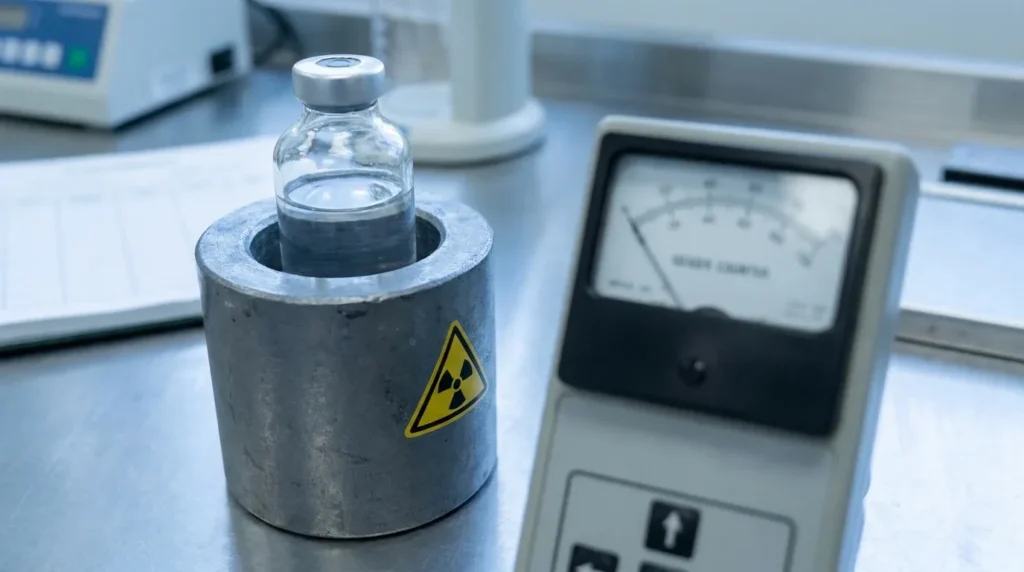
The FDA label for Pluvicto, a lutetium-177 cancer drug, carries a decay table, and one row reads 720 hours, 0.044. Thirty days after calibration, 4.4% of the radioactivity is left. Nobody had to measure that row in a lab the week the label was printed. It falls straight out of one number, a half-life of 6.647 days, and a formula short enough to fit on the back of a parking ticket.
One number and one formula
Half-life is a rate wearing a clock’s clothing
The U.S. Nuclear Regulatory Commission defines radiological half-life as “the time required for half the atoms of a particular radioisotope to decay into another isotope,” and adds that each radioisotope has its own characteristic value, with measured half-lives ranging from millionths of a second to billions of years.
The math that follows from “half per half-life” is one line. If T is the half-life and t is elapsed time, the fraction remaining is:
fraction = 0.5 ** (t / T)After one half-life, 0.5 is left. After two, 0.25. After ten, 0.5 to the tenth power, which is just under one part in a thousand. Every half-life multiplies what remains by the same factor, no matter how much is there, and that is the whole difference between exponential decay and a tank draining through a pipe at a fixed flow. The tank empties at a known time. The isotope only ever halves.
Scientists often write the same thing as N(t) = N0 * e^(-λt), where the decay constant λ equals ln 2 divided by T. The two forms are the same curve. The second one is handy because λ works as a probability rate: over a short interval, λ times that interval is the chance that any one nucleus decays.

Lutetium-177: checking the FDA’s decay table
A drug label is a worked problem with the answers printed in the back
According to the 2022 Pluvicto prescribing information, lutetium-177 decays to stable hafnium-177 with a physical half-life of 6.647 days, and the dose is 7.4 GBq (200 mCi) given intravenously every 6 weeks for up to 6 doses. The label’s Table 6 lists the fraction of activity left at intervals after calibration.
Running the formula in Python against four of the label’s rows:
$ python3 calc.py
Lu-177 label table check:
    24 h  fraction=0.901
    48 h  fraction=0.812
   168 h  fraction=0.482
   720 h  fraction=0.044
  42 d (6-week dose interval): 0.0125
All four match the label to three decimal places: 0.901 at one day, 0.812 at two, 0.482 at a week, 0.044 at thirty days. The last line is not on the label. It is the fraction of the physical activity from one dose still present when the next dose is due six weeks later, about 1.25%. The dosing schedule and the half-life are not strangers to each other.
The same label contains a second half-life, and confusing the two is a real mistake. The drug’s terminal elimination half-life, how fast the compound leaves the blood, is listed as 41.6 hours in the pharmacokinetics section. That is a biological process. The NRC keeps a separate glossary entry for effective half-life, the time for a radioisotope deposited in a living organism to lose half its activity through both decay and the body’s own removal. When two independent first-order processes run at once, their rate constants add, so the effective half-life is always shorter than either one alone: 1/T_eff = 1/T_physical + 1/T_biological. The physical clock never stops for the patient’s convenience, and the body adds a second drain to the same tank.
The label’s radiation-safety advice reads like those clocks put into plain instructions: limit close contact (less than 3 feet) with household contacts for 2 days, and with children and pregnant women for 7 days, per Section 5.1.
Carbon-14: the half-life radiocarbon labs use on purpose is slightly wrong
A known error kept for the same reason a building keeps its old floor numbers
Carbon-14 has three half-lives in circulation, and all three are honest about what they are.
| Value | Source | What it is |
|---|---|---|
| 5,700 ± 30 years | NNDC NuDat (Brookhaven) | Evaluated nuclear data |
| 5,686 ± 40 years | TUNL Nuclear Data Evaluation, Duke | Recommended value, September 2015, a weighted average of measurements |
| 5,568 ± 30 years | Oxford Radiocarbon Accelerator Unit | The Libby half-life, still used to report radiocarbon ages |
Oxford’s methods page puts it bluntly: the 5,568-year value “is still used today, even though we know it is slightly wrong.” Keeping it means every radiocarbon age ever reported stays comparable with every other one, and the page notes dates are given in years BP, with 0 BP set to 1950.
The size of the gap is easy to compute. One sample, one measured fraction, run through both half-lives:
  25% remaining -> age 11136 yr with T=5568
  25% remaining -> age 11400 yr with T=5700
  10% remaining -> age 18496 yr with T=5568
  10% remaining -> age 18935 yr with T=5700
The two answers differ by about 2.4%, which at 18,000 years is more than four centuries. Nothing about the sample changed. Only the number on the ruler did.
The method’s ceiling is a half-life fact too. Oxford gives the limit of the technique at around 50,000 to 55,000 years, after about 10 half-lives. At ten half-lives, 0.098% of the original carbon-14 is left, under one part in a thousand, and the signal sits down in the noise of the instrument and of any modern carbon that crept in.
Caffeine: the same curve, a much fuzzier number
A half-life in a person is an average, and the person is not average
The European Food Safety Authority’s 2015 caffeine explainer gives the average half-life in healthy adults as “approximately four hours, with a range of two to eight hours,” and says it varies with age, body weight, pregnancy, medication and liver health. The same document says single doses of 100 mg may affect sleep duration and patterns in some adults, particularly close to bedtime.
That gives a clean worked problem. A 200 mg dose at 3 p.m., run at the low, average and high ends of EFSA’s range:
caffeine T=2h 200mg at 3pm: 7pm 50  11pm 12  3am 3 mg
caffeine T=4h 200mg at 3pm: 7pm 100  11pm 50  3am 25 mg
caffeine T=8h 200mg at 3pm: 7pm 141  11pm 100  3am 71 mg
At 11 p.m., one person is carrying about 12 mg and another is carrying 100 mg, from the identical cup. EFSA’s 100 mg figure is about a single dose taken close to bedtime, not caffeine left over from the afternoon, so the comparison is rough, but the slow metabolizer goes to bed with that whole amount still circulating. The fast metabolizer who says afternoon coffee never bothers them and the slow one who swears it does are both reporting the arithmetic correctly.
The model is a simplification. Real pharmacokinetics includes absorption time, and EFSA notes stimulatory effects may begin 15 to 30 minutes after ingestion. The single-exponential version here starts the clock at full dose and ignores the climb, which barely matters for the evening tail, the hours that keep people awake.
Why “half gone” never reaches zero, and why it does
The smooth curve is a fiction about crowds; the atoms keep their own time
The formula never hits zero. Plug in any time at all and 0.5 to that power is still positive. That fact gets repeated as a deep truth about decay, and for a continuous quantity like a concentration in a large population of molecules, it is a fine description.
Matter is not continuous. A sample is a finite count of atoms, and each one either has decayed or has not. The curve that never touches zero is an average over a crowd, and a finite crowd does run out.
A 7.4 GBq dose of lutetium-177 contains a countable number of atoms. Activity equals λ times N, so N equals activity divided by λ:
atoms in 7.4 GBq dose: 6.131e+15; log2(N)=52.4 half-lives = 349 daysAbout 6.1 quadrillion atoms. Halving 6.1 quadrillion down to one takes about 52 halvings, roughly 349 days of lutetium time. A full mole of carbon-14, using the Avogadro constant of 6.02214076 × 10²³ particles per mole, takes 79 halvings, about 450,000 years at a 5,700-year half-life. After that, the expected count is below one atom. Zero arrives.
When exactly, though, nobody can say, because individual decays are random. A Monte Carlo run makes the point with 1,000 simulated atoms, each with a 50% chance of surviving each half-life:
MC last atom gone after 10 half-lives; first counts [1000, 473, 230, 117, 63, 35, 19, 6, 4, 1, 0]
MC last atom gone after 12 half-lives; first counts [1000, 486, 250, 130, 63, 33, 18, 9, 4, 3, 1, 1]
MC last atom gone after 9 half-lives; first counts [1000, 519, 252, 128, 63, 25, 15, 5, 4, 0]
MC last atom gone after 16 half-lives; first counts [1000, 484, 256, 133, 63, 30, 21, 12, 8, 6, 4, 3]
MC last atom gone after 15 half-lives; first counts [1000, 516, 261, 134, 68, 44, 22, 12, 2, 1, 1, 1]
expected half-lives until last of 1000 decays: 10.80
The first few steps of every run track the formula closely: 1,000, then about 500, then about 250. The end is a coin toss. Identical starting piles emptied after 9 half-lives in one run and 16 in another, while the theoretical expectation for the last of 1,000 is 10.8. The early curve is a law. The tail is weather.
Where people get burned
Four mistakes, each with a number attached
- Treating two half-lives as “all gone.” Two half-lives leave 25%. Five leave about 3%. The intuition that something with a six-day half-life is finished in twelve days is off by a quarter of the original amount. Pluvicto’s own table shows 48.2% left after a full week.
- Mixing physical and biological half-lives. The 41.6-hour figure in the Pluvicto label describes the drug leaving the blood, and the 6.647-day figure describes the nucleus decaying. Quoting one where the other belongs changes an answer by a factor of almost four.
- “Correcting” a radiocarbon age with the modern half-life. A reported radiocarbon age uses the Libby value on purpose, per Oxford. Rescaling it with 5,700 years produces a number that no longer matches the convention every other published date follows.
- Using an average half-life as a personal one. EFSA’s caffeine range runs from two hours to eight, a factor of four. At that spread, the average describes almost nobody’s evening.
Exponential decay also shows up where nothing is radioactive. The GLP-1 drug explainer on this site covers a drug with a half-life of about a week, which is why it can be injected weekly, Wright’s law versus Moore’s law covers curves that compound in the other direction, and why AI scaling laws follow power laws is a useful contrast, because a power law falls off far more slowly than any exponential. The same arithmetic run forward, as doubling instead of halving, is the subject of the x9m8 post on the two-hour leftover rule as bacteria math.
A patient handed that label can do the arithmetic at the kitchen table: 0.901 tomorrow, 0.812 the day after, 0.044 a month out. A gram of carbon-14 sealed in a jar tonight will still be halving long after everyone now alive is gone, and its last atom will go at a moment no instrument can predict. What other half-life has turned up on a label, a receipt or a doctor’s handout and never been checked?
Sources
- U.S. NRC glossary, “Half-life, radiological”: https://www.nrc.gov/reading-rm/basic-ref/glossary/half-life-radiological
- U.S. NRC glossary, “Half-life, effective”: https://www.nrc.gov/reading-rm/basic-ref/glossary/half-life-effective
- FDA, Pluvicto (lutetium Lu 177 vipivotide tetraxetan) prescribing information, revised 3/2022: https://www.accessdata.fda.gov/drugsatfda_docs/label/2022/215833s000lbl.pdf
- NNDC NuDat, Brookhaven National Laboratory, carbon-14 decay data: https://www.nndc.bnl.gov/nudat3/decaysearchdirect.jsp?nuc=14C&unc=NDS
- TUNL Nuclear Data Evaluation Project, carbon-14 ground state decay (recommended value September 2015): https://nucldata.tunl.duke.edu/nucldata/GroundStatedecays/14C.shtml
- Oxford Radiocarbon Accelerator Unit, methods: https://radiocarbon.arch.ox.ac.uk/methods
- EFSA, “EFSA explains risk assessment: Caffeine” (2015): https://www.efsa.europa.eu/sites/default/files/corporate_publications/files/efsaexplainscaffeine150527.pdf
- NIST, “Meet the Constants”: https://www.nist.gov/si-redefinition/meet-constants