






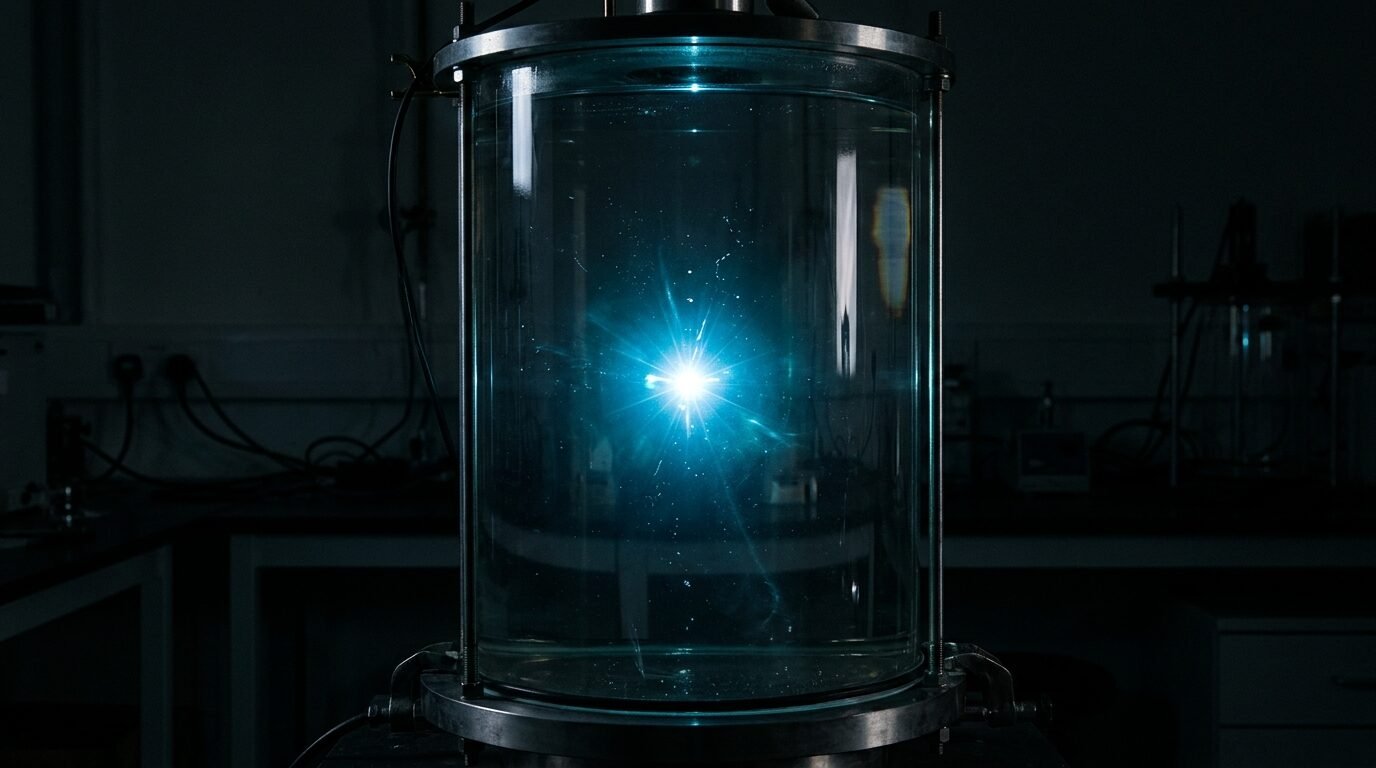
A ten-tonne xenon detector saw one event that its backgrounds struggle to explain. Here is what 2.6 sigma means, why the simplest WIMP fails, and how the hint gets tested.
The LZ dark matter experiment, a ten-tonne tank of liquid xenon sitting almost a mile beneath South Dakota, reported a single particle interaction on September 1 that its known backgrounds struggle to explain. The significance is 2.6 sigma. The collaboration says in plain terms that it is not claiming a discovery, and three weeks on, that restraint is the most useful thing to understand about the result.
Headlines have run the full range, from “possible dark matter signal” to “nothing to see.” Both miss what makes this event interesting. One lone event cannot be a discovery. Yet it does not read as noise to the people who know the detector best. This article covers what LZ measured, how the detector separates rare signals from impostors, why the simplest dark matter model fails to fit, and which independent checks will settle the matter. Wherever a number rests on a single secondary source, it is flagged.
What LZ Reported on September 1
LUX-ZEPLIN (LZ) analyzed 220 live days of data taken between March 2023 and April 2024. In the region of the data where a weakly interacting massive particle, or WIMP, would appear, the team found one event. Expected background there is very low, which is why the interaction stands out. The result was presented at the 2026 TeV Particle Astrophysics conference in Japan, and the collaboration says a paper is going to arXiv and Physical Review Letters.
| Quantity | Reported value |
|---|---|
| Data set | 220 live days, March 2023 to April 2024 |
| Detector | About 10 tonnes of liquid xenon in a time projection chamber, nearly a mile underground at the Sanford Underground Research Facility, South Dakota |
| Candidate events | One, in the WIMP search region |
| Significance | 2.6 sigma, roughly a 0.5% chance that known backgrounds explain it; discovery requires 5 sigma |
| Implied WIMP mass | At least about 200 GeV/c² if the event is dark matter |
| Status | Paper headed to arXiv and Physical Review Letters; LZ continues to take data |
Those values come from the university releases listed at the end, which agree with each other.
How a Liquid Xenon Chamber Sees a Single Collision
When a particle strikes a xenon nucleus, the atom recoils and releases energy in two forms: a prompt flash of scintillation light and a cloud of freed electrons. Light sensors above and below the tank record the flash. An electric field then drags the electrons up to the liquid surface, where they produce a second, delayed flash. The gap between the two signals gives the depth of the interaction, and the pattern on the sensor arrays gives its position in the other two directions. Every event becomes a point in a three-dimensional map.

The ratio of the two flashes carries the particle’s identity. Gamma rays and beta decays scatter off electrons and yield proportionally more charge per unit of light than a heavy particle bumping a nucleus. WIMPs are expected to behave like the second kind, a nuclear recoil, so the analysis keeps those and rejects the rest.
Neutrons are the troublesome mimic, since they also strike nuclei. LZ surrounds the xenon with a water tank and outer detectors that tag neutrons through their other interactions, while the rock overhead removes most cosmic-ray particles. Position matters too. Radioactivity from detector materials concentrates near the edges, so the search uses a central fiducial volume. One technical write-up puts that volume at 5.5 tonnes and the exposure at 2.84 tonne-years; I could not confirm either figure in the collaboration’s own releases.
Why One Event Counts for Anything
A lone event usually means nothing. A detector expecting five background events that sees six has learned nothing at all. The argument here rests on the expectation. Backgrounds in this region are described as very low, and a detailed write-up puts them well below one event, so seeing even one is mildly surprising. Sigma is the unit that measures that surprise.
Sigma converts a tail probability into a distance from the centre of a bell curve. The table gives the standard one-sided conversions.
| Significance | One-sided chance of a fluctuation this large | How physicists treat it |
|---|---|---|
| 2 sigma | 2.3% | Routine; happens constantly |
| 2.6 sigma | 0.47% | The LZ result: a hint |
| 3 sigma | 0.13% | Conventional threshold for “evidence” |
| 5 sigma | About 3 in 10 million | Discovery |
The 0.5% in the LZ releases lines up with the 2.6 sigma row. One technical write-up separates a local significance of 3.4 sigma from a global 2.6 sigma, the difference being the look-elsewhere effect: a statistical penalty for having searched many energies and models instead of one spot chosen in advance. I have not seen the 3.4 figure in the collaboration’s releases, so treat it as unconfirmed.
Why the Simplest WIMP Does Not Fit
The textbook WIMP scatters elastically off nuclei with an interaction that ignores spin. That model predicts a recoil spectrum falling steeply with energy, so most of the signal should pile up at low energy. LZ’s earlier search of this same data set was tuned for exactly that case and set the strongest limits yet on it. A lone event at relatively high energy, with no crowd of low-energy companions, is close to the opposite of what the simplest model produces.

JiJi Fan, a Brown University theorist who is not part of the experiment, makes the same point. The event could not have come from the simplest interaction, so explaining it takes an extended theory. Two are named in the coverage.
Inelastic dark matter
In an inelastic model, the WIMP scatters off a xenon nucleus and leaves it in an excited state slightly higher in energy. The collision only works if the incoming particle carries enough kinetic energy to cover that cost. Gentle, low-energy collisions are forbidden, which would explain the missing low-energy events, and the allowed ones leave large recoils. One write-up cites masses of roughly 200 to 1,000 GeV/c² for this class and points out that the event’s June date happens to fit a proposed seasonal prediction. A single event cannot establish a seasonal pattern, so that coincidence is a curiosity and nothing more.
Momentum-dependent scattering
Here the strength of the interaction grows with the momentum transferred in the collision. Slow encounters are suppressed and energetic ones enhanced, which again thins out the low-energy end of the spectrum.
What Could Make It Something Else
- A background no one has modeled. Aaron Manalaysay of Berkeley Lab says the team is still checking whether a rare background mechanism was missed. UCL’s release adds that outliers in this field usually dissolve into backgrounds under scrutiny, and that this one has not yet.
- A statistical fluctuation. At 2.6 sigma, a fluctuation of this size is rare but hardly exotic, particularly across the many analyses a large collaboration runs.
- An instrument artifact. The release says the event has held up through months of checks, which is reassuring but is not the same as independent confirmation.
In the collaboration’s own framing, spokesperson Rick Gaitskell says the team is not claiming to have seen dark matter and does not want to get ahead of the data with one event. UCL’s Chamkaur Ghag, LZ’s international spokesperson during the data period, uses similar words: no discovery is claimed, though the moment is exciting.
How the Field Will Test It
Three things can move the number. First comes more data. LZ has more than 700 live days in total and is still collecting, so a real signal should keep producing events at similar energies while a fluke fades. Second, other large xenon detectors can look in the same high-energy region. XENONnT and PandaX-4T are comparable in scale; as of this writing I found no result from either on this event. Third, theory has to commit. The inelastic and momentum-dependent models each predict a specific energy spectrum, so every new event would help discriminate between them.
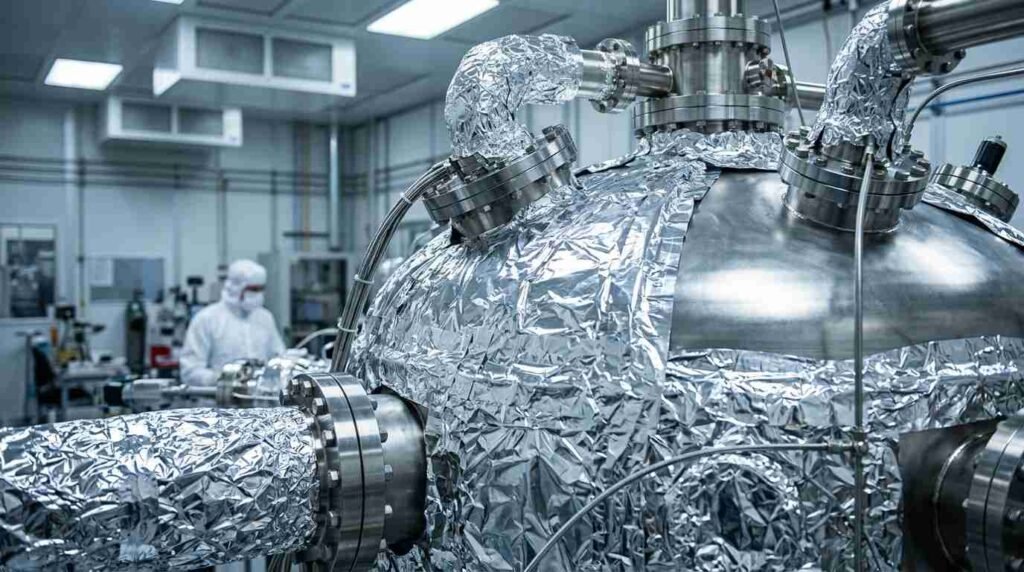
One technical write-up expects independent checks to take several months to about a year. Nothing in the releases contradicts that.
What to Watch For
- The paper itself. The exact energy, expected background count and look-elsewhere treatment belong in the Physical Review Letters submission. I could not verify whether it has been posted to arXiv yet.
- New events. Does the next LZ data release add anything near the same energy?
- Cross-checks. Any statement from XENONnT or PandaX-4T about the same region.
- Model building. Theory papers that pin down a mass, a mediator and a predicted spectrum.
None of this raises the odds of a discovery on its own. The sensible reading is the collaboration’s: interesting, unproven and testable. For readers following the wider particle-physics picture, our coverage of the IceCube Nobel and the LHC high-luminosity upgrade sits alongside this story.
Sources and Verification Notes
- Brown University: LZ experiment sees surprising result in search for dark matter (September 1, 2026)
- University of Michigan News: LZ release
- UCL News: possible hint of dark matter recorded
- Berkeley Lab Physics Division: LZ sees surprising result (teaser only)
- XenoSpectrum technical write-up (secondary source)
Could not verify: whether the LZ paper had been posted to arXiv as of this writing; the 248 keV recoil energy, the 3.4 sigma local significance, the 5.5-tonne fiducial mass and the 2.84 tonne-year exposure, which appear only in the secondary write-up; and any XENONnT or PandaX-4T response. A CNN report on the result could not be fetched and was not used.


One thought on “One Event, 2.6 Sigma: Reading the LZ Dark Matter Hint Without Hype”