

Thirty-one seconds after matches flared in its lower branches, a dry seven-foot Douglas fir under a NIST exhaust hood was releasing heat at 7,362 kilowatts. That figure comes from NIST Technical Note 2131, published in December 2020 under the title “Fire Hazards of Dry Versus Watered Christmas Trees.” NIST filmed the burn for fire safety awareness. The report behind the footage says, in its abstract, that one dry tree and one watered tree were tested, with no replicates.
The second tree is the quieter half of the story. Three tries with matchbooks never got the watered fir to burn on its own, and the best attempt peaked at 6.7 kilowatts before going out. Both results are real measurements from a serious lab. Both come from a sample of one, and the authors wrote down plainly what that means.
Four firs from a Maryland farm
What NIST actually set on fire, and what it chose not to measure
The trees were cut on October 5, 2017, at a Maryland tree farm, about four weeks before testing, and stored indoors at NIST’s National Fire Research Laboratory. Four were harvested. Two went into water within three hours, after a fresh cut about 50 millimeters above the base; the other two were nailed to plywood bases and given nothing. Only one of each pair was burned. The spares were insurance.
Every tree stood about 2.1 meters, or 7 feet. According to the report, the mass and dimensions of the trees were not measured, and the report contains no moisture content readings at all. “Dry” and “watered” describe what was done to the trees, not a number on a moisture meter.
The fires were set in a mock living-room corner with an 8-foot ceiling, rebuilt for each test with the same props: an upholstered wing chair, a wood table, a shelf of objects, a carpet and a painting. The report is frank about its purpose. The corner was built to provide background for video recording and not to replicate a specific or typical living room, and the tests were designed by NIST’s Fire Research Division with its Public Affairs Office for fire safety awareness.
That is a stage set wired to a very good meter.

A matchbook, a nichrome wire and a 20-megawatt hood
How the heat was counted, and where the count gets soft
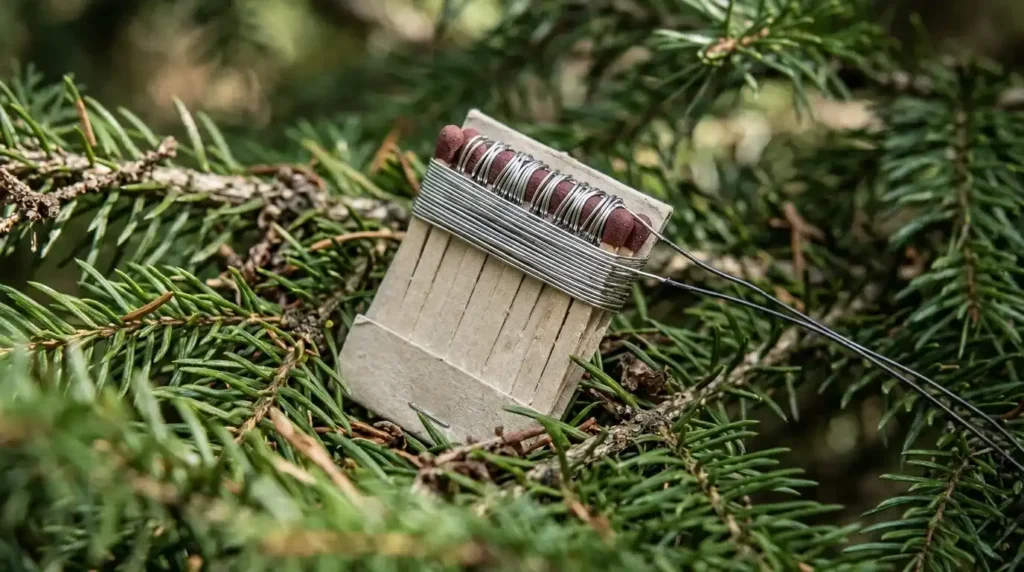
The ignition source was an “electric match”: a book of matches with the heads wrapped in thin nickel-chromium wire, so the team could light it remotely. It went into the branches in the lower third of the tree. After the first watered-tree attempt failed, the team added a second matchbook to make a larger source, and two books were used for the remaining ignitions of both trees, including the dry tree’s.
Heat release was measured with NIST’s 20 MW calorimetry system, using oxygen consumption calorimetry under a 6-meter hood that pulled about 21 kilograms of exhaust per second. The method works like a gas meter read backwards: burning consumes oxygen in a known ratio to the heat released, so measuring how much oxygen goes missing from the exhaust gives the fire’s output. NIST’s own competition page for modeling tree fires describes the same approach as a way to quantify how rapidly a burning tree releases energy.
The report attaches an expanded uncertainty figure to each hood and adds a warning that bears directly on this burn: transient events lasting less than 30 seconds may carry larger uncertainty because of the system’s response time. The dry tree hit its peak at 31 seconds. That is a fast rise of the kind the warning covers, so the 7,362 figure is best read as a well-measured number whose error bars may run wider than the hood’s stated uncertainty, and not as a value good to the last kilowatt.
Thirty-one seconds against seventy-one
Half a minute to megawatts, and a second fire that put itself out
The dry tree caught on the first attempt and, in the report’s words, the fire grew rapidly. The two timelines, from the report’s event tables (Table 2 for the dry tree, Table 1 for the watered one):
| Event | Dry tree | Watered tree (attempt 3) |
|---|---|---|
| Ignition | 0 min | 0 min |
| Peak heat release rate | 0.52 min (31 s), 7,362 kW | 1.18 min (71 s), 6.7 kW |
| Suppression | 12.02 min | none needed |
| Fire out | 16.55 min | 4.05 min (self-extinguished) |
All figures from NIST TN 2131.
The watered tree took three attempts. The first electric match in the lower branches failed. A second matchbook went in for the next try, which also failed. For the third, two books were placed where the needles looked most dried out, and the fire grew as neighboring needles caught, then went out on its own. NIST calls its 6.7 kW peak at the limit of detection for this calorimeter and not well quantified, which is a polite way of saying an instrument built for megawatt fires was asked to weigh a feather.
That is why a ratio between the two peaks, roughly 1,100 to 1 on paper, means very little. The bottom number is barely above the floor of the scale.
7,362 kilowatts, in space heaters
Converting a lab number into something that plugs into a wall
A kilowatt figure that large doesn’t register with most people, so it helps to put it next to a household appliance. A Yukon government energy tip sheet describes a typical 1,500-watt portable heater as enough to warm about 185 to 215 square feet. Heater maker Lasko notes that a 1500 watt space heater on high will draw 12.5 amps, close to the limit of the 15-amp breaker a bedroom typically sits on.
At peak, the dry tree was putting out heat at the rate of about 4,900 of those heaters running on high. Even allowing generous error bars for a fast transient, the answer stays in the thousands. At one heater per 15-amp bedroom breaker, matching it would take about 4,900 bedrooms, and an electrician with a very long afternoon.
The watered tree’s best effort, 6.7 kW, comes out to about four and a half space heaters. That is a real fire in a living room, and nobody would want it next to a wing chair; commercial kitchens, where burns are a routine entry in federal injury data for food service, treat far smaller flames with respect. It is also not in the same category as the dry tree.
One comparison stays off the table. The footage is easy to read as a flashover, and NIST’s fire dynamics guidance ties flashover to room conditions: its reference tables list gas temperatures of 400 °C or more at the beginning of room flashover and a threshold flux of 20 kW/m² to the floor. TN 2131 reports heat release rate, not room temperatures or floor heat flux, and it makes no flashover comparison. The video may look like one. The report doesn’t say so.
What one tree can and cannot prove
The authors said it first: these results should not be extrapolated
The report’s limitation is stated without hedging. Because of the limited number of tests, and because the room corner wasn’t designed to replicate real conditions, NIST writes that these results should not be extrapolated. Artificial trees were not considered.
A sample of one is an existence proof. It shows that a dry Douglas fir of this size, left unwatered for about four weeks indoors and lit with two matchbooks in its lower branches, can reach several megawatts within half a minute. It shows that one watered fir, given three tries, did not sustain a fire from the same kind of source.
It cannot show how often either outcome happens. It can’t give a typical peak for dry trees, because there is no distribution, only a point. It can’t say how much water is enough or how many days without it turn a tree dangerous, because moisture was never measured. Other species, other heights, taller ceilings, a lamp cord instead of a matchbook: none of that was tested. And the watered result can’t be read as “watered trees don’t burn.” It is three attempts on one tree, the last of which grew a small fire among the nearby needles that was out about four minutes after ignition.
There is a sharper point underneath that one. The famous video has done most of its persuading on a viewer’s gut, and guts are bad at counting. Anyone who watched it and concluded that a watered tree is fireproof took more from n=1 than NIST ever put in.

Why the advice survives the small sample
The strongest case against this post is that the water rule never rested on one tree
The fair objection to all of this caution is that the practical advice doesn’t depend on TN 2131 at all. NIST’s own holiday fire safety page says dry Christmas tree fires can ignite and grow quickly to release large amounts of heat, and that keeping a cut tree well watered can help limit ignition likelihood, fire growth rate and peak fire size. That page points to earlier NIST work, including a 2008 report on a residential sprinkler and a Christmas tree fire, and a 2009 Combustion and Flame paper on burning Douglas fir trees. The modeling competition page also lists a 1999 NIST report on Scotch pine tree fires. The 2017 burns put on camera a hazard NIST had been measuring since at least 1999.
The national numbers keep the hazard in proportion. NFPA’s statistics pages could not be fetched for this post, so the figures here come from trade press reports quoting NFPA. For 2018 to 2022, NFPA counted an average of 155 home structure fires a year that began with Christmas trees, with four civilian deaths, seven civilian injuries and $15 million in direct property damage annually. Forty-one percent involved electrical distribution or lighting equipment, 20 percent lamps or bulbs and 11 percent candles, and 40 percent started in the living room, per the same report. A January 2025 report adds that 36 percent of these fires occur in January, after the holidays, when many trees have been standing for weeks.
Run the arithmetic and four deaths over 155 fires is about one death for every 39 tree fires. Rare, and not gentle when it happens. National counts like these come from fire-incident estimates rather than lab burns, the same kind of record behind x9m8’s 21 years of US Fire Administration restaurant fire estimates.
The advice NFPA gives is the same advice the video sells: cut two inches from the base of the trunk before placing the tree in a stand, and water it daily, and keep it at least three feet from heat sources. A tree stand is a reservoir with a pipe running up through the trunk, and the pipe only works if the cut end is fresh and wet. Both the n=1 test and the broader record point the same way. One just has better lighting.
Sitting in the national data is that January number: more than a third of tree fires come after the presents are gone. How many living rooms still have last month’s fir standing in a dry stand when the ball drops?
Sources
- Hoehler, M. S., Bundy, M. F., DeLauter, L., Materese, R., Geršković, L., García, J. R., “Fire Hazards of Dry Versus Watered Christmas Trees,” NIST Technical Note 2131, December 2020, https://doi.org/10.6028/NIST.TN.2131: https://nvlpubs.nist.gov/nistpubs/TechnicalNotes/NIST.TN.2131.pdf
- NIST, Christmas Tree Heat Release Rate (HRR) modeling competition page: https://pages.nist.gov/christmas_tree_fire_safety
- NIST, “What Does Fire Size Mean?” (holiday fire safety): https://www.nist.gov/fire/holiday-fire-safety/holiday-fire-safety/what-does-fire-size-mean
- NIST, Fire Dynamics (fire service resources): https://www.nist.gov/el/fire-research-division-73300/firegov-fire-service/fire-dynamics
- x9m8, “What starts fires in restaurants and bars”: https://x9m8.com/restaurant-fires-usfa-estimates/
- x9m8, “Cuts and burns, not falls”: https://x9m8.com/food-service-injuries-bls-soii/
- Fire & Safety Journal Americas, “NFPA issues advice on preventing Christmas tree fires this holiday season,” Nov. 27, 2024: https://fireandsafetyjournalamericas.com/nfpa-issues-advice-on-preventing-christmas-tree-fires-this-holiday-season/
- Security Sales & Integration, “NFPA Warns More Than One-Third of Christmas Tree Home Fires Occur in January,” Jan. 7, 2025: https://www.securitysales.com/news/nfpa-christmas-tree-home-fires-january/609188/
- Energy Solutions Centre (Yukon), “Easy$ Tip Sheet: Portable Electric Space Heaters”: https://emrlibrary.gov.yk.ca/emrlibrary/energy/ets11-electric-heaters.pdf
- Lasko, “Learn About Your Home’s Circuits to Run Space Heaters Safely”: https://www.lasko.com/learn-about-your-homes-circuits-to-run-space-heaters-safely/