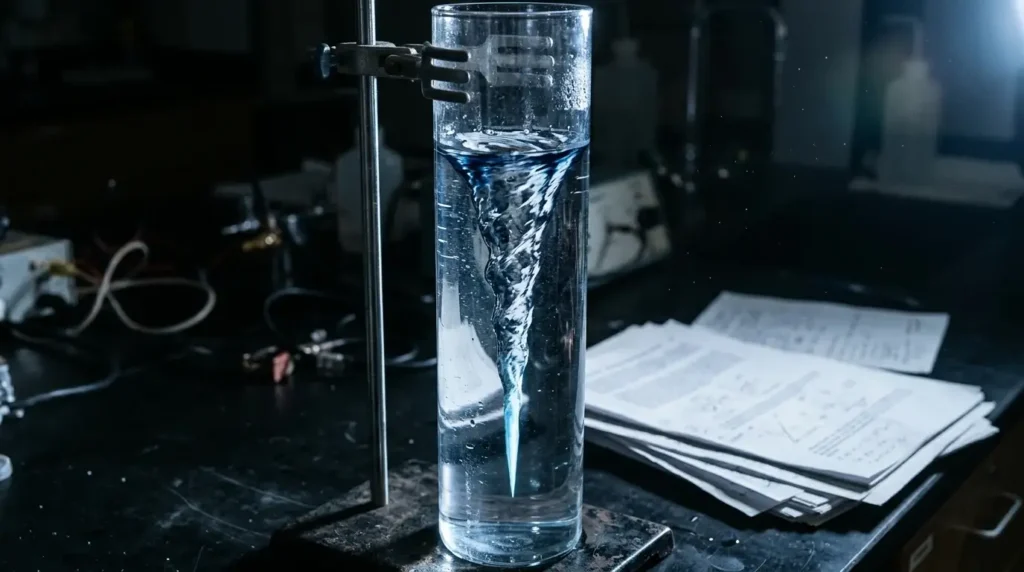
The manuscript is 166 pages long, and its title page names no person, only “OpenAI.” Inside is a construction of a fluid that starts from rest and develops unbounded velocity in finite time while its total kinetic energy stays bounded. If it holds, it settles one of the seven problems the Clay Mathematics Institute selected in 2000, each carrying a $1 million prize, by showing that the Navier–Stokes equations can break.
OpenAI announced the result on September 8, 2026. Eleven weeks later the honest status report runs to three lines. The paper says its theorem establishes one of the four prize statements, and a side-by-side reading of the two documents finds no obvious mismatch, though no independent mathematician has published that comparison. Nobody has publicly finished checking the proof by hand. And the prize clock, under Clay’s own rules, has not started.
A vortex that runs out of room
What OpenAI says it built, in the words of its own paper
Science News described the object as a vortex that grows thinner and faster until its speed becomes infinite. The paper is more exact. Its Theorem 1.1 works in three-dimensional space with no walls, for every positive viscosity. The fluid begins with zero velocity. A smooth force, switched on and off within a bounded region of space and a bounded window of time, pushes on it. The solution stays smooth up to time 1, and then its peak velocity has no upper bound.
That last part is a pipe bursting at a single point while the gauge on the whole boiler still reads normal. The total energy stays finite. Only the local speed runs off the dial.
From that, the paper draws the conclusion that matters for the prize: there is no smooth solution with the same force and initial datum whose kinetic energy stays bounded for all time. The paper then states its claim outright: “This establishes alternative (C) in the Millennium problem statement for Navier–Stokes as stated by Fefferman.” That sentence is OpenAI’s assertion, not an outside finding. A later corollary carries the construction onto a periodic box, which the paper says establishes alternative (D) as well.
According to Science News, OpenAI ran around 10,000 AI agents at a time on the search and estimated the cost in the millions of dollars.
The four doors in the Clay statement
Fefferman’s official text writes an outside push into two of the four statements
Science News described what the agents found as a solution to “the forced version of the Navier-Stokes problem,” a phrase that can make it sound like a side road. The official problem statement reads differently.
Charles Fefferman’s description for the Clay Institute asks for a proof of exactly one of four statements. Two say the equations always behave. Two say they don’t.
| Clay statement | What it asserts | Domain | Force allowed? |
|---|---|---|---|
| (A) | Smooth, finite-energy solutions always exist | All of 3D space | No, force is zero |
| (B) | Smooth solutions always exist | Periodic box | No, force is zero |
| (C) | Some smooth starting data and smooth force produce no smooth, finite-energy solution | All of 3D space | Yes, if smooth and rapidly decaying |
| (D) | Some smooth periodic data and force produce no smooth periodic solution | Periodic box | Yes, if smooth and periodic |
Summarized from Fefferman’s official problem description. Table by x9m8.
The two “breakdown” statements were written with a force in them from the start. For (C), the force has to be smooth and it and its derivatives have to decay faster than any power of distance and time. The starting velocity has to be smooth, divergence-free and decay just as fast. A “physically reasonable” solution is one that is smooth everywhere for all time and keeps its energy bounded. Statement (C) asks for a case where no such solution exists.
Set the theorem’s stated hypotheses beside that checklist, as x9m8 did for this post, and the boxes appear to fill in. A force confined to a bounded patch of space and time decays faster than any power, because past the edge of the patch it is zero. A starting velocity of zero is smooth, divergence-free and decays trivially. The paper phrases its conclusion as the absence of a smooth solution with bounded energy. That is a comparison of how two documents are worded. It says nothing about whether the 166 pages of argument in between are correct, and no outside expert quoted in the coverage has signed off on the match.
So “forced” is not, by the text, a disqualifier. The door is in the official statement, and OpenAI’s paper says it walked through it.
What the match doesn’t settle
The unforced questions, and the Euler result next door
A blowup under (C) answers the Millennium problem in the negative direction. It says nothing about statements (A) and (B), which ask whether a fluid left alone, with no outside force, always stays smooth. Those are different claims, and proving one breakdown statement does not resolve them either way. Clay only requires one of the four.
The competing result announced the day before sits further from the prize. Tristan Buckmaster of New York University and Levent Alpöge of Anthropic reported a blowup for the forced Euler equations, the version with no viscosity. Fefferman’s description sets the Euler case to zero viscosity and calls the Euler problems also open and very important, but all four prize statements require positive viscosity. A result about Euler, however strong, is outside the four doors.
Buckmaster’s own public statement says he and Alpöge obtained blowup results with smooth forcing for both Boussinesq and Euler on August 15th. The Navier–Stokes version, which carries viscosity and is the one Clay pays for, was the gap still open when OpenAI’s announcement landed.
Who has checked it
A Lean confirmation, one written dissent on credit, and no finished human read
Science News reported that Lean, the proof-checking software, confirmed OpenAI’s solution. The report does not say how much of the 166 pages was formalized, who ran the check, or which definitions the formal statement used. Those details decide what a Lean confirmation is worth. A formal proof is a sealed system: it guarantees the conclusion follows from the stated premises, and someone still has to confirm the premises say what Clay’s text says.
The human side is further behind. Gregory Eyink, a mathematical physicist at Johns Hopkins University, told Science News: “I don’t think anyone has completely verified the proof yet, certainly not on the human side.” That was in September.
Some outside work has started. On September 28, Zhen Lei and Xiao Ren posted a paper to arXiv that presents a more readable account of the profile-construction part of OpenAI’s manuscript, with another piece of the argument, the cancellation by oscillatory pulses, deferred to a companion Part II. The authors describe OpenAI’s manuscript as a major advance. A careful rewrite of one part is how checking usually begins in this field. It is not the same as a finished check of the whole.
Then there are Clay’s rules, which move slowly by design. Under the Millennium Prize rules, a proposed solution has to be published by a qualifying outlet, at least two years have to pass after that publication, and the solution has to achieve “general acceptance in the global mathematics community.” The rules also say CMI will not accept solutions submitted directly to it. A PDF on a company server meets none of those conditions yet.
OpenAI, for its part, said in a blog post that it will not claim the prize, according to Science News.
The argument about who did the work
Credit, a request about an author list, and a careful sentence about data
The proof is not the only contested object. Buckmaster’s statement says he was told that an internal OpenAI model had produced a proof of finite-time blowup for the forced Navier–Stokes equations, and adds: “I have not seen OpenAI’s proof.” He writes that during talks about how to present the two results, “Sebastien twice asserted that he wanted Levent removed from authorship.” Those are his allegations, stated in his own document. Science News reported the same claim, that the discussions included a request to exclude Alpöge, who works at Anthropic.
Buckmaster also asked “whether the model had been trained on, or had access to, our sessions in Codex,” referring to OpenAI’s coding tool, which he and Alpöge had used. His statement says he was told the model did not look up user data, and that a second question, about training, went unanswered. Science News reports that OpenAI denies its agents had direct access. Its statement, quoted by Science News, says: “while unlikely, we cannot rule out that de-identified data derived from their usage of our products” may have helped improve its models.
The denial covers direct access. The sentence after it leaves a side door propped open.
Buckmaster’s statement does not attack the mathematics. If an OpenAI model did close the gap, he writes, that is a remarkable thing, and he wants it “said loudly, by them, with the history intact.” He also asked for something slower: “The community needs to have serious and unhurried discussion about where to go from here.” Eyink called credit attribution for AI-assisted discoveries the really serious ongoing problem.
The case that it matters less than the headline
A celebrity equation, a construction built to break, and a field that learns from the struggle
The strongest case against treating this as a turning point comes from mathematicians themselves. Eyink pointed out, in Science News’s paraphrase, that real fluids are made of molecules and atoms, so the equations already carry a known cutoff and a velocity going infinite at a point has little practical consequence. “There’s a huge mathematical celebrity associated with these equations,” he told Science News.
Terence Tao, in a Mastodon thread quoted by MIT Technology Review, argued that human-directed efforts tend to spur further development of the field, and warned against “prematurely solving the problem by purely AI-powered methods.” A proof found by ten thousand agents may close the question without handing people the understanding that years of failed human attempts usually leave behind. Javier Gómez-Serrano of Brown University, quoted in the same article, added that very few mathematicians will have resources on that scale.
There is a fair answer on the other side. Dallas Albritton of the University of Wisconsin–Madison, who was not involved, told Science News: “It’s one of the guiding problems for the field. It is a huge deal to know the answer.” Knowing that blowup with a smooth force is possible changes what people try next, whatever produced the proof. And Fefferman’s text puts a force into both breakdown statements, so if the proof survives checking, the construction answers a question the problem actually asks.
Earlier x9m8 coverage traced a similar pattern with OpenAI’s model and the Erdős unit distance conjecture, and laid out why proof search explodes and what an AI would need to do this kind of work. The equations themselves can be stirred in a browser tab in the x9m8 Navier–Stokes fluid simulator, where the numbers stay politely finite.
What is established, as of late November: a 166-page manuscript that says its main theorem establishes Clay statement (C), with a corollary it says reaches (D); a wording match that holds up on a plain reading but has no published independent check; a reported Lean check whose scope has not been described in public reporting; one part rewritten by outside mathematicians; no completed human verification on record; no journal publication; and a prize the claimant says it won’t take. The proof itself remains unverified. Whether the answer will count as understood, or only as true, is the kind of question the two-year waiting period leaves room for. Should a proof nobody has read end to end count as solved?
Sources
- Science News, Emily Conover, “AI may have solved one of math’s biggest puzzles, raising controversy” (Sept. 9, 2026): https://www.sciencenews.org/article/ai-math-puzzle-navier-stokes-openai
- OpenAI, “Finite time blowup for Navier–Stokes” (manuscript PDF): https://cdn.openai.com/pdf/32d9f210-8b73-45e0-91bc-82a30aef8a9a/navier-stokes.pdf
- Clay Mathematics Institute, Charles L. Fefferman, “Existence and Smoothness of the Navier–Stokes Equation” (official problem description): https://www.claymath.org/wp-content/uploads/2022/06/navierstokes.pdf
- Clay Mathematics Institute, Rules for the Millennium Prizes (Sept. 26, 2018): https://www.claymath.org/wp-content/uploads/2022/03/millennium_prize_rules_0.pdf
- Tristan Buckmaster, public statement (NYU Courant): https://cims.nyu.edu/~tristanb/statement.pdf
- Zhen Lei and Xiao Ren, “Finite-Time Blowup for Navier-Stokes with Smooth Forcing, Part I,” arXiv:2609.35406: https://arxiv.org/abs/2609.35406
- MIT Technology Review, “What OpenAI’s latest controversy tells us about the future of math” (Sept. 8, 2026): https://www.technologyreview.com/2026/09/08/1143747/what-openais-latest-controversy-tells-us-about-the-future-of-math/amp/