Sixty-four. That is how many cells one bacterium becomes in two hours if it splits every 20 minutes and nothing slows it down, and it is the number hiding inside the most repeated sentence in American kitchen safety: leftovers must be refrigerated within 2 hours of cooking, according to the USDA’s Food Safety and Inspection Service. The rule gets printed on fridge magnets and repeated every November. The arithmetic behind it almost never gets shown.
Two hours, one hour, and a band of temperatures
The federal rule fits on an index card, and the card leaves out the reasoning
The FSIS leftovers page sets three limits. Food goes into the refrigerator within two hours of cooking or of coming off a warmer, and the window shrinks to 1 hour if the temperature is over 90°F, the page’s example being a summer picnic. Its stated reason is a single line: bacteria grow rapidly between the temperatures of 40°F and 140°F.
The CDC gives the same two numbers on its prevention page for Clostridium perfringens, adding that cooked food should be kept at 140°F or hotter before serving and that leftovers should be reheated to 165°F. FSIS puts storage at three to four days in the refrigerator.
None of those pages says how fast “rapidly” is. That gap is where the folklore moves in.
Twenty minutes, a million cells, and a clock that doesn’t match
One popular explainer carries two numbers that can’t both be true for the same bug
A common version of the speed claim comes from university extension writing. A 2016 Illinois Extension post by Lisa Peterson says bacteria double in as little as 20 minutes when left in the danger zone, and in the next breath that under optimal conditions it only takes 5 hours for bacteria to go from one to one million.
Run those two together and they disagree. Getting from one cell to a million takes about 19.9 doublings, since 2 raised to the 20th power is just over a million. At one doubling every 20 minutes, that is 6.6 hours, not five. Five hours would require a doubling roughly every 15 minutes.
Neither number is crazy on its own. The likeliest reading is that they come from different organisms, or the same organism in different conditions, folded into one paragraph as if a single bacterium had a single speed. The 20-minute figure has a respectable pedigree: the OpenStax Microbiology textbook notes that Escherichia coli can double in as little as 20 minutes under optimal growth conditions in the laboratory. Those last three words carry the load. A lab flask of warm broth is a tuned engine on a dyno. A turkey carcass on a kitchen counter at 70°F is the same engine idling in a cold garage.
The table the magnets don’t print
Growth multiples at three doubling speeds, before any real-world brakes
The textbook formula is simple. After n doublings, the population is the starting count times 2 to the n, which OpenStax writes as Nn = N0 × 2^n. The table below applies it, computed in Python, assuming growth never pauses, never slows, and never runs out of room. Each cell is how many cells one starting cell becomes.
| Doubling time | After 1 hour | After 2 hours | After 4 hours | After 5 hours |
|---|---|---|---|---|
| 10 minutes | 64 | 4,096 | about 16.8 million | about 1.07 billion |
| 20 minutes | 8 | 64 | 4,096 | 32,768 |
| 30 minutes | 4 | 16 | 256 | 1,024 |
| 60 minutes | 2 | 4 | 16 | 32 |
The curve bends violently. Halving the doubling time from 20 minutes to 10 does not double the four-hour result; it multiplies it by 4,096. Small changes in temperature, which move doubling time, swing the outcome by orders of magnitude.
Hour two is also worse than hour one, and hour four is far worse than hour two. At a 20-minute doubling, the first hour adds seven cells per starting cell. The fourth hour adds more than 3,000. Leaving food out is less like a slow leak from a pipe and more like a boiler pressure gauge creeping up, where each minute counts more than the one before it.
For at least one common foodborne bacterium, the 10-minute row is close to measured reality.
The bacterium that waits for the pot to cool
Cooking kills most of it, and that turns out to be the problem
Clostridium perfringens is the leftover pathogen in the plain sense of the word. The CDC estimates it causes nearly 900,000 foodborne illnesses in the United States each year, and lists poultry, meat and gravy among the usual foods. Its outbreaks most often involve foods cooked in large batches and held at unsafe temperatures, which describes a holiday kitchen as well as a catering hall.
A pathogen data sheet prepared for New Zealand’s food safety regulator by the government science institute ESR lays out the numbers. The organism grows between a minimum 10°C and maximum 54°C, with an optimum of 43°C, which is roughly 50°F to 129°F with a sweet spot near 109°F. The same document, citing published microbiology reviews, says some isolates have a very short generation time (<10 min.).
Put that next to the table. A sub-10-minute doubling is the top row, and the top row runs to millions within four hours.
The harder fact sits underneath. C. perfringens forms spores, and the Canadian Food Inspection Agency says plainly that ordinary cooking will not kill C. perfringens spores. The ESR data sheet explains why slow cooling matters so much: slow cooling and/or slow reheating provide germinating spores and surviving cells a chance to multiply. Cooking clears out the competition. Then a deep pot of gravy or stock drifts down through 120°F, 110°F, 100°F, spending a long stretch right at the organism’s favorite temperature, and the survivors have the place to themselves.
The counter matters less than the slow slide through the middle of the band, and a deep pot makes that slide longer.
The brake the simple math leaves out
Real bacteria spend the first stretch getting their bearings, and regulators lean on that
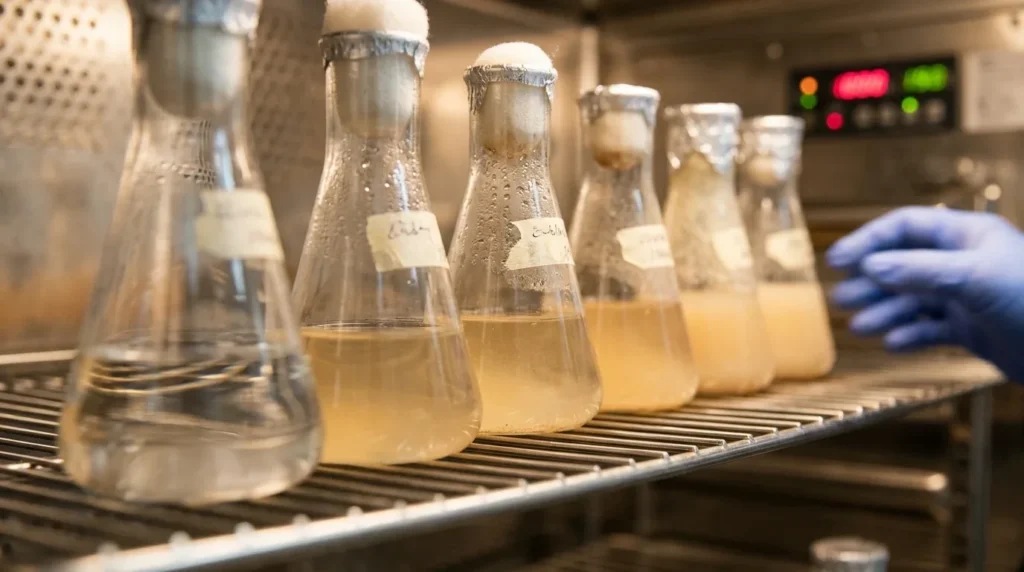
Bacteria dropped into a new environment don’t start splitting at once. OpenStax describes a lag phase, during which the number of cells does not change while the cells grow larger and build the proteins they need. Only afterward does the exponential phase begin. Every row of the table above assumes zero lag, which is the worst case, not the typical one.
How much that brake matters shows up in the numbers. With a 20-minute doubling and no lag, two hours yields 64 cells per starting cell. Add a hypothetical one-hour lag and the same two hours yields eight. Add 90 minutes of lag and it yields fewer than three. Those lag lengths are illustrations, not measurements; real lag depends on the organism, the food, the temperature and the cells’ recent history.
Regulators already build some slack into restaurant rules. The FDA Food Code lets restaurants hold certain food without temperature control under “time as a public health control,” with a maximum up to 4 hours, after which the food has to be cooked and served, served, or discarded. The 2017 Food Code supplement adds a narrow exception for cut fruits and vegetables and freshly opened canned foods that start at 70°F or below. Its public health rationale for that exception cites modeling and peer-reviewed literature showing Salmonella and Listeria monocytogenes will not exceed a 1-log increase in growth when the food starts and stays at 70°F or less for up to four hours. One log is a tenfold increase. Staying under tenfold in four hours means an average doubling time no faster than about 72 minutes, slower than even the bottom row of the table.
Food Standards Australia New Zealand runs a similar scheme for businesses. Under its 2-hour/4-hour rule, food that has spent under two hours between 5°C and 60°C can be used, sold or put back in the fridge; between two and four hours it can be used but not refrigerated for later; past four hours it must be thrown away. FSANZ says the time between 5°C and 60°C is cumulative, so a dish that sits out for an hour on Thursday and another hour on Friday has used its whole allowance.
Taken together, that is a strong argument that the home rule is conservative. Professional kitchens get four hours under specific conditions. Home cooks get two, and one in summer heat.
The counterargument is the organism in the previous section. FDA’s one-log rationale covers Salmonella and Listeria in cut produce and opened canned food kept at 70°F or below. It says nothing about a pot of gravy sitting at 110°F, where C. perfringens works fastest. The two-hour home rule covers food at any temperature in the band, held by people with no thermometer and no time stamp. A margin that looks generous for room-temperature salad looks thin for a warm roasting pan.
Where the two hours came from
The agencies print the rule, and the derivation is harder to find than the magnet
A clear origin for the specific two-hour figure did not turn up in the federal pages reviewed for this post. FSIS states the rule without derivation. FSANZ says its own version has been scientifically checked and is based on how quickly microorganisms grow in food, without publishing the calculation on that page. The closest thing to a published basis in the documents reviewed is FDA’s one-log growth ceiling, and it supports a narrow restaurant exception for cold produce and canned food, not the home leftovers rule.
What the documents do show is a consistent design logic. Time limits are set so that growth stays small enough that cooking, reheating or the body’s defenses handle what is there. The two-hour home figure reads like half of the four-hour professional figure, a safety factor for kitchens without timers, though no agency page reviewed here says that in so many words.
Cooling is the other half of the clock
The rule says when food goes in the fridge, and physics decides how long it stays warm once there
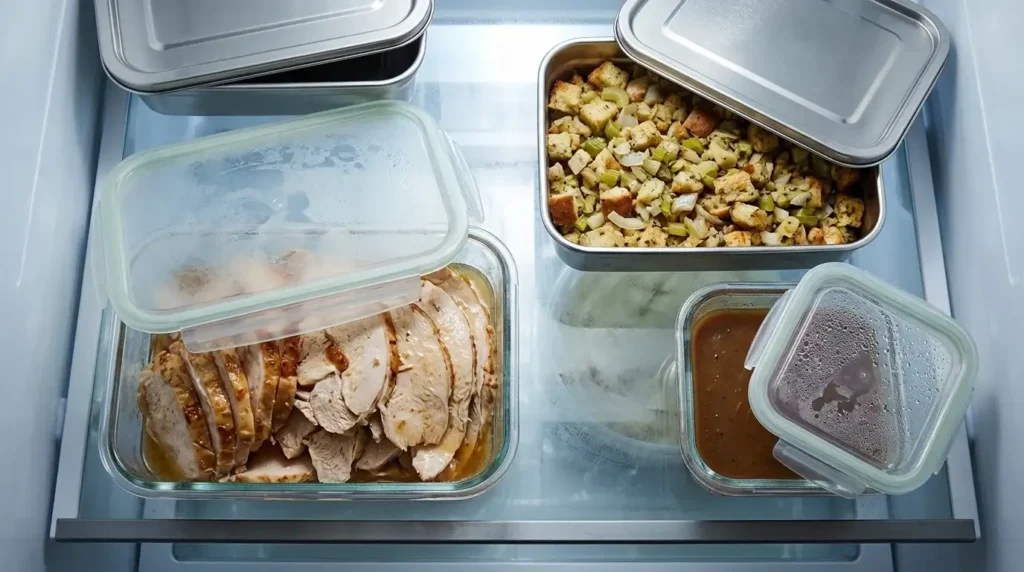
FSIS adds instructions that matter as much as the deadline. It says hot food can be placed directly in the refrigerator, which cuts against a stubborn habit of letting the pot cool on the stove first. It also says to divide large amounts of food into shallow containers. The CFIA likewise advises refrigerating leftovers promptly in uncovered, shallow containers so they cool quickly.
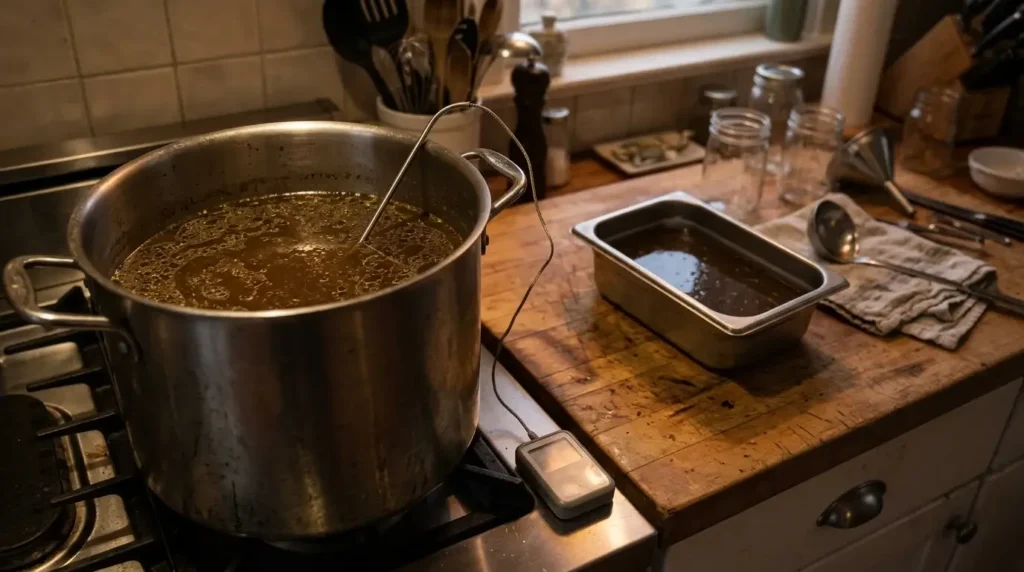
The reason is geometry. A deep pot of stock loses heat through its surface, so the center is the last part to cool, like a radiator that keeps ticking after the boiler shuts off. Splitting it into shallow pans gives the heat a short way out. The two-hour rule starts the clock; container depth decides how long the food spends in the 100°F range, where the C. perfringens row of the table lives.
Bacteria never sorted through a fridge magnet. They respond to the temperature at the center of the food, minute by minute, and that is the number nobody at the table checks.
The same exponential logic shows up wherever bacteria multiply, from antibiotic cycling strategies to phage therapy, and the leftovers question sits right next to the one x9m8 took on in US food waste revisited: every pan thrown out to be safe is food somebody paid for.
A turkey that came out of the oven at 3 p.m. and was carved at 4 is already halfway through its allowance before anyone sits down. What does the clock look like in kitchens where the carcass goes into stock the same night: shallow pans, or the big pot straight into the fridge?
Sources
- USDA FSIS, “Leftovers and Food Safety”: https://www.fsis.usda.gov/food-safety/safe-food-handling-and-preparation/food-safety-basics/leftovers-and-food-safety
- Illinois Extension, Lisa Peterson, “How important is the 2-hour rule?” (Sept. 16, 2016): https://extension.illinois.edu/blogs/illinois-nutrition-edition/2016-09-16-how-important-2-hour-rule
- OpenStax, Microbiology, 9.1 “How Microbes Grow”: https://openstax.org/books/microbiology/pages/9-1-how-microbes-grow
- CDC, “About C. perfringens Food Poisoning”: https://www.cdc.gov/clostridium-perfringens/about/index.html
- CDC, “Preventing C. perfringens Food Poisoning”: https://www.cdc.gov/clostridium-perfringens/prevention/index.html
- ESR for NZFSA, pathogen data sheet “Clostridium perfringens” (July 2010), hosted by New Zealand Ministry for Primary Industries: https://www.mpi.govt.nz/dmsdocument/11021/direct
- Canadian Food Inspection Agency, “Pathogen: Clostridium perfringens”: https://inspection.canada.ca/en/food-safety-consumers/fact-sheets/food-poisoning/clostridium-perfringens
- FDA / U.S. Public Health Service, Supplement to the 2017 Food Code (§ 3-501.19 and Annex 3): https://fda.gov/media/133749/download
- Food Standards Australia New Zealand, “2-hour/4-hour rule”: https://www.foodstandards.gov.au/business/food-safety/2-hour-4-hour-rule