






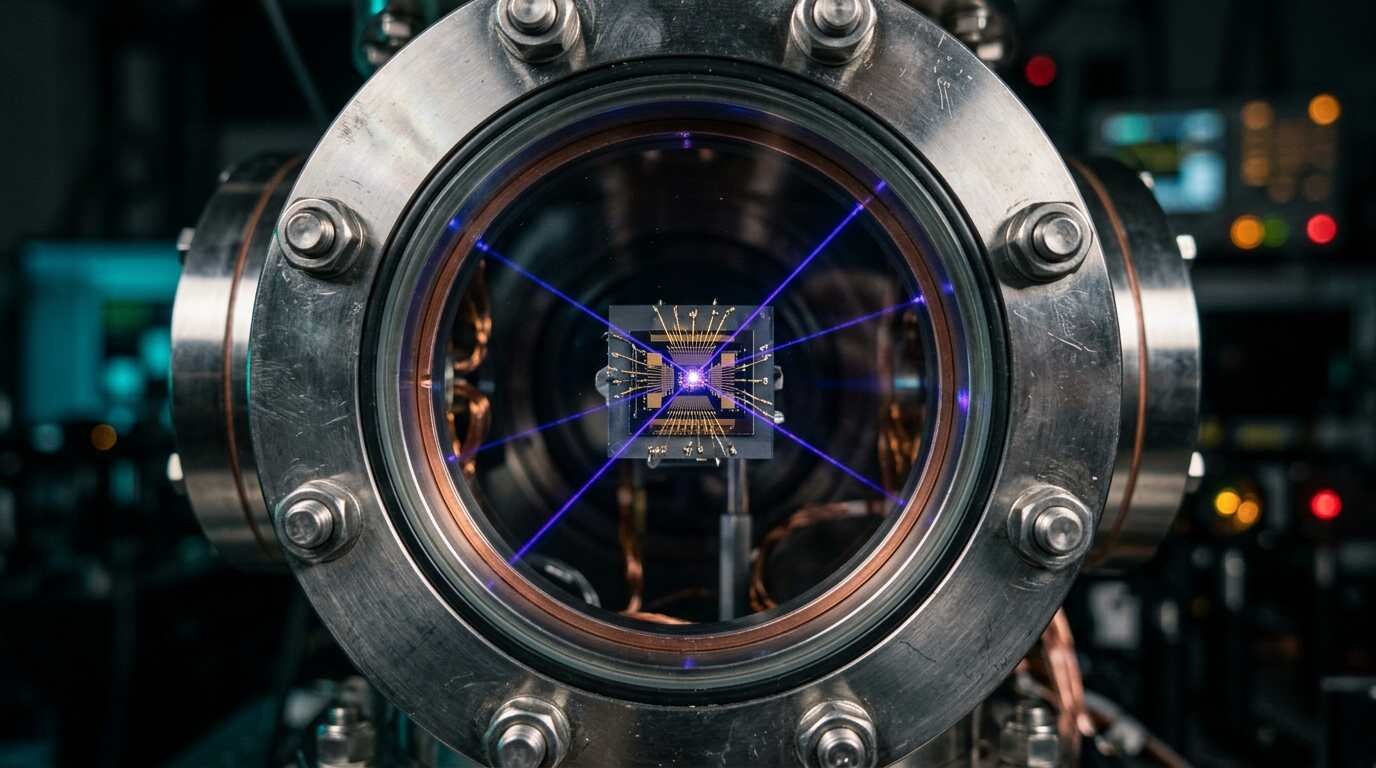
A Nature paper reports universal gates from braided anyons on Quantinuum's H2. Here is what it shows, what the headlines overstate, and what to watch next.
Six in a hundred. That is roughly the share of attempts that survived every check when a team prepared a so-called magic state from braided anyons on Quantinuum’s H2 trapped-ion machine, going by the figure captions of a paper published in Nature this July.
Coverage has framed the work as topological quantum computing finally going universal. The paper’s claims are narrower than that, and in some ways more interesting. What follows takes the result apart claim by claim: what the authors demonstrated, what the headlines imply, and where the two part ways.
A note on sourcing. I could read the abstract, the metadata, figure captions and the university press materials, but the full text sits behind a paywall. Where a number below comes from a caption, I say so, and anyone quoting it should check it against the paper.
The Result in One Paragraph
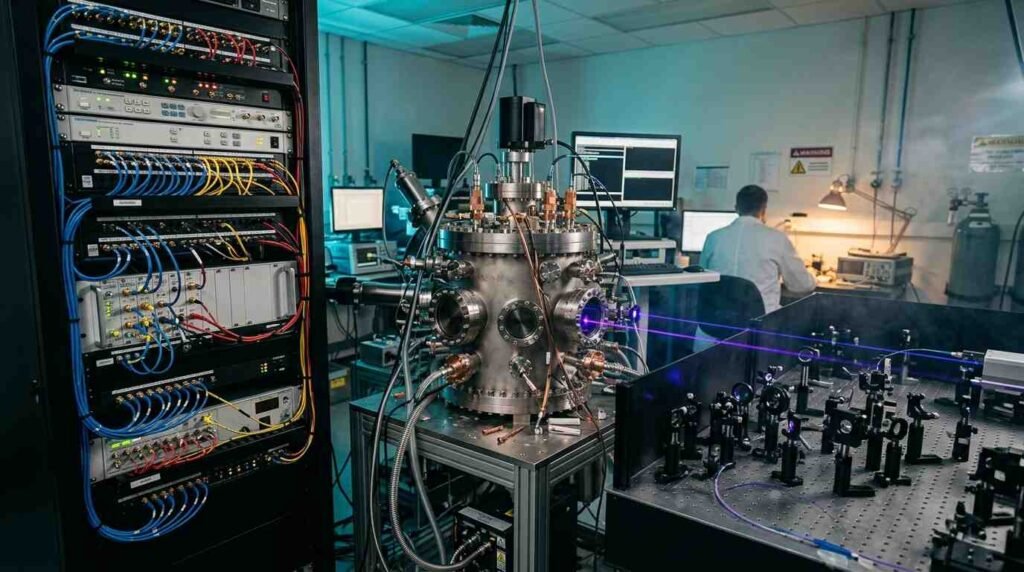
The paper, “Universal gates from braiding and fusing anyons on quantum hardware”, appeared online on 15 July 2026 in Nature (volume 655, pages 591–597), with an earlier version posted to arXiv in January. Authors from Harvard, the University of Chicago, Stony Brook and Quantinuum prepared a 54-qubit state on the H2 processor that behaves like a non-Abelian topological order built on the symmetry group S3. In it, they braided anyons, measured the outcome of fusing them, and showed that the pair of operations forms a universal gate set for logical qutrits.
Why Anyons, and Why These Ones
Ordinary particles are bosons or fermions: swap two identical ones and the quantum state either stays the same or flips sign. Anyons exist only in two dimensions and can do something stranger. In the non-Abelian kind, swapping them, called braiding, changes the state in a way that depends on the order of the swaps. That order-dependence is exactly what a quantum gate needs, and since the information lives in the global pattern rather than in any single particle, it is naturally protected from local noise.

The long-standing catch is that the easiest non-Abelian anyons to realize do not braid their way to full universality. The paper’s central point, per the abstract and its coverage, is that S3, the smallest non-Abelian group, cannot do it by braiding alone, but becomes universal once fusion is allowed as a computational primitive alongside it. Fusion means bringing two anyons together and measuring what comes out.
This also builds on earlier work. ScienceDaily’s coverage notes that a 2024 experiment by some of the same researchers used a different group, D4, which could create the anyons but was not powerful enough for universal computation.
What the Team Actually Built
| Ingredient | What it is | Why it matters |
|---|---|---|
| Hardware | Quantinuum H2 trapped-ion processor, 54-qubit ground state | Same processor family used in earlier non-Abelian anyon experiments |
| Logical unit | Topological qutrit, encoded in pairs of anyons | Three levels per unit instead of two |
| Entangling gate | One gate produced by braiding (a “pull-through” operation) | Entanglement is the resource for any non-trivial computation |
| Readout | Two measurements produced by fusion | Fusion supplies the operations braiding cannot |
| Magic state | Prepared topologically | Magic states are the usual price of universality |
The magic state deserves a sentence of context. A quantum computer built only from the easy gate family, the Clifford gates, can be simulated efficiently on a classical machine. A magic state is the extra ingredient that breaks that ceiling, and most architectures manufacture them through a costly purification step called distillation. According to the ScienceDaily write-up, the S3 approach could produce the state directly through topological operations, which might sidestep part of that cost.
Reading the Numbers
Here is where captions matter, so I report them as I could read them and no further. The nonlocal projector measurement landed around 0.44 to 0.45 against a theoretical value of 0.5. The post-selection acceptance rate was about 0.115, against a predicted 0.125. The total acceptance, with heralding included, was about 0.06. The captions put average standard errors for the projector measurements at roughly 0.017 to 0.03, with maxima near 0.07.
Read those as a proof that the machinery works within noise, not as a benchmark. Some initial-state measurements also deviate from ideal, for example 0.28 where theory predicts one third. And the magic-state result depends on post-selection, which discards runs that fail checks. When only about six runs in a hundred survive, the method may be sound while remaining far from efficient.
Background viewing: a university lecture titled “Non-Abelian Anyons & Topological Quantum Computation,” for readers who want the underlying math.
Claim Check
| Claim (paraphrased) | Verdict | Reasoning |
|---|---|---|
| Universal quantum computing has been achieved | Overstated | The team demonstrated building blocks of a universal gate set. It was not a complete computer, and it had no active error correction. |
| First non-Abelian anyons on a quantum computer | No | An earlier experiment with some of the same authors created them using a different symmetry group. |
| Removes the need for magic state distillation | Unproven | A magic state was prepared topologically, but with post-selection and low total acceptance. Whether this scales to beat distillation is untested. |
| Fault-tolerant topological computing is here | Not shown | The researchers describe it as a proof of principle; combining it with error correction is the next major step. |
| The work is published in Nature | True | It is peer-reviewed. The paper also discloses that some authors work for Quantinuum and that one holds company shares. |
The authors themselves are measured on the limits. Chicago assistant professor Ruben Verresen calls the experiment a proof of principle, since it lacks error correction. His collaborator Henrik Dreyer, a Quantinuum managing director and the company’s scientific lead on the work, frames the upside this way:
“Non-Abelian codes are a dark horse in the race to quantum error correction.”Henrik Dreyer, Quantinuum, quoted in ScienceDaily
Note the phrase “dark horse.” A dark horse is a contender nobody has seen finish yet, and the claim is accordingly modest.
How to Read a Hardware Paper Like This One
Quantum-hardware results arrive wrapped in headline qubit counts, and the number on the label rarely describes the experiment that produced the physics. A few habits make the difference between reading a result and being sold one.
Check which system size carried each claim
The 54-qubit figure belongs to the prepared ground state. According to the caption material I could read, several of the protocols and figures refer to smaller lattices, 3×2 and 3×3 among them. That does not weaken the physics. It does mean “54 qubits” should not be read as the size of every gate demonstration in the paper.
Ask what was thrown away
Post-selection keeps the runs that pass a consistency check and discards the rest. It is a legitimate technique, and the paper reports its acceptance rates openly: about 0.115 against a predicted 0.125 for the post-selection step, and about 0.06 once heralding is included. The practical question is what happens at scale, because discarding most of the data is affordable for a few qutrits and expensive for thousands.
Separate proof of principle from benchmark
A proof of principle shows that a mechanism exists and works. A benchmark shows how well it works compared with alternatives. This paper is the first kind, by its authors’ own description, which is why the useful comparison is with the earlier D4 experiment, not with any competing architecture. The step from one to the other is exactly where active error correction enters.
Read the disclosures
The paper lists company employees among its authors and discloses that one of them holds Quantinuum shares. Neither fact makes the work wrong; peer review at Nature is a real filter, and hardware experiments of this kind can only run on hardware that someone built. But a result produced and promoted by the machine’s maker deserves the same extra attention as a drug trial funded by the drug’s maker, and independent replication is the standard remedy.
Where This Sits in the Hardware Race
Quantinuum’s own blog on October 8 described an independent study from the Jülich Supercomputing Centre comparing its Helios system with superconducting hardware on operations used for fault tolerance. The company reports about 13 times lower effective hardware error at 30 data qubits and about 8 times lower at 50. Two cautions apply: that figure comes from the vendor’s summary of the study, and it concerns error-correction primitives, not anyons. Still, it shows what the trapped-ion camp is optimizing for, and why a topological scheme that might lighten error-correction overhead would interest it. The company’s blog lists these posts alongside its earlier non-Abelian work.
What to Watch Next
- Active error correction combined with non-Abelian codes. Everyone involved names this as the real test.
- Better acceptance rates. A six percent survival rate must climb for any scaling argument to hold.
- Stabilized non-Abelian quantum memories. Verresen is working on them with other Chicago researchers, per the ScienceDaily write-up.
- Independent replication on other hardware, given the disclosed company ties.
Quick Definitions
What is an anyon?
A quasi-particle that exists only in two dimensions and picks up a more general phase than a boson or fermion when swapped with another.

What is a qutrit?
A quantum unit with three levels where a qubit has two.
What is fusion here?
Combining two anyons and measuring the result. In this scheme, that measurement is itself a computational operation.
Does this change anything for encryption?
The paper makes no claims about cryptography, and a proof-of-principle demonstration of gate building blocks is a long way from the machines that cryptographic attacks would require.
Numbers in “Reading the Numbers” come from figure captions as reported to me, not from the full text. Check them against the published paper before reusing them.
Sources
- Nature: Universal gates from braiding and fusing anyons on quantum hardware (15 July 2026)
- arXiv:2601.20956: Universal Topological Gates from Braiding and Fusing Anyons on Quantum Hardware (28 January 2026)
- ScienceDaily: Quantum computing’s “dark horse” just proved it can go universal (September 2026)
- Quantinuum blog: A step forward for non-Abelian quantum computing, with October 2026 posts listed


2 Comments