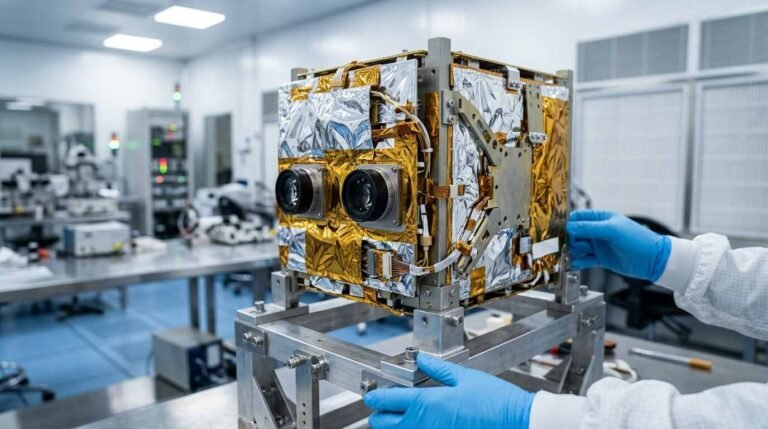



Webb measured a redshift of 2.148 for FRB 20240304B, the most distant localized fast radio burst. Its tiny, young host galaxy argues against a neutron-star merger.
A radio flash lasting a few thousandths of a second has now been traced to a faint galaxy that existed when the universe was only about 3 billion years old. The burst, catalogued as FRB 20240304B, was caught by South Africa's MeerKAT array in March 2024. The James Webb Space Telescope later supplied what no ground-based instrument could: the host galaxy, and a precise redshift of 2.148. The result appears in the journal Science, and NASA's science news item covers it.
Two claims sit inside that headline, and they deserve different levels of trust. The distance is a measurement. The origin is an inference. Below, the measurement comes first, then the method behind it, then an honest look at how far the inference can carry.
What the team found
FRB 20240304B is the most distant fast radio burst with a confirmed host galaxy. Its redshift of 2.148, with an uncertainty of 0.001, comes from the Science paper's arXiv version. Live Science reports that this more than doubles the previous distance record, and Sky & Telescope puts the redshift at roughly twice the old one. The light left its source more than 10 billion years ago, according to both outlets.
MeerKAT found the burst through its MeerTRAP transient search, and the paper localizes it to within a fraction of an arcsecond in each direction. Ground-based telescopes then looked at that spot and saw essentially nothing. Keck and the MMT found no host.
Webb did. Its NIRCam imager picked out a small, faint, star-forming dwarf galaxy at the burst position, and its NIRSpec spectrograph read the galaxy's emission lines to fix the redshift. The paper lists about two hours of NIRCam imaging and about 6.5 hours of NIRSpec integral field spectroscopy, obtained through Director's Discretionary Time.
The galaxy is tiny. The paper gives a stellar mass near ten million suns and a star-formation rate of roughly 0.15 to 0.2 solar masses per year. The team says it is about 1,000 times less massive than they expected for a burst host. Most known hosts are massive star-forming galaxies.
The lead author is Manisha Caleb of the University of Sydney. Co-authors named in the sources include Themiya Nanayakkara (Sydney), Ben Stappers (University of Manchester), Kaustubh Rajwade (Oxford) and J. Xavier Prochaska (UC Santa Cruz). The full author list runs to 28 names.
Webb is not new to unmasking hidden structure. Its infrared eyes also exposed collisions in extreme debris disks, a very different corner of astronomy that leans on the same sensitivity to faint, dusty light.
How a distance to a burst is measured
A radio burst arrives with no obvious distance tag. Astronomers have two ways to build one.
The first uses the burst itself. Free electrons in space slow low-frequency radio waves slightly more than high-frequency ones, so the burst sweeps in pitch as it arrives. The size of that delay is the dispersion measure, and it grows with the amount of ionized gas the signal crossed. More gas usually means more distance. Sky & Telescope calls this burst's dispersion unusually large.
The paper puts numbers on it. The scattering-corrected dispersion measure is 2458.20 parsecs per cubic centimetre, with the Milky Way contributing roughly 28 for its disk and 40 for its halo. That leaves about 2,330 for everything beyond. Fed through the Macquart relation, which links average dispersion to redshift, it predicts a redshift near 2.8, with a 95 percent range from 1.628 to 3.397.
That is a statistical estimate, and it is loose, because gas along any single sightline varies a lot. The second method sidesteps the problem. Pin the burst to a host galaxy, take that galaxy's spectrum, and read the redshift directly from how far its known spectral lines have shifted toward the red. The measured 2.148 lies inside the dispersion-based range but below its centre.
The gap is informative. The measured redshift implies the burst carries about 550 parsecs per cubic centimetre more dispersion than the median cosmic expectation. The authors attribute most of that excess to foreground structure on the line of sight: the Virgo Cluster, at about 235, and a galaxy group at redshift 0.31131, at about 33. They describe the group figure as likely a lower limit.
The host's own contribution is not tightly constrained either. In other words, the two methods agree, but only the host-galaxy route gives a distance one can lean on, and the dispersion route still teaches something about the gas it crosses.
One wrinkle in the coverage: NASA describes the foreground cluster as sitting at redshift 0.3, about 3.5 billion light-years away, and lists Virgo at about 54 million light-years. The paper's group redshift is 0.31131. These are consistent descriptions of the same structures at different precision.
What "suggests origin" means here
Nobody has seen what produces a fast radio burst. The two leading ideas are a magnetar, meaning a neutron star with an extreme magnetic field, and the merger of two neutron stars. Magnetars are born in supernovae of massive stars, which live fast and die within a few tens of millions of years. Mergers take far longer, since two stellar remnants must first spiral together.
The argument runs on timing. The host is a small, metal-poor, actively star-forming galaxy seen about 3 billion years after the big bang. NASA reports that its star-formation rate implies most of its stars formed within about 30 million years. A burst from such a place leaves little room for a progenitor that needed billions of years to mature.
Caleb says the work makes a merger origin very unlikely, and the Manchester account quotes her saying there is no conclusive proof of what generates these bursts. Mergers are not hypothetical, and astronomers do catch them in other bands; our write-up of the Einstein Probe transient EP250704a covers one such neutron-star merger signal.
The supporting reasoning in the paper is the delay-time logic above, plus the observation that low metallicity favours massive progenitor stars, and so magnetars. Fact: the host is young and low-mass. Interpretation: therefore the source is a young magnetar, perhaps born in a recent supernova and producing bursts through starquakes, as the NASA item describes.
How strong is that? Moderately. It fits the leading theory and it rules out one rival for this burst. It does not show a magnetar was present, because no direct signature of one was observed. Sky & Telescope notes that the authors' conclusion holds at least in this case, and that the origin of magnetars themselves is less clear.
There is also a population argument. One burst cannot speak for all. Some bursts may arise from older systems, and a single high-redshift example at cosmic noon, the era of peak star formation, mostly shows that young sources existed then.
What is still unknown
Start with the source. No instrument has resolved the engine behind this burst, and nothing in the data distinguishes a magnetar from other young compact objects. The intrinsic rotation measure the paper derives, around minus 550 radians per square metre, is high compared with most known bursts, yet the observed value is low. The authors suggest cancellations or reversals in the magnetic field along the way.
The scattering is unresolved as well. It may come from the host or from the galaxy group, and the paper says more data are needed. The host's dispersion contribution is similarly loose, and energy estimates skip a standard correction for how redshift stretches the observed band, which adds uncertainty.
Then there is sample size. Sky & Telescope puts the total number of detected bursts at only a few thousand, and only a small share have hosts. Most localized ones lie below redshift 0.5, according to the paper, so the early universe is nearly unsampled.
That may change. The team estimates MeerKAT could detect and localize several bursts per year beyond redshift 1. Wide, deep surveys will help too: the Rubin Observatory's ten-year southern sky survey is built to catch fast-changing sources, though radio localizations will still lead the way for this kind of object.
A note on provenance. The paper first appeared as an preprint on arXiv in August 2025, and the peer-reviewed version came out in Science under the title "A fast radio burst at redshift 2, three billion years after the Big Bang." Numbers here come from the arXiv text, which may differ in small details from the published paper.
Questions readers ask
Is this really the farthest fast radio burst ever detected?
It is the most distant one with a confirmed host galaxy and a measured redshift, according to NASA and Live Science. Bursts with only a dispersion-based guess are less certain by comparison, since that method scatters widely along any single line of sight.
Does this prove magnetars make fast radio bursts?
No. The result argues against a neutron-star merger for this specific burst and fits a young magnetar. Direct proof would need more bursts from young hosts, or a distinctive signal tied to a magnetar. The authors themselves describe the origin as unsettled.
How can light from 10 billion years ago still be useful?
Because radio waves carry a record of everything they crossed. The delay in each burst tells astronomers how much ionized gas lay in between, and the paper says this one probes gas across roughly 80 percent of cosmic history.
Sources
- NASA Science: Webb Measures Distance to Farthest Fast Radio Burst, Suggesting Origin
- Caleb et al., arXiv:2508.01648, a fast radio burst from the first 3 billion years of the universe
- Live Science: James Webb telescope pinpoints the most distant fast radio burst ever seen
- Sky & Telescope: A fast radio burst from the early universe
- University of Manchester: UK astronomers help reveal host galaxy of most distant fast radio burst