




DNA has a measured half-life of 521 years in one famous study, yet genomes more than a million years old have been read. Here is how both are true.
How long can DNA last? Longer than most people would guess, and far shorter than the plot of a certain dinosaur movie requires. Under the right conditions, genetic material has been read from animals that died over a million years ago. Under ordinary ones, it falls apart within thousands of years, and in a warm climate, much sooner.
The record keeps moving, and the reasons it moves say a lot about how DNA breaks down. This article covers what destroys it, the measured decay rate from one famous study, the oldest sequences yet recovered, and what the Neanderthal and Denisovan genomes have added to the story of our own species.
Why does DNA fall apart after death?
In a living cell, repair enzymes constantly patch damage. When an organism dies, the repair stops and chemistry takes over. Three kinds of damage dominate. Strands break into ever shorter fragments. Chemical cross-links form between molecules. And letters change: a process called deamination converts cytosine into something that reads as thymine, so old DNA fills up with characteristic C-to-T substitutions.
Heat, water, and microbes speed all of this up. Temperature and humidity strongly affect decay, and fluctuating storage conditions after a bone is dug up can accelerate it. Nuclear DNA, the kind that holds most of your genome, degrades at least twice as fast as mitochondrial DNA, which is why early ancient DNA studies relied on the mitochondrial kind: there are many copies per cell, so more survive.
Cold, dry, stable, and dark are the friendly conditions. Permafrost, deep caves, and sealed sediments have all produced remarkable results.
What is the half-life of DNA?
The best-known measurement came from a 2012 study in Proceedings of the Royal Society B, led by Morten Allentoft of the University of Copenhagen and Michael Bunce of Murdoch University. The team analyzed 158 leg bones from three extinct species of New Zealand moa, giant flightless birds. The bones ranged from about 600 to 8,000 years old and came from three sites within roughly 5 kilometers of each other, with nearly identical preservation conditions, including an average temperature of 13.1 degrees Celsius.
The result was a half-life of 521 years. In plain terms, every 521 years, half of the chemical bonds in the DNA backbone break, then half of what remains, and so on.
The model, if you extrapolate it, predicts that at a steady minus 5 degrees Celsius every bond would be gone after about 6.8 million years. DNA would stop being readable much earlier, around 1.5 million years, once the fragments are too short to carry usable information.
Does the half-life predict how old a sample can be?
Not very well on its own. In the moa study, age accounted for only 38.6 percent of the variation in how degraded the samples were. Bunce pointed out that how a bone was stored after excavation, the chemistry of the soil, and even the season in which the animal died could all play a part. Other researchers cautioned that results needed testing in very different settings, such as permafrost and caves.
The sensible reading is that the half-life is a rule of thumb for a particular temperature, not a stopwatch. A bone in a warm climate can lose usable DNA in a few thousand years, while one in frozen ground may keep it for hundreds of thousands.
What is the oldest DNA ever sequenced?
It depends on whether you mean DNA from a physical specimen, or traces recovered from soil.
For a physical specimen, the record belongs to Siberian mammoths. In a Nature paper published on 17 February 2021, a team led by Tom van der Valk, Patrícia Pečnerová, and David Díez-del-Molino, with Love Dalén and Anders Götherström as senior authors, reported genome-wide DNA from three mammoth specimens. Two were more than a million years old. The Adycha tooth is estimated at 1 to 1.3 million years old, and the Krestovka tooth at 1.1 to 1.65 million years. The previous record for genomic data was a horse dated to 780,000 to 560,000 years ago.
For environmental DNA, fragments shed by living things into the surrounding sediment, a Nature study published in December 2022 reported material about 2 million years old from Greenland. It came from plants and animals, including mastodons, geese, lemmings, and ants.
Marine sediment has contributed too: a 2016 study found diatom DNA up to 1.4 million years old, with a half-life of up to 15,000 years in those cold, stable conditions. That figure is far longer than the moa figure, a clear sign of how much environment matters.
What did the million-year-old mammoths reveal?
More than a record. The sequences showed that two distinct mammoth lineages lived in eastern Siberia during the Early Pleistocene. One gave rise to the woolly mammoth. The other, previously unknown, was the ancestor of the first mammoths to colonize North America.
The Columbian mammoth of North America, the study concluded, descends from a hybridization in the Middle Pleistocene between those two lineages, with roughly equal contributions from each. Many of the protein-coding changes tied to woolly mammoth cold adaptation were already present a million years ago.
Younger mammoths also help. Researchers have sequenced nuclear genomes from animals that died about 20,000 and 60,000 years ago. The last known population survived on Wrangel Island, off Siberia, until about 4,000 years ago. Genetic evidence there points to a small, inbred group, roughly 300 to 1,000 animals, that died out suddenly instead of fading gradually.
Can DNA from dinosaurs be recovered?
On the available evidence, no. Dinosaur bones are at least 65 million years old, far beyond even the most generous estimates for survival. Even at minus 5 degrees Celsius, the moa-based model predicts that every bond would break after about 6.8 million years.
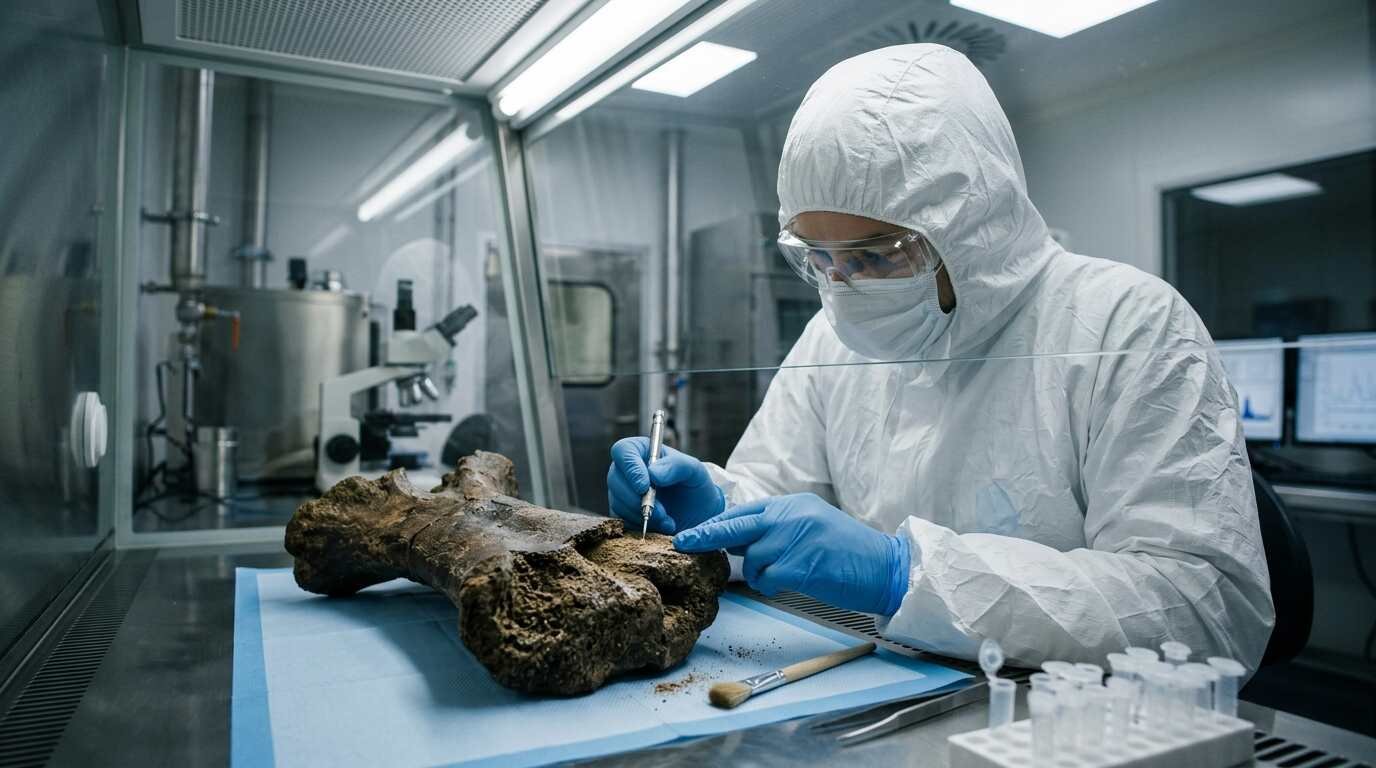
Claims of dinosaur DNA from amber or fossils do not hold up well. The usual problem is contamination: modern DNA from microbes, or from the scientists themselves, can look like a real signal. This is a general weakness in the field, and a reason that laboratories working on ancient material use sterile extraction and special adapters to separate genuine old molecules from recent intruders.
How do researchers know the DNA is really ancient?
Mostly by looking at its damage. Authentic ancient DNA is short, with fragments often far shorter than modern DNA, and it shows the C-to-T letter changes at the ends of fragments that deamination creates. These signatures grow with sample age. Software tools such as mapDamage and PMDtools measure them.
Absence of these marks is a red flag, because it suggests the DNA is modern. Researchers also estimate the amount of contamination by comparing sequences with known modern genomes, and they run controls throughout the lab process.
What have Neanderthal and Denisovan genomes taught us?
Quite a lot, and the timeline is recent. Since 2010, laboratories have been able to recover entire ancient human genomes. The first Neanderthal genome sequence appeared in 2010, drawn from three specimens from Vindija Cave in Croatia. A far more complete genome from a Neanderthal found in the Altai Mountains followed in 2014, and a high-quality Vindija genome in 2017.
The headline result is that modern humans interbred with Neanderthals. Estimates range from 1 to 4 percent of ancestry overall, with figures of 1.8 to 2.4 percent for modern Europeans and 2.3 to 2.6 percent for East Asians. Most people carry only a few percent.
Denisovans, a third group, were first identified in 2010 from mitochondrial DNA in a juvenile finger bone excavated in 2008 from Denisova Cave in Siberia. Melanesians carry an estimated 4 to 6 percent Denisovan DNA by one estimate (another puts it at 1.9 to 3.4 percent). Around 17 percent of the Denisovan genome itself comes from Neanderthals, and a specimen known as Denisova 11, dated to about 90,000 years ago, is a first-generation Neanderthal-Denisovan hybrid.
In June 2025, researchers reported that mitochondrial DNA from dental calculus and 95 proteins showed that the Harbin cranium, once assigned to a separate species named Homo longi, belonged to a Denisovan. The skull is dated to more than 146,000 years ago. Proteins can persist in fossils where DNA has long since vanished, which is why they are used alongside it.
Common questions
Can scientists bring back a mammoth from its DNA?
Not at present. Fragments of mammoth DNA have been edited into elephant cells in laboratory work (a 2015 team led by George Church edited some mammoth genes into an Asian elephant genome), but none of the proposed revival methods is currently feasible according to the general reference sources cited below.
What is the oldest DNA ever found?
For a physical specimen, mammoth teeth more than a million years old, reported in 2021. For environmental DNA, about 2 million years from Greenland sediments, reported in 2022.
Does DNA last longer in ice?
Generally yes, and in dry, cold, stable conditions. Temperature is one of the strongest influences on decay.
Why is mitochondrial DNA easier to find in old remains?
There are many copies of it in each cell, while nuclear DNA is present in only two copies per cell. Even when it degrades at least twice as fast, more mitochondrial DNA survives.
Is the 521-year half-life universal?
No. It was measured on moa bones from one cool region and depends on temperature and burial conditions. Age explained less than 40 percent of the variation in that study.
What to remember
DNA is a fragile molecule that survives mostly by luck and by cold. The decay model from the moa study gives a feel for the scale, with a half-life of 521 years at about 13 degrees, but real samples vary widely. The proven records stand at more than a million years for a genome from teeth and about 2 million for traces in sediment.
What the old genomes have delivered is less about the records and more about the people and animals they describe: ancestors who interbred, lineages we did not know existed, and a mammoth family tree.
Further reading
- Who We Are and How We Got Here by David Reich: Leading ancient-DNA researcher's account of what old genomes reveal. See it on Amazon (affiliate link)
- Neanderthal Man by Svante Pääbo: First-hand story of sequencing the Neanderthal genome. See it on Amazon (affiliate link)
As an Amazon Associate I earn from qualifying purchases. A commission may be earned if you buy through this link, at no extra cost to you.
Sources