






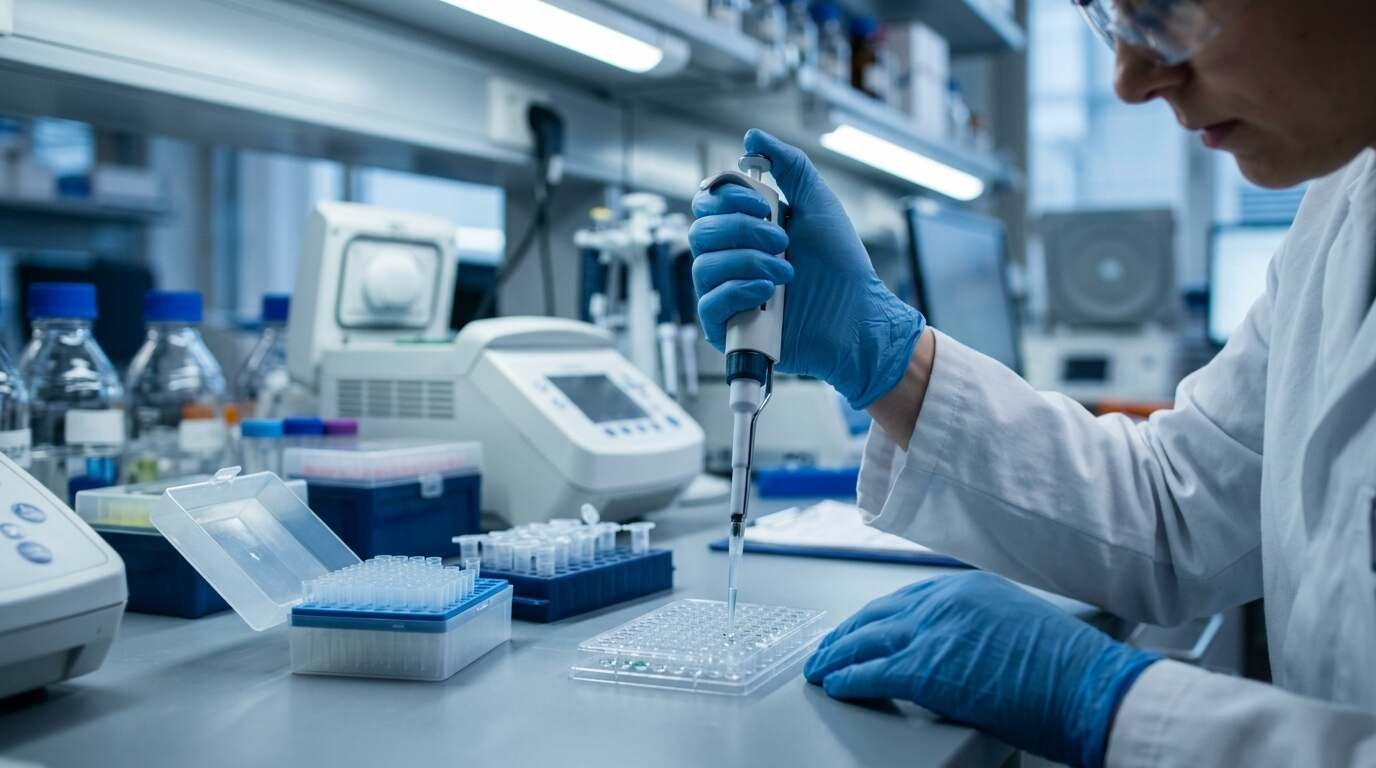
CRISPR began as a bacterial immune system. This article explains the mechanism, the first approved therapy, a 2025 personalized treatment, and the risks.
To understand how CRISPR works, start with bacteria, not laboratories. Bacteria are attacked by viruses constantly, and over billions of years some of them evolved a defense that stores snippets of an invader’s DNA and uses them to recognize and cut that invader on its next visit. Scientists noticed the oddly repetitive stretches of bacterial DNA in 1987, worked out in 2007 that they were an immune system, and by 2012 had turned the mechanism into a programmable tool.
Since then CRISPR has gone from a lab technique to an approved medicine, and in 2025 to a treatment built for a single child. It has also been used in a case that most scientists regard as a serious ethical breach. This article covers the mechanism, the real results so far, and the limits.
What does CRISPR stand for, and what is it?
CRISPR stands for clustered regularly interspaced short palindromic repeats, which describes the repeating sequences found in bacterial genomes. In everyday use the word refers to the gene-editing system built from them, usually CRISPR-Cas9. Cas9 is an enzyme from the bacterium Streptococcus pyogenes that cuts DNA.
On its own, Cas9 would cut anywhere. What makes it useful is a second part: a guide RNA, about 20 bases long, that matches a chosen stretch of DNA. The guide leads the enzyme to the matching spot and Cas9 cuts both strands. A short neighboring sequence, called a PAM (usually NGG for this version of Cas9), must also be present, which limits where the standard system can act.
The common comparison is a pair of molecular scissors with a GPS-style address label. It is a fair picture for the cutting step, though the real work comes next.
How does CRISPR actually edit a gene?
The cut is only the opening move. A cell treats a broken double strand as an emergency and repairs it using one of two main routes, and the choice determines the result.
In the first route, called non-homologous end joining, the cell glues the ends back together quickly and sloppily. This often leaves small insertions or deletions that scramble the gene, which is a convenient way to switch a gene off. In the second, called homology-directed repair, the cell copies a provided template, so researchers can supply a replacement sequence and have it written in. That route is more precise in principle but less efficient in many cell types.
The guide RNA is cheap to synthesize and quick to redesign. Earlier tools, zinc finger nucleases in the early 2000s and TALENs in 2010, needed a new custom protein for every target. CRISPR swapped that for a short stretch of RNA, which is the main reason it spread so fast.
Who invented it?
Several groups contributed, and the credit is contested, partly because of a long patent fight. Researchers described the repeats in bacteria in 1987, and a 2007 study showed they function as an immune defense. In 2012, a team including Jennifer Doudna and Emmanuelle Charpentier showed that Cas9 could be programmed with RNA to cut chosen DNA, and they filed a patent application. Feng Zhang’s group at the Broad Institute showed the approach works in cells of higher organisms, and the Broad received a US patent in 2014.
The patent dispute between the Broad Institute and the University of California went through several rounds. In March 2022 the US Patent Office ruled against the university, finding the Broad had filed first for use in eukaryotic cells. In October 2020, Doudna and Charpentier were awarded the Nobel Prize in Chemistry. Virginijus Šikšnys, whose group published related work, was not among the recipients, and some scientists have argued he should have been.
Is there anything beyond ordinary CRISPR?
Yes, and the newer tools matter because cutting DNA has risks. Base editing, developed in the lab of David Liu at the Broad Institute and described in 2016, attaches an enzyme to a disabled form of Cas9 so that it changes one DNA letter into another without breaking the strands. It suits fixes that need a single-letter change. Prime editing, reported by Liu’s lab in 2019, is often described as search-and-replace: it nicks one strand and uses an attached enzyme and an extended guide RNA to write in new sequence, with no double-strand break and no separate template. It can make all types of single-letter changes as well as small insertions and deletions.
Prime editing is early. In 2024 a therapy called PM359 from Prime Medicine became the first prime editor to enter human trials, and the company reported in December 2025 that two patients with chronic granulomatous disease had been effectively cured. That claim comes from the company, based on two patients, and has not had the long-term follow-up that firm conclusions need.
What has CRISPR actually done for patients?
The first approved CRISPR medicine is Casgevy (exagamglogene autotemcel), for sickle cell disease and transfusion-dependent beta thalassemia. It was approved by the UK regulator in November 2023, and by the US FDA on 8 December 2023 for sickle cell patients aged 12 and older with recurrent pain crises, with an approval for beta thalassemia following in January 2024.
The process is elaborate. Doctors collect a patient’s blood stem cells, edit them in the lab with CRISPR-Cas9 so the body produces more fetal hemoglobin, which prevents red blood cells from sickling, and then give the patient strong chemotherapy to clear space in the bone marrow before returning the edited cells. In the FDA’s account of the trial, 29 of 31 evaluable patients, or 93.5 percent, went at least 12 months in a row without severe pain crises. The trial was small and had no control group, and patients will be followed for years to assess safety.
The list price is reported as $2.2 million. Cost, the demands of treatment, and access are real obstacles, and the number of people treated so far is small. In February 2025 Bahrain announced it had completed treatment of the first patient with sickle cell outside the United States.
What was the case of baby KJ?
In May 2025, doctors from the Children’s Hospital of Philadelphia and the University of Pennsylvania described what they called the first personalized CRISPR-based therapy. The patient, KJ Muldoon, was born with a severe form of carbamoyl phosphate synthetase 1 (CPS1) deficiency, a rare metabolic disorder that prevents the body from clearing ammonia. His ammonia levels were about thirty times normal when he was two days old.
The team, led by Kiran Musunuru and Rebecca Ahrens-Nicklas with David Liu’s input, built a base editor with a guide tailored to his exact mutation, packaged in lipid nanoparticles, the same kind of fat droplets used in COVID-19 mRNA vaccines, so it would reach liver cells. They first tested the approach on a model of his mutation in human liver cells in a dish. KJ received two infusions, at 7 and 8 months old, and went home after 307 days in the hospital. The details appeared in the New England Journal of Medicine and were presented at a gene therapy meeting on 15 May 2025.
The result is encouraging, but it is a single patient, and one case cannot show how well the approach works generally or how durable the effect is. What it did show is that a custom treatment could be designed and delivered in months, not years. Whether such therapies can be made affordable at scale is an open question.
What about editing embryos?
Editing a patient’s blood or liver cells changes only that person. Editing an embryo, egg, or sperm changes every cell and can be passed to descendants, which is why it is treated as a different category.
In late November 2018 the Chinese researcher He Jiankui announced that twin girls had been born after he edited the CCR5 gene in their embryos, aiming at resistance to HIV. Scientists and institutions widely condemned the work, citing secrecy, weak medical justification, and questionable consent. A Chinese court convicted him in December 2019 of illegal medical practice and sentenced him to three years in prison. A third child was later reported. The Innovative Genomics Institute at Berkeley says it does not support editing human embryos or reproductive cells for pregnancy, because effects on future generations are not understood.
What are the risks and limits?
Safety questions fall into a few groups. Off-target effects are cuts or edits in the wrong place. On-target rearrangements are the wrong outcome in the right place. Immune reactions to the editing machinery are possible. Many of the long-term risks are not yet known, which is why trials include extended follow-up.
Delivery is the other big constraint. Getting editing tools into the right cells is hard. Editing cells outside the body and returning them, as Casgevy does, is feasible for blood. Reaching organs inside the body relies on viruses or lipid nanoparticles, and the liver is currently the easiest target.
Finally, there are ethical questions: who gets access, how to weigh disability and treatment, and where treatment ends and enhancement begins. These are discussions, not settled positions.
Common questions
Is CRISPR safe?
The honest answer is that it depends on the use. Approved and trial therapies are monitored closely, and some risks are still being measured. Off-target effects and immune reactions are the main concerns.
Can CRISPR cure genetic diseases?
For some conditions it has produced durable-looking results in trials, such as sickle cell disease. “Cure” is a strong word for treatments with a few years of follow-up. Most genetic diseases have no CRISPR treatment yet.
Can you do CRISPR at home?
It is not realistic or advisable. Genome editing needs expertise and equipment, and the Innovative Genomics Institute recommends outreach events, college courses, and community labs as safer ways to learn.
Does CRISPR create designer babies?
Editing embryos for pregnancy is widely opposed and illegal or restricted in many places. No approved therapy involves it, and the 2018 case drew a criminal conviction.
Where does CRISPR come from?
From bacteria, which use it to defend against viruses. Scientists adapted the natural system into a programmable tool.
What is the difference between CRISPR, base editing and prime editing?
CRISPR-Cas9 cuts both DNA strands. Base editing changes single letters without cutting both strands, and prime editing nicks one strand and writes in new sequence.
What to remember
CRISPR is a bacterial defense system turned into a programmable editor: a guide RNA picks the spot, Cas9 cuts, and the cell’s repair process makes the change. Newer versions, base editing and prime editing, avoid some of the risks of cutting.
The record so far is real but narrow. One approved therapy for two blood disorders, a handful of early trials, and one personalized treatment for a single infant. Cost, delivery, and long-term safety are unresolved. Editing that changes future generations remains off the table for most of the research community.
Further reading
- The Code Breaker by Walter Isaacson: Biography of Jennifer Doudna and the CRISPR race. See it on Amazon (affiliate link)
- A Crack in Creation by Jennifer A. Doudna and Samuel H. Sternberg: Doudna's own account of the science and ethics. See it on Amazon (affiliate link)
As an Amazon Associate I earn from qualifying purchases. A commission may be earned if you buy through this link, at no extra cost to you.
Sources
- CRISPR gene editing (Wikipedia)
- CRISPR FAQ (Innovative Genomics Institute)
- FDA approves first gene therapies to treat patients with sickle cell disease
- Exagamglogene autotemcel (Wikipedia)
- Prime editing (Wikipedia)
- The new gene therapy playbook: baby KJ (Core Memory)
- First personalized CRISPR therapy patient baby KJ discharged (Center for Genetics and Society)
- He Jiankui (Wikipedia)



