






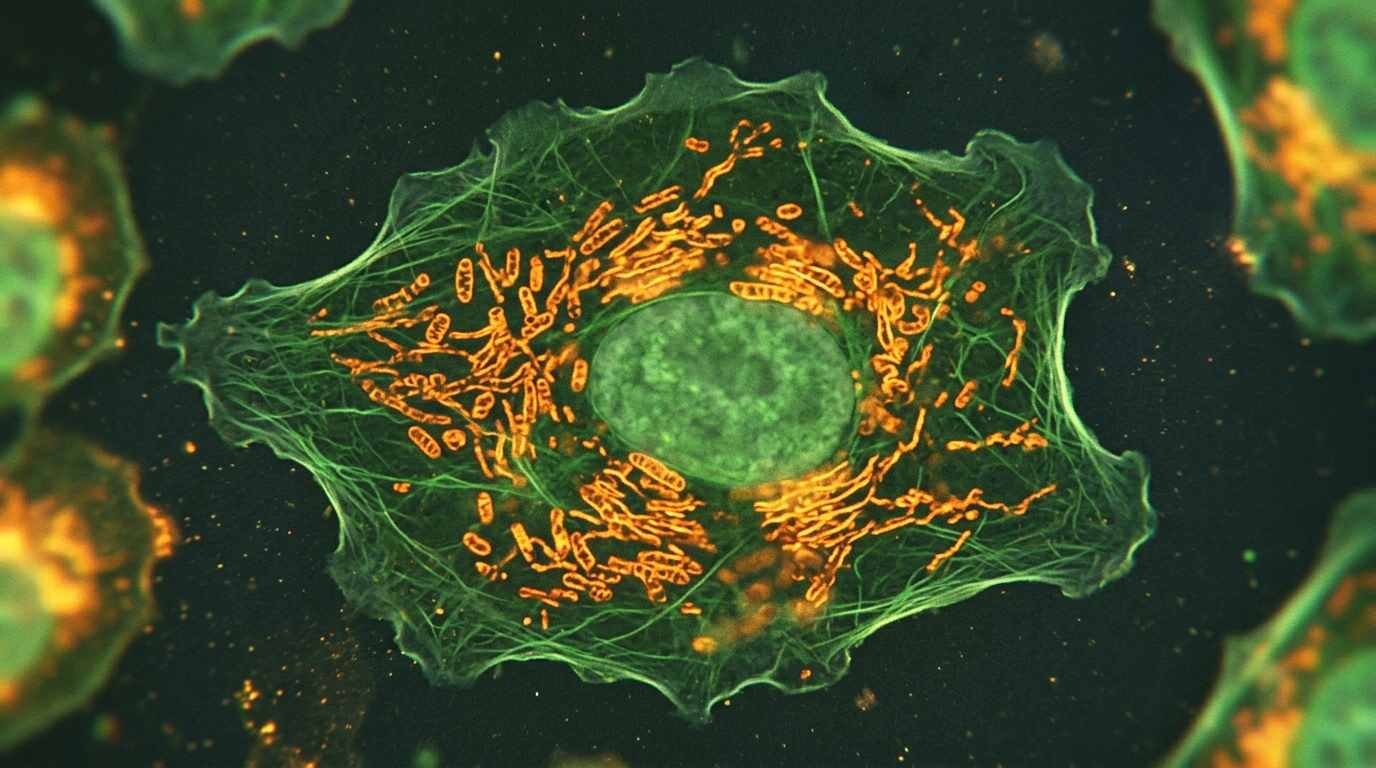
Mitochondrial DNA is a small genome inside your cells that comes almost entirely from your mother. Here is why, and what the exceptions and applications are.
Mitochondrial DNA is the small, separate set of genes that sits inside the mitochondria of your cells, and it comes almost entirely from your mother. That single fact has made it one of the most useful tools in genealogy and evolutionary biology, and one of the most carefully watched in reproductive medicine. It also raises a fair question: if you are half your father genetically, why does this one piece of you skip him?
What is mitochondrial DNA?
Most of your genetic material lives in the nucleus of each cell, packed into 23 pairs of chromosomes. Mitochondria carry a second, much smaller genome of their own. In humans it is a circular molecule of 16,569 base pairs, first fully sequenced in 1981 by a team led by Anderson. Compare that with roughly three billion base pairs in the nuclear genome and the difference in scale is plain.
Human mitochondrial DNA, usually shortened to mtDNA, holds 37 genes: 13 that code for proteins, 22 for transfer RNAs and 2 for ribosomal RNAs. The proteins are parts of the machinery that turns food into usable energy. Most of the other proteins mitochondria need are encoded in the nucleus and shipped in.
They make most of the cell’s ATP, the molecule cells spend as energy. Aerobic respiration in mitochondria yields about 13 times more ATP than fermentation does. They also take part in managing calcium levels, signaling and the controlled self-destruction of damaged cells.
How many you have depends on the cell. Mature red blood cells have none. A human liver cell has roughly 1,000 to 2,000. Each mitochondrion holds a handful of copies of its DNA, typically two to ten, so a single cell can contain thousands of copies of the mitochondrial genome.
Why does an organelle carry its own genome at all? The leading explanation is endosymbiosis. Roughly 1.7 to 2 billion years ago, an ancestral cell took in a free-living bacterium, and the two never separated. That is the mainstream view, supported by the bacteria-like features of mitochondrial DNA and ribosomes. Over time most of the bacterium’s genes moved into the host’s nucleus, leaving the small remnant genome that persists today.
The timing is an estimate, and the exact path of events is still debated. The broad idea, though, is as close to settled as evolutionary biology gets.
Why do you inherit it from your mother?
Mostly because of numbers and housekeeping. A human egg contains around 200,000 copies of mtDNA. A healthy sperm carries about five. At fertilization, the egg’s mitochondria swamp whatever the sperm brings.
Then there is active cleanup. Sperm mtDNA appears to be degraded in the male reproductive tract and again after fertilization. A 1999 report described sperm mitochondria being tagged with the protein ubiquitin inside the embryo, marking them for destruction. In some species, sperm mitochondria fail to enter the egg at all. The mix of mechanisms varies by organism, and the details in humans are not fully mapped.
One practical consequence: both sons and daughters inherit mtDNA from their mother, but only daughters pass it on. A man’s mitochondrial lineage ends with him.
Is the maternal rule ever broken?
This is where careful wording matters. In 2018, a study in the journal PNAS reported that some people carry mitochondrial DNA from both parents. That finding drew immediate pushback. Follow-up work published in 2019, 2020 and 2021 argued that the result was likely an artifact: long stretches of mitochondrial sequence that have been copied into the nuclear genome, sometimes called mega-NUMTs, can be amplified along with the real thing and mimic a paternal signal.
A 2021 review in Nature Reviews Genetics summed it up as evidence that remains limited and disputed, with several recent studies not supporting paternal transmission. So the established position is maternal inheritance, with rare exceptions in other animals documented and the human exceptions still contested. That is a judgment of where the evidence stands, and it could change with better data.
What is heteroplasmy?
Because a cell holds many copies of mtDNA, they do not all have to be identical. Heteroplasmy means a mixture of normal and mutant copies in the same cell. The proportion matters. A small fraction of mutant copies may do nothing, while a high fraction can cause disease.
In animals, a developmental bottleneck during egg formation reduces the number of mtDNA copies that pass into a new egg cell, which increases the variation between eggs. This helps explain why siblings of the same mother can have very different amounts of a mutation, and why the severity of mitochondrial disease can differ so much inside one family.
Why is mitochondrial DNA so useful to scientists?
Part of the appeal is that comparison works across species. Human and chimpanzee mitochondrial genomes differ by about 9.8 percent, and human and gorilla genomes by about 11.8 percent, a spread that lets researchers place lineages on a tree. The standard human reference, the revised Cambridge Reference Sequence, was updated in 1999, and sequences are described by how they differ from it.
There is a wrinkle. Pieces of mitochondrial DNA sometimes get copied into the nuclear genome. A study of more than 66,000 people estimated that such insertions occur about once in every 4,000 human births. These nuclear copies are harmless in most cases, but they can confuse sequencing and, as noted above, may explain some claims of paternal inheritance.
How is mitochondrial DNA used to trace ancestry?
Since mtDNA is passed down the maternal line without being shuffled with a father’s DNA, changes accumulate only by new mutation. Scientists compare these changes between people to build a family tree of maternal lineages, grouped into branches called haplogroups. Consumer genetic tests report your haplogroup for this reason.
The method has real limits. Your mtDNA tells you about exactly one line of your ancestry, your mother’s mother’s mother and so on, out of the many lines that make up your family tree. It says nothing about the other ancestors.
Who was mitochondrial Eve?
Run the tree backward and you arrive at the term. Mitochondrial Eve is the most recent woman from whom all living humans descend through unbroken maternal lines. The original 1987 study by Cann, Stoneking and Wilson, using mtDNA from 145 women plus two cell lines, put her at roughly 140,000 to 200,000 years ago. Later estimates differ: one 2013 study gave about 160,000 years, within a range of 134,000 to 188,000, while another gave 99,000 to 148,000. A commonly used rule of thumb is about one mutation every 3,500 years along a single line of descent.
She is often misunderstood. She was not the first woman, and she was not the only woman alive at the time. Other women of her era have living descendants too, just not through an unbroken chain of daughters. Her identity is also not fixed. If a maternal line dies out, the title moves to a more recent woman.
What happens when mitochondrial DNA goes wrong?
Mutations in mtDNA can cause a range of conditions, including Kearns-Sayre syndrome, MELAS and MERRF, and have been linked to maternally inherited diabetes and deafness. Tissues with high energy demands, such as brain, muscle and heart, tend to be affected. Mitochondrial disease can also come from mutations in nuclear genes, in which case the inheritance follows ordinary Mendelian patterns rather than the maternal line.
Mitochondrial DNA also changes faster than nuclear DNA. Its repair is less efficient, and its mutation rate has been estimated at about five to ten times that of the nuclear genome. That is why it is useful for dating lineages and also why it accumulates damage.
Can mitochondrial disease be prevented from passing on?
There is one approach: mitochondrial donation, sometimes called three-person IVF. The mother’s nuclear genetic material is moved into a donor egg whose own nucleus has been removed, so the child carries nuclear DNA from both parents and mitochondrial DNA from the donor. In April 2016, a boy was born in Mexico to a Jordanian couple using a version of this method called spindle transfer.
In July 2025, researchers in the United Kingdom reported eight babies born after the procedure, in two papers in the New England Journal of Medicine. The UK fertility regulator, the HFEA, said it had approved 35 patients by 1 July 2025, with 25 having undergone pronuclear transfer. Five children had undetectable levels of their mother’s mtDNA. Three had between 5 and 20 percent, below the level generally linked to disease. Commentators noted that maternal mtDNA can sometimes rise again over time, a problem called reversion, so long follow-up is needed. The numbers are small, and the long-term picture is not yet known.
The UK describes itself, through the HFEA, as the first country in the world to license mitochondrial donation. Only people at very high risk of passing on a serious mitochondrial disease are eligible, and each application is assessed individually under the law. Critics have raised concerns about unregulated clinics abroad that offer similar techniques for general infertility without convincing evidence, and about the ethical slope from this treatment toward heritable genome editing. Supporters point out that the technique targets a narrow set of severe, otherwise untreatable conditions. Both positions are arguments about values as much as data, and reasonable people weigh them differently.
Common questions
Do fathers pass any mitochondrial DNA to their children?
In the large majority of cases, no. Sperm contribute very few copies, and those are usually destroyed. A few reports of paternal inheritance exist, but they are disputed in humans.
Does mitochondrial DNA determine my mother’s traits in me?
Not in a broad sense. It carries 37 genes, mostly about energy production. Most traits come from nuclear DNA, which you inherit from both parents.
Can I find out my mitochondrial haplogroup?
Yes, through consumer DNA tests or direct sequencing. The result describes your maternal line only, and it is best treated as a piece of ancestry rather than a complete picture.
Why don’t red blood cells have mitochondrial DNA?
Mature red blood cells lose their mitochondria, so they have none to carry DNA. Their job is carrying oxygen, and they do not need the machinery.
Is mitochondrial Eve the mother of all humans?
No. She is the most recent common ancestor along unbroken maternal lines. Many other people were alive in her time, and most of our nuclear DNA comes from them as well.
What to remember
Mitochondrial DNA is a small, bacterial-looking genome inside your cells, with 37 genes and a main job in energy production. You inherit it from your mother because her egg supplies about 200,000 copies against a sperm’s five, and because paternal mitochondria are generally destroyed after fertilization.
The rule has rare reported exceptions, but in humans these remain disputed. The same maternal pattern makes mtDNA valuable for tracing lineages and for studying disease, and it has led to a carefully regulated, still-young technique to prevent some inherited conditions.
Further reading
A well-regarded popular science book on mitochondria and their evolutionary origin. See it on Amazon (affiliate link)
As an Amazon Associate I earn from qualifying purchases. A commission may be earned if you buy through this link, at no extra cost to you.
Sources
- Mitochondrial DNA (Wikipedia)
- Mitochondrion (Wikipedia)
- Mitochondrial Eve (Wikipedia)
- Pagnamenta et al., Nature Reviews Genetics, 2021 (Springer)
- HFEA comments on eight babies born after mitochondrial donation, 16 July 2025
- UK researchers announce eight babies born through three-person IVF, but questions remain (Center for Genetics and Society)



