






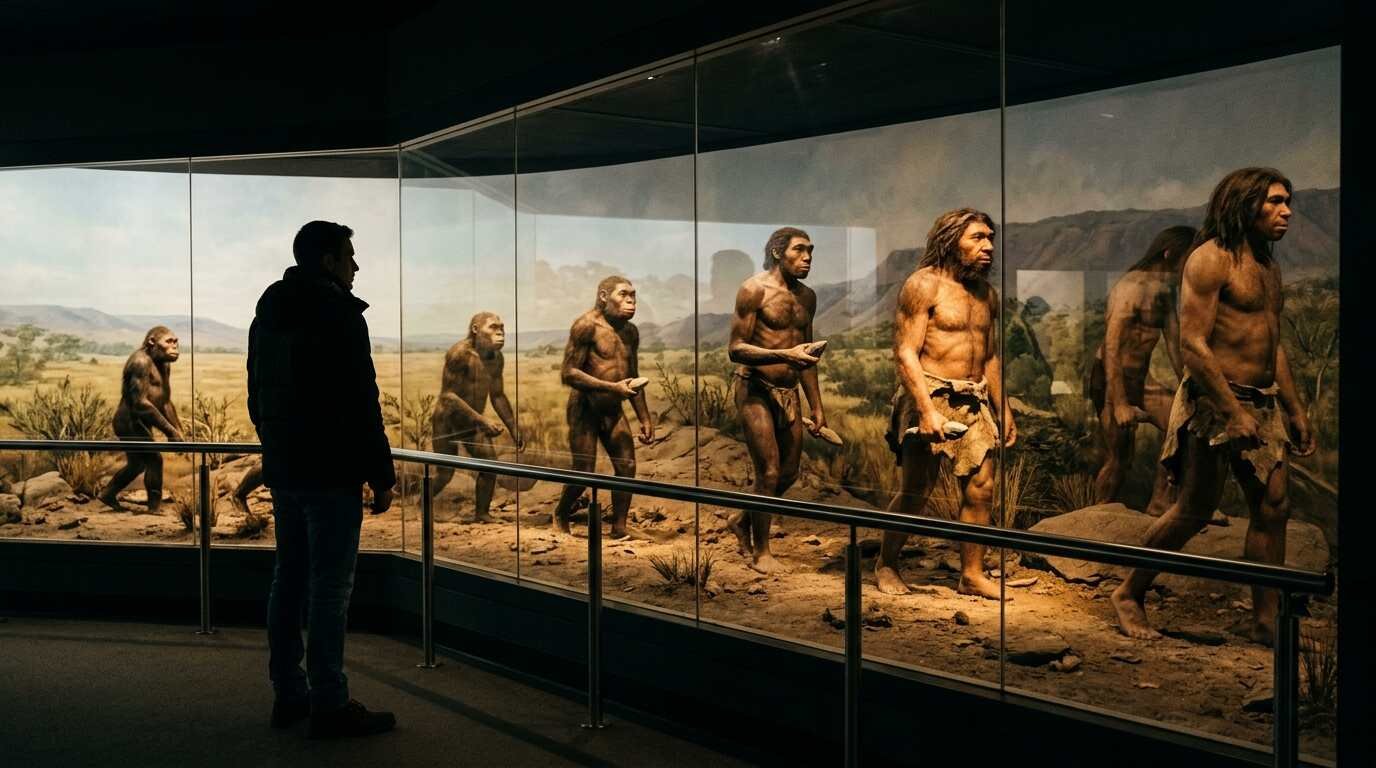
Human evolution never stopped. The firmest evidence involves diet, altitude and disease, while claims about modern trends rest on small effects.
Are humans still evolving? Yes, by every definition biologists normally use, and there is measurable evidence that it has gone on throughout recorded history. Evolution is a change in the frequency of gene variants within a population over generations. It does not need a dramatic new species, a visible mutation, or a harsh environment. It needs only that some variants get passed on more often than others, and that is still happening to us.
The tricky part is separating what has been shown from what is guesswork. Some recent human adaptations are nailed down at the level of individual genes. Others, especially claims about where modern society is pushing us, rest on small statistical effects that researchers argue about. This article keeps those two groups apart.
What does “evolving” actually mean for humans?
Evolution is often pictured as a march toward something better, which is wrong in a way that distorts the whole question. Natural selection has no goal. It favors whichever variants happen to help survival or reproduction in a given place and time, and a variant that is helpful in one setting can be a liability in another.
Selection works through two routes. Differences in survival matter, since a person who dies young leaves fewer descendants. Differences in reproduction matter just as much, since a person who lives to ninety with no children contributes nothing to the next generation’s gene pool. Two other forces also shift gene frequencies: random drift, which is stronger in small populations, and gene flow, when groups mix.
So the real question is whether any of these forces still operate on people. They do. Whether they push in a direction anyone would call progress is another matter entirely.
What is the strongest evidence of recent human evolution?
The cleanest example is lactase persistence. Most mammals stop producing the enzyme that digests milk sugar after weaning, and for most of human history so did most people. In some populations that changed after the domestication of animals. The common European variant is traced to central Europe about 7,500 years ago, and early Neolithic Europeans lacked it. Separate variants arose independently in East African herding peoples, in some cases within the last 3,000 to 7,000 years. In parts of East Africa the trait went from rare to near-universal in roughly 3,000 years, which some researchers describe as among the strongest selection measured in any human gene, though other studies argue the sweep was softer than that and varied with local conditions.
Another solid case is high altitude. Tibetans carry a variant of the gene EPAS1 that keeps hemoglobin from rising too steeply at low oxygen levels. That variant appears to have been inherited from Denisovans, an extinct relative of Neanderthals, which means the adaptation was borrowed instead of invented. Other highland peoples, including some in Ethiopia and the Andes, evolved different solutions.
Disease supplies a third kind. The sickle cell variant protects carriers from severe malaria, and it arose independently in Africa and in parts of Pakistan and India. It reached frequencies of 10 to 15 percent in some of those populations within roughly 4,000 years. The cost is that people who inherit two copies develop sickle cell anemia, which is why the variant is rare where malaria is absent. A 2021 study reported that malaria resistance evolved in Cape Verde within about 20 generations.
Can humans evolve in a few thousand years?
They can, and these examples show it. Anatomically modern humans are about 300,000 years old, a span that covers many thousands of generations, and the genetic record shows no pause.
One line of evidence is simply how much new variation exists. A 2012 analysis of about 6,500 Americans, by Kong and colleagues, reported that most of the single-letter DNA variants found had arisen in the last 5,000 to 10,000 years. That reflects population growth: when many more people are born, more mutations appear. It is not a sign of selection by itself, but it widens the pool selection can work on.
Another is a method pioneered by Jonathan Pritchard and Yair Field, who counted very recent single-letter changes in a large British dataset. They concluded that variants for lactase persistence, blond hair and blue eyes had spread among Britons within about the last 2,000 years, and that selection had also favored taller height. These are statistical inferences from genomes, not direct observations, and some researchers treat their size estimates cautiously.
Is natural selection still happening today?
Almost certainly, and researchers have tried to measure it. The Framingham Heart Study, which began in 1948 and has followed families across generations, has been analyzed for signs of selection. Work by Stearns and colleagues reported pressure against high blood pressure and high cholesterol, and trends in women’s body size and the timing of menopause. Large biobank studies have looked for shifts too. Using about 150,000 UK Biobank participants and 60,000 Northern Californians, Pickrell and Przeworski found that a variant linked to heavy smoking declined among Britons but not Californians, and that a variant of the Alzheimer’s-associated gene APOE declined as well.
Another team, led by Sanjak, linked a number of traits to having children earlier. Higher body mass and lower education were associated with earlier childbearing in that analysis.
Here caution is warranted. These effects are small, the datasets cover a single narrow slice of the world, and a statistical association with having children is not the same as a gene causing it. Education, for example, is shaped by culture, family and money as much as by genetics. A reader should treat claims that humans are evolving to be dumber, or taller, or anything else with a single cause as speculation until replicated.
Has modern medicine stopped evolution?
It has changed which pressures apply. It has not switched selection off. That is the position most evolutionary biologists argue, though not unanimously.
The case that medicine matters is straightforward. Many genetic conditions and infections that killed children a few centuries ago are now survivable. The historian-style comparison often quoted is that in 16th-century England only about a third of babies lived to 21, against nearly 99 percent today, which means far less variation in who survives to adulthood. Steve Jones has made the point that this reduces one major route for selection.
The case against is that survival is only half the story, and reproduction still differs enormously between people. Culture, contraception, education and the timing of childbirth all shape who has children and when. Stearns and others argue that culture and environmental change drive evolution rather than halting it.
Childbirth offers a curious example. The Mitteroecker estimate, as summarized on Wikipedia, is that about 6 percent of births worldwide would be obstructed without intervention, and cesarean rates have climbed. Some researchers suggest that rescuing mothers and babies who might once have died could slowly increase the fraction of people for whom vaginal birth is difficult. That is a hypothesis and is still debated.
Do humans still evolve in the sense of new species?
No sign of it. Speciation usually needs populations to be separated for long periods so that they can no longer interbreed. Modern humans move and mix constantly, and that gene flow works against splitting into separate groups. For the foreseeable future humanity is one interbreeding species.
That does not mean human populations are identical. Frequencies of many variants differ by region because of history, geography and chance. But the differences are small and overlapping, and the species is not heading for separate branches.
What have recent discoveries added?
Ancient DNA has transformed this field. By sequencing genomes from skeletons thousands of years old, researchers can watch variants rise and fall instead of inferring from the present. A 2015 scan of 230 ancient West Eurasians found the earliest lactase persistence variant in a person dated to roughly 2450 to 2140 BCE. Work published in 2021 suggested that persistence rose quickly in early Iron Age Britain, about a thousand years before it became common on the European mainland.
Studies of Neanderthal and Denisovan inheritance have shown that some of our adaptations were acquired by interbreeding. A study published in Science in January 2025 found that Neanderthal variants tied to immunity, metabolism and skin pigmentation were retained at higher-than-expected levels, while many harmful ones were purged within roughly 10,000 years. That counts as natural selection operating on human genomes in real time, even if the time scale was long.
Another well-documented case is the Sama-Bajau divers of Southeast Asia. A 2018 study by Ilardo and colleagues reported that Bajau free-divers have larger spleens, which release oxygen-rich red blood cells during dives. That points to selection over perhaps a thousand years.
What will humans look like in the future?
Nobody knows, and be wary of anyone who says otherwise. Evolution responds to conditions, and conditions change unpredictably. Cultural shifts, medicine, migration and technology all interact. Popular images of big-headed, small-bodied future humans are artists’ fancies with no support in the genetic data.
What can be said is more modest. Selection will probably keep nudging traits connected to disease resistance, diet and reproduction, slowly, and mostly in ways nobody will notice within a lifetime.
Common questions
Are humans still evolving?
Yes. Gene frequencies keep changing through selection, drift and gene flow. Documented examples include lactase persistence, high-altitude adaptation and malaria resistance, and statistical studies suggest weaker selection is going on now.
Did evolution stop when civilization began?
No. Many of the best-documented examples, such as lactase persistence, are consequences of farming and herding. Culture changed the pressures; it did not remove them.
Could humans split into separate species?
Not without long-term isolation, which is unlikely given how much people move and mix. Scientists see no sign of it happening.
Does modern medicine stop natural selection?
It weakens some pressures, such as childhood infectious disease, but selection on reproduction continues. Whether medicine causes harmful traits to accumulate is a topic of debate and not a settled finding.
How fast can a human trait evolve?
Quite fast for strongly beneficial variants. Lactase persistence rose to high frequency in parts of East Africa in about 3,000 years, and malaria resistance in Cape Verde was reported to emerge in around 20 generations.
What to remember
Human evolution never stopped; it continues through selection, drift and gene flow. The firmest evidence involves diet, altitude and disease, where individual genes have been identified. Claims about where modern life is steering us are far less certain and mostly rest on small statistical effects. Medicine and culture have changed the pressures without erasing them.
Further reading
Popular, readable account of what human genomes reveal about recent ancestry and evolution. See it on Amazon (affiliate link)
As an Amazon Associate I earn from qualifying purchases. A commission may be earned if you buy through this link, at no extra cost to you.
Sources



