Shaper says its lineup, including the Origin handheld CNC router, joins Festool in 2027. The dates, the published specs and a simple test for the accuracy claim.
Shaper Origin, the handheld CNC router, is about to change owners in all but name: Shaper says its product lineup moves into the Festool portfolio beginning in 2027. For anyone who owns an Origin or is thinking of buying one, the practical questions are narrow and dated. Orders through Shaper’s own store close on October 31, accounts move on December 15, and the warranty gets an extra year if you register. This post lays out what was announced, what the machine’s published numbers actually say, and how to test the accuracy claim yourself before you rely on it.
What Shaper and Festool announced
Shaper posted its announcement on August 25, 2026, and ToolGuyd covered it the next day. According to Shaper’s own post, the lineup “will officially move into the Festool portfolio beginning in 2027,” while the Shaper brand and its online stores wind down later in 2026. Festool’s press page frames it as the end of roughly a decade of collaboration. It names Origin and the BenchPilot as the products involved and does not list the rest of the range.
The two companies already shared a parent. Festool belongs to TTS Group, which the press page describes as a family-owned firm of about 3,000 employees with 2025 revenue of EUR 807 million. Festool also builds the Origin’s router spindle and has helped manufacture the tool, and more recently produced the BenchPilot. So this is less a surprise acquisition than a tidy-up of a relationship that was already close.
ToolGuyd reads the move as Festool absorbing Shaper. It also floats the idea of a future Origin engineered and branded by Festool, but labels that speculation, and neither company has said anything of the kind. Treat it as a guess.
The dates that matter to owners and buyers
Shaper’s post sets out a short list of deadlines and promises. Here they are in one place.
| Item | What Shaper says |
|---|---|
| Last day to order from Shapertools.com | October 31, 2026 |
| Shaper accounts | Move automatically to MyFestool accounts on December 15, 2026 |
| Warranty | Active-warranty Origin owners can register for one extra year, taking Shaper’s 2-year warranty to Festool’s 3 years |
| Software | Shaper and Festool will keep maintaining and updating Origin software during and after the transition |
| Lineup transfer | Beginning in 2027 |
Two details are still open. Shaper’s post gives no deadline for the warranty registration, and it does not say what happens to accessories such as tape and bits after the stores close. If you rely on consumables, ask before October 31 rather than after.
The sale, and why the numbers disagree
Shaper is running a closing-out promotion on Origin packages. Its own post says up to $500 off plus $300 in free accessories, while supplies last. ToolGuyd, reporting a day later, quoted up to $500 in cash discounts plus $390 in free accessories. Those two figures do not match, and the source pages we could read do not explain the gap. It may be a difference between packages, a typo, or an update between the two posts.
The practical advice is boring but sound. Add up what you would actually use from the free-accessory bundle, check the cart total on the day you buy, and ignore the headline. Also note that ToolGuyd points out Shaper runs similar promotions often, so a discount alone is not evidence of a fire sale.
How Origin finds its place
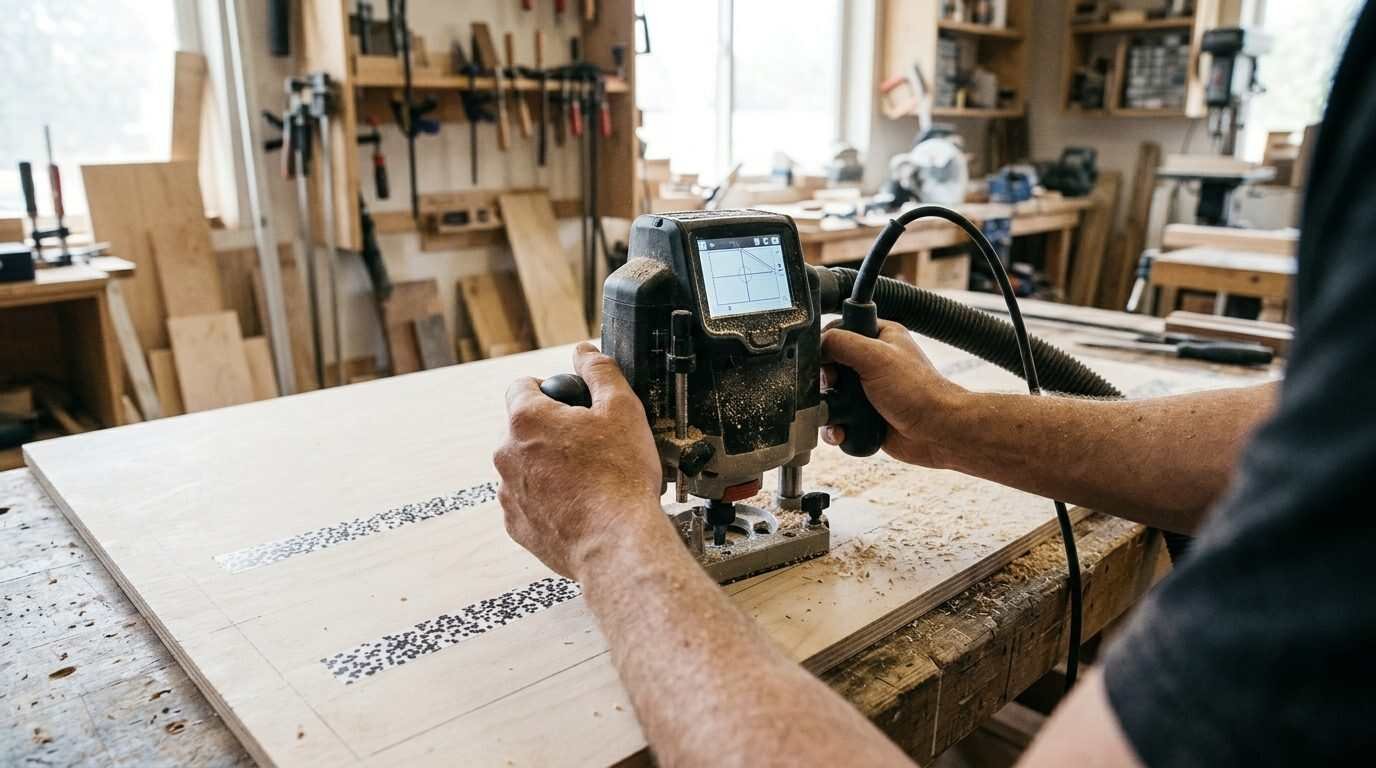
Shaper’s support page describes the principle in plain terms. Origin uses computer vision to work out where it is relative to the workpiece, and precision motors shift the router spindle in real time to stay on the intended line. You still push the tool along the path by hand; the machine nudges the cutter back onto the line within a limited range.
That limit matters. If your hand drifts beyond the correction range, the cutter retracts automatically to protect the work. The support page mentions the range but gives no number, so the exact reach is unconfirmed here. What the page does state is the headline claim: the tool keeps you within 1/100th of an inch of the intended path.
One inch-fraction is easier to judge in metric. A hundredth of an inch is 0.254 mm, which is about the thickness of a few sheets of printer paper. Whether that is tight or loose depends on the job. For a decorative inlay it is more than enough. For a press-fit joint it is real tolerance that can be eaten by something other than the tool, for instance an inaccurate bit.
Position sensing in this tool depends on markers stuck to the work surface. Shaper’s tape page says each marker’s dimensional accuracy is critical to performance, and that the tape is designed to come off without residue and lets Origin recognise a saved workspace days or months later. We could not confirm placement rules or spacing from the pages we read, so follow the current instructions that come with the tape.
Published hardware numbers
The figures below come from a retailer listing, the Toolstoday page for the Origin and Plate combo, plus Shaper’s spindle page. The retailer page carries no date, so treat the price as a snapshot to confirm, not a current quote.
| Spec | Published figure |
|---|---|
| Spindle motor | 720 W brushed, made by Festool to Shaper’s specification |
| Spindle speed | 10,000 to 26,000 RPM, built to hold speed under load |
| Z-axis travel | 43 mm (1.7 in) |
| Collet | 1/4 in included; 1/8 in sold separately |
| Input | 120 VAC, 60 Hz, 7 A |
| Weight | 14.9 lb tool; 23.5 lb packaged in the Systainer |
| Dimensions | 13.35 x 8.94 x 12.04 in |
| Connectivity | Wi-Fi and USB, color capacitive touch display |
| Listed price | $3,274 for the Origin plus Plate combo (retailer, undated) |
A quick sanity check on the electrical numbers: 7 A at 120 V is 840 VA of supply capacity, comfortably above the 720 W motor rating once you allow for the screen, motors and electronics. Nothing odd there.
The second generation, announced in October 2022, brought a 5.5-inch display, a camera Shaper put at 3.3 times the first generation’s resolution, and assembly moved to Festool’s plant in Weilheim, Germany. Those are manufacturer claims, and none of them is independently verified in the pages we read.
Buy now or wait for Festool?
There is no clean answer, and it depends on what you value. Buying before October 31 gets you the current promotion, the existing support channel and, by Shaper’s account, the extra warranty year once you register. Waiting means a possibly new product and a Festool dealer network, but also an unknown price and no promised date beyond 2027.
A sensible middle path is to decide by workload. If you have paid jobs queued that need accurate inlays, hardware cut-outs or joinery, the tool in hand beats a rumor. If you are curious about handheld CNC and have no deadline, there is little to lose by watching what Festool publishes in the first months of 2027. Whichever way you go, do not treat speculation about a redesigned model as a reason to delay a purchase that you need now.
A test you can run before you trust the 1/100 inch
A manufacturer’s tolerance describes ideal conditions. Your shop has a different bit, different material and a different grip. The following test is our suggestion, not a Shaper procedure, and it takes an hour with a pair of calipers.
- Pick flat, stable sheet stock of a single thickness, and tape a cutting area the way the instructions describe.
- Design a 3 in square with 1/2 in diameter circular holes near each corner, and cut it with a new, sharp bit.
- Measure the square’s width, height and the hole diameters with calipers that read to 0.001 in. Record every number.
- Repeat in a second location, then again after re-scanning the same workspace on another day.
- Compare the spread of your measurements with the claim. A systematic offset on every cut usually points at the bit diameter, not the machine. Random variation points at the tape, the surface or your technique.
The same habit applies to any precision claim. We took the identical approach with a cordless track saw in our piece on what a 1/32-inch claim depends on.
What is still unknown
Several things are not answered by the announcements. Neither company has said whether a Festool-branded Origin is planned, what the post-2027 price will be, or whether Shaper’s current accessories will carry over unchanged. Festool’s press page also describes no warranty terms of its own for Shaper products; the extra year is stated only in Shaper’s post.
Software is the other open point. The promise to keep maintaining and updating it is welcome, but it does not say how long, and a tool that depends on a cloud account and a touchscreen is only as durable as the support behind it. If you already own an Origin, register your warranty, save your files locally, and keep a record of your serial number.
Sources
- Shaper Tools, announcement of the move to Festool
- Festool, press release on Shaper products joining the portfolio
- ToolGuyd, Festool taking over Shaper
- Shaper support, how Shaper Origin works
- Shaper support, what is ShaperTape
- Shaper support, Origin spindle
- Toolstoday, Origin and Plate listing
- Shaper Tools, second generation Origin announcement