






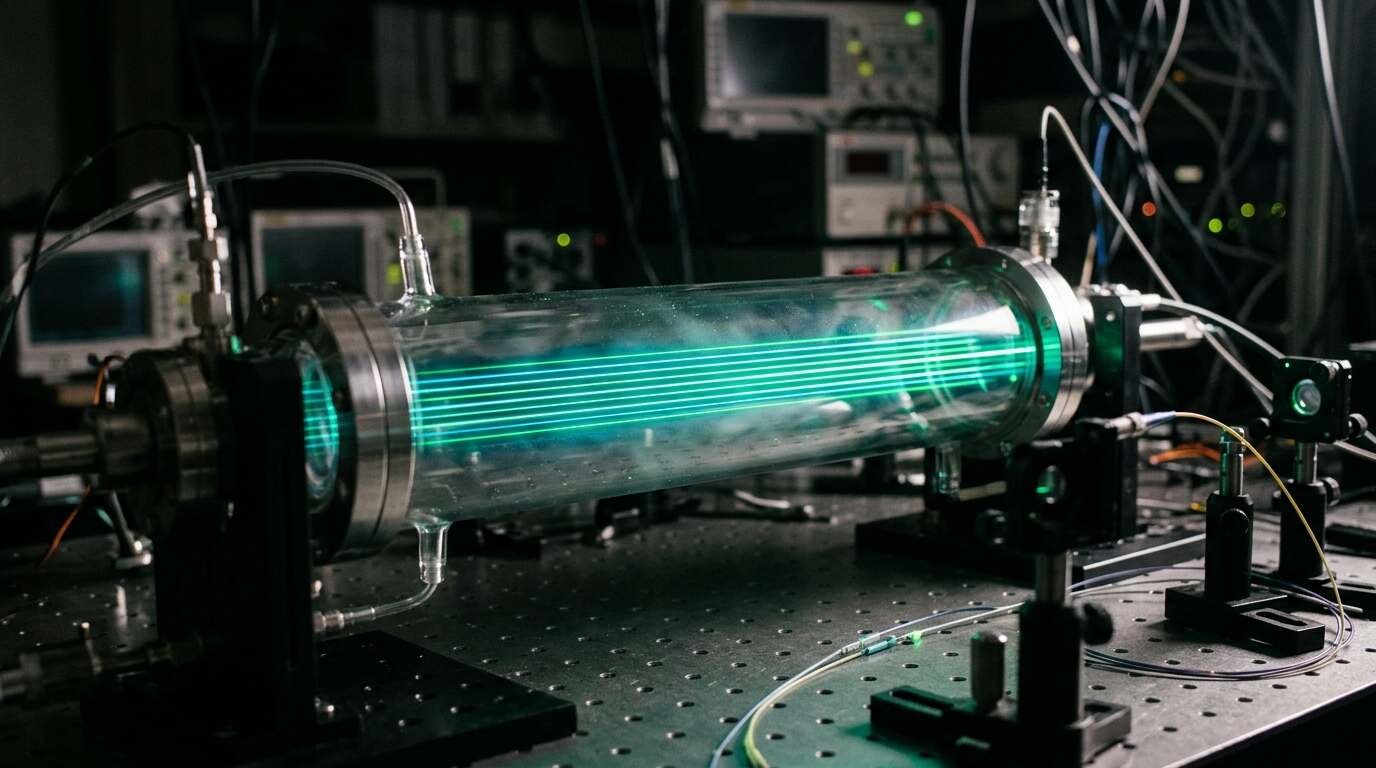
Physicists in Innsbruck observed Bethe strings, multi-particle bound states predicted in 1931, in a one-dimensional gas of cesium atoms. How the two-expansion test works and what it does and does not show.
Bethe strings are clusters of particles that stay bound together only through their mutual interactions, with no chemical bond involved, and they can exist only in one dimension. Physicists at the University of Innsbruck, led by experimentalist Hanns-Christoph Nägerl, have now observed them in a gas of cesium atoms cooled to within a few tens of billionths of a degree of absolute zero. The states trace back to a 1931 proposal by Hans Bethe.
The work appeared in Nature Communications on 29 August 2026, in an open-access paper titled “Probing Bethe strings in an attractive one-dimensional Bose gas.” A summary circulated by ScienceDaily on 9 October brought it wider attention. The paper reports bound states of more than six particles and finds that its measurements agree quantitatively with a theory of non-equilibrium integrable systems called generalized hydrodynamics.
This article explains what a Bethe string is, why one dimension makes them possible, how the team arranged thousands of atomic wires and tuned the atoms from repulsion to attraction, and how a clever two-expansion measurement revealed the binding. The figures come from the paper’s displayed text and the ScienceDaily summary. I did not have access to the full methods or supplementary data, so check the paper before citing any specific value.
The numbers at a glance
| Quantity | Reported value |
|---|---|
| Condensate atom number | 2 × 10⁴ to 6 × 10⁴ cesium atoms |
| Condensate temperature | 10 to 35 nanokelvin |
| Populated one-dimensional tubes | About 3,000 to 5,000 |
| Atoms per tube | 7 to 30 |
| Lattice depth and spacing | 25 recoil energies; 532.2 nanometers |
| Transverse trap frequency | 10.5 kilohertz |
| Interaction sweep | From repulsive (+3.4 per micrometer) through zero to attractive, at about −0.038 per micrometer per millisecond |
| Example four-particle string at −1 per micrometer | Bond length about 0.67 micrometers; binding energy about h × 190 hertz, or roughly 9 nanokelvin |
| Largest string | At least six particles |
| Release energy per particle at −1 per micrometer | About h × 35 hertz in one dimension; about h × 110 hertz after three-dimensional expansion |
| Tan’s contact at an interaction strength of one per micrometer | About six times higher on the attractive side than on the repulsive side |
What a Bethe string is
Take atoms confined to a line and let them attract each other. In three dimensions, a handful of attracting atoms tends to collapse or form ordinary molecules. In one dimension, mathematics permits something cleaner: stable multi-particle bound states whose properties can be calculated exactly. These are the Bethe strings.
The paper’s abstract calls them the quantum counterpart of bright solitons, the self-bound wave packets familiar from classical physics, such as a pulse of light that holds its shape in an optical fiber. A bright soliton stays together because its self-attraction balances its tendency to spread. A Bethe string is what that idea looks like when the objects are discrete quantum particles.
Before this experiment, Bethe strings had been detected mainly in solid-state magnetic systems, according to the Innsbruck summary, while in atomic gases they had been largely a theoretical object.
Why one dimension is special
Certain one-dimensional quantum models are integrable, meaning they have so many hidden conservation laws that they can be solved exactly instead of approximately. Bethe’s 1931 method, now called the Bethe ansatz, was the first such solution. In an integrable system, the possible motions of particles organize into well-defined building blocks, and for attractive interactions some of those building blocks are bound clusters, the strings.

That tidy picture comes with a catch. Real gases are never perfectly one-dimensional or perfectly integrable. The paper describes its system as nearly integrable, and it is the closeness of the match to theory that makes the observation meaningful.
Building thousands of atomic wires
The team began with a Bose-Einstein condensate of 20,000 to 60,000 cesium atoms at 10 to 35 nanokelvin. They loaded it into two crossed beams of light, which together form an optical lattice, a grid of intensity peaks that traps atoms. The lattice cut the cloud into an array of independent one-dimensional tubes, with roughly 3,000 to 5,000 tubes populated and 7 to 30 atoms in each.
The tubes are tight. The paper gives a transverse oscillator length of 83 nanometers, small enough that atoms cannot move sideways in any meaningful way. Along the tube they are free, with a much weaker confinement of about 29 hertz.
Tuning from repulsion to attraction
Cesium atoms offer a convenient control knob. Near a Feshbach resonance, a magnetic field changes how strongly the atoms interact, and even whether they attract or repel. The team set the field with an offset of about 20.8 gauss, and then swept the interaction in the tubes from repulsive, through zero, to attractive.
The sweep rate was about −0.038 per micrometer per millisecond. Going from the starting interaction of +3.4 to −1.0 per micrometer would take about 115 milliseconds at that rate, by my arithmetic. A ramp that is not instantaneous matters: the gas does not settle into equilibrium, and instead ends up with a mixture of string sizes, which the authors can compare against theory.
The two-expansion trick
Seeing a bound state of ultracold atoms is not like photographing a molecule. The team instead measured energy, in two ways, and compared.

- Expansion inside the tubes. The atoms were allowed to spread along their tubes while still confined. The Innsbruck summary says the strings spread, collided with one another, and stayed intact.
- Expansion in three dimensions. The confinement was then removed, and the interactions set near zero so that nothing else interferes. Bound states break apart, and the binding energy is converted into motion.
If the atoms are unbound, as with repulsive interactions, both measurements give essentially the same energy, around h × 100 hertz down to about h × 60 hertz per particle. With strings present, the story changes. At an interaction of −1.0 per micrometer, the energy measured in one dimension plateaus near h × 35 hertz, while the three-dimensional value rises to about h × 110 hertz.
The gap, roughly 75 hertz in these units by my subtraction, is the extra energy released when the strings fall apart. That gap is the signature, and it gives the average binding energy per particle. For a four-particle string at this interaction the paper’s reference value is about h × 190 hertz, equivalent to a temperature of around 9 nanokelvin.
Two more pieces of evidence
The binding energy is not the only evidence. The momentum distribution, a map of how fast the atoms move along the tubes, started with a full width of about 6.0 per micrometer, narrowed to about 3.0 near zero interaction, and then nearly doubled as the interaction became more attractive, reaching an interaction strength of −2.
The second probe is Tan’s contact, a quantity that measures how often pairs of atoms sit very close together. On the attractive side at an interaction strength of one per micrometer, it is about six times higher than on the repulsive side. Bound clusters put atoms close together, so a large contact fits the picture. All of these measurements, the paper reports, agree quantitatively with generalized hydrodynamics.
What the experiment does not settle
- The gas is nearly integrable, not exactly. Atoms were lost during the strongest attractive ramp, about 20% overall and about 40% for the coldest 15-nanokelvin gas, and the paper fits a three-body loss rate.
- Thousands of tubes are measured at once, each with a different atom number, so results are averages over a distribution.
- The largest string is bounded only from below, at six or more particles. The sources I read do not give a firm upper size.
- I could not see the full methods. ScienceDaily’s text notes it may be edited for style and length.
Why it matters
The importance is less the confirmation of a mathematical prediction than the platform. In magnetic crystals, the geometry and interactions are fixed by chemistry. In an atomic gas, the density, the shape of the trap and the interaction strength can all be adjusted, and the system can be watched evolving in time. That opens the way to studying how these collective objects form, move and collide.

There is also a conceptual payoff. The same mathematics sits behind solitons in classical waves and strings in quantum magnets. Seeing one object appear across such different settings is the kind of unification that tends to improve intuition in several fields at once.
A short glossary
- Bethe string: a multi-particle bound state in a one-dimensional integrable quantum system, held together by interactions.
- Integrable system: a system with enough conserved quantities to be solved exactly.
- Bose-Einstein condensate: a cloud of atoms cooled until they share a single quantum state.
- Optical lattice: a standing wave of light that traps atoms in a regular pattern.
- Feshbach resonance: a magnetically tunable point where atoms’ interaction strength changes dramatically.
- Tan’s contact: a measure of short-range pair correlations in a quantum gas.
- Generalized hydrodynamics: a theory for the large-scale behavior of integrable systems out of equilibrium.
Frequently asked questions
Who made the observation?
A team at the University of Innsbruck, with Hanns-Christoph Nägerl as corresponding author and Alvise Bastianello as lead theorist, per the ScienceDaily summary.
When was it published?
The paper appeared in Nature Communications on 29 August 2026. ScienceDaily’s summary ran on 9 October.
Were Bethe strings ever seen before?
According to the Innsbruck summary, they had been detected in solid-state magnetic systems but not in a controllable ultracold gas.
How big were the strings?
The paper reports bound states of more than six particles.
Does this have practical uses?
Not directly. It is a fundamental physics result that improves the toolbox for simulating and understanding strongly interacting quantum matter.
Sources



