The Ripple Tank simulator solves the two-dimensional wave equation on a 300 by 210 grid and draws the water height in gold (crests) and teal (troughs). Five scenes cover what a physical tank is used for: two point sources, a gap in a barrier, a lens, and a moving source, plus a single drop.
What a physical ripple tank shows
According to Wikipedia, a ripple tank is a shallow glass tank of water lit from above, and it can demonstrate reflection, refraction, interference and diffraction. The Harvard Natural Sciences Lecture Demonstrations page adds circular and plane waves, the change of wavelength with frequency, and focusing. The University of Maryland Physics Demonstration Facility lists single and double point sources, interference, and diffraction through openings and around obstacles.

Two sources and interference
Each dipper adds a circular wave. Where crests meet crests the water rises; where a crest meets a trough it stays flat. Those flat lines fan outward from between the sources. Raising the frequency slider shortens the wavelength, so the fan lines pack closer together.
Refraction through a lens
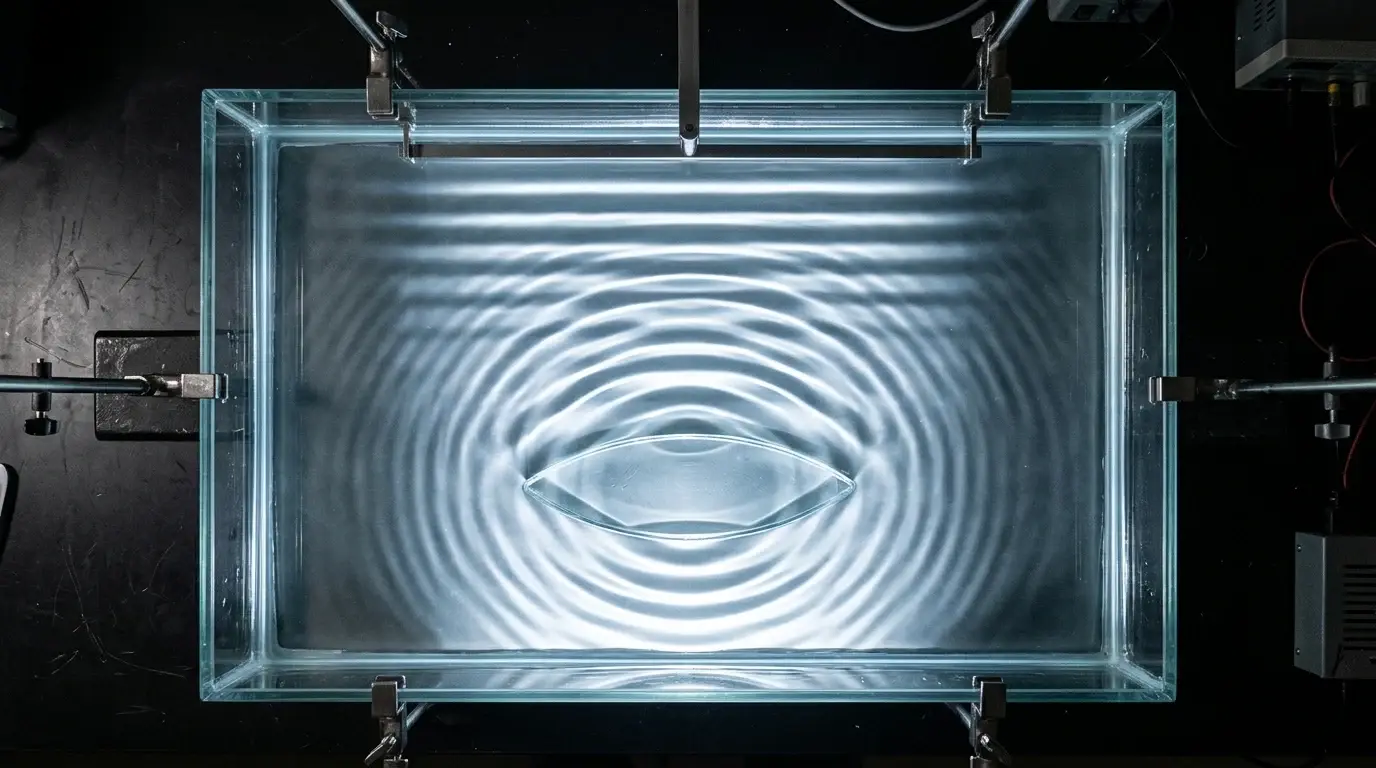
Refraction is a change in direction when a wave crosses a boundary where its speed differs, as the University of Toronto lab notes describe. In the lens scene the wave speed inside an elliptical patch is lowered by a chosen percentage (the slider sets it relative to deep water). The wavelength shrinks inside the patch and the front curves toward a focus beyond it.
Gap in a barrier: diffraction
The barrier scene sends a plane wave at a wall with a narrow opening. Beyond it the wave spreads as rings centered on the gap. Narrower gap, wider spread. This is the water version of the single-slit pattern; the double-slit light experiment has its own simulator on this site.
A moving source
Drag the speed slider in the moving-dipper scene and the crests bunch ahead of the source and stretch behind it. That is the Doppler effect, shown directly in the wave field.

How the simulation works
Each cell’s next height comes from its current height, its previous height and the average of its four neighbors, scaled by the local wave speed squared. Two buffers are swapped each step. A strip of damped cells around the edge absorbs waves so they do not bounce back. Water that is not an obstacle gets a speed of one; solid cells and the lens patch change the speed term.
Controls: scene buttons, frequency (0.1 to 0.45), damping, a scene-specific slider, Pause, Calm water, Full screen. Drag on the water to add bumps. Settings are kept in the page address so a view can be shared. Marcellino NY and x9m8 share an owner; a companion post on the leather side is on the other site.

Sources