





Two lutetium ion clocks built in Singapore were verified at the 19th digit, according to a Nature paper. How hyperfine averaging works, how the clocks were checked, and what it means for the second.
A lutetium optical clock built at the National University of Singapore has been verified at the 19th digit. The Nature paper, published online on 23 September 2026, describes two independent single-ion clocks, each with an evaluated fractional uncertainty near 1 × 10⁻¹⁹, which is about one part in 10 quintillion. Both run at room temperature.
The team includes K. J. Arnold and Murray Barrett. Live Science describes the result as the most accurate atomic clock yet, though that is the researchers’ own claim and has not been independently confirmed. The BIPM, the international body that maintains the definition of the second, is expected to redefine it around 2030, and the authors suggest lutetium could be the front-runner.
This article explains what the clock counts, why a single lutetium ion is a good place to do it, how a trick called hyperfine averaging cancels magnetic errors, and how anyone verifies a clock when no better reference exists. The technical figures come from the paper’s abstract and methods summary as displayed on the Nature website. Items that come only from press coverage are labeled as such.
The numbers at a glance
| Quantity | Reported value |
|---|---|
| Journal | Nature, volume 658, pages 60 to 64, published online 23 September 2026 |
| Ion | Lutetium-176, singly ionized (¹⁷⁶Lu⁺) |
| Clock transition | ¹S₀ to ³D₁ at 848 nanometers |
| Evaluated systematic uncertainty | 1.2 × 10⁻¹⁹ (clock Lu-1) and 1.3 × 10⁻¹⁹ (clock Lu-2) |
| Measured difference between the two clocks | [−0.1 ± 5.7 (statistical) ± 1.0 (systematic)] × 10⁻¹⁹ |
| Comparison time | 200 hours across 11 measurements over 12.4 days |
| Comparison instability | 4.8 × 10⁻¹⁶ divided by the square root of averaging time in seconds |
| Typical Ramsey time | 5 seconds, with runs up to 10 seconds |
| Ion temperature | About 301 kelvin, room temperature |
| Operating magnetic field | 0.1 millitesla |
| Largest single systematic | Blackbody radiation shift, about 1 × 10⁻¹⁹ per clock |
What a clock actually counts
Every clock needs something that repeats. A pendulum swings, a quartz crystal vibrates, and an atom, when hit by light of exactly the right color, flips between two energy states. Lock a laser to that flip and you can count its oscillations. The count is the clock.
Since 1968 the second has been defined by a microwave transition in cesium-133, with 9,192,631,770 vibrations equal to one second. Live Science rounds that to 9.19 billion. Before that, the second was a fraction of the length of the solar year 1900. An optical clock counts a much faster oscillation. The 848-nanometer transition in lutetium works out to roughly 354 terahertz by my arithmetic, since the sources I read do not state it. That is about 38,000 times the cesium rate, which means finer slices of time to count.
Why one ion, and why lutetium
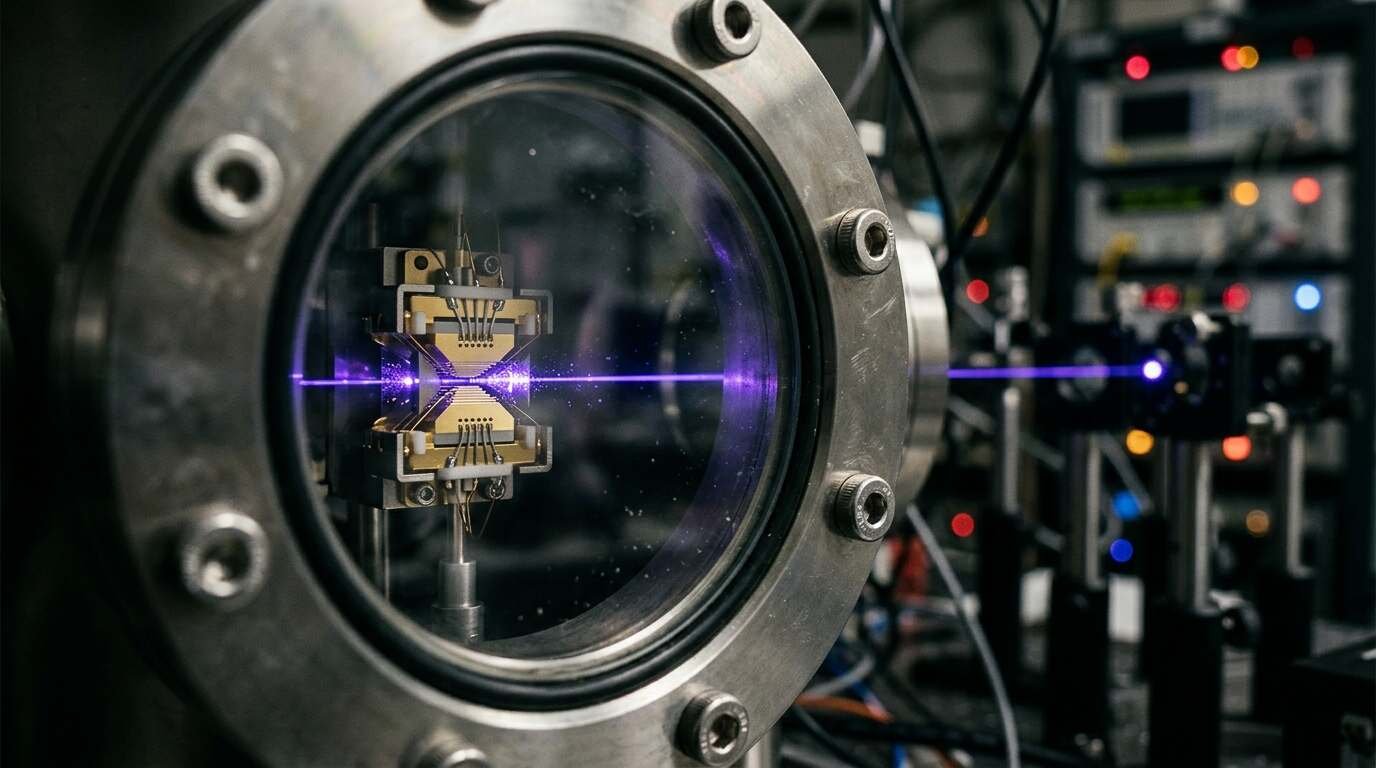
The clock traps a single charged lutetium atom, an ion, in an electromagnetic cage and probes it with a laser. One ion at a time means no collisions between atoms to blur the tick, and the paper bounds the collision shift at roughly 4 × 10⁻²⁰ or below for each clock.
Lutetium has a quality that matters in practice: it is far less sensitive to magnetic fields and temperature than earlier clock species, according to Live Science’s summary of the work. The report says the clock keeps ticking through a swing of 5 degrees in external temperature, while some other elements may need their temperature calibrated within a few thousandths of a degree. The paper’s own largest systematic, the blackbody radiation shift caused by the thermal glow of the surroundings, is only about 1 × 10⁻¹⁹ per clock even at room temperature.
Hyperfine averaging: cancelling magnetic error by averaging
The central technical trick, developed in Barrett’s lab, takes advantage of lutetium’s hyperfine structure. The clock transition has several components, and the authors measure the transitions from one ground state to three excited sublevels, labeled F equals 6, 7 and 8. They then average the three frequencies: f equals (f₆ plus f₇ plus f₈) divided by three.
That average removes the first-order magnetic sensitivity and suppresses the smaller quadratic Zeeman and quadrupole shifts, the same environmental effects that limit many other clocks. It is carried out within a single Ramsey sequence using hybrid microwave and optical pulses, combined with a hyper-Ramsey method that suppresses the shift caused by the probe light itself, known as the AC Stark shift. The paper calls the combined method HA-HR.
A Ramsey sequence is a gentle way of interrogating an atom. Two short pulses bracket a long wait, here typically 5 seconds and up to 10, and the phase accumulated during the wait shows up as an interference signal. The longer the wait, the narrower the signal, provided the atom stays coherent.
How do you verify a clock better than any reference?
That is the awkward question at the frontier. If your clock is the best in the world, nothing measures it. The standard solution is to build two and compare them.
The team ran two independent lutetium ions in separate traps, called Lu-1 and Lu-2. They compared them using correlation spectroscopy, which rejects noise that is common to both and therefore removes much of the burden from the probe laser. The comparison is then limited by atomic coherence rather than by laser stability.
The result was a relative frequency difference of −0.1 × 10⁻¹⁹, with a statistical uncertainty of 5.7 × 10⁻¹⁹ and a systematic uncertainty of 1.0 × 10⁻¹⁹. In plain terms, the two clocks agree to within the noise. The reduced chi-squared of 0.75 for 10 degrees of freedom says the scatter in the data is about what pure statistics would predict.
A sanity check shows why it took 200 hours. The comparison instability is 4.8 × 10⁻¹⁶ at one second of averaging, and noise of this kind falls with the square root of time. To reach 5.7 × 10⁻¹⁹ you need about (4.8 × 10⁻¹⁶ divided by 5.7 × 10⁻¹⁹) squared seconds, roughly 7 × 10⁵ seconds, or about 200 hours. That matches the reported figure.
What the 19th digit is good for
- Timekeeping. An uncertainty of 1 × 10⁻¹⁹ corresponds to losing or gaining about one second in some 300 billion years. That is my arithmetic from the number, and it is more than twenty times the age of the universe.
- Height measurement through time. Clocks run slightly faster at higher altitude because of gravity. The effect is roughly 1.1 × 10⁻¹⁶ per meter of height, so a clock verified at 1 × 10⁻¹⁹ can in principle sense a height difference of about a millimeter. The paper itself lists millimeter-scale chronometric levelling as a use.
- Fundamental physics. Comparing clocks of different atoms over time can test whether constants of nature drift. Live Science describes this as speculative, and it is the kind of claim that needs years of data.
Redefining the second
Live Science reports that the BIPM is expected to redefine the second in 2030 using modern atomic clock technology. The decision is not made. Several kinds of optical clock are candidates, and the description of lutetium as the front-runner for accuracy comes from the authors. Choosing a new definition involves more than a single accuracy number: reproducibility between labs, long-term operation and how a clock ties into the global time scale all count.

What the Singapore result adds is evidence that a clock can reach this level while running at room temperature and tolerating a shift in ambient conditions. That matters for anyone who wants to build many such clocks rather than one in a showcase lab.
What to keep in mind
- Most accurate is the researchers’ claim. The press article offers no independent verification.
- The 41% improvement over the previous record reported by Live Science did not appear in the abstract I read, and the coverage does not name the previous record holder.
- Two clocks agreeing shows they are consistent, not that they are both right. Shared systematic errors can hide in a pair of similar machines, which is why other labs’ independent confirmation matters.
- The redefinition is expected, not settled.
A short glossary
- Optical clock: a clock that counts oscillations of visible or near-infrared light instead of microwaves.
- Fractional uncertainty: the size of a clock’s possible error as a fraction of its frequency. 1 × 10⁻¹⁹ means one part in 10 quintillion.
- Ramsey sequence: a measurement using two pulses separated by a free-evolution time.
- Hyperfine structure: small energy splittings arising from the interaction between an atom’s nucleus and its electrons.
- Zeeman shift: a change in energy levels caused by a magnetic field.
- Correlation spectroscopy: comparing two clocks in a way that cancels noise they share.
Frequently asked questions
How accurate is the lutetium clock?
The paper evaluates each of its two clocks at a fractional uncertainty near 1 × 10⁻¹⁹, and a direct comparison between them agrees within a statistical uncertainty of 5.7 × 10⁻¹⁹.
Does this change the length of a second today?
No. The second is still defined by cesium. A redefinition is expected around 2030, according to Live Science, but has not been decided.
Why does it run at room temperature?
Lutetium’s response to temperature and magnetic fields is small enough that, with hyperfine averaging, room-temperature operation reaches this level. The blackbody shift is about 1 × 10⁻¹⁹ per clock.
Who built it?
A team at the National University of Singapore including K. J. Arnold and M. D. Barrett, among others, as listed in the Nature paper.
Sources