Husky's $34 HLDMPKT claims ±1/8 inch and Bosch's GLM100-23 claims ±1/16 inch, but neither page states test conditions. Here is how these tools measure, what ISO 16331-1 says and where real error comes from.
A laser distance measurer is the one tool in a contractor’s pouch that gets quoted to a sixteenth of an inch and used by people who rarely read the footnote. Home Depot’s new Husky model, the HLDMPKT, sells for $34.17, reaches 60 feet and claims ±1/8 inch. Bosch’s GLM100-23 reaches 100 feet and claims ±1/16 inch.
Those two numbers look comparable, but they are not, because neither page says what conditions the accuracy applies to. This post explains how these tools turn light into a distance, what an industry test standard says about stating accuracy, where real-world error comes from and what to check before trusting a reading. It draws on manufacturer pages, ToolGuyd’s October 5 coverage of the Husky and a Leica explainer. I did not test any of the tools.
- Husky HLDMPKT: 60 ft, ±1/8 in., USB-C rechargeable, $34.17. Laser class not listed.
- Bosch GLM100-23: 100 ft, ±1/16 in., two AAA batteries, 0.19 lb, rated 14–104°F. Price not listed on Bosch’s page.
- Hoto: About $40, 98 ft, ±1/16 in., with Bluetooth and an app, according to ToolGuyd.
- Standard: ISO 16331-1 sets how range and accuracy are stated, including test scenes at 3 and 30 klux. Neither the Husky nor the Bosch page says it follows that standard.
How a laser distance measurer turns light into inches
Two methods dominate. A time-of-flight instrument fires a short pulse, times the round trip and multiplies by the speed of light, which demands sub-nanosecond timing electronics and usually averages many pulses. A phase-shift instrument modulates the beam’s intensity and compares the phase of the returning light with the outgoing signal.
Many handheld units are built on the phase-shift principle, though none of the pages I read says which method these three models use. The geometry is easy to work out. Light travels out and back, so the path is twice the distance, and the modulation pattern repeats every half modulation wavelength of range. That makes the unambiguous range half the modulation wavelength, or c divided by twice the frequency. The instrument reads the fraction of a cycle from the phase. To count whole cycles it uses several modulation frequencies, a multiple-frequency variant that solves simultaneous equations.
f = 10 MHz → 299,792,458 ÷ 20,000,000 = 15.0 m
f = 100 MHz → 1.5 m
1/16 in = 1.59 mm
Phase resolution needed for 1.59 mm: 0.038° at 10 MHz; 0.38° at 100 MHz
Those frequencies are illustrative, because makers do not publish modulation frequencies for these models. The point is the trade-off. A higher frequency gives finer distance resolution for a given phase error but repeats sooner, which is why a single tone is never enough.
What the three spec sheets say
| Model | Range | Accuracy | Power | Price and notes |
|---|---|---|---|---|
| Husky HLDMPKT | 60 ft | ±1/8 in. | Rechargeable Li-ion, USB-C | $34.17. Feet, inches and meters; single-button operation; backlit display, per ToolGuyd. |
| Bosch GLM100-23 | 100 ft | ±1/16 in. | Two AAA (included) | Price not listed. 0.19 lb; rounding down to 1/32 in.; one-year warranty, plus one more if registered within eight weeks. |
| Hoto (per ToolGuyd) | 98 ft | ±1/16 in. | Not stated | About $40. A Bluetooth app selects the front or rear reference. |
ToolGuyd calls the Bosch GLM100-23 its favorite basic laser measure and has little praise for the Husky’s design. Those are the reviewer’s judgments, not measurements.
What ±1/16 inch is measured against
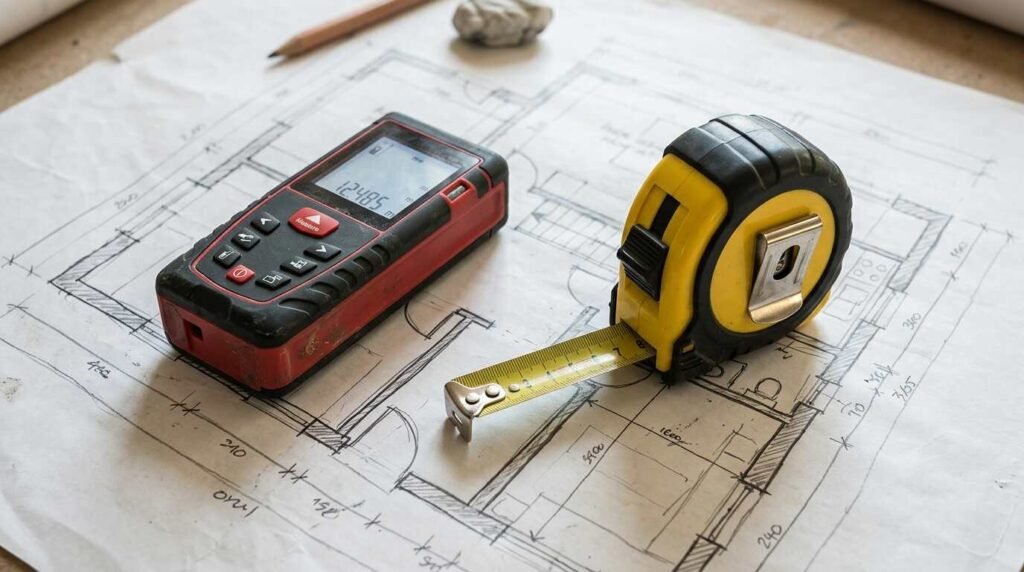
ISO 16331-1 exists so that makers state accuracy and range in a comparable way and so independent labs can test the claims. Leica’s explanation of the standard names two reference scenes. The favorable one is indoor: weak ambient light of 3 klux, a white painted wall as the target and room temperature. The unfavorable one is outdoor: bright sunshine at 30 klux, the same white wall and the full operating temperature range. Other targets, such as strong or weak reflectors, can also be specified.
Bosch’s page gives ±1/16 inch with no conditions attached. Husky’s gives ±1/8 inch, also without conditions. Neither says it follows ISO 16331-1, and I could not confirm whether either does. A figure with no stated scene may describe the best case.
±1/8 in at 60 ft: 3.18 mm ÷ 18,288 mm = 0.0174%
If each spec held across the whole range, the Bosch figure would be a much tighter claim at 100 feet than the Husky’s at 60. A flat inch-based number cannot show that, which is one more reason to ask what distance and scene a figure refers to.
Where real jobs lose accuracy
The electronics are rarely the largest error. Setup is.
Reference edge
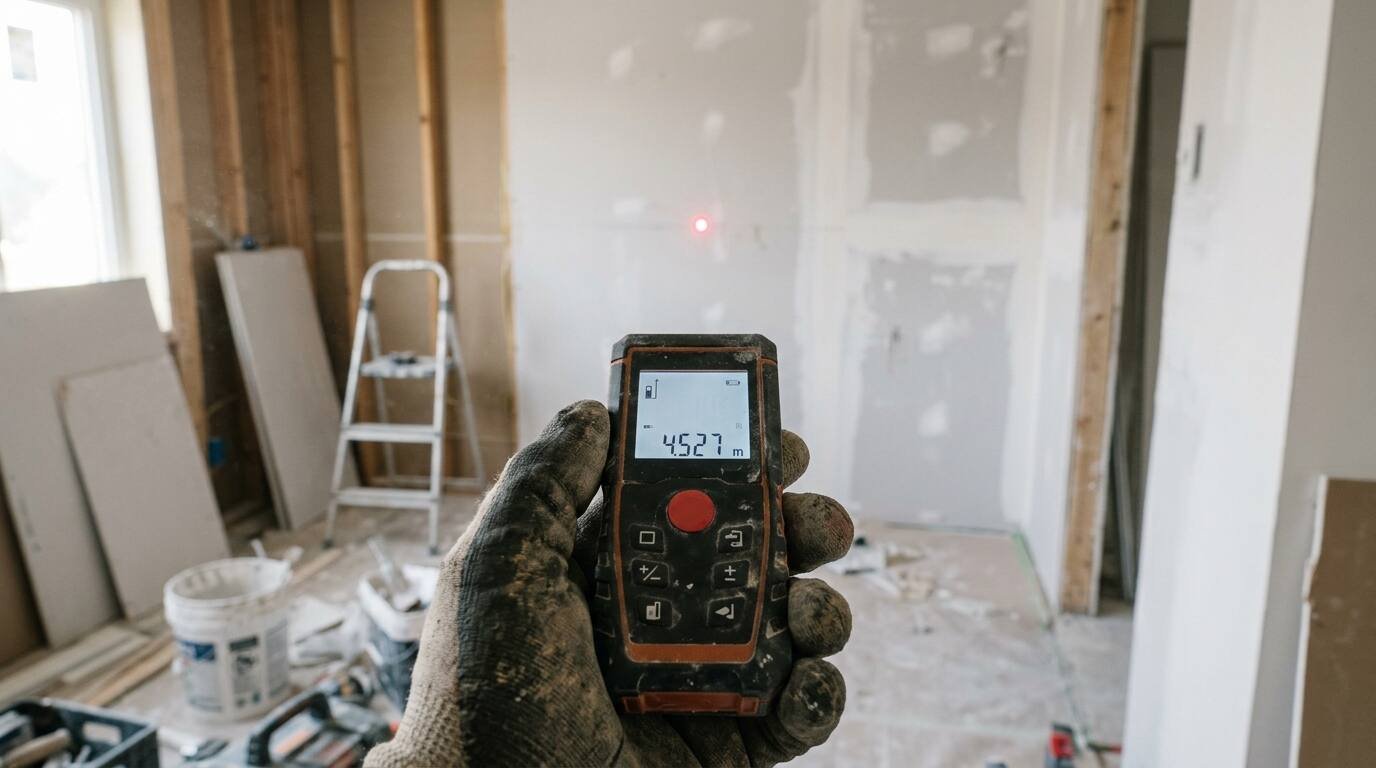
A laser measure reports distance from a reference point on its body, usually the back end and sometimes the front. Some models, such as the Hoto, let an app switch between them. Measuring from the wrong end shifts every reading by roughly the length of the tool. Bosch lists the GLM100-23 at 3.9 × 1.7 × 0.9 inches, so a wrong reference can cost something on the order of four inches.
Angle
The beam measures the straight-line distance to the spot it hits, so a tilted or skewed shot reads long. The error equals the true distance multiplied by (1 ÷ cos θ − 1).
At 10°: 240 × (1 ÷ cos 10° − 1) = 3.70 in
Target and light
ISO’s two reference scenes exist because dark, glossy or textured surfaces return less light and sunshine can swamp the red dot, so range and accuracy both fall outdoors. Leica names target surface and color, ambient light and temperature as the main influences. A target plate can help. Bosch rates the GLM100-23 for 14 to 104°F only. Atmospheric effects are small at this scale: temperature and pressure change the speed of light in air slightly, which matters over long surveying distances rather than across a room.
Laser class and eye safety
Visible red beams of this kind are usually Class 2, which means at or below 1 mW. Class 2 relies on the blink reflex to limit exposure, and deliberately overriding that reflex could cause injury. Husky’s page does not list a class, and neither does Bosch’s, so the safe habit is the same for both. Never aim the beam at anyone’s eyes, and avoid mirror-like surfaces that could bounce it back.

Resolution is not accuracy
A display that shows fractions of an inch is reporting resolution, which is a different thing from accuracy. Bosch’s page lists a rounding function that can round results from 1/2 inch down to 1/32 inch. That is a display setting, not a promise that every reading is good to 1/32. A tool can print finer digits than its accuracy supports, so judge it by the accuracy line and the conditions behind it.
Bosch also lists a real-time mode that updates as you move toward or away from the target. If a tool tracks readings continuously, a slow sweep turns that into an accuracy aid: pivot the tool gently across a wall and the smallest reading is the one taken square to the surface, which removes the angle error described above. This is a general technique, and I did not test it on the GLM100-23.
Battery, warranty and what the pages leave out
- Husky: Battery capacity and runtime are not stated, the Home Depot page lists a 90-day return policy but no warranty, and no laser class appears.
- Bosch: The page lists no price, no IP rating and no laser class. It does give a one-year limited warranty, plus a second year if the tool is registered within eight weeks.
- Hoto: ToolGuyd reports range and accuracy but not the power source or warranty.
Gaps like these matter more for a tool used on a jobsite, where drops, dust and cold are routine. A missing rating is not evidence of a weak tool, only of a claim you cannot check.
A field check before you trust any reading
A five-minute test beats any spec sheet. Lay a steel tape along a straight run of 10 or 20 feet, measure it with the laser from both reference edges and compare. Repeat at a short distance such as 3 feet, then at the longest distance you use. If the difference grows with distance, the error is proportional. If it stays the same, it is an offset, most likely the reference edge. This is practical advice, not a manufacturer procedure.
My take: For rough framing and layout, ±1/8 inch is plenty, and a $34 tool can earn its place. Cabinet, countertop and flooring work calls for a tool whose accuracy is stated under conditions, or for a tape on the final dimension. Whichever you buy, the reference edge and the angle of the shot will cost you more than the electronics. That is a judgment call.
Frequently asked questions
Is ±1/8 inch accurate enough for home projects?
For rough layout, room sizing and material estimates, usually yes. For cabinets, countertops and trim, where gaps show, a tolerance of 1/8 inch is wide. Check the final dimension with a tape before cutting.
Do laser measures work outdoors?
Expect less range and less accuracy in bright sunlight. ISO 16331-1 includes a 30 klux sunshine scene because outdoor performance differs from indoor. Neither the Husky page nor the Bosch page gives separate outdoor figures.
Why does my reading change by an inch or more?
The usual causes are a shot that is not square to the surface, a different reference edge and a target that returns little light. A 10-degree tilt over 20 feet adds about 3.7 inches.
What laser class is a laser measure?
Visible red pocket measures are usually Class 2, at or below 1 mW. Husky’s page does not list a class, so check the label on the tool.
What does ISO 16331-1 cover?
It sets how range and accuracy for handheld laser distance meters should be presented and how laboratories can test those claims, including indoor and outdoor reference scenes, according to Leica’s explanation and the standard’s published introduction.
Sources