






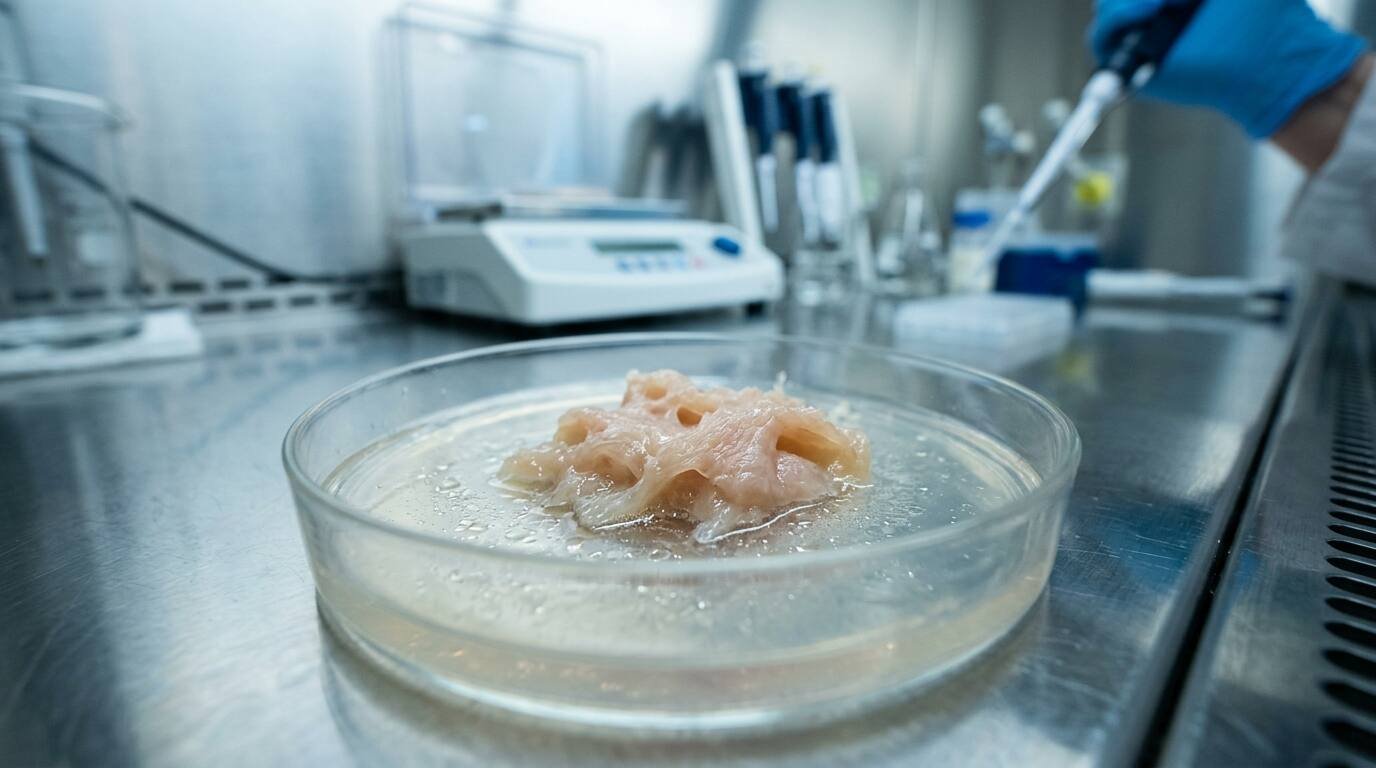
Cultivated meat has been grown in tanks and sold in a few countries. Here is how it is made, where it is legal, and what remains unproven.
Lab-grown meat is real, in the narrow sense that animal cells have been grown in steel tanks, turned into food, and sold to paying customers in a handful of places. It is also not yet something most people can pick up at a supermarket, and the gap between those two statements is where most of the confusion lives. Industry calls the product cultivated meat, cultured meat or cell-based meat, and the names are part of an ongoing argument. What follows sticks to what regulators, journals and company announcements have documented, and flags the parts that remain claims rather than results.
What is lab-grown meat, exactly?
It is animal muscle, fat and connective cells grown outside an animal. The cells are real beef, chicken, quail or salmon cells, not plant protein dressed up to resemble them. That separates cultivated meat from the plant-based burgers sold in most grocery stores, which contain no animal cells at all.
The idea draws on tissue engineering, the same family of methods used in regenerative medicine. A small sample of cells is taken from a living animal, often through a biopsy, or drawn from a bank of previously frozen cell lines. Those cells are fed and encouraged to multiply, then coaxed into forming tissue.
“Lab-grown” is the most common label in headlines, though producers dislike it because the work happens in production facilities, not laboratories. The Good Food Institute, an advocacy group for alternative proteins, prefers “cultivated.” Critics prefer “lab-grown” or “fake meat” for roughly the opposite reason. None of these terms is a legal standard everywhere, and labeling rules differ by country and, in the United States, by state.
How is cultivated meat actually made?
The process has four broad parts: cells, food for the cells, a place to grow them, and sometimes a structure to hold them in shape.
Start with the cells. Producers use stem cells or other cell types that can divide many times. These might be adult muscle precursor cells or induced pluripotent stem cells, which are adult cells reprogrammed to behave like embryonic ones.
Next comes the growth medium, a liquid containing sugars, amino acids, salts and signaling proteins called growth factors. Historically the factors came from fetal bovine serum, a product taken from cattle fetuses. Newer approaches use serum-free mixtures and factors made by engineered microbes.
Then the cells go into a bioreactor, a sealed vessel that holds the temperature near 37 °C, the body temperature of a mammal, and supplies oxygen and about five percent carbon dioxide. Several designs exist, including stirred tanks, airlift systems and perfusion systems. Tiny beads called microcarriers give the cells extra surface to cling to.
Finally, there is structure. Ground-style products such as nuggets or sausage need little. A steak-like cut needs a scaffold, and researchers have tested materials ranging from textured soy protein to bacterial cellulose to the cleaned-out framework of spinach leaves. A 3D-printing approach has produced a steak-like item from three types of bovine cell fibers, though that remains a demonstration, not a supermarket product.
Why is the growth medium such a big deal?
Because it is the single largest expense and the biggest ethical wrinkle. Fetal bovine serum costs on the order of $1,000 per litre, which makes it ruinous at industrial volumes, and it comes from animals, which undercuts a central selling point of the technology.
The first cultivated burger, made in 2013 by Mark Post, cost more than $325,000 and took roughly two years to produce. Costs have fallen since, but company claims about price per kilogram vary widely and are often projections. A target of about one dollar per litre for growth medium has been floated as necessary for scale; getting there is a research problem, not a settled one.
There is encouraging science on this front. A study published in January 2024 found that cow cells can be nudged into making their own growth factors, which could reduce the need for expensive purchased ones. Another study, reported in November 2025, found that cow cells can become immortal on their own after about 500 days in culture, without genetic modification. If that holds up, it matters, because cells that never stop dividing are far easier to run as an ongoing production line.
Where can you actually buy it?
In very few places, and mostly in small amounts. The timeline of approvals is short enough to list.
- Singapore: the Singapore Food Agency cleared Eat Just’s cultivated chicken bites on 2 December 2020, the first approval anywhere. A restaurant began serving them that month. Later reports describe a retail product in 2024 that contained only about three percent cultivated chicken.
- United States: the USDA and FDA cleared cultivated chicken from Upside Foods and GOOD Meat in June 2023. In 2025 the FDA cleared Wildtype’s cultivated coho salmon, the first cultivated seafood allowed for sale there.
- Israel: the Ministry of Health approved Aleph Farms’ cultivated beef in January 2024.
- Australia and New Zealand: regulators approved Vow’s cultivated quail in 2025, with restaurant service planned in Sydney and Melbourne.
- United Kingdom: cultivated chicken has been allowed in a pet food, sold by a company called Meatly. For human food, the Food Standards Agency is running a review programme, and one trade outlet reports that products could reach shelves as early as 2027. Treat that date as an expectation, not a promise.
Approval is not the same as availability. A product can be legal and still sold only at a few restaurants, in a hybrid blend, or in tiny quantities. The United States shows this well: tastings and limited restaurant servings have happened, but the products are not on ordinary store shelves.
Where is it banned?
Italy passed a national ban in late 2023, citing the protection of traditional food and farming. Sources differ on the exact legislative steps, so the year is the safer detail than the month.
In the United States, a patchwork of state laws has appeared. Florida treats making or selling cultivated meat as an offense, and Upside Foods sued the state in August 2024. Alabama’s ban took effect in October 2024. Other states, among them Nebraska and Texas, have enacted restrictions as well. South Dakota passed a five-year moratorium, reported to run until July 2031. Several more states limit use of the word “meat” on packaging instead of banning the product.
The arguments on each side are political as much as scientific. Supporters of bans point to consumer choice, food safety questions and ranching livelihoods. Opponents argue the bans block a technology before anyone has had a chance to test it in the market. Neither framing settles what the cell-based product is actually like, which is a question for tasting and long-term data.
Is it better for the environment?
Possibly, though the evidence is mostly modeled and not measured at scale. That qualifier carries more weight than any single number.
One widely cited life-cycle analysis, by Hanna Tuomisto and colleagues, compared conventional European meat with a projected cultivated version. It estimated far lower greenhouse gas emissions, a much smaller land footprint, and lower water use, with energy use falling by a smaller range of 7 to 45 percent. A later study by the consultancy CE Delft suggested cultivated beef could cut emissions by up to 92 percent compared with conventional beef, but only if the facility ran on renewable power.
Those results rest on assumptions about a factory that does not yet exist at scale. Critics, including Margaret Mellon of the Union of Concerned Scientists, have argued that the heavy energy and purification demands of industrial cell culture could erase some of the benefit if electricity comes from fossil fuels. The honest summary is that cultivated meat has a plausible environmental advantage, particularly compared with beef, and that real-world proof will have to wait for real-world plants.
Is it safe to eat, and how does it taste?
Regulators in the countries above reviewed safety data before allowing sales, and the process was not quick. Singapore’s review took about two years, and the European Union’s novel food process is typically described as taking around eighteen months. Because cells grow in a sterile vessel, producers say antibiotics are not needed. That is a manufacturer claim, and it is one reason regulators examine the facility as well as the product.
Long-term health comparisons with conventional meat are thin. Few people have eaten these products, and published research on their nutrition and health effects is limited. That is not a warning sign by itself, only a gap.
Taste is subjective, and the evidence is small. The 2013 burger was described by its tasters as intensely flavored with a good texture but not very juicy. Most products now being sold are processed formats, like bites, sausage and fillets, where flavor is easier to control than in a whole steak.
What stands in the way of wider sales?
Cost, scale, and public acceptance, in roughly that order. Scaling from lab vessels to plants that could supply a national market is an engineering problem that has not been solved in public.
Money is a factor too. The Good Food Institute reported more than $2.5 billion invested from 2021 to 2023, with about 47 percent of the money raised from 2016 to 2023 going to just five companies, according to one analysis. Religious rulings add another variable: rabbinical authorities disagree, with some ruling certain products kosher, and some Islamic scholars consider the product permissible if the cells come from a permitted animal.
Common questions
Is lab-grown meat genetically modified?
Not necessarily. The basic process uses ordinary animal cells grown in culture. Some companies use genetic engineering to help cells grow faster or make their own growth factors, so the answer depends on the company and product.
Is lab-grown meat vegan?
No. It is made from real animal cells, and many products began with a sample from a living animal. It avoids slaughter, which some vegetarians consider acceptable, but it does not fit a strict vegan definition.
Is lab-grown meat cheaper than regular meat?
Not yet at scale. Company projections of future parity exist, but they are projections. The cost of growth medium and the scarcity of large bioreactors remain the main obstacles.
Has anyone been harmed by eating it?
No such reports appear in the regulatory records reviewed for this article, but the number of consumers is small, and long-term studies are lacking.
Will it replace farms?
That is a prediction, not a finding. Current volumes are tiny compared with conventional meat production, and most analysts treat cultivated meat as a possible supplement to existing supply.
What to remember
Cultivated meat exists and has been legally sold in Singapore, the United States, Israel and Australia. It is real animal tissue, not plant protein, and it is made in bioreactors from cells fed a nutrient broth. The cost, the energy footprint at scale, and the long-term health data are all open questions. Bans in Italy and several US states show how contested it has become, so expect the rules to keep shifting.
Further reading
A popular, journalistic account of the cultivated meat industry's early years. See it on Amazon (affiliate link)
As an Amazon Associate I earn from qualifying purchases. A commission may be earned if you buy through this link, at no extra cost to you.
Sources



