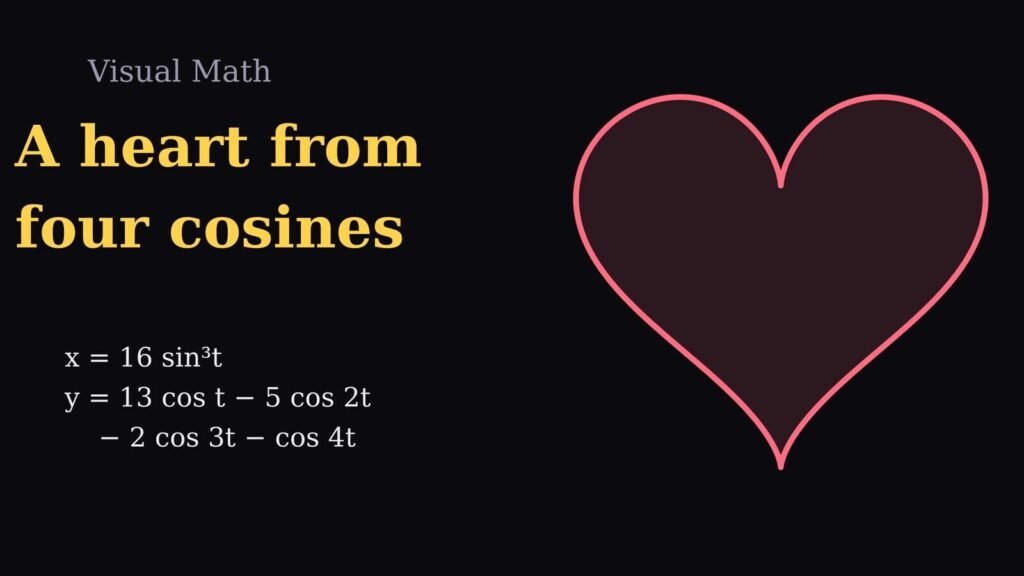
One line of trigonometry draws a heart: x = 16 sin³t, y = 13 cos t − 5 cos 2t − 2 cos 3t − cos 4t. The free Four Cosines and a Heart app puts each of those numbers on a slider, so the curve can be bent, broken and rebuilt, and it also carries two of the implicit heart equations from the same reference page.
Many curves share the name
MathWorld’s entry states that the name heart curve covers a number of curves that produce heart shapes, and it tabulates three implicit, three parametric and three polar examples. The oldest family member is the cardioid, whose name means heart-shaped. The St Andrews curves archive credits de Castillon in 1741 with the name, and notes that La Hire had already found its length in 1708.
The app uses three of the tabulated curves. One is parametric, and the other two are implicit, defined by an equation in x and y that the curve satisfies rather than by a formula for each coordinate.
The parametric heart, one cosine at a time
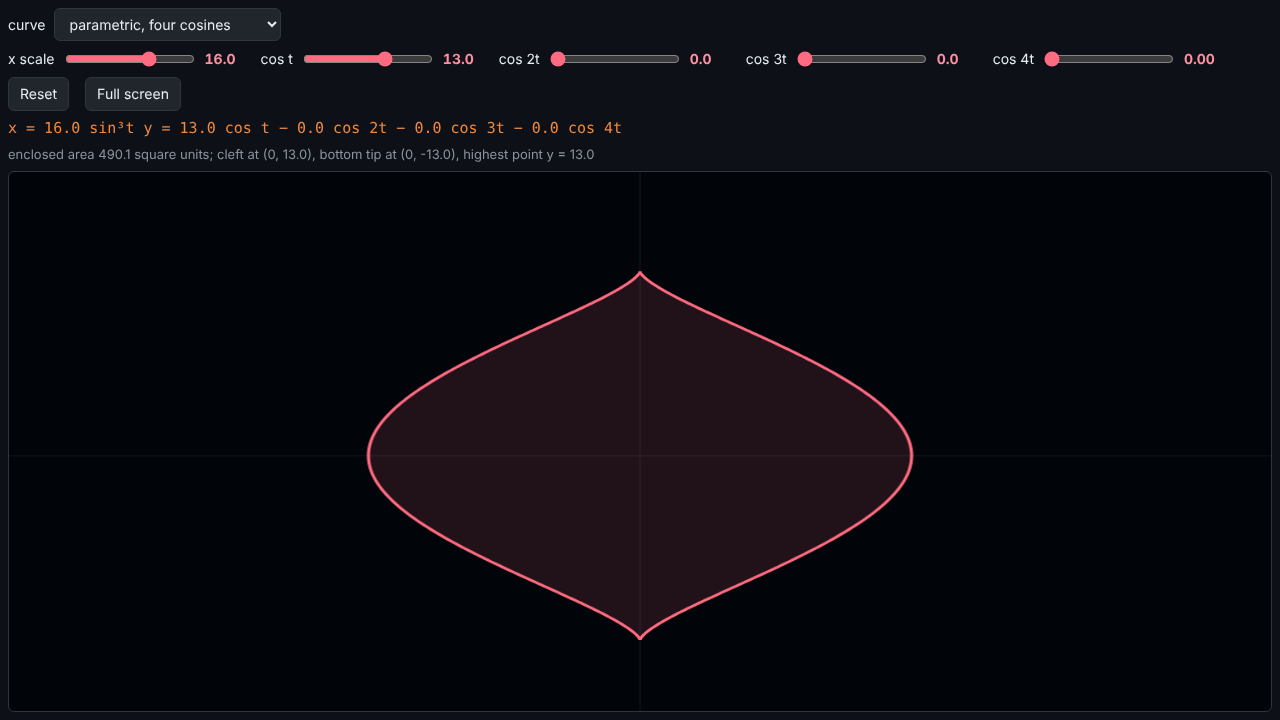
Start with y = 13 cos t and x = 16 sin³t alone. The result is a rounded diamond with points at the top and bottom, (0, 13) and (0, −13), and an enclosed area that the app computes as 490.1 square units. It looks nothing like a heart.
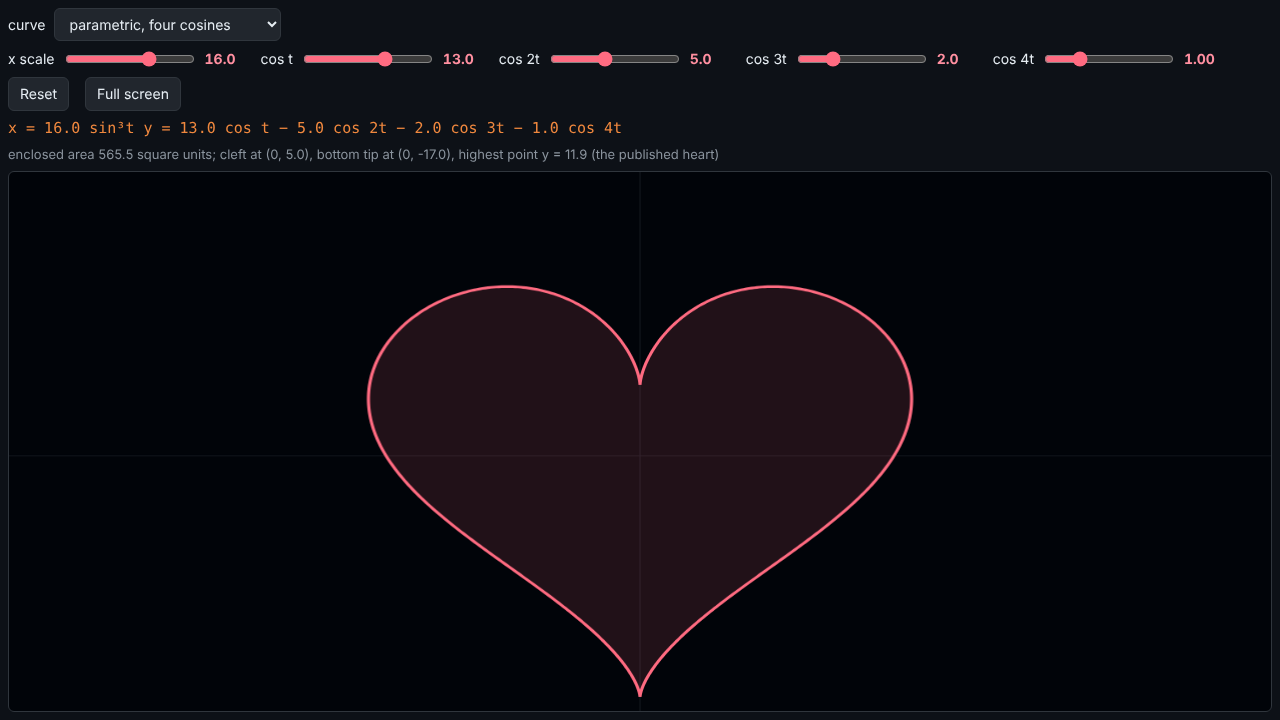
Adding −5 cos 2t pulls both ends of the shape down by 5 at once. At t = 0 that lowers the top point to a dip, and the two shoulders stay higher, which is the cleft of the heart. The −2 cos 3t and −1 cos 4t terms then refine it: the dip settles at y = 13 − 5 − 2 − 1 = 5, the lobes peak at about 11.9, and the bottom tip lands at y = −13 − 5 + 2 − 1 = −17.
With all four terms in place the enclosed area reads 565.5 square units in the app.
Why x has a cube
The factor sin³t looks odd next to a plain cosine series, but the identity sin 3t = 3 sin t − 4 sin³t turns it into 16 sin³t = 12 sin t − 4 sin 3t. Both coordinates are then short sums of sines and cosines of t, 2t, 3t and 4t. The pairing of sines for x and cosines for y keeps the curve symmetric about the vertical axis.
The x scale slider in the app stretches the heart sideways without changing any of the y terms, so the shape can be fattened or narrowed before the coefficients are touched.
The implicit hearts
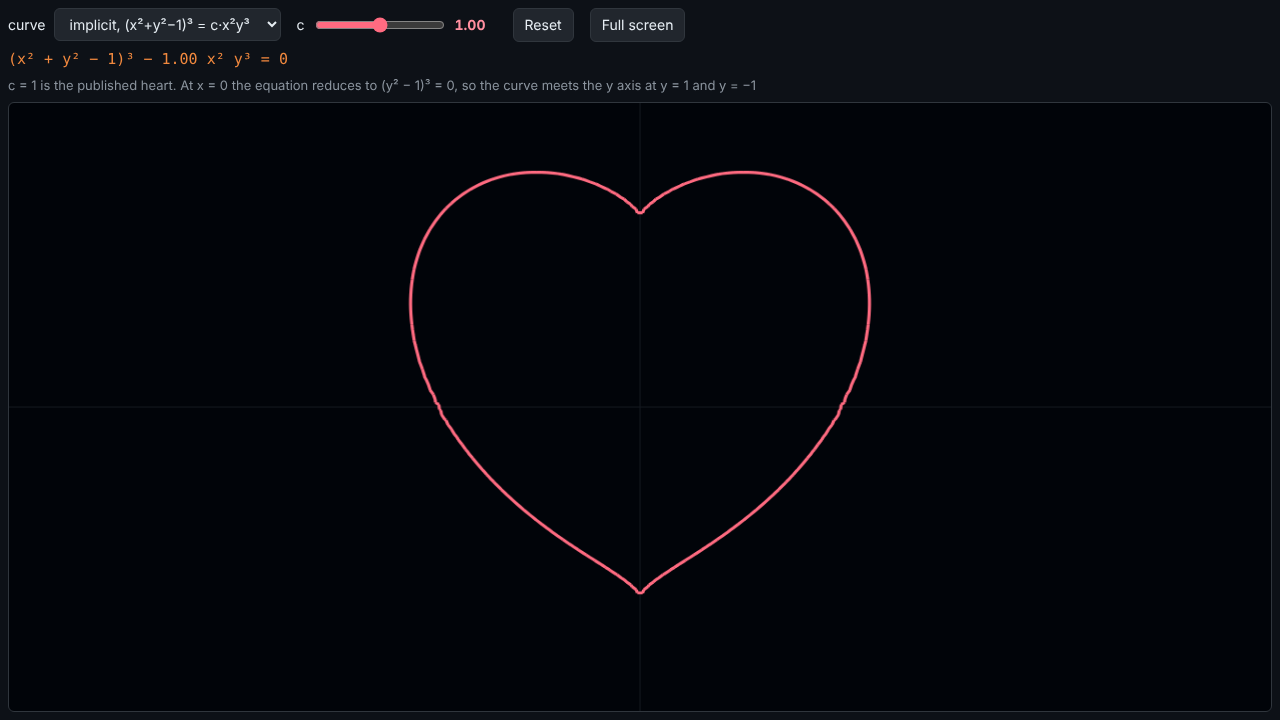
MathWorld’s first implicit heart is (x² + y² − 1)³ − x²y³ = 0. The page explains that it comes from the y = 0 cross section of a heart surface, which gives an order-6 algebraic equation. The second, x² + [y − (x²)^(1/3)]² = 1, is a unit circle with each half lifted by |x|^(2/3), and the reference credits it to a greeting card noted by J. Schroeder in 2021.
The app exposes one control for each. In the first curve a coefficient c multiplies the x²y³ term, with c = 1 the published heart and c = 0 leaving only the unit circle. In the second the exponent 2/3 is a slider p. For any value of either control the curve meets the vertical axis at y = 1 and y = −1, which follows from setting x = 0 in the equations.
The video
The companion reel runs 15 seconds and adds the three terms one after another while a readout tracks the height of the cleft, falling from 13 to 5. The tone follows the same number, rising one semitone for every unit the cleft descends, so eight semitones separate the first note from the last. It sits alongside the rhythm-to-pitch app in the same series.
Sources