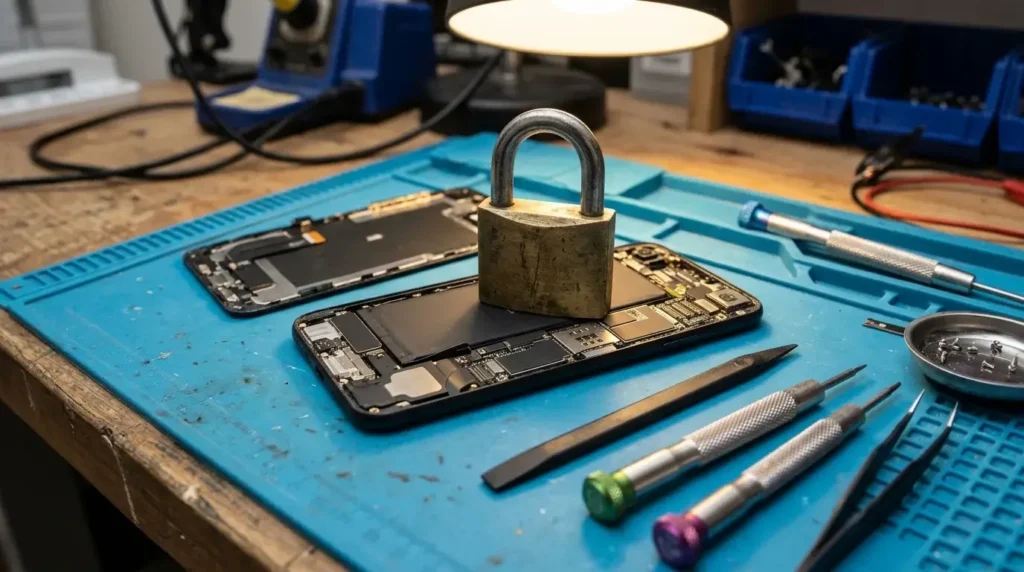
The statutory damages for one act of getting around a digital lock run from $200 to $2,500. That range sits in 17 U.S.C. § 1203, and it applies per act, so a repair shop that bypassed the software lock on 40 devices would face a range of $8,000 to $100,000 before anyone asked whether a single copyrighted work had been copied. The devices could all belong to the people who brought them in, and every repair could be lawful; the lock is a separate question, and federal law has treated it as one since 1998.
The sentence that does the work
Eighteen words in Title 17 that most owners have never read
Section 1201 opens with one prohibition. 17 U.S.C. § 1201(a)(1)(A) says: “No person shall circumvent a technological measure that effectively controls access to a work protected under this title.” The chapter was enacted October 28, 1998, and the statute delayed that prohibition two years, so it took effect in October 2000.
The definition is broad. Under § 1201(a)(3)(A), circumventing includes descrambling a scrambled work, decrypting an encrypted one, and otherwise avoiding, bypassing, removing, deactivating or impairing a technological measure, all “without the authority of the copyright owner.” The protected work, in a modern appliance, is usually the firmware. A tractor, a phone, a coffee machine and a car each run copyrighted software, and the encryption or authentication guarding that software counts as the lock.
Buying the device does not buy the key. The owner holds title to the metal and plastic; the software inside is still a copyrighted work, and the access control on it belongs to the statute. That is the hard fact under the whole topic: a person can own a machine outright and still commit a federal violation by opening the software door on it.
The harder fact sits beside it. Section 1201(c)(1) says “Nothing in this section shall affect rights, remedies, limitations, or defenses” to infringement, including fair use. That clause keeps fair use alive as a defense to infringement. Nothing in it turns a circumvention into an authorized one.

Two kinds of violation, and why the difference matters
Picking a lock is one offense; selling lock picks is another
The statute splits the conduct. Section 1201(a)(1) covers the act of circumventing. Section 1201(a)(2) covers tools: “No person shall manufacture, import, offer to the public, provide, or otherwise traffic in” a technology, product or device that is primarily designed for circumvention, has only limited commercially significant purpose beyond it, or is marketed for it. Section 1201(b) adds a parallel trafficking ban for tools that get around measures protecting a copyright owner’s rights.
That split decides what the famous exemptions can do. Under § 1201(a)(1)(E), neither the built-in exception nor any rulemaking determination “may be used as a defense in any action to enforce any provision of this title other than this paragraph.” The paragraph is (a)(1), the act of circumvention. The exemptions shield the person who picks the lock. They are not written as a defense for the person who sells the pick.
The criminal side is narrower than people fear and steeper than they expect. § 1204(a) reaches violations committed “willfully and for purposes of commercial advantage or private financial gain,” with penalties of up to $500,000 or five years for a first offense and up to $1,000,000 or ten years after that. A person jailbreaking a personal device at a kitchen table is outside the commercial-gain language. A business selling unlock services may not be.
The civil side applies to everyone. A quick Python run of the § 1203 range shows how it scales with volume:
1 acts:   statutory range $200 - $2,500
10 acts:  statutory range $2,000 - $25,000
40 acts:  statutory range $8,000 - $100,000
250 acts: statutory range $50,000 - $625,000
Section 1203(c)(5)(A) lets a court “reduce or remit the total award” when a violator proves it “was not aware and had no reason to believe that its acts constituted a violation.” That relief has to be proved, by the violator, after the lawsuit has started.
The triennial exemptions, as a timeline
A permission slip that expires every three years
Congress built a release valve into the act-of-circumvention ban. Section 1201(a)(1)(C) has the Librarian of Congress, on the recommendation of the Register of Copyrights, decide in a rulemaking whether users are adversely affected in making noninfringing uses, “during each succeeding 3-year period.” Exemptions granted in one cycle lapse at the end of it unless renewed.
The Copyright Office’s rulemaking page lists every final rule. Computing the gaps between them shows the rhythm the process settled into:
| Proceeding | Final rule published | Days since previous dated rule |
|---|---|---|
| 2000 | October 27, 2000 | |
| 2003 | 68 FR 2011 (no date on the page) | |
| 2006 | November 27, 2006 | 2,222 (since 2000) |
| 2010 | July 27, 2010 | 1,338 |
| 2012 | October 26, 2012 | 822 |
| 2015 | October 28, 2015 | 1,097 |
| 2018 | October 26, 2018 | 1,094 |
| 2021 | October 28, 2021 | 1,098 |
| 2024 | October 28, 2024 | 1,096 |
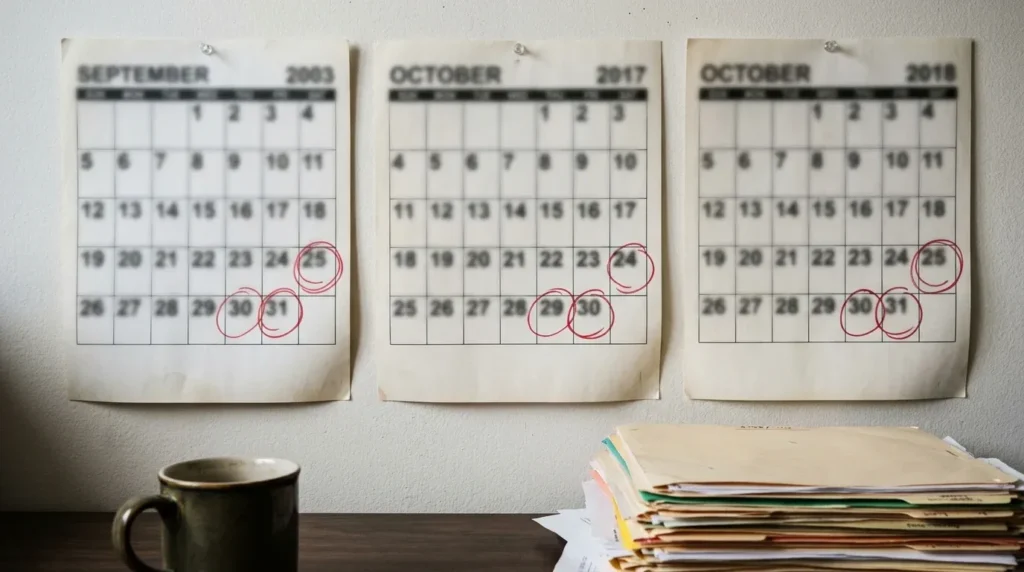
Since 2012 the rules have landed within a few days of late October, three years apart. The 2024 rule, which the Office announced on October 25, 2024, completed the ninth proceeding. The Register recommended granting proposed exemptions “in whole or in part, in three of the seven classes” and renewing every existing exemption for which petitions were filed, and the Librarian “adopted the Register’s Recommendation in full.”
The tenth proceeding is under way as this is written. The Copyright Office announced its start on June 9, 2026, with petitions for new exemptions and for renewal of existing ones due August 24, 2026, and written comments on renewal petitions due September 28, 2026. According to the rulemaking page, renewed exemptions would “remain in force for an additional three-year period (October 2027–October 2030).”

What the current exemptions cover
Phones yes, consoles mostly no, ice cream machines yes
The exemptions live in regulation at 37 CFR 201.40, last amended October 28, 2024. Each comes with conditions that do real work, and the core permissions are these:
- Jailbreaking. Paragraphs (b)(9) through (b)(12) allow circumvention to “enable smartphones and portable all-purpose mobile computing devices to execute lawfully obtained software applications,” with parallel language for smart televisions, voice assistant devices, and routers and dedicated network devices.
- Unlocking for a carrier. Paragraph (b)(8) covers enabling wireless devices “to connect to a wireless telecommunications network.” This one has history: the Unlocking Consumer Choice and Wireless Competition Act, approved August 1, 2014, reinstated the earlier unlocking exemption “as such paragraph was in effect on July 27, 2010,” and let unlocking be started “by another person at the direction of the owner.”
- Consumer device repair. Paragraph (b)(15) allows circumvention on lawfully acquired devices primarily designed for consumers when it “is a necessary step to allow the diagnosis, maintenance, or repair of such a device.” For video game consoles, the regulation limits “repair” to “repair or replacement of a console’s optical drive.”
- Vehicles and vessels. Paragraph (b)(13) covers “diagnosis, repair, or lawful modification of a vehicle or vessel function,” and (b)(14) covers access to “operational data.”
- Commercial food equipment. Paragraph (b)(16) reaches “equipment that is primarily designed for use in retail-level commercial food preparation.”
Consoles are the sharp edge. There is no general console jailbreaking exemption in the paragraphs above, which is why the PS5 jailbreak coverage on x9m8 matters for owners in a way a phone jailbreak does not. A repair exemption that stops at the optical drive leaves the rest of the box locked.
Where people get burned
Four misreadings that turn a lawful repair into a lawsuit
“I own it, so the law does not apply.” The Federal Circuit came close to agreeing in 2004. In Chamberlain v. Skylink, decided August 31, 2004, a garage door opener maker sued the seller of a universal remote. The court required “a reasonable relationship between the circumvention at issue and a use relating to a property right,” and wrote of buyers: “What the law authorizes, Chamberlain cannot revoke.” Six years later the Ninth Circuit went the other way. In MDY Industries v. Blizzard, decided December 14, 2010, over a World of Warcraft bot called Glider and Blizzard’s anti-bot system Warden, the court said Chamberlain’s approach was “contrary to the plain language of the statute” and held that “we reject the imposition of an infringement nexus requirement.” Ownership arguments that work in one circuit can fail in another.
“The exemption covers the tool I sell.” Section 1201(a)(1)(E) limits the rulemaking’s determinations to the act-of-circumvention paragraph. A shop may lawfully perform an exempted repair; a vendor shipping the bypass device is answering to the trafficking provisions, which the exemptions do not name.
“Fair use will save me.” Section 1201(c)(1) preserves fair use as a defense to infringement, and the D.C. Circuit has declined to stretch it further. In the second appeal in Green v. Department of Justice, decided August 2, 2024, the court said it “disagree[s] that the First Amendment necessarily shields all fair uses of copyrighted work from regulation,” called the exemption process “not a speech-licensing scheme,” and affirmed. The first appeal, decided December 6, 2022, involved security researcher Matthew Green, who planned a book that included circumvention code, and engineer Andrew “bunnie” Huang, who wanted to build and sell a device containing code that circumvents HDCP. That panel, affirming the denial of a preliminary injunction, found the provisions content neutral because they target “the act of circumvention” and called intermediate scrutiny “a test it easily survives.”
“The exemption is permanent.” Every one of them sits on a three-year clock. Renewal has been routine in recent cycles, and in 2024 the Register recommended renewing every exemption that drew a petition. A habit still binds no future Librarian.
The case for the locks
The statute was not written by accident, and courts keep upholding it
The strongest argument against the repair-and-jailbreak position comes from the courts that have looked at it hardest. MDY described § 1201(a) as “a new anti-circumvention right distinct from the traditional exclusive rights of a copyright owner.” Under that reading, Congress chose to protect access controls themselves, so that copyright owners would not have to prove infringement case by case in a world where perfect digital copies cost nothing. The D.C. Circuit rejected the Green plaintiffs’ First Amendment challenges twice. The exemption process, slow and narrow as it is, does respond: the 2024 cycle granted new relief, in whole or in part, in three of the seven classes proposed.
The trouble is what the lock is guarding by now. The same rule sits inside garage door openers, cars and commercial kitchen equipment, where the copyrighted work is a control program nobody wants to copy, only to fix. State right-to-repair laws appear nowhere in § 1201’s text, and the notice-and-takedown process in a different part of the same act does nothing for a device owner holding a screwdriver and a password prompt. The exemptions help the owner who does the work alone. Whether they help the owner who has to pay someone else, using a tool someone else built, is a question the statute answers in a different paragraph.
Nearly twenty-eight years after enactment, the most useful repair right in American copyright law still has to be asked for again every three years. Which device on your workbench is waiting on the October 2027 rule?
For informational purposes only — consult a licensed attorney or financial advisor.
Sources
- 17 U.S.C. § 1201, Legal Information Institute: https://www.law.cornell.edu/uscode/text/17/1201
- 17 U.S.C. § 1203, Legal Information Institute: https://www.law.cornell.edu/uscode/text/17/1203
- 17 U.S.C. § 1204, Legal Information Institute: https://www.law.cornell.edu/uscode/text/17/1204
- 37 CFR § 201.40, Legal Information Institute: https://www.law.cornell.edu/cfr/text/37/201.40
- U.S. Copyright Office, Rulemaking Proceedings Under Section 1201: https://www.copyright.gov/1201/
- U.S. Copyright Office NewsNet No. 1057, Final Rule Published in Ninth Triennial Section 1201 Proceeding (Oct. 25, 2024): https://copyright.gov/newsnet/2024/1057.html
- U.S. Copyright Office NewsNet No. 1088, Start of Tenth Triennial Rulemaking (June 9, 2026): https://www.copyright.gov/newsnet/2026/1088.html
- Public Law 113-144, Unlocking Consumer Choice and Wireless Competition Act: https://www.congress.gov/113/plaws/publ144/PLAW-113publ144.htm
- Chamberlain Group v. Skylink Technologies, 381 F.3d 1178 (Fed. Cir. 2004): https://law.resource.org/pub/us/case/reporter/F3/381/381.F3d.1178.04-1118.html
- MDY Industries v. Blizzard Entertainment (9th Cir. 2010), FindLaw: https://caselaw.findlaw.com/us-9th-circuit/1548042.html
- Green v. U.S. Department of Justice, No. 21-5195 (D.C. Cir. Dec. 6, 2022): https://media.cadc.uscourts.gov/opinions/docs/2022/12/21-5195DST.pdf
- Green v. U.S. Department of Justice, No. 23-5159 (D.C. Cir. Aug. 2, 2024): https://media.cadc.uscourts.gov/opinions/docs/2024/08/23-5159-2067976.pdf
- x9m8, PS5 jailbreak relapse: https://x9m8.com/ps5-jailbreak-relapse-what-owners-should-know/
- x9m8, Right to repair: state laws, warranties and the FTC: https://x9m8.com/right-to-repair-devices-state-laws-warranty-ftc/
- x9m8, DMCA takedown notice and counter-notice: https://x9m8.com/dmca-takedown-notice-counter-notice-how-it-works/