






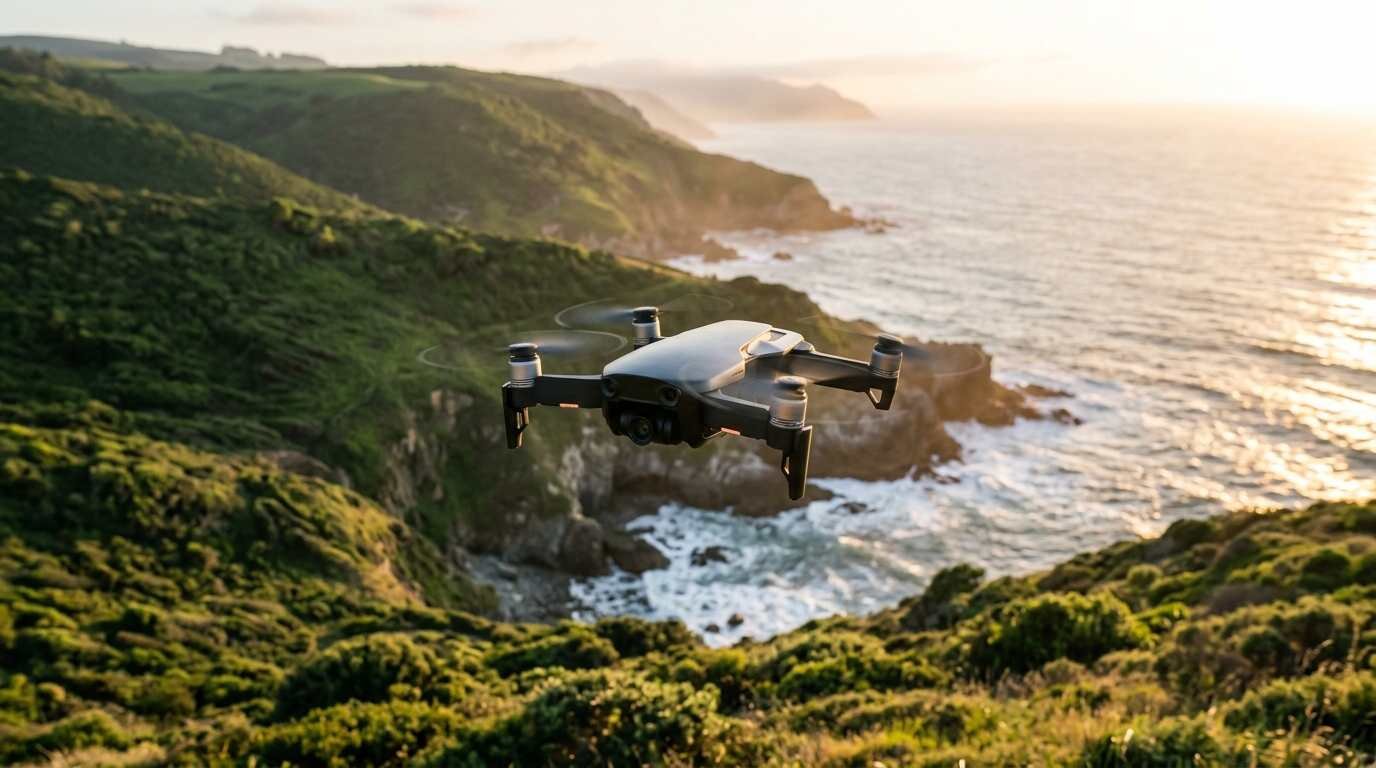
A sub-250 gram drone with 4K video and a simple app. Reviewers love the value but flag missing obstacle avoidance, optimistic flight time and uncertain US supply.
As an Amazon Associate I earn from qualifying purchases. A commission may be earned if you buy through this link, at no extra cost to you.
This DJI Mini 4K review is about a small camera drone that shoots 4K video, weighs under 250 grams and has been among the cheapest ways into DJI’s lineup. It is also a product with a complicated US supply story, which matters as much as the specs. I haven’t tested this unit; this review is based on published tests and shopper feedback. Check the current price on Amazon before buying.
What the Mini 4K is and who it is for
DJI released the Mini 4K in April 2024. TechRadar describes it as essentially a Mini 2 SE with 4K video, and that is a fair summary: a small folding drone with a three-axis mechanical gimbal, a 1/2.3-inch 12MP sensor and a simple app.
Its weight is the selling point. Reviewers measured it at 246 to 249 grams, which keeps it under the 250 g line that spares recreational pilots from FAA registration, according to Fstoppers and DroneXL. Check current rules before you fly; I did not verify them for this post.
| Video | 4K/30fps, 2.7K/60fps, 1080p/60fps, up to 100 Mbps |
| Stills | 12MP, JPEG and RAW |
| Gimbal | 3-axis mechanical |
| Rated flight time | 31 minutes; reviewers measured roughly 20 to 25 |
| Range | 10 km FCC / 6 km CE transmission rating |
| Wind | Level 5 resistance; DroneXL held position in a measured 24 mph wind |
| Obstacle sensing | Downward only; none front, back or side |
| Storage | microSD, up to 256GB |
The target buyer is a first-time pilot, or a traveler who wants 4K video in something that fits in a jacket pocket and costs little.
What Amazon shoppers say
Amazon shoppers are broadly enthusiastic. Amazon’s summary of the written reviews calls it an amazing entry-level drone that is easy to fly, with crystal-clear video and good value. One customer reports reliable flight out to about a mile.
Battery life is the one area where opinions diverge. Some buyers report around 40 minutes, a figure well above anything the professional reviewers measured, while others call the battery inadequate. I would trust the measured 20 to 25 minutes over a single anecdote.
I did not pull a Google or Google Shopping rating for this post, so shoppers can compare that themselves if they want another view.
What independent reviewers found
TechRadar gave it 4.5 out of 5 in each category and called it the best first drone, reviewed in October 2024. Digital Camera World, writing in May 2024, scored it 4 for features, 4 for design, 5 for performance and 5 for value. It praised the 4K quality and the software, and noted that the Mini 4K is not a redesign of what came before.
Space.com, in June 2024, liked the image quality and flying performance for the money. It also said the flight-time claim is overstated and that avoidance and tracking are missing. Fstoppers, in April 2024, was positive about stability, range and footage, and listed no drawbacks. That reads as a first-flight impression rather than a long test.
DroneXL is the most recent voice. Its reviewer calls the Mini 4K the best first drone he has recommended, if flown carefully, and updated the piece in August 2026 to note how far the price has dropped. He also clipped a branch on his first flight, which brings us to the main weakness.
What it does well
Video is the draw. True 4K at 30 frames per second, at this price, is the line that TechRadar, Digital Camera World and Space.com all return to.
Flight behavior earns praise too. Fstoppers and DroneXL both found the drone stable in wind and generous in range for its class. Level 5 wind resistance is about 21 mph by Space.com’s figure, and DroneXL held position in a measured 24 mph gust.
The DJI Fly app is simple enough for a beginner, with tutorials and QuickShots automated moves, yet Pro mode gives manual control for people who want it. TechRadar and Digital Camera World both liked this mix.
The price has also been soft. DroneXL recorded a notable low in April 2026, and in January 2026 saw discounts on both the single-battery kit and the Fly More bundle. The list price may not be what you pay.
Photographers get a small bonus. Stills can be saved as JPEG or RAW, and video runs at up to 100 Mbps, so there is something to work with when editing. Recording goes to a microSD card of up to 256GB.
Where it falls short
The Mini 4K has no forward, backward or side obstacle sensing, only downward sensors. For a beginner, that is the biggest problem. Trees and walls are exactly where beginners crash, and DroneXL’s own tester proved the point on his first outing.
There is no subject tracking either, so Follow Me style shots are out. Flight time is optimistic: the 31-minute rating drops to about 20 to 25 minutes in TechRadar, Space.com and DroneXL tests.
The small sensor limits dynamic range in high-contrast scenes, according to Digital Camera World. QuickShots drop to 1080p, per Space.com, and the controller relies on your phone, with no built-in screen option, as Space.com and DroneXL point out.
In my view, the gap between marketing and measured flight time matters more than it looks. A drone that really gives you 22 minutes is fine. It is the 31 on the box that sets a trap.
Reading the scores together, a pattern appears. Nobody calls the Mini 4K a breakthrough; Digital Camera World says as much. What they praise is the combination of a real gimbal, real 4K and a low price. Complaints are about what is missing, not about what is there, and every missing feature (avoidance, tracking, a bigger sensor) is something DJI sells in a pricier model.
It helps to separate what the drone does from what the market does around it. As a product, the Mini 4K has been reviewed consistently well since April 2024, and nothing in the more recent coverage contradicts that. The uncertainty is about supply: leftover stock, unpredictable discounts and the chance that accessories or replacement batteries become harder to find. A buyer who plans to fly it for a few seasons should weigh that risk against the appeal of a capable first drone. Someone who only wants to try the hobby may reasonably decide the risk is small.
The US availability question
Here the sources are less tidy. The FCC added DJI and other foreign drone makers to its Covered List in late December 2025; DroneXL gives the date as Dec 22 and Capture Integration as Dec 23. Capture Integration says the Mini 4K, which was authorized earlier, can still be sold. DroneXL says official channels will not restock it, so what you find is leftover inventory.
The two accounts differ, and I could not settle which is right. In practice, expect stock and prices to swing, and expect newer DJI models to face US sales restrictions. DroneXL also mentioned tariffs as of Sept 3, 2026, which I did not check independently.
Video reviews
Three independent videos cover the Mini 4K, including one that asks whether it still holds up in 2026.
How it compares
The DJI Mini 3 has a bigger sensor, vertical shooting and a longer battery, according to TechRadar and Digital Camera World. Gadgeteer lists it at a higher price. If the budget stretches that far, many reviewers see it as the step up.
Potensic’s Atom and Atom SE are non-DJI 4K gimbal drones at similar or lower prices, as TechRadar and Space.com note. As non-DJI aircraft they sit outside the DJI question, though I did not check their own availability.
The DJI Neo is cheaper still and offers subject tracking but no mechanical gimbal. It is a different kind of toy, aimed at selfies and casual clips rather than cinematic shots. For anyone who wants obstacle protection or better low-light footage, reviewers point to the Mini 4 Pro or Mini 5 Pro, which sit higher in DJI’s range.
Verdict: who should buy it, and who should skip
Buy it if you are a first-time pilot with open space to practice in, or a traveler who wants decent 4K from something very light. For that person the price-to-quality ratio is hard to beat, as the reviews agree.
Skip it if you fly among trees, if you want subject tracking, strong low-light footage or a pro-grade camera, or if you want DJI’s newest hardware. Anyone anxious about long-term US supply should think twice as well.
Some practical points for a new owner. Buy a second battery if you can, since a real 20 to 25 minutes goes quickly. Fly in an open field first and keep a wide margin around trees. Keep the phone charged, as it doubles as the screen. And confirm the current rules for your area before the first flight.
My take: it is a good first drone with one serious flaw, and you can manage that flaw by flying slowly in open fields. Learn the controls before you chase the shot.
- DJI Mini 4K: a sub-250 g drone with 4K/30 video and a three-axis gimbal, best for beginners flying in open space. See it on Amazon (affiliate link)
As an Amazon Associate I earn from qualifying purchases. A commission may be earned if you buy through this link, at no extra cost to you.



