The Creality Sermoon P1S 3D scanner costs $1,000 less than the P1. What the 0.02 mm claim means, how volumetric error scales, and what is unproven.
The Creality Sermoon P1S is a standalone handheld 3D scanner announced in the last week of September 2026 at $2,299, about $1,000 below the Sermoon P1 it is based on. Creality quotes a point accuracy of 0.02 mm, 34 crossed blue laser lines, and a near-infrared mode for dark or shiny surfaces.
A cheaper scanner that looks almost identical on a spec sheet invites the question of what was cut. The answer is partly visible in the numbers: looser volumetric accuracy, less memory, a lower-resolution screen. This post works through what those differences mean for real parts, notes where the sources disagree, and lists what nobody has measured yet. x9m8 has not used the scanner; every figure comes from Creality material as reported by others.
What was announced and when
Notebookcheck and All3DP both date the announcement and preorder opening to September 23, 2026, while Makers101 says September 22. The list price is $2,299, with an early-bird price of $2,099 for preorders placed before October 12. All3DP says shipping is estimated to begin in October; Makers101 says delivery dates are unconfirmed. Makers101 adds a launch bonus of one can of blue scanning spray during the launch period.
Notebookcheck puts the P1 at $3,299. That makes the P1S 30 percent cheaper at list and about 36 percent cheaper at the early-bird price. These are straightforward divisions of published prices, not a statement about value.
How a laser line scanner measures
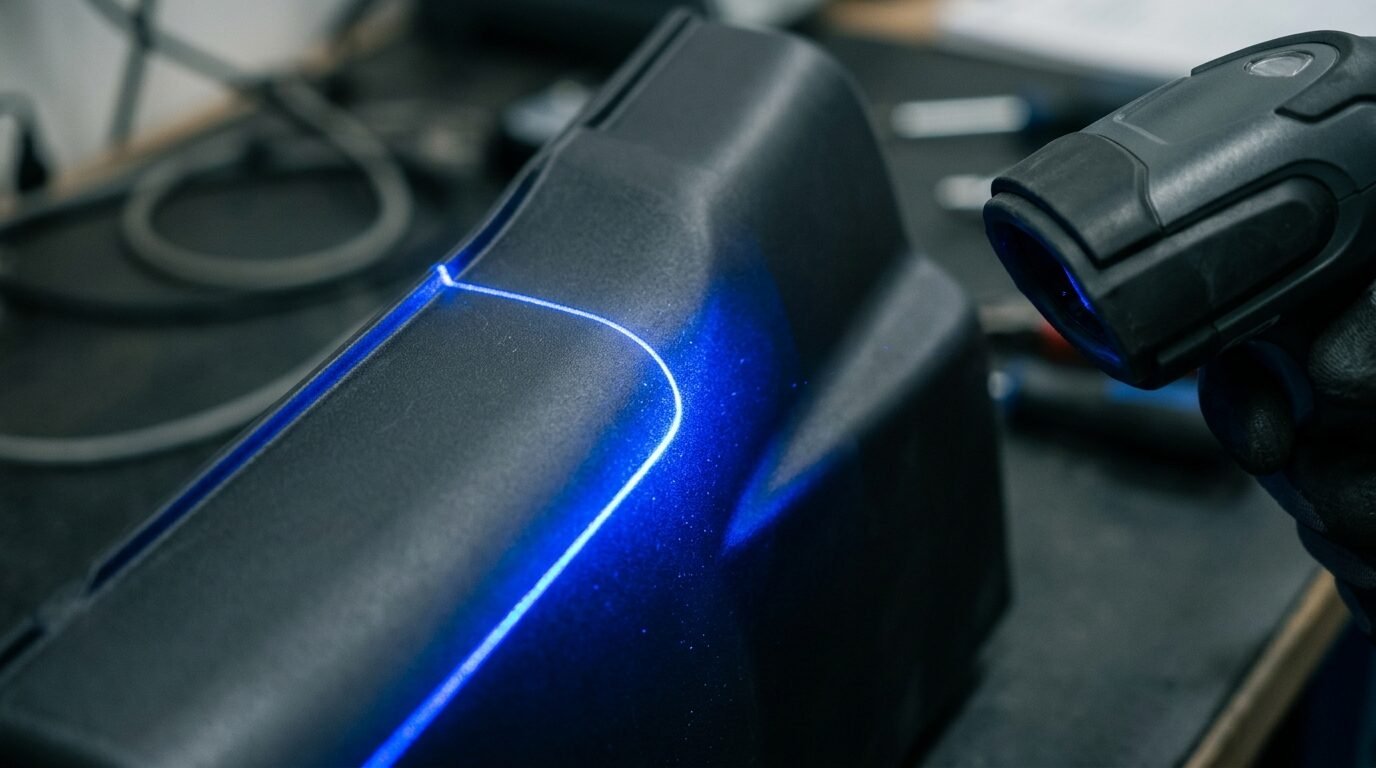
The blue laser modes use triangulation. A projector throws a thin line of light across the part, a camera set a known distance away from the projector sees the line, and the position of the line in the camera image tells the scanner how far away that bit of surface is. Where the surface is closer, the line shifts one way; farther, the other. Sweep the scanner over the object and the sequence of profiles is stitched into a point cloud, then a mesh.
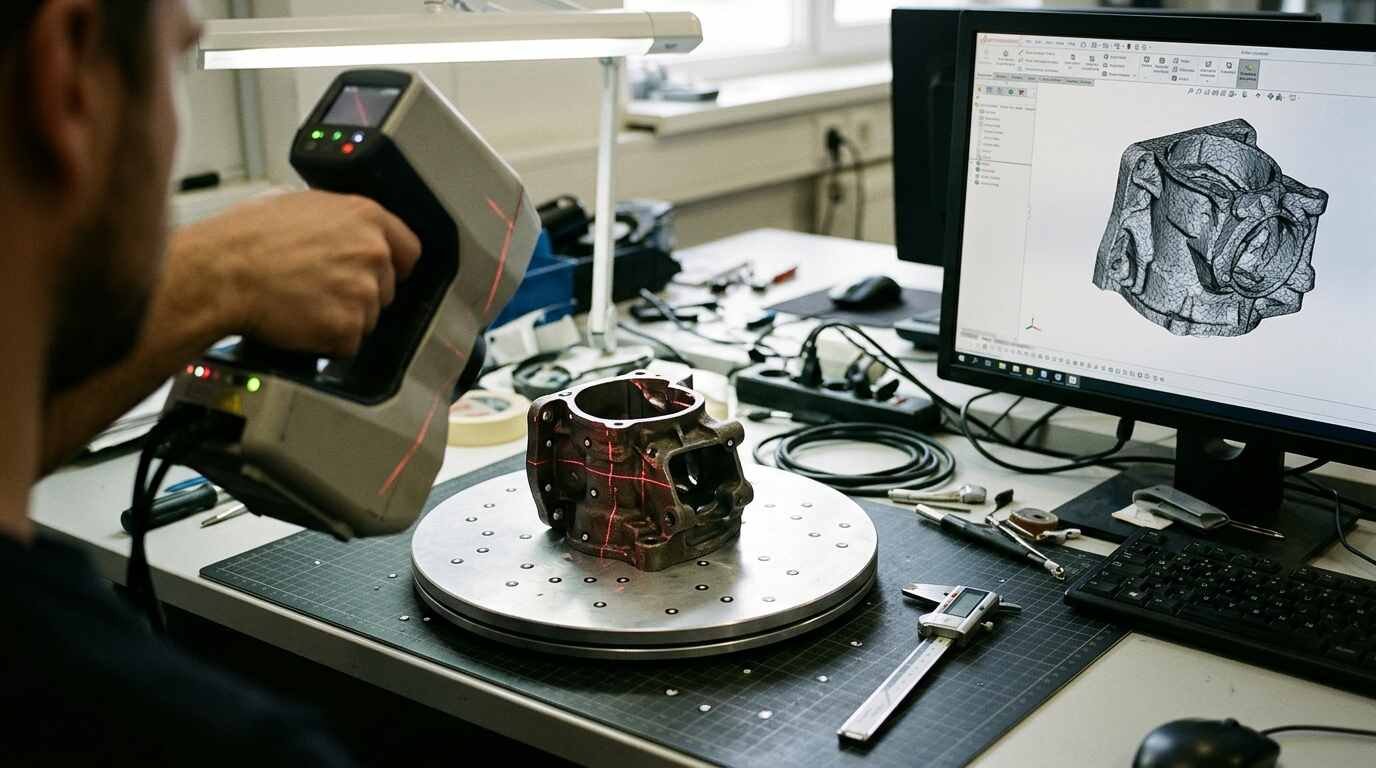
Creality describes three blue-laser patterns: 34 crossed lines for coverage of large surfaces, 7 parallel lines for finer detail, and a single line for grooves and deep holes. Near-infrared mode uses structured light, a projected pattern rather than lines, and the P1S version is marketed with a MASK feature, a larger field of view and an optical filter. Makers101 notes that the sources do not make clear whether the MASK approach is new technology or a name for existing technique, a doubt All3DP shares.
Working through the accuracy numbers
Creality gives two accuracy figures: 0.02 mm for a single measurement, and a volumetric accuracy of 0.02 mm plus 0.08 mm per meter. The second is the one that matters on larger parts, because errors accumulate as the scanner moves and alignment stitches overlapping scans together.
Taking the formula at face value, the error bound for an object of length L in meters is 0.02 + 0.08 L millimeters. A 0.5 m part gives 0.06 mm. A 1 m part gives 0.10 mm. A 2 m part, such as a car panel set, gives 0.18 mm. The P1’s formula, 0.02 + 0.06 L, gives 0.05, 0.08 and 0.14 mm at the same lengths. So the P1S allows 20 to 29 percent more error at those sizes in the best case, and the gap grows with length.
Two cautions. The 0.02 mm figure is described by Makers101 as a lab claim, and no independent scans or measurements were available as of September 23. And accuracy on paper says nothing about the quality of the final mesh, which depends on surface finish, tracking and the onboard processing.
Field of view and speed
All3DP reports a laser-mode field of view of 500 by 400 mm at 550 mm distance, against 380 by 365 mm for the P1. That is 200,000 square millimeters against about 138,700, roughly 1.44 times the area per capture. A larger field of view means fewer passes to cover a panel, which can offset the looser volumetric spec by reducing the number of stitched seams. That trade-off is plausible but has not been tested.
Blue-laser speed is up to 60 frames per second standalone and 100 with a PC connection, matching the P1, according to Makers101. If the 34 lines are all projected in each frame, that is 2,040 line profiles per second standalone. That is an inference from the spec, not a published figure.
Near-infrared speed is where the sources diverge. Makers101 lists 20 fps standalone and 30 with a PC, versus 15 and 30 for the P1. Notebookcheck says the standalone NIR rate is capped at 20 fps against 60 for the P1. Both cannot be right about the P1, so treat the NIR comparison as unresolved.
What was cut
The P1S ships with 16 GB of LPDDR5X memory against the P1’s 24 GB, a 6-inch touchscreen that All3DP describes as HD rather than Full HD, and a volumetric accuracy that is looser. Storage is 256 GB UFS 4.0 and the processor is the same eight-core Qualcomm chip with an Adreno 740 GPU. It weighs 807 g with a battery, against 830 g for the P1. Two swappable 3,300 mAh batteries are listed.
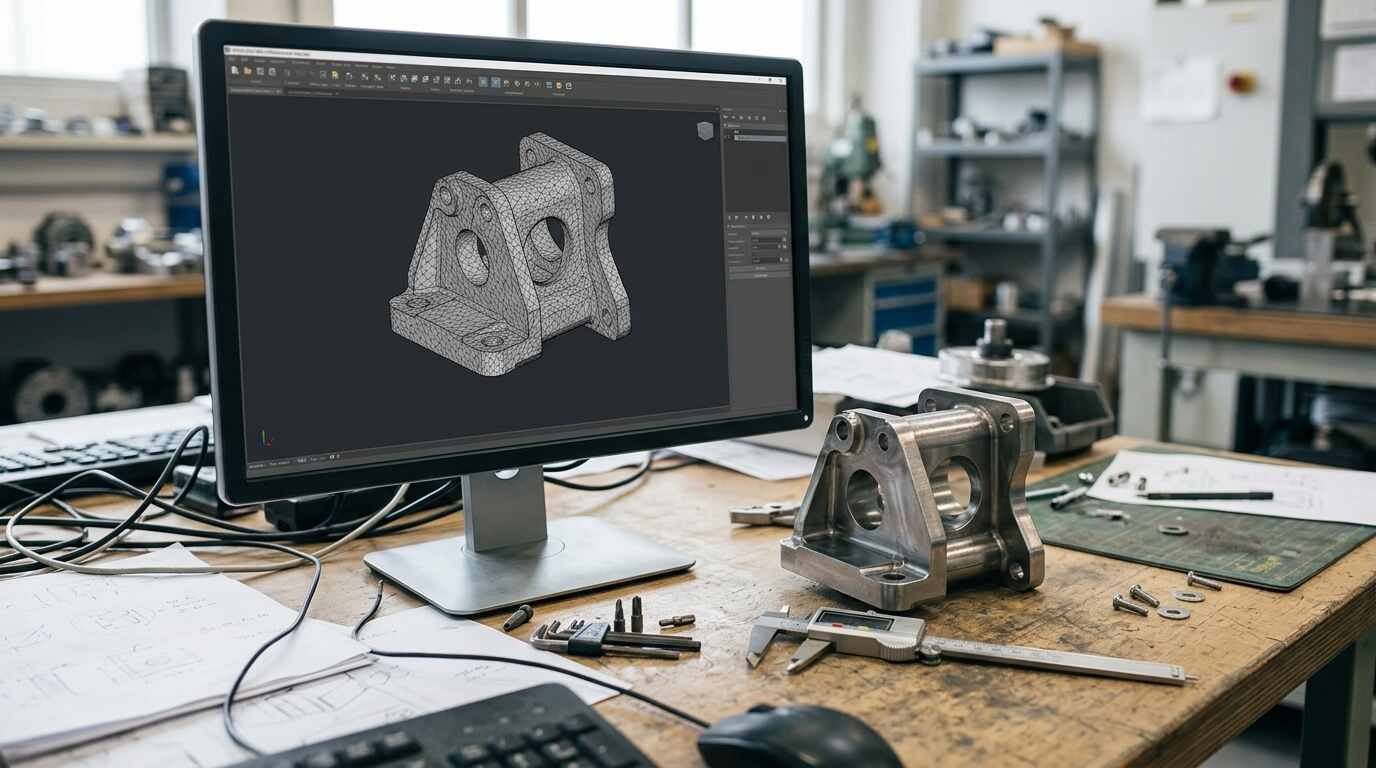
Memory matters because alignment, fusion and meshing run on the device. Makers101 points out that an independent review of the P1 suggested onboard fusion can reduce resolution, and that this has not been confirmed for the P1S. Whether 16 GB changes processing speed or maximum scan size is, again, unmeasured.
Makers101 also warns that Creality’s comparison sheet appears to swap some model columns and contains laser-count and volumetric errors, so the table of P1 versus P1S figures is only as reliable as the P1 page and manual it was corrected against.
Conflicts and unverified claims
Besides the NIR frame rate, the sources differ on the strong-light rating: Makers101 reports blue laser up to 110,000 lux and NIR up to 80,000 lux with a filter, while All3DP gives outdoor use rated to 100,000 lux. These could be different test conditions, but neither source explains.
Marker-free scanning is claimed for blue-laser mode in wired PC use, according to Notebookcheck. Makers101 cautions that marker-free capture does not apply to every mode or object, and that dark, shiny, transparent or repetitive surfaces may still need reflective markers, spray or added features. The bundled scanning spray hints at the same thing.
Who it fits
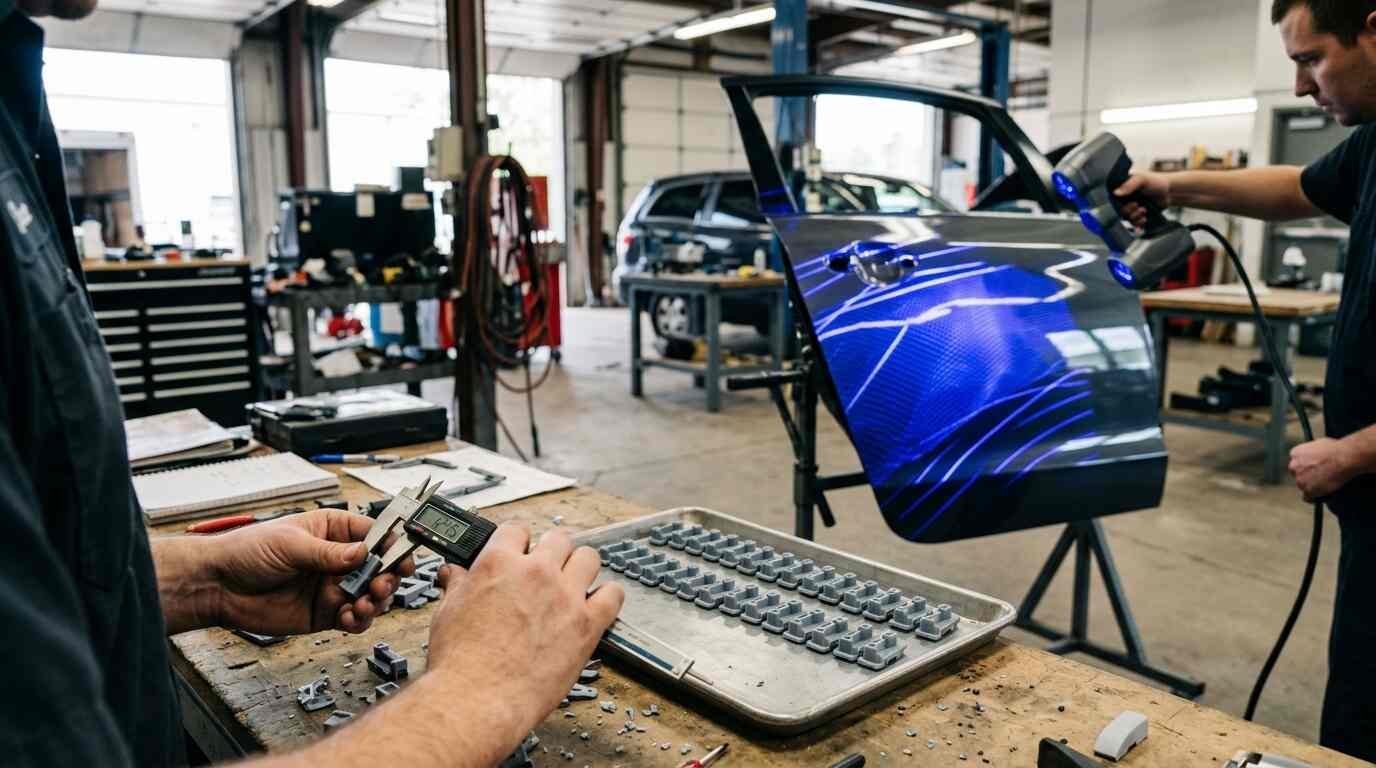
By Creality’s own positioning and the reviewers’ reading, the target is mobile reverse engineering, automotive work and anything where carrying a laptop is a burden. The output is a mesh in STL, OBJ or PLY, not parametric CAD, so a part destined for machining or precise replacement still needs reference measurements and cleanup. For occasional reference meshes, Makers101 suggests a phone-based or cheaper scanner may be enough.
One more point: the setup of the P1 used a Creality Cloud login, and whether the P1S can run fully offline is unproven. Software licensing and long-term support terms for CrealityScan are also unclear.
The scanning spray bundled with the launch offer is a clue about the physics. A triangulating scanner needs the surface to scatter light back toward the camera, and glossy, dark or transparent material either mirrors the line away or lets it sink in. A thin matte coat fixes that, but the coat has its own thickness, and the sources do not say how much error it adds. Runtime on the two 3,300 mAh batteries and thermal behavior during long scans are also untested, so a day of field scanning remains a plan rather than a demonstrated workflow.
Frequently asked questions
How much does the Creality Sermoon P1S cost?
The list price is $2,299, with a $2,099 early-bird price for preorders before October 12, 2026, according to Notebookcheck and All3DP.
How accurate is the Sermoon P1S?
Creality claims 0.02 mm point accuracy and 0.02 mm + 0.08 mm/m volumetric accuracy. No independent measurements existed as of September 23, 2026.
What is different from the Sermoon P1?
More crossed laser lines (34 versus 22), a larger laser-mode field of view, looser volumetric accuracy, 16 GB instead of 24 GB of RAM, and a lower-resolution display, per Notebookcheck, All3DP and Makers101.
Does it output CAD files?
No. It produces meshes (STL, OBJ, PLY), not parametric CAD models.
The P1S is a reasonable bet on a particular idea: that most people who buy a handheld scanner care more about coverage and price than about the last 0.02 mm per meter of stitched accuracy. That may well be true for car panels and cast parts. It is less true for anything you plan to machine to fit. Until someone scans a calibrated artifact with it and publishes the deviation map, the 0.02 mm figure is a ceiling set by the manufacturer. If the preorder deadline is the only thing pushing you, remember that an early-bird price of $2,099 is a $200 saving, not a reason to buy before independent numbers exist.
Sources