A biosimilar can be highly similar to its reference biologic but never identical. How the drugs are made, what regulators compare, and what the FDA's draft guidances would change.
Biosimilar manufacturing is a different job from making a generic pill, because a biosimilar can only be highly similar to its reference drug, never identical. Living cells make the protein, and living cells vary. That is why the FDA asks for a heavy dossier of laboratory comparisons, and why the agency’s 2025 and 2026 draft guidances, which would trim some clinical testing, are being watched closely by developers and critics alike.
Why a biologic cannot be copied like a pill
A small-molecule drug is a fixed structure; any chemist can confirm that two samples match. A therapeutic antibody is a protein thousands of times larger, folded in three dimensions and decorated with sugar chains. It is produced inside cells that the maker has engineered and grown in bioreactors, and the exact process leaves a fingerprint on the product.
The FDA’s biosimilar guidance states the problem directly. A biosimilar maker usually does not have the originator’s process knowledge, so the agency expects more data than a company would submit when changing its own process. Different biological production systems can alter post-translational modifications, and those changes may affect safety or effectiveness (FDA, Scientific Considerations in Demonstrating Biosimilarity, Section IV.B, a 2015 document the agency has since withdrawn, as discussed below).
What the manufacturing process looks like
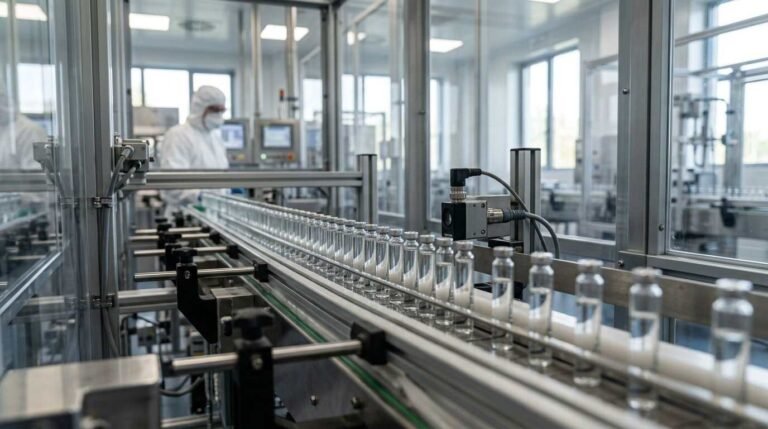
The broad sequence is common across the industry, though each company’s recipe is proprietary. This outline reflects general bioprocess practice rather than any single filing.
- Cell line development. The developer builds a cell line that encodes the same amino acid sequence as the reference product. The FDA’s quality guidance says that sequence should match, although justified minor truncations at the ends can be acceptable.
- Upstream culture. Cells grow in a bioreactor under tuned conditions of temperature, nutrients and oxygen. Small changes here shift the product.
- Purification. The protein is captured and cleaned of cell debris, related variants and contaminants.
- Formulation and fill-finish. The purified drug goes into its final buffer and into vials, syringes or pens under sterile conditions.
- Release testing. Each batch is checked against specifications before it ships.
Nothing here is simple to copy. The developer never sees the originator’s cell line or process, so it has to reverse-engineer a product from the finished drug on the pharmacy shelf.
Glycosylation: the variable that causes the most trouble
The FDA’s quality considerations guidance calls glycosylation a key source of heterogeneity. Sponsors are asked to characterize the type, location and amount of each sugar chain, and to assess some features together because their effect on potency can depend on the combination. Subtle shifts in the mix of glycoforms can change bioavailability, and laboratory assays may miss that.
The same document asks for testing across multiple lots of both products, so the developer can see natural batch-to-batch spread. Acceptance criteria should rest on the whole data set, not just the observed range of the reference product. In practice, a biosimilar sponsor gathers dozens of lots of the originator, measures them, and then tunes its own process until the new product sits inside that envelope.
| Attribute compared | Why it matters |
|---|---|
| Amino acid sequence | Must match the reference |
| Higher-order structure | Folding drives binding and activity |
| Glycosylation pattern | Can alter potency and how long the drug stays in the body |
| Impurities and degradation | Linked to safety and immune response |
| Lot-to-lot variability | Shows whether the process is consistent |
What the FDA changed in 2025 and 2026
In late October 2025 the FDA issued a draft guidance on when comparative efficacy studies are needed. Per RAPS, the proposal would let developers rely on comparative analytical assessments instead of large efficacy trials in most cases, keeping such studies for situations like locally acting products where pharmacokinetic comparison is not feasible. The agency’s stated reason was that these trials are “not as sensitive as modern analytical technologies” at spotting differences. RAPS also reported that officials said development takes five to eight years, and that the agency planned a final guidance to drop switching studies for interchangeability.
On March 9, 2026 the FDA followed with further draft Q&As (Revision 4). They would reduce unnecessary clinical pharmacokinetic testing, which the agency estimates could cut those study costs by up to half, or roughly $20 million. They also describe when data from a non-US comparator product can be used, and withdraw the 2015 biosimilarity guidance as no longer reflecting current thinking.
As of the sources I could read, these are drafts. A trade-press FAQ in BioPharm International says they remain in draft form and that important questions about practical use are open. I did not find a final interchangeability guidance.
What a comparative analytical assessment actually involves
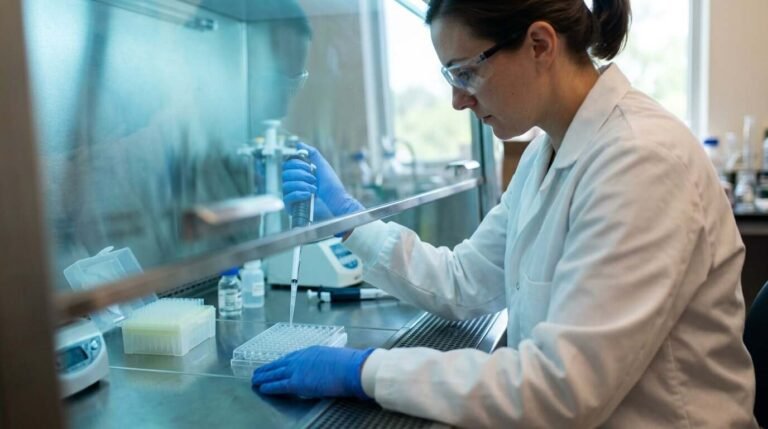
The phrase sounds abstract, so it helps to picture the work. Technicians pull many lots of the originator drug and the candidate, then run both through a battery of instruments: mass spectrometry to read the sequence and spot modifications, chromatography to separate variants, and cell-based assays to check that the protein binds its target and triggers the intended response. The FDA’s quality guidance asks for both physicochemical and functional comparisons, and for binding properties where they are part of how the drug works.
A clinical trial answers a different question: did patients get better at about the same rate? The agency’s argument, as reported, is that for most antibodies the laboratory comparison is the more sensitive instrument. A trial of a few hundred people can miss small differences in a protein that a mass spectrometer would catch. The trade-off is that analytics cannot observe immune reactions in patients, which is why the October 2025 draft keeps room for efficacy studies in some cases, such as locally acting products.
Why the cost and time matter
Officials quoted by RAPS put development, including FDA review, at five to eight years. They also said 76 biosimilars were approved at the time of the October 2025 announcement, a number they argued should be several times greater. That is a policy claim, and reasonable people disagree about whether lighter testing is the right lever. Patent exclusivity, litigation and payer contracting all shape how many copies reach patients, and none of them is about manufacturing.
What manufacturing does control is the front end of the timeline. A developer has to build a cell line, grow it, characterize dozens of originator lots, tune the process, then show the product stays consistent at commercial scale. The FDA’s March 2026 estimate that cutting redundant pharmacokinetic studies could save roughly $20 million shows how much of the budget sits in the clinical package, but the analytical work that replaces it is not free either.
Process changes do not stop at approval
Even the originator’s product changes over the years. The 2015 FDA guidance points to ICH Q5E, the international standard under which a company that changes its own manufacturing process shows the product before and after is comparable. A biosimilar sponsor has the same obligation for its own process, and it begins with less knowledge of the molecule than the originator has.
That detail explains why regulators spend so long on analytics. Two lots of the same drug from the same factory are never perfectly identical, so the question is whether the biosimilar falls inside the normal spread of the originator. If the originator itself changes a process step, the target moves slightly. Developers tracking a moving reference product need to keep measuring, which is one reason well-run analytical laboratories are a core asset of biosimilar companies. The ICH reference is cited in the FDA’s own 2015 text; I have not opened the ICH document itself.
Myth versus fact
Myth: A biosimilar is a generic biologic
Fact: Generics must be chemically identical to their reference drugs. A biosimilar is held to a different standard, high similarity with no clinically meaningful difference, because exact duplication of a cell-made protein is not possible.
Myth: Less clinical testing means less evidence
Fact: The proposed change shifts where the evidence comes from. The FDA’s argument is that modern analytics detect product differences better than a comparative efficacy trial does. Critics may disagree, and the guidance is still a draft, so the debate is live.
Myth: Approval means the product is on the market
Fact: Launch can lag approval. Samsung Bioepis’s report, summarized by Pearce IP, counts 96 US approvals across 21 molecules as of June 2026, with 71 launched.
Where the market stands
That same summary says ustekinumab biosimilars reached 42% market share in the first quarter of 2026, up 15% on the prior quarter, and that uptake is faster than adalimumab’s was. Biocon launched two denosumab biosimilars in the US in the second quarter of 2026. These are manufacturer-published market figures, so treat them as one view of the market.
The approval count deserves a caution. The FDA’s March 2026 announcement says 82 biosimilars had been approved, while the Samsung Bioepis figure of 96 comes from a different source and may be counted differently, such as by separate product or presentation. I could not reconcile them.
A checklist for reading biosimilar news
Announcements about biosimilars tend to blur approval, launch and uptake. A short checklist keeps the terms straight.
- Is it approved, or only filed? A filing means a company has asked; approval means the agency said yes.
- Is it launched? By the Samsung Bioepis count above, 25 approved US products had not launched as of June 2026. Patents and settlements often explain the gap.
- Is the guidance draft or final? The FDA page for the October 2025 document labels it “Not for implementation” and non-binding.
- Who published the number? A regulator, a company, a trade group and a law firm summary can each count differently, as the 82 versus 96 gap shows.
- Does the claim concern manufacturing, or something else? Price, rebates and formulary decisions are separate from how the protein is made.
Applying those five questions removes most of the confusion in the headlines. It also shows how much of the biosimilar story is still moving: two draft guidances, one disputed count and a market where a single molecule, ustekinumab, reached 42% share in the first quarter of 2026, up 15% on the quarter before.
What to watch
- Whether the FDA finalizes the October 2025 and March 2026 drafts, and in what form.
- Whether interchangeability designations stop requiring switching studies.
- How fast follow-on products arrive for more biologics, which depends partly on patents, a separate issue from manufacturing.
This article describes regulatory and manufacturing facts and is not medical or financial guidance.
Sources
- FDA, Scientific Considerations in Demonstrating Biosimilarity to a Reference Product (2015)
- FDA, Quality Considerations in Demonstrating Biosimilarity of a Therapeutic Protein
- FDA, Updated Recommendations for Assessing the Need for Comparative Efficacy Studies (draft)
- FDA, FDA takes further steps to streamline biosimilar development
- RAPS, FDA proposes to cut comparative efficacy study requirement
- BioPharm International, FAQ on FDA’s new approach to biosimilar interchangeability
- Pearce IP, Samsung Bioepis Q3 2026 US biosimilar market report