A USTC preprint reports room-temperature entanglement moved from an electron to silicon-29 spins in silicon carbide, lasting about 244 microseconds.
Most quantum memories live in a refrigerator. A preprint posted in mid-September 2026 by a team at the University of Science and Technology of China reports room-temperature entanglement held in the nuclear spins of a silicon carbide crystal, with the stored state surviving for roughly 244 microseconds instead of about one.
The work has not been peer reviewed, and the numbers deserve a careful read. The headline gain is quoted as up to a factor of 240, while the paper’s own table implies something nearer 230. Neither figure is the interesting part. What matters is how the trick works and what it still cannot do.
The device: one defect and two silicon-29 nuclei
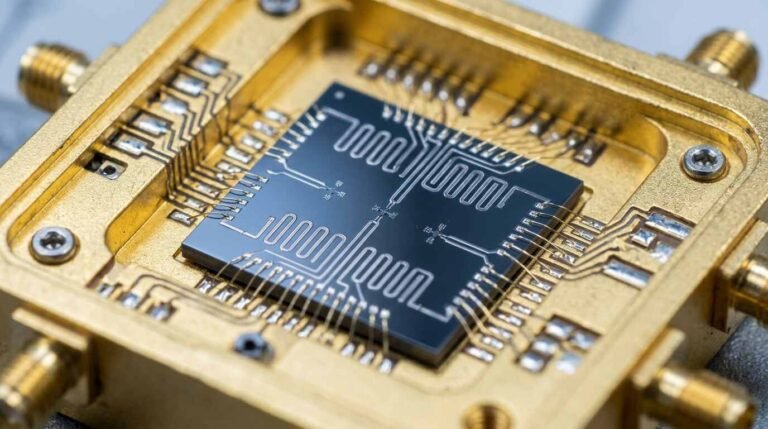
The qubit hardware is a single PL6 color center in 4H silicon carbide, a defect created by implanting nitrogen ions (N2+) so that it sits about 15 nm below the surface. Its electron spin is a triplet, and the authors use the m_s = 0 and −1 levels as the working qubit. That electron is the fast, optically readable processor.
Two nearby silicon-29 atoms, each a spin-1/2 nucleus, act as the memory. They couple to the electron through the hyperfine interaction, with A_zz values of 9.6 MHz and 12.5 MHz for the two sites. The measurement runs at 330 gauss along the crystal axis, with a zero-field splitting of about 1351 MHz and an optical zero-phonon line near 1038 nm, in the near infrared. Everything happens at room temperature.
Together the electron and two nuclei form a fully addressable three-qubit register. Optically detected nuclear magnetic resonance resolves the two nuclei at about 9.18 and 12.16 MHz, which is what lets the team address each one separately with radio-frequency pulses.
Why storage is the hard part
An electron spin in a shallow defect is a noisy object. Surface charges and magnetic impurities keep jostling it, and the measured electron coherence time here, T2*, is only 1.75 ± 0.29 µs. An entangled state that involves the electron inherits that fragility. The authors measure electron-nuclear entanglement lasting 1.06 ± 0.05 µs, which is too short for almost anything beyond the gate sequence that made it.
Nuclear spins are the opposite. They couple weakly to the environment, which is exactly why they are hard to control and easy to protect. The nuclear T2* of the second silicon-29 spin is 359 ± 69 µs, about 200 times longer than the electron’s. The strategy is old but effective: build the entanglement on the fast qubit, then park it on the slow ones.
How the swap works
First the register is initialized. Repeated microwave and radio-frequency pulses transfer polarization from the electron to the nuclei, preparing the state |000⟩. A controlled-phase gate on the electron, combined with π/2 rotations on a nucleus, produces an electron-nucleus Bell state.
Then comes the storage step. A sequence of SWAP operations, which exploit the strong hyperfine coupling, maps the electron-nucleus Bell state onto the pair of nuclei. After the swap the electron is disentangled and free to be reset or reused, while the entanglement now lives entirely in the two silicon-29 spins. The authors call this a SWAP-based protocol; the entanglement is moved, not copied, which is the only thing quantum mechanics allows.
The numbers, line by line
The reported fidelities are the first thing to check. The nuclear Bell state has a fidelity of 94 ± 2% from state tomography. The electron-nucleus Bell state before the swap is at 94.5 ± 1.5%, and the stored Bell state afterward is at 92.5 ± 2.5%. Within the error bars the swap costs little, perhaps two percentage points.
Coherence of the entangled states is where the gain appears. The electron-nucleus state decays with a coherence time of 1.06 ± 0.05 µs. The stored nuclear state lasts 244 ± 17 µs. Divide 244 by 1.06 and you get about 230, not 240. The abstract says up to a factor of 240, and the discrepancy is probably rounding or a comparison against a slightly different baseline, but the paper as retrieved does not say. Either way the gain is more than two orders of magnitude.
The same pattern appears in a mixed-isotope register built from silicon-29 and carbon-13: the initial fidelity is 93 ± 2%, the stored fidelity 91 ± 1.5%, and the lifetime grows from 1.08 ± 0.09 µs to 196 ± 15 µs, a factor of about 180 by my arithmetic. The three-qubit GHZ-type state, which keeps the electron involved, reaches only 89 ± 4% fidelity and a coherence of 0.75 ± 0.07 µs. It is not stored, and it dies quickly.
Reading the coherence table
Put the coherence times in a row and the structure becomes clear. The electron’s T2* is 1.75 µs. The electron-nucleus entangled state lasts 1.06 µs, shorter than the electron alone, which is what you expect when two things can each dephase the pair. The nuclear T2* is 359 µs, the nuclear Bell state lasts 296 µs, and the stored state, after the swap, lasts 244 µs.
The stored state therefore keeps about 82% of the nuclear Bell-state coherence time (244 over 296) and about 68% of the single-nucleus T2*. That is a useful sanity check on the claim. A memory that reached the full nuclear value would suggest the electron had been decoupled completely. A stored time somewhat below it means the electron is still leaking noise in, as the authors say. The 240-fold headline is a ratio against the short-lived electron-nucleus state, which is fair as a description of the swap’s benefit but should not be read as a record for nuclear-spin memories.
One more point on fidelity. State tomography estimates how closely the prepared state matches the ideal Bell pair. A value of 94 ± 2% means the state overlaps the ideal one by that amount, which is good for a three-spin device at room temperature but short of what error-corrected computation needs. The GHZ-type state is lower still, at 89 ± 4%, and the error bar overlaps the Bell-state values. The paper calls the generation deterministic, and that is a statement about the protocol, not about the fidelity.
What limits the storage time
A stored coherence of 244 µs is below the nuclear T2* of 359 µs, and below the nuclear Bell-state coherence of 296 ± 21 µs. The authors attribute the shortfall to residual decoherence mediated by the electron, linked to the electron’s finite T1. In plain terms, the electron is still sitting next to the memory nuclei, and when it relaxes it perturbs them through the hyperfine coupling.
That suggests a route to improvement that the paper points toward without demonstrating: decouple the electron more cleanly, or reset it between operations. A related companion preprint on decoherence-protected entangling gates in a silicon carbide quantum node (arXiv:2602.03296) is cited in the reference list. I did not open it, so I can say nothing about its results.
The survey of 200 defects
One defect is a demonstration, not a platform. To address that, the authors report a statistical survey of 200 PL6 centers and find that more than 10% of them have at least two strongly coupled nuclei. That means roughly one defect in ten could host a register like the one in the main experiment, at least by the criterion used.
The details of that survey are in the supplementary material, which the retrieved text did not include, so the selection criteria and coupling thresholds are unconfirmed here. The main results, as far as the text shows, rest on a single defect, and the heteronuclear register is a second device. Reproducibility across defects is the claim that most needs the supplement.
Where this fits and where it does not
A room-temperature memory with hundreds of microseconds of coherence does not make a quantum computer. The gate fidelities are 89 to 94%, well short of what error correction needs, and the electron’s short coherence still limits how many operations fit in a sequence. The authors present quantum-enhanced sensing as a prospect, not something shown.
What the result does establish is that the electron-to-nucleus swap trick, long used in diamond nitrogen-vacancy centers, works in silicon carbide at room temperature with this particular defect. Silicon carbide is a semiconductor that can be grown on wafers and processed with existing tools, which is the argument for caring. The paper’s journal status is unconfirmed: the supplementary link and DOI prefix point to an American Physical Society venue, but I could not verify that.
It is also worth keeping the wavelength in mind. The optical transition near 1038 nm is in the near infrared, so photons from this defect could in principle couple to optical networks. The paper, as far as the retrieved text shows, does not demonstrate photon-mediated entanglement between two nodes. That step, entangling two distant defects and storing the result in their nuclei, is where a memory becomes a network element.
Frequently asked questions
What is room-temperature entanglement storage?
It means holding an entangled quantum state in a memory that does not need cryogenic cooling. Here the memory is a pair of silicon-29 nuclei next to a defect in silicon carbide, and the stored state lasts about 244 microseconds.
Is the 240-fold improvement accurate?
The abstract says up to 240-fold. The table values, 244 microseconds divided by 1.06 microseconds, give about 230. Both are above two orders of magnitude, but the exact factor is not consistent in the text.
Has this been peer reviewed?
Not that I could confirm. The text retrieved is an arXiv manuscript dated September 15, 2026 with no journal named.
Does this bring a room-temperature quantum computer closer?
A little, for memory and networking. Fidelities of 89 to 94% and a short electron coherence time mean it is a building block, not a processor.
The useful lesson here is about division of labor. The electron is fast and readable but short-lived; the nuclei are slow and sturdy; the swap moves a fragile resource to where it can last. That the trick works in a wafer-grade semiconductor at room temperature is worth noting, though only if other defects behave like this one. The open questions are all in the supplement and the follow-up work: how many centers qualify, how far electron-mediated decoherence can be suppressed, and whether the stored fidelity of 92.5% can be pushed upward without giving up the temperature advantage.
Sources