GoPro’s Mission 1 Pro ILS is a compact cinema camera with a 50MP 1-inch sensor and a Micro Four Thirds lens mount, the first time the company has built a body around interchangeable lenses. GoPro launched it on August 26 at $699.99, with pre-orders opening that day and retail availability starting September 2. It records […]
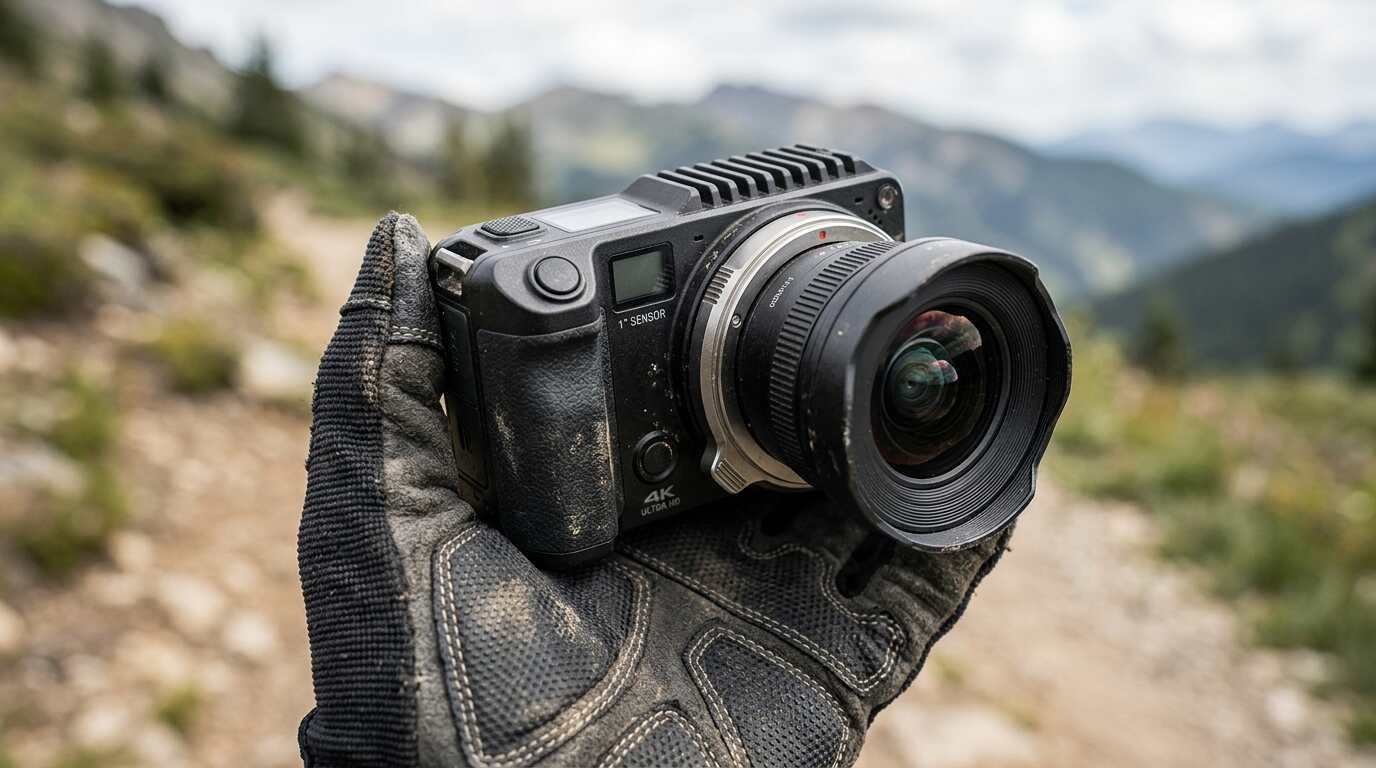
GoPro’s Mission 1 Pro ILS is a compact cinema camera with a 50MP 1-inch sensor and a Micro Four Thirds lens mount, the first time the company has built a body around interchangeable lenses. GoPro launched it on August 26 at $699.99, with pre-orders opening that day and retail availability starting September 2. It records 8K at 60 frames per second, weighs 197 grams, and accepts everything from vintage glass to cinema lenses through adapters.
The mount is where the camera becomes interesting and where it gets complicated. A Micro Four Thirds (MFT) mount is common, but this version has no electronic contacts, so autofocus and electronic aperture control are off the table. This article explains what the mount allows, what the sensor size does to your lenses, and which specifications GoPro has not yet published. Facts come from GoPro’s launch release unless another source is named.
The Core Specification
Inside is a 50MP sensor measuring one inch in the traditional naming scheme, driven by GoPro’s GP3 processor. A Quad Bayer 12MP mode is available in 4K Open Gate. The body is described as weatherproof, though GoPro lists no IP rating, and it weighs 6.95 ounces (197 grams).
Video modes are generous for the size:
- 8K at 60 fps, 4K at 240 fps and 1440p at 480 fps
- Open Gate recording at 8K30 and 4K120
- Burst Slo-Mo: 10-second 1080p clips at 960 fps in 8-bit, without GP-Log2
Color is 10-bit, with GP-Log2 and HLG HDR options. Bit rates reach 240Mbps, and GoPro Labs unlocks 300Mbps. At 240Mbps, a single hour of footage works out to about 108GB (simple arithmetic, not a GoPro figure), so storage planning matters. The release does not say what recording media or ports the camera uses beyond a USB-C microphone input, which is a notable gap for a body aimed at filmmakers.
What “No Electronic Contacts” Means
Modern MFT lenses from Panasonic and Olympus talk to the camera. The body tells the lens where to focus and what aperture to set, and the lens reports its identity back. This body has no contacts for that conversation. GoPro says the camera works with manual-focus, manual-aperture lenses, plus adapters for vintage and PL cinema glass.
The practical consequences follow directly:
- Focus is manual. GoPro includes Focus Assist with up to 8x magnification and Focus Peaking to help.
- Aperture must be set on the lens itself. GoPro’s footnote calls for either manual aperture adjustment or a fixed aperture “no greater than f/4.5,” which is GoPro’s wording.
- Some modern autofocus lenses may not work at all, since many set their aperture electronically and have no ring.
Cinema shooters have lived with these rules for decades, and many prefer them. A photographer used to autofocus, however, should read the footnotes before buying a lens.
A 1-Inch Sensor Behind an MFT Mount
The Micro Four Thirds sensor format is larger than one inch. A true MFT sensor measures roughly 17.3 by 13 mm, while a 1-inch-type sensor measures about 13.2 by 8.8 mm. GoPro’s footnote requires any lens to cover a 1-inch or larger sensor, meaning the camera uses only the central part of the image a lens projects.
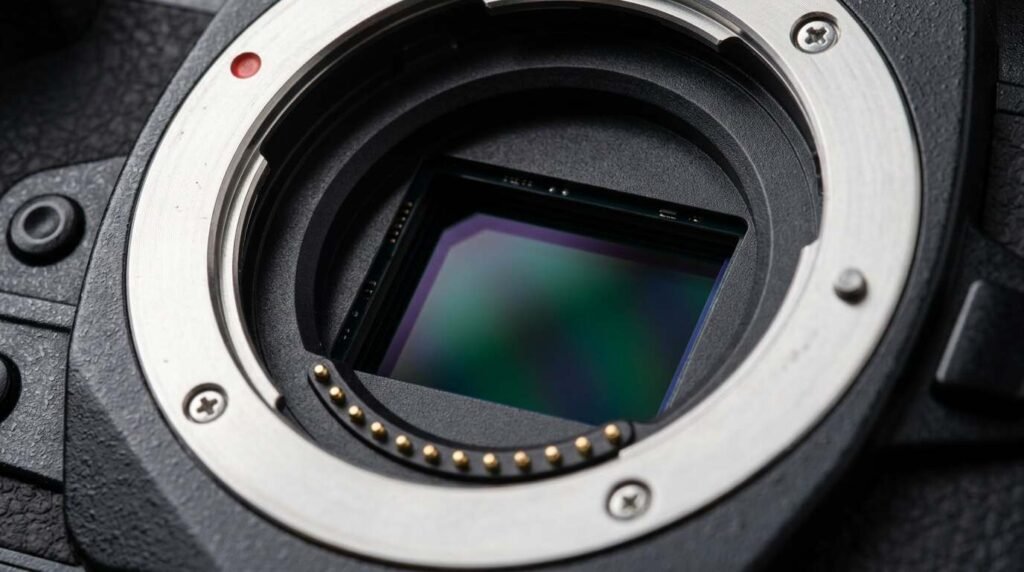
That has a visible effect on field of view. Using the standard comparison against full-frame cameras, a 1-inch sensor has a crop factor near 2.7, versus 2.0 for MFT. The equivalents below come from arithmetic on nominal sensor dimensions and ignore any extra crop from stabilization:
| Lens (MFT) | On a true MFT body | On the Mission 1 Pro ILS |
|---|---|---|
| 12mm | about 24mm equivalent | about 33mm equivalent |
| 25mm | about 50mm equivalent | about 68mm equivalent |
| 45mm | about 90mm equivalent | about 123mm equivalent |
In plain terms, every lens frames tighter than it would on a regular MFT camera, so wide-angle glass matters more here. GoPro says in-camera processing supports five fisheye lenses and rectilinear MFT lenses from 6mm to 500mm, tested up to 50mm.
Why the Mount Is a Smart Choice for Adapters
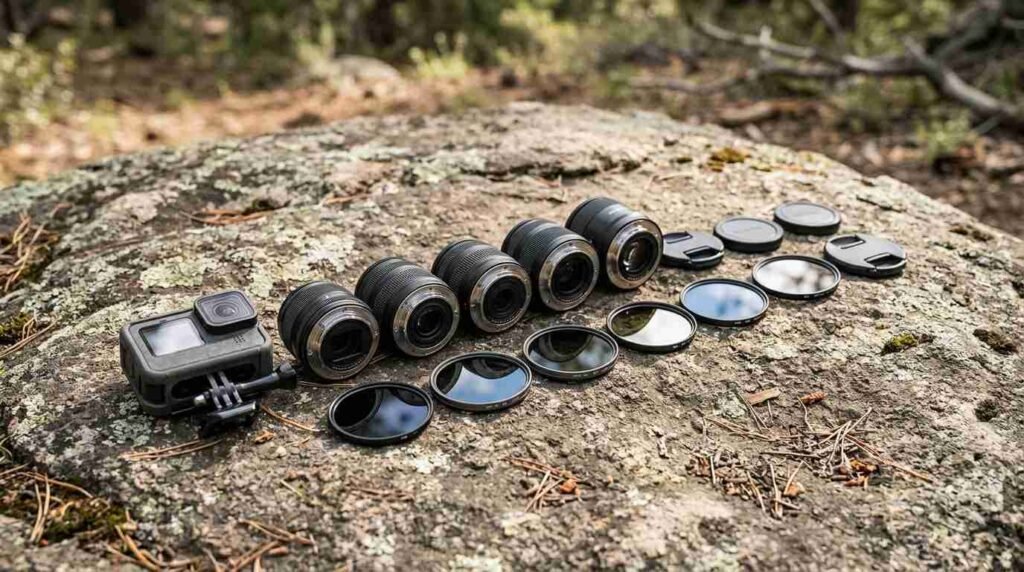
MFT uses a short flange distance, around 19.25 mm, which is the gap between the mount and the sensor. A short gap leaves room for adapters that stretch the distance for lenses designed for longer-flange systems, which is why MFT is a favorite platform for adapting vintage lenses. GoPro’s mention of adapters for vintage and PL cinema lenses reflects that. It also means buyers get a large secondhand lens market without paying for modern autofocus they cannot use.
Pixels, Binning and Dynamic Range
Dividing the sensor’s area by its 50 megapixels gives a pixel pitch of roughly 1.5 microns, though that too is derived rather than published. Small pixels collect less light individually, which is why the Quad Bayer 12MP mode matters: it combines groups of four pixels into one larger effective pixel, trading resolution for sensitivity. For comparison with a much larger sensor, the Sony a7R VI uses a full-frame stacked design, and the difference in light-gathering area is substantial.
GoPro’s own claims stay at the format level: 10-bit capture, GP-Log2 for grading flexibility, HLG for HDR delivery, and HyperSmooth stabilization, which it describes as Emmy Award-winning. The release gives no dynamic-range figure in stops.
Open Gate, Log and HLG in Plain Terms
Open Gate recording captures the whole sensor area instead of a 16:9 crop. For a camera with a small sensor, that matters, since cropping to widescreen throws away pixels that a vertical social cut or a stabilization margin could use. The trade is a larger file and an aspect ratio that needs reframing in the edit, which is why GoPro lists 8K30 and 4K120 in Open Gate alongside the standard 8K60 and 4K240 modes.
Color options address two different needs. GP-Log2 is a flat profile that preserves highlight and shadow information for later grading, at the price of washed-out footage until a color correction is applied. HLG is an HDR broadcast format that looks acceptable on both HDR and standard displays, so footage can go out quickly with little grading. Having both at 10-bit depth gives either path enough tonal gradations to avoid visible banding in skies and walls.
Audio, Battery and Monitoring
Four microphones record audio, with 32-bit float audio saved to a separate .wav file, plus Bluetooth 5.3 and USB-C microphone support and automatic gain control. The 32-bit float format stores levels with so much headroom that a loud clap or a passing truck rarely produces a clipped, unusable track, and a quiet recording can be lifted in editing without the usual noise penalty from the file itself. The microphones and preamps still have physical limits, so the format forgives bad levels rather than excusing them. The 2150mAh Enduro 2 battery is rated for more than three hours of 4K30 and more than five hours of 1080p30, under test conditions listed in GoPro’s footnotes. Timecode Sync supports multi-camera work.
The free MISSION Monitor app arrived on the Apple App Store on September 2 and requires iOS 18 or later. Android is not mentioned in the release.
A Lens-Shopping Checklist
Because the mount carries no electronics, the buying process looks different from a typical mirrorless purchase. Four questions narrow the field.
- Does the lens have a physical aperture ring? If not, check that its fixed aperture meets the “no greater than f/4.5” wording in GoPro’s footnote.
- Does the image circle cover a 1-inch sensor? Most MFT lenses do, because MFT’s sensor is larger, but vintage and cine lenses vary.
- Is the focal length right once the crop is applied? Use the equivalents above to avoid buying a lens that frames tighter than expected.
- Can you focus it by hand reliably? Long lenses at wide apertures demand a steady hand even with Focus Assist and 8x magnification.
Pricing and Where It Fits
The body costs $699.99, or $599.99 for existing GoPro subscribers, with lenses sold separately. Accessories include a Point-and-Shoot Grip, extension poles and mounting buckles. At launch, GoPro also took $100 off the Mission 1, Mission 1 Pro and Mission 1 Pro Grip Edition for a limited time.
Photography Talk, which covered the camera earlier in its life, raises cautions worth weighing: GoPro reported a $93.48 million net loss for fiscal 2025 and has been conducting a strategic review that includes a possible sale, and the author argues buyers who do not need interchangeable lenses are better served by the fixed-lens Mission 1 Pro or the Insta360 Ace Pro 2. That article also described the ILS body as not yet on sale, which conflicts with GoPro’s September 2 retail date, so confirm stock before ordering.
Still Unconfirmed
- Recording media and port layout
- Autofocus behavior with any lens (GoPro describes manual operation only)
- Independent dynamic-range and low-light measurements
- Which specific MFT lenses meet the manual-aperture and coverage requirements
Sources