







DeWalt's DCS525 puts a 6-1/2-inch plunge track saw on the 20V MAX XR platform. Here is what DeWalt has published, what the 1/32-inch claim depends on and what is still missing.
DeWalt’s new cordless plunge track saw, the DCS525, puts a 6-1/2-inch blade on the 20V MAX XR battery platform and, according to retail coverage published this week, starts at $429 as a bare tool. DeWalt announced it on August 11 alongside two sanders, an oscillating multi-tool and a pair of nailers, and its product page promises cuts accurate to 1/32 inch.
Track saws earn their keep on sheet goods, where a long straight edge matters more than raw speed. This post covers what DeWalt has published about the DCS525, turns a few of the claims into numbers you can reason with and lists what is still missing as of Saturday, August 22, 2026. It rests on DeWalt’s press release, its product page and trade coverage. I found no independent testing of the saw.
- Models: DCS525B (bare tool, $429), DCS525ST (with tracks, $579) and DCS525STWW1 (kit with 8.0Ah battery, charger, connecting rod and two 30-inch tracks, $749). Prices are as quoted by SlashGear on August 20.
- Capacity and speed: 6-1/2-inch blade, hardwood rips to 2-1/8 inches, 2,500–5,400 rpm.
- DeWalt’s claims: 1/32-inch accuracy on its DWS5130 dual-sided track, up to 94% dust capture with a compatible vacuum, and a Kickback Brake.
- Not published: Bevel range, depth at 45°, weight, and the battery behind the runtime claim.
How a plunge track saw gets a straight cut
A track saw rides in a groove on an aluminum guide rail that grips the workpiece, so the straightness of the cut depends on the rail and not on the user’s hand. The plunge part describes the mechanism. The blade sits retracted inside a housing, and the saw pivots down into the material, which lets a cut start or stop in the middle of a panel. Most rails also carry a rubber splinter strip along the cutting edge. The first pass trims that strip, leaving a clean edge that shows exactly where the blade will exit. Those are features of the category, not DeWalt-specific claims.
DeWalt’s 1/32-inch figure is worth converting into an angle. An error of 1/32 inch (0.79 mm) across a four-foot rip equals about 0.04 degrees. Holding that tolerance depends on the rail’s straightness, the play between saw and rail, blade runout and how the rail is set on the stock.
0.79 mm over 48 in (1,219 mm) = 0.00065 rad ≈ 0.037°
DeWalt attaches the claim to a specific rail, the DWS5130 dual-sided track, and to cuts at 90 degrees. The product page does not extend the figure to bevel cuts.
What DeWalt has published
| Item | Published detail | Source |
|---|---|---|
| Blade | 6-1/2 in. DeWalt lists a 48-tooth fine-finish blade (DWA261248TS) and a 24-tooth general-purpose blade (DWA261224TS) as compatible. | Press release |
| Cutting capacity | Rips solid hardwood up to 2-1/8 in. thick | Product page |
| Speed | 2,500–5,400 rpm, variable | SlashGear, August 20 |
| Motor | Brushless. DeWalt claims more power than the leading competitor but gives no figure. | Press release, product page |
| Accuracy | Within 1/32 in. at 90° on the DWS5130 dual-sided track, sold separately | Product page |
| Dust | Up to 94% capture with a compatible vacuum; Wireless Tool Control starts the vacuum from the saw trigger | Product page |
| Safety | Kickback Brake shuts the saw off when a pinch, stall or bind-up is detected | Product page |
| Runtime | Up to 70 cuts, or up to 280 linear ft. of 3/4-in. MDF; the battery is not named | Product page |
| Prices | $429 bare; $579 with tracks; $749 for the full kit | SlashGear, August 20 (retailer pricing) |
| Availability | DeWalt says the products are available now through its usual sellers | Press release, August 11 |
| Weight, bevel range, 45° depth | Not published in the pages I read | — |
One oddity: the contents line on the product page names a DCST525B, which does not match the DCS525B model number. It looks like a typo, but check the box contents before ordering.
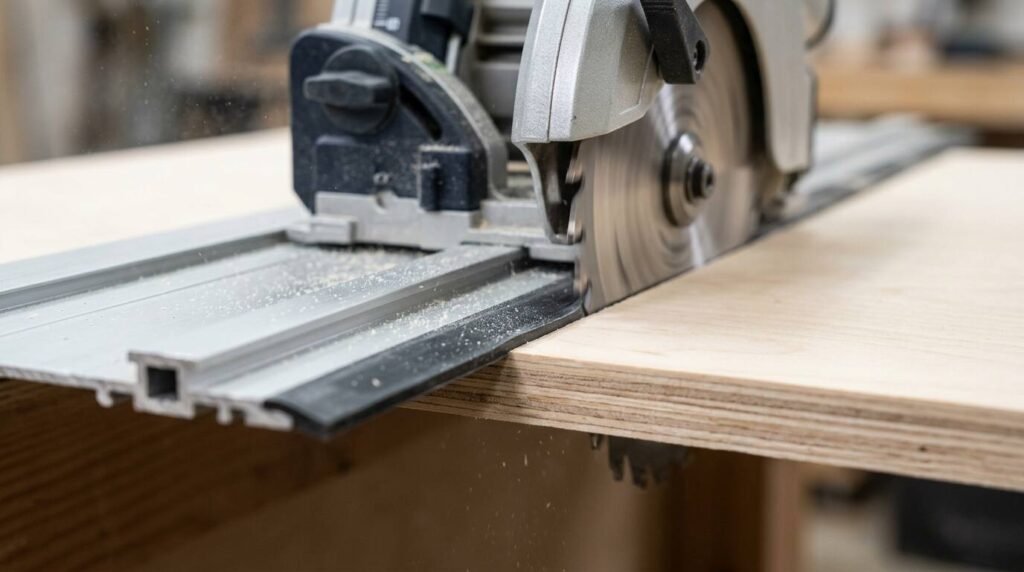
Depth deserves one more question. A guide rail lifts the saw slightly, so depth of cut on the track is lower than off it. DeWalt’s pages give 2-1/8 inches without saying which condition applies, while the FlexVolt review discussed below states its 2-1/8 inches as an on-track figure. Until DeWalt clarifies, treat the DCS525’s number as unconfirmed.
Blade speed in tip-speed terms
Rpm figures mean little across different blade diameters, so tip speed gives a cleaner comparison. For a 6-1/2-inch (165.1 mm) blade, tip speed is the circumference multiplied by revolutions per second.
2,500 rpm → 21.6 m/s
5,400 rpm → 46.7 m/s (about 104 mph)
4,200 rpm (the older 60V FlexVolt DCS520, per an online review) → 36.3 m/s
A range this wide gives the user room to slow the blade for plastics and laminates, where a fast blade can melt the cut edge instead of shearing it. DeWalt does not publish settings by material, so that is a rule of thumb rather than a documented feature of this saw.
DeWalt already sells a 60V FlexVolt track saw, the DCS520. An online review lists its range as 2,500 to 4,200 rpm, with 2-1/8 inches of depth at 90 degrees, 1-5/8 inches at 45 degrees and a 0–47 degree bevel range. The new saw matches that depth at 90 degrees and raises the top speed on paper. Its 45-degree depth and bevel range are not yet published, so a direct comparison stops there.
Blade choice: 48 teeth or 24
DeWalt lists two compatible 6-1/2-inch blades, and the tooth count says what each is for. A 48-tooth fine-finish blade takes smaller bites, which cuts down tear-out in veneered plywood and laminate and leaves a smoother edge. A 24-tooth general-purpose blade removes material faster with a rougher result, a fair trade in framing lumber or a first rough cut. Neither blade’s kerf width appears in the pages I read, and kerf matters on a battery saw because a wider cut means more wood to remove per foot.
The product page’s image captions mention the 48-tooth blade, which suggests it is the one supplied. With the contents line carrying the typo noted above, verify that before assuming you can start on veneered stock.
Kickback Brake and Wireless Tool Control
DeWalt’s product page says the saw shuts off when it detects a pinch, stall or bind-up. It does not say how detection works or how quickly the blade stops, and independent stopping data does not exist yet. The FlexVolt model, by contrast, used a mechanical anti-kickback knob that locks the saw to the rail, plus an adjustable riving knife, according to the same review. Whether the new saw carries a riving knife is not stated in the pages I read.
Wireless Tool Control is DeWalt’s name for a link between saw and compatible vacuum. Pulling the trigger starts the vacuum, which is sold separately. DeWalt claims up to 94% dust capture when the pair is used together. That number comes from DeWalt’s own testing, and the page does not describe the method. The FlexVolt review cites 90% under a different, unstated test, so the two figures are not directly comparable.
Rail length, sheet size and the 1/32-inch claim
The full kit ships with two 30-inch tracks that join with a connecting rod, which DeWalt describes as a 60-inch system. That length covers a 48-inch cross-cut with room to spare. A rip down the length of an 8-foot sheet is another matter.

Cross-cut of a 4-ft panel: 48 in → fits, with 12 in to spare
Rip of an 8-ft panel: 96 in → 36 in longer than the rail
Longer rips mean buying additional track, which the product page lists as a separate purchase, or moving the rail partway along the cut. Each repositioning adds a fresh chance of misalignment, and the 1/32-inch figure describes one setup, not two. That is my reasoning rather than a DeWalt statement, but it explains why rail length belongs on the checklist next to the saw’s own specs.
Price and runtime arithmetic
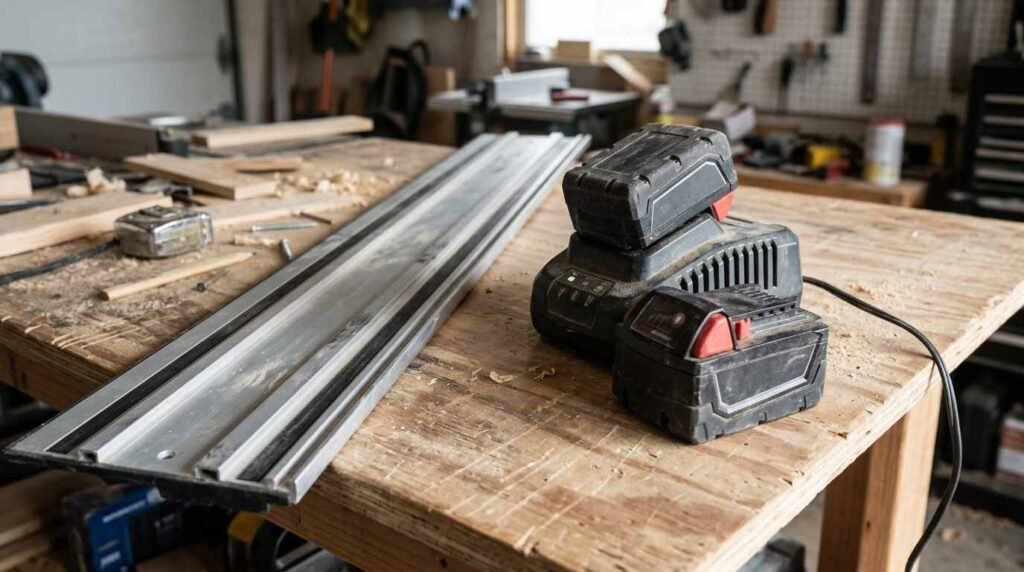
Retail pricing quoted on August 20 puts the bare tool at $429. Stepping up to the DCS525ST adds tracks for $150. The DCS525STWW1 kit costs $170 more than that and adds an 8.0Ah battery, a charger and a bag; DeWalt’s release also lists a track connecting rod in that kit.
$749 − $579 = $170 (8.0Ah battery, charger, bag)
280 linear ft ÷ 70 cuts = 4 ft per cut
DeWalt rates the saw at up to 70 cuts or up to 280 linear feet of 3/4-inch MDF. Dividing one by the other gives four feet per cut, the width of a standard sheet, so the claim is probably a count of rips across a 4-by-8 panel. DeWalt does not say which battery produced it. The only pack its release ties to this saw is the 8.0Ah (DCB2108) used for the Kickback Brake footnote. Treat the figure as a ceiling.
My take: The 1/32-inch claim is tied to a particular rail at 90 degrees, so the test that matters is a bevel cut along a full-length rail. Independent measurements of blade runout, rail play and Kickback Brake behavior would settle more than any spec sheet can. Buyers who already own 20V MAX XR batteries stand to gain the most, because platform savings can outweigh a small spec gap. That is a judgment call, not a test result.
Frequently asked questions
Does the DCS525B include a battery or a track?
No. It is a bare tool, and the product page says the track, battery and charger are sold separately. The DCS525ST adds tracks, and the DCS525STWW1 kit adds a battery, charger and track connecting rod, according to DeWalt and SlashGear.
What blade does it take?
A 6-1/2-inch blade. DeWalt lists a 48-tooth fine-finish blade (DWA261248TS) and a 24-tooth general-purpose blade (DWA261224TS) as compatible.
How deep can it cut?
DeWalt says it rips solid hardwood up to 2-1/8 inches thick. Depth at 45 degrees has not been published.
Is it in stock?
DeWalt’s August 11 release says the products are available now. Retail coverage on August 20 noted stock gaps on some of the companion tools, and I could not confirm the track saw’s stock at specific retailers.
Sources




One thought on “DeWalt’s New 20V MAX XR Plunge Track Saw: What the 1/32-Inch Claim Depends On”