A Galton board drops balls through rows of pegs, and each peg sends a ball left or right. The simulator below runs that experiment with adjustable rows and bias, and compares the pile with the exact binomial prediction. It is built by the same owner as Marcellino NY, which carries a companion piece on the machine as a crafted object.
What the board computes
On an idealized board each ball bounces left or right with probability 1/2, and the piles that accumulate in the slots give a binomial distribution, as the Wolfram Demonstrations Idealized Galton Board puts it. With n rows of pegs, the number of paths to the kth bin is the binomial coefficient, and Wikipedia gives the probability for a bounce-right chance p as that coefficient times p^k (1 − p)^(n − k).
That is the dotted line in the app. For N balls it plots N · C(n, k) · p^k (1 − p)^(n − k) over each bin, so the heights are expected counts. The mean bin is n p and the spread is √(n p (1 − p)), and the stats line under the controls shows these next to the measured values.
Bias, the second slider
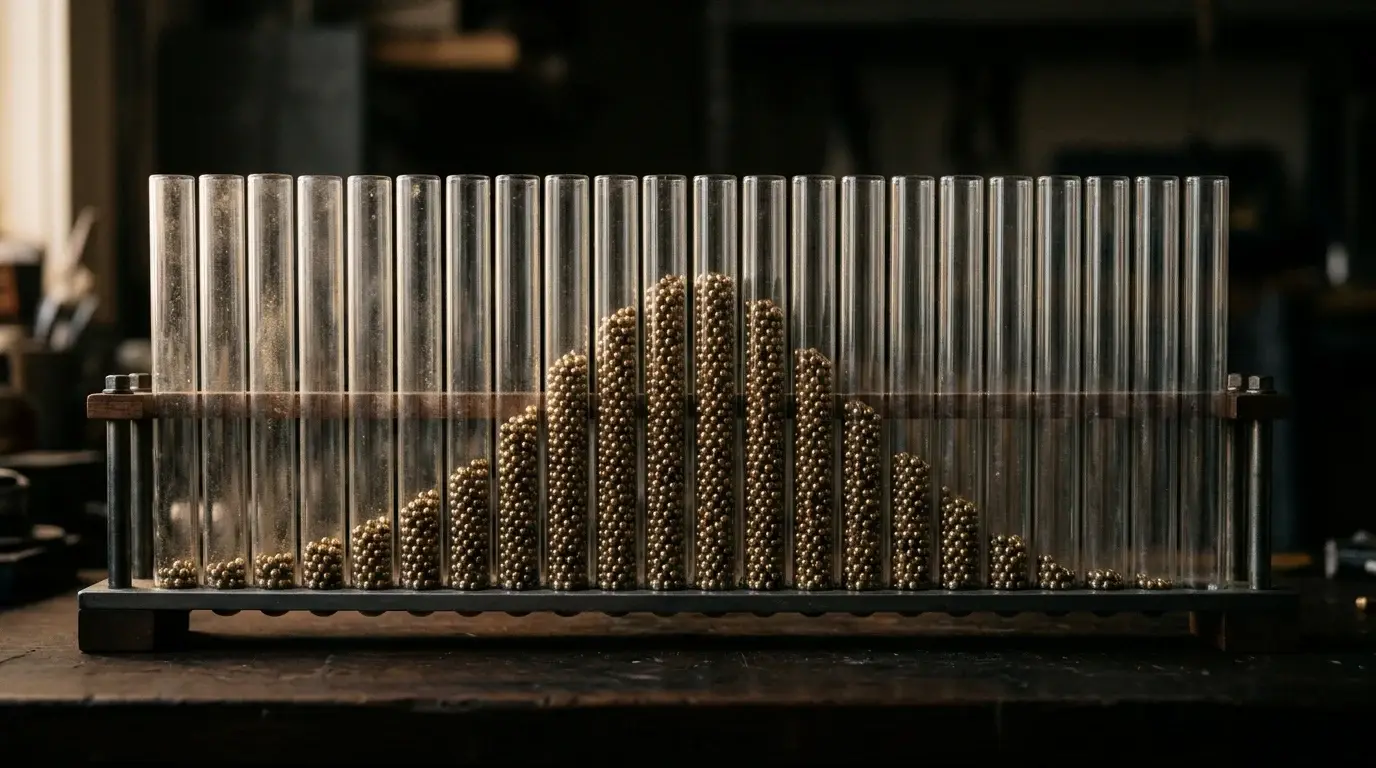
Setting the chance of a right bounce away from 0.5 tilts the pile. The Flexible Galton Board demonstration likewise lets each bounce go left or right with a chosen probability, and the balls still approximate a binomial distribution. In the app, 0.5 gives the symmetric curve, while 0.2 or 0.8 shifts the mean to n p and narrows the spread.

How the animation works
Each ball’s whole path is drawn in advance: one random left-or-right choice per row, with the chance set by the bias slider. The ball then follows a short bouncing arc between pegs, one segment per row, and lands on top of its bin. The pile is drawn as a column of brass sized to fit, and the scale shrinks as the tallest bin grows. This layout is the triangular variant, which MathWorld describes as keeping only the nails a ball can reach.
In one test run of the app with 10 rows and a fair bounce, 259 balls gave a mean bin of 4.98 against a theoretical 5.00, and a spread of 1.67 against 1.58. A single run varies, and more balls tighten the match.

History and dates
Sources disagree slightly on when the board dates from. A patent document (“Probability demonstrator”) on the US Patent Office gives 1873, while an arXiv paper on a cylindrical Galton board says Galton first alluded to the mechanism in an 1875 paper, with fuller descriptions in 1877 and in his 1889 book Natural Inheritance. UCL adds that Galton’s name is rarely mentioned today because of his association with eugenics, in its note on the quincunx.
Using it
- Set the rows of pegs from 4 to 14.
- Move the bounce-right chance from 0.1 to 0.9.
- Change the drop rate, or press Drop 100 for a quick batch.
- Toggle the bell curve overlay, press Clear to restart, and use Full screen for the biggest view.
The URL records rows and bias, so a particular setting can be shared.
Sources