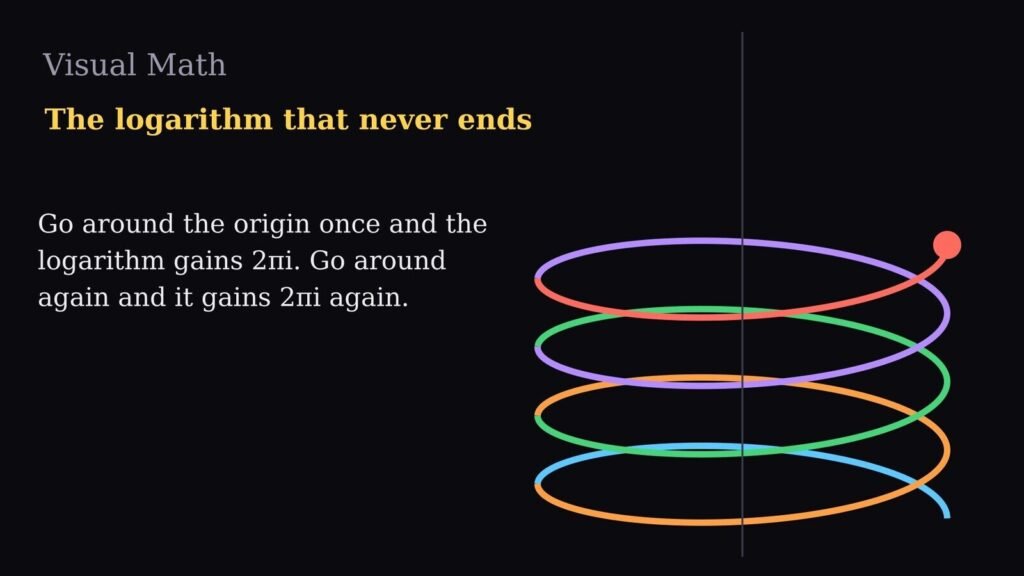
Every nonzero complex number has infinitely many logarithms, and they differ by exactly 2πi. The free The Logarithm That Never Ends app on x9m8 shows why: a point is dragged around the origin, and a second panel keeps the whole list of values for its logarithm while a third draws the spiral staircase, called the Riemann surface, on which those values live as a single answer.
An angle with no single value
The logarithm is the inverse of the exponential, so log z is a number w with e^w = z. Write z in polar form, with |z| = e^X and an angle Y. A Berkeley complex analysis lecture then gives the definition: log z = log|z| + i·arg(z). The real part is fixed. The imaginary part is the angle, and an angle is only defined up to whole turns.
The consequence follows directly. Since arg(z) is defined up to multiples of 2π, the same lecture states that log z is defined up to multiples of 2πi. A point at an angle of 0.86π can equally be described at 2.86π, at 4.86π, or at −1.14π, and every one of those is a legitimate logarithm.
A lecture handout from West Texas A&M writes the full family as log z = ln r + iθ + i2πn for any integer n, and counts an infinite number of branches.
Walking once around the origin
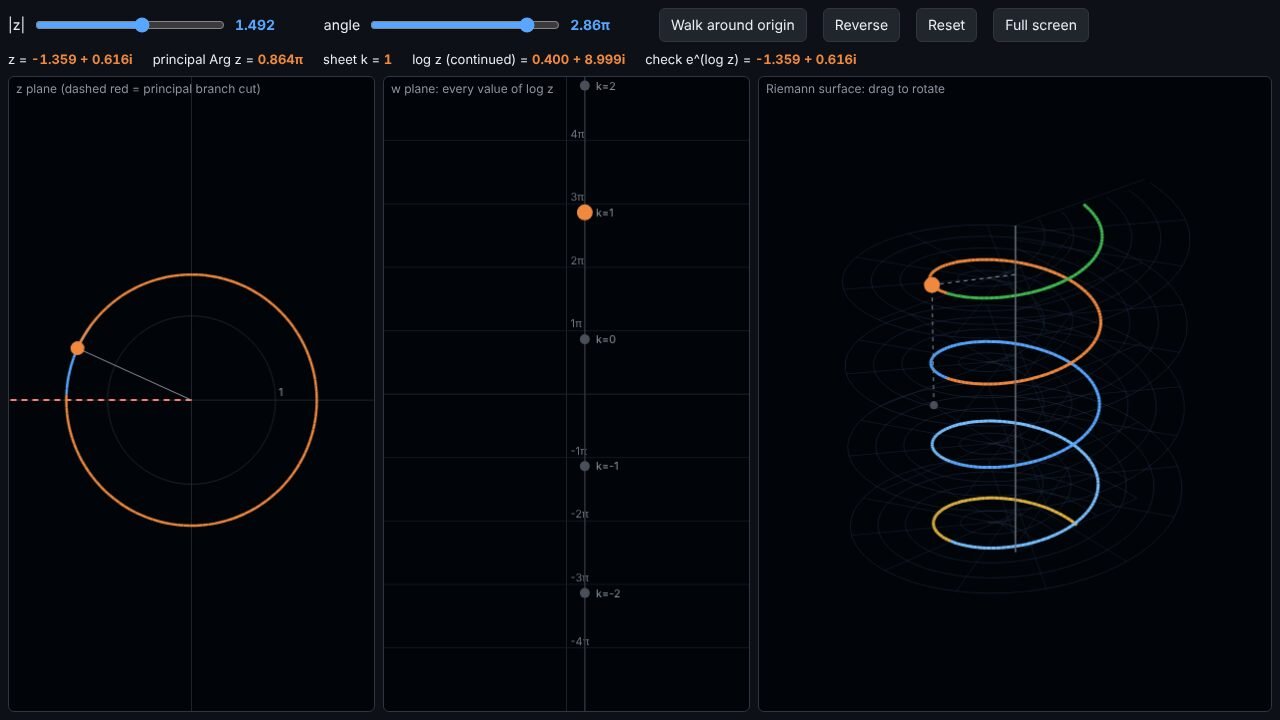
The app’s first panel is the z plane. The point can be set by two sliders, a modulus on a logarithmic scale from e⁻³ to e³ and an angle from −4π to 4π. The button labelled Walk around origin sends it round the circle at a steady pace, with the trail coloured by lap.
The second panel is the w plane, where logarithms live. Every logarithm of the current point sits on one vertical line at height ln|z|, and the dots are spaced 2π apart. The dot for the current lap is enlarged and labelled k.
One setting from the app shows the numbers. With |z| = 1.492 and the angle at 2.86π, the point sits at z = −1.359 + 0.616i. Seen from the origin its angle is 0.864π, which is the principal value, so it is on sheet k = 1, and the continued logarithm reads 0.400 + 8.999i. The app also evaluates e raised to that logarithm and gets −1.359 + 0.616i back.
The principal value and the cut
Mathematicians usually pick one value and call it the principal logarithm. The Berkeley lecture defines Log z = log|z| + i·Arg(z), with the principal angle Arg between −π and π, so that every other value is Log z + 2πin.
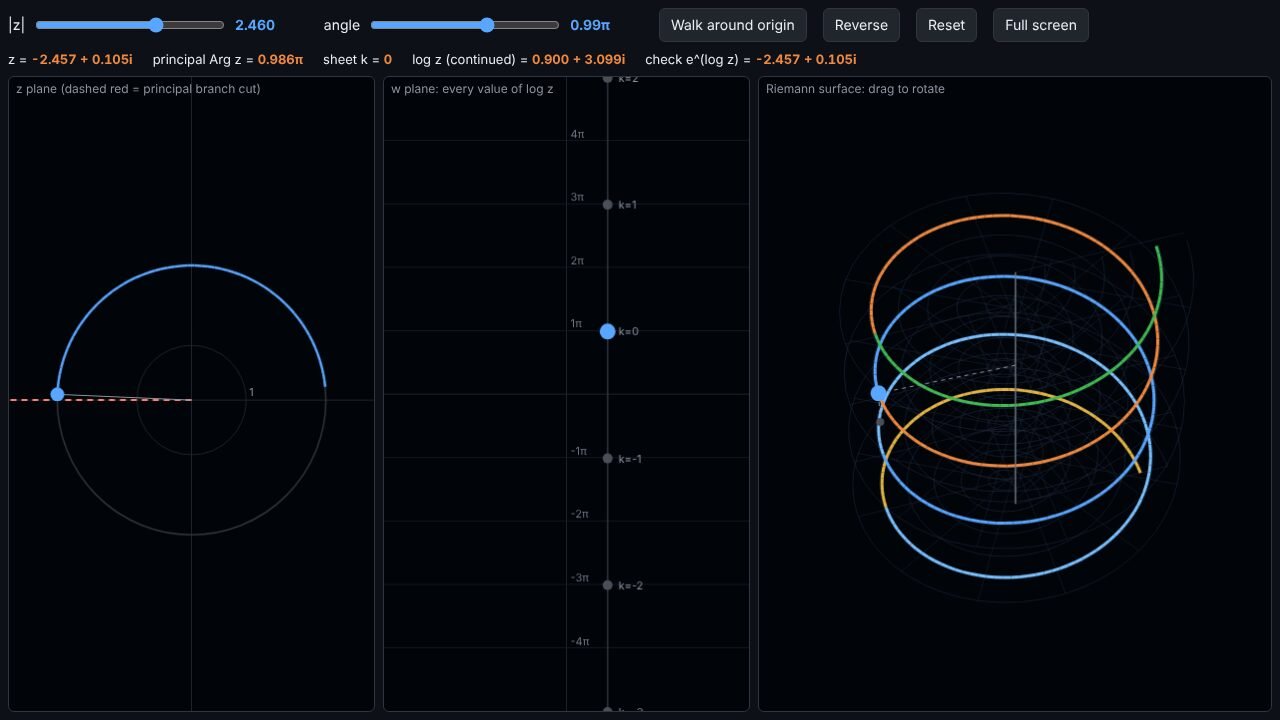
That choice has a price. Walk the point across the negative real axis and the principal angle jumps from just under π to just above −π, a leap of 2π. In the app the jump is the red dashed ray on the left of the z plane. An MIT OpenCourseWare page on Riemann surfaces of the logarithm describes the same fix: cut the plane along the negative real axis and the logarithm splits into infinitely many branches, each differing from the next by 2πi.
The principal value is correct on its own sheet. It cannot follow a point on a walk that crosses the cut, because the walk has no cut in it.
Replacing the cut with a staircase
The cut can be dropped if the domain is changed. The same MIT page states that on its Riemann surface a multiple-valued function becomes single valued, and the multiple values appear only when the surface is projected onto the plane. A paper by Nikolaos Katzourakis describes the logarithmic Riemann surface as a classical holomorphic 1-manifold that covers the plane minus the origin through the exponential.
Concretely, the surface is built from the cut planes. A paper on analytic mechanics builds it by taking one copy of the plane for each integer n, with the logarithm on copy n equal to log|z| + i(Arg z + 2πn), and welding the border of each sheet to the border of the next. Katzourakis shows that exponential helicoids, surfaces in three-dimensional space, are copies of this surface, though not copies that preserve the complex structure.
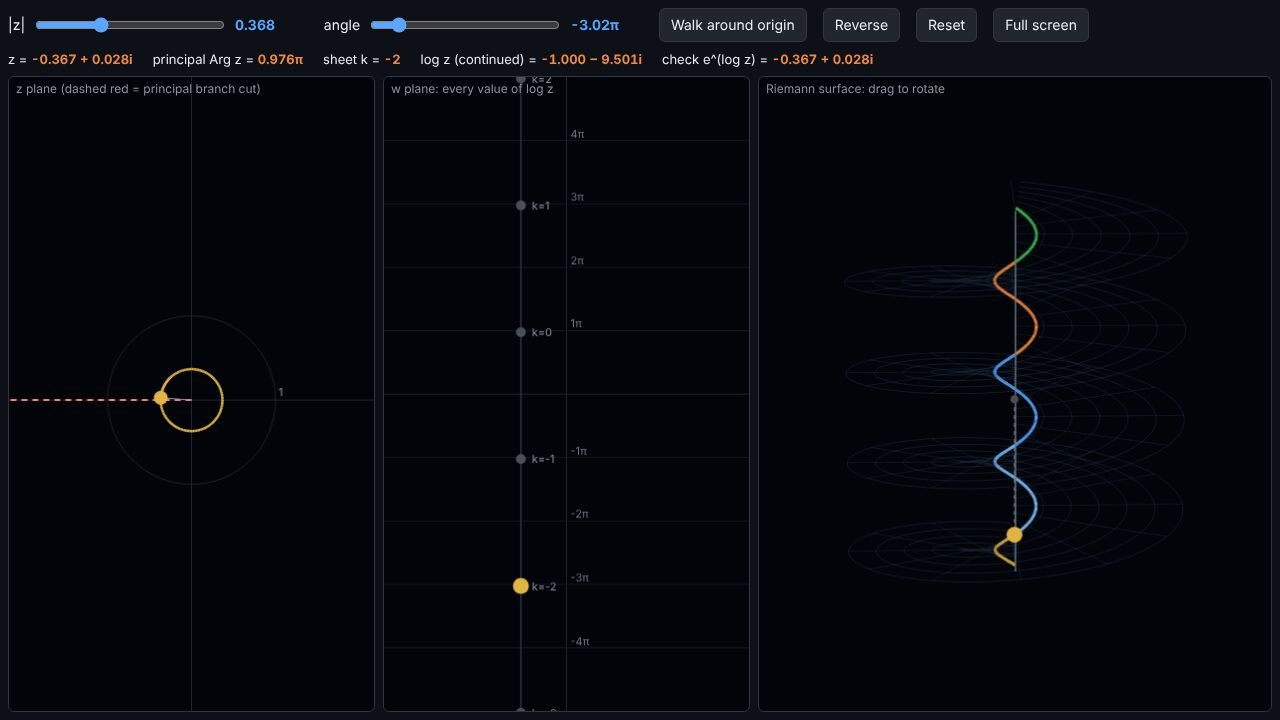
The app’s third panel draws that helicoid. The coloured helix is the path of the current point, and a dashed line drops from it to its shadow on the flat plane. Dragging the panel rotates the view. One lap around the origin raises the point by one full turn of the staircase, and it never comes back to the starting height.
Hearing the staircase
The companion video adds sound to the same walk. It runs four laps in sixteen seconds. One tone follows the angle the logarithm keeps, rising an octave per lap from 110 Hz to 1760 Hz. A second tone follows the angle seen from the origin and falls back to the bottom of its range every lap, which is the cut showing up as a sawtooth.
The on-screen numbers match the app. In the frame at 13 seconds the point has completed two laps, its angle seen from the origin reads −0.26π, and the angle the logarithm keeps reads 5.74π. The two differ by exactly 6π, three turns.
Rotating circles of this kind are the building blocks of the Fourier series lab, where a point turning at constant speed is the exponential function in motion. The rhythm-to-pitch app in the same Visual Math series uses the same pairing of an interactive page and a short video.
Sources
- Berkeley complex analysis course, lecture 3 (definition of log z, principal branch)
- MIT OpenCourseWare 18.04, Riemann Surfaces: The Logarithm
- N. Katzourakis, The Riemann Surface of the Logarithm Constructed in a Geometrical Framework (arXiv math/0406428)
- Analytic Mechanics of Locally Conservative Physical Systems, appendix on the logarithm (arXiv 0705.3415)
- West Texas A&M, multivalued functions handout (PHYS 4340)